Trade[XYZ] × ICE: Bringing Hyperliquid to TradFi
文章目录
Top Idea
Today, Intercontinental Exchange (ICE) announced a strategic partnership with trade[XYZ] to bring 24/7 perpetual markets to the US through HIP-3*. ICE will also take a minority stake in Trade[XYZ] and is likely the buyer behind the 3.75M HYPE OTC purchase.
We view this as the strongest validation yet of Hyperliquid’s exchange thesis. The world’s second-largest exchange operator has chosen to build on Hyperliquid rather than offer 24/7 perpetuals through traditional infrastructure, as CME attempted.
Pending regulatory approval, distribution through futures commission merchants (FCMs) could make Hyperliquid RWA and crypto perpetuals available to retail platforms such as Schwab, Interactive Brokers, and Robinhood, provided they opt into ICE[XYZ]’s clearinghouse, with ICE handling DCM/DCO clearance and settlement.
TradeXYZ and Intercontinental Exchange
Intercontinental Exchange (ICE) announced a strategic investment in trade[XYZ] and plans to serve as the sole operator of its regulated US markets. Pending regulatory approval, the firms will build a new market and clearing structure on Hyperliquid to offer KYC/AML-compliant leveraged perpetual futures on crypto, equities, commodities, FX, and other RWAs. This marks ICE’s third crypto investment since 2025, following its investment of up to $2B in Polymarket and its stake in OKX at a $25B valuation.
ICE operates marketplaces for stocks, futures, and options, including the New York Stock Exchange. It currently runs 13 exchanges and six clearinghouses across multiple geographies, spanning both futures and spot markets. As an exchange operator, ICE lists products and safeguards the security and integrity of its markets. This involves four core functions:
-
Listing: ICE determines which products can trade, sets futures contract terms such as size, expiry, and settlement, and approves companies for listing on the NYSE.
-
Matching: ICE operates the order books where buyers and sellers transact under uniform rules.
-
Clearing: For futures, ICE’s clearinghouses act as the buyer to every seller and the seller to every buyer. They collect margin from both sides and manage defaults, so traders are not directly exposed to their counterparties.
-
Supervision: Regulators require ICE to monitor its markets for manipulation, enforce position limits, and discipline brokers that violate its rules, under CFTC and SEC oversight.
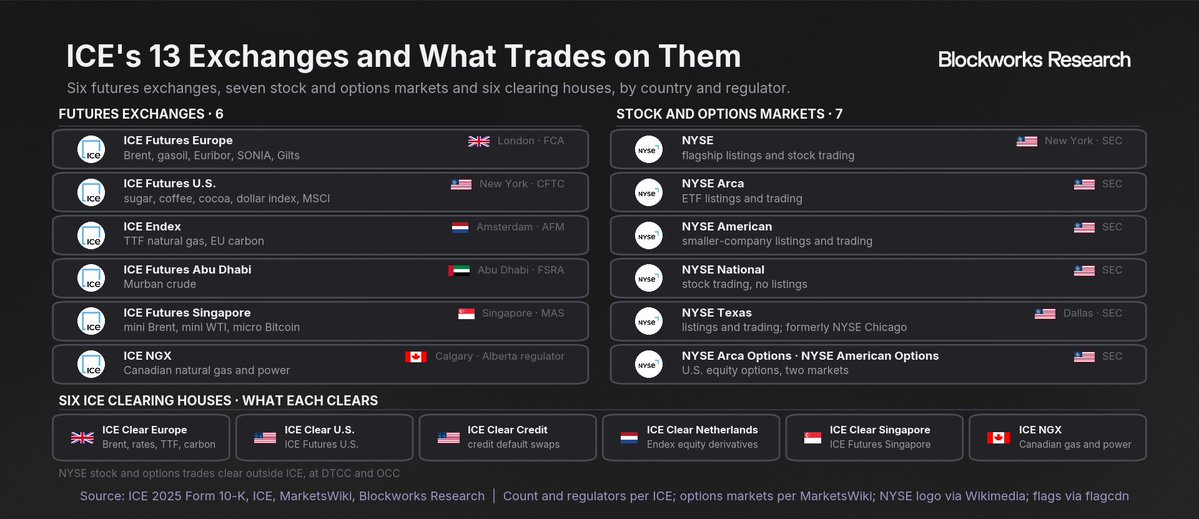
To remain compliant, ICE’s subsidiaries also hold the required licenses. In the US, its futures exchange operates as a designated contract market (DCM), authorized to list and operate futures markets, while its clearinghouses are derivatives clearing organizations (DCOs), authorized to clear them.
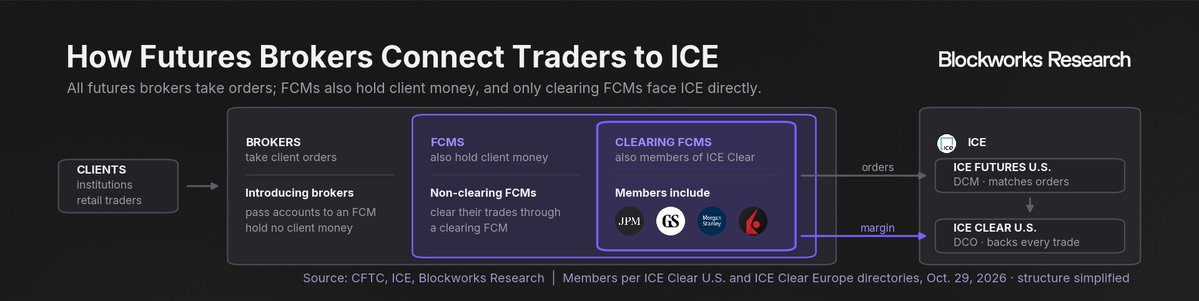
Institutions and brokers access these markets through FCMs, which hold client funds and guarantee their clients’ trades. Given ICE’s significance, the majority of FCMs route through its markets.
Offering 24/7 Perpetuals
To offer new products, exchanges must obtain CFTC clearance through self-certification or formal approval and arrange clearing through a clearinghouse.
Even with DCM and DCO licenses, however, perpetual listings only became possible on May 29 of this year, when the CFTC approved Kalshi’s Bitcoin perpetual. CME moved its crypto futures to 24/7 trading the same day, but only matching operates continuously; clearing and settlement still wait until the next business day. After trade[XYZ]’s 24/7 RWA markets gained traction, CME attempted to self-certify 24/7 oil futures. The CFTC stayed the listing pending review, freezing it before launch, and CME withdrew it in October.
Rather than launching its own 24/7 perpetuals and adapting its TradFi systems to accommodate them, ICE chose to work directly with trade[XYZ] to launch markets on Hyperliquid through HIP-3*. This would use a new regulatory pathway under development that allows TradFi market infrastructure providers to use Hypercore, provided they meet the same settlement and transparency requirements as traditional market offerings.
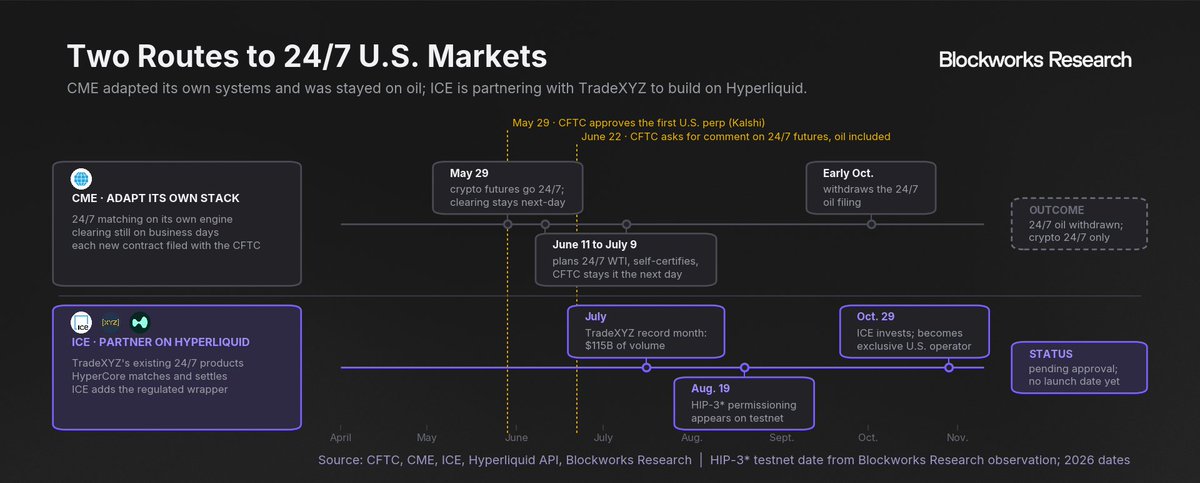
We have previously outlined how this would work. In short, HIP-3* enables Hyperliquid deployers to list permissioned markets with features such as KYC/AML controls, though existing HIP-3 deployers would need to relist their markets. ICE will assume this role as the exclusive operator of trade[XYZ]’s regulated US markets. The revenue split between trade[XYZ] and ICE remains undisclosed, but Hyperliquid would receive 50% of the fee revenue generated by these markets.
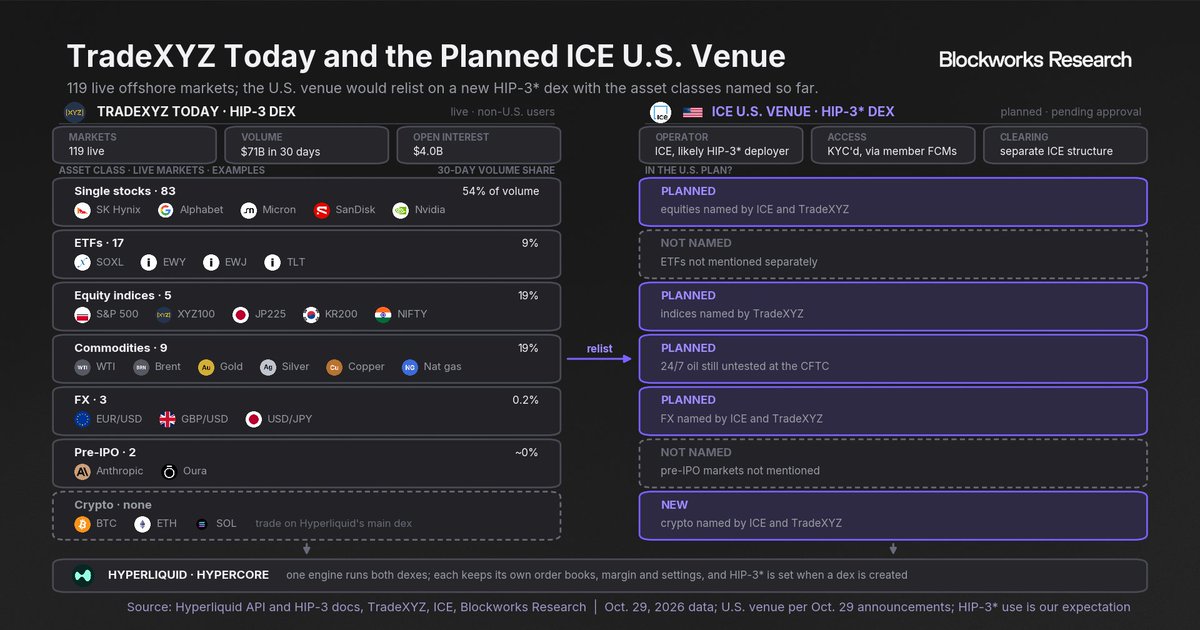
According to the official press release, the new market is designed for retail traders seeking short-duration, 24/7 exposure to crypto, equities, commodities, FX, and other RWAs.
Market Impact of ICE Partnership
In our view, this partnership is one of the clearest validations of the Hyperliquid thesis and also one of the most consequential, for two reasons.
First, it validates Hyperliquid’s infrastructure for traditional exchanges. The world’s second-largest exchange operator has chosen to leverage Hyperliquid’s existing technology rather than build its own. While CME attempted to internalize all of the economics through its own 24/7 listing, ICE’s willingness to pursue a 50/50 economic split underscores the value of Hyperliquid’s technology. We have long framed HyperCore as an alternative to DCM/DCO infrastructure, and its adoption by the second-largest exchange operator is perhaps the strongest possible validation.
Second, the partnership unlocks significant distribution. Unlike the Kraken partnership, which brought HIP-3* to NinjaTrader users, ICE can distribute these markets through its network of partners, brokers, and platforms that retail traders already use, with OKX being just one example.
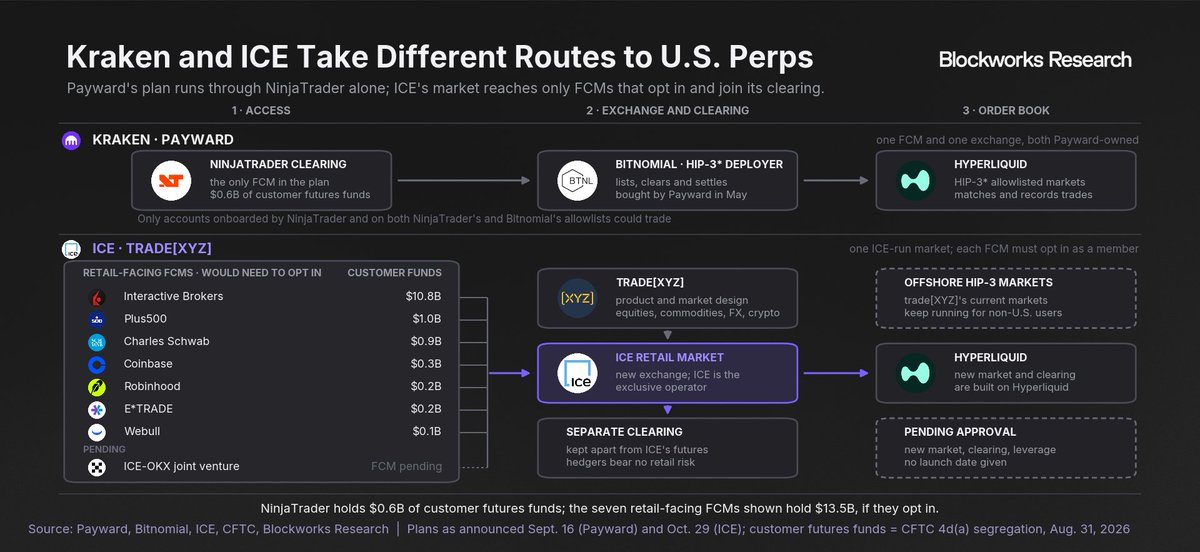
Importantly, ICE works with numerous clearing firms, and not every FCM will be a member of the clearing organization used by ICE[XYZ]. Its clearinghouse will likely be separate, creating a silo between ICE’s existing TradFi products and its new perpetuals. However, FCMs can become clearing members of the organization and then offer these products to clients.
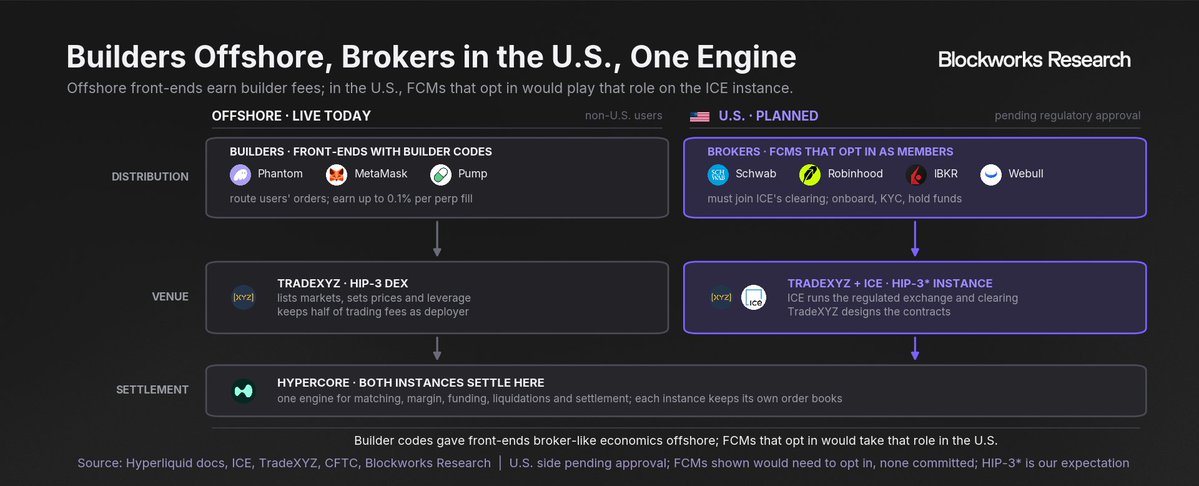
Similar to the builder-code model, which introduced broker-like economics and a division of responsibilities, a DCM/DCO structure, subject to regulatory approval, would allow existing brokers to access trade[XYZ] and ICE’s regulated instance directly.
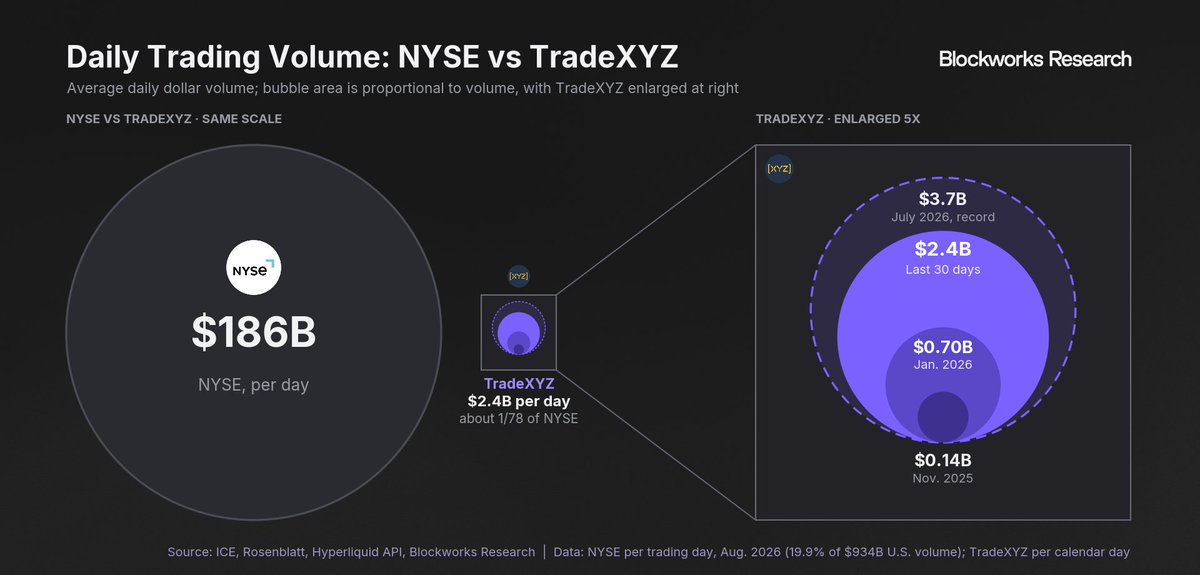
Given the massive volume difference between NYSE and TradeXYZ, where the latter is around 1/78th of NYSE volume, even adoption from a handful of FCMs would be enough to dramatically increase TradeXYZ perpetual volumes.
Conclusion
We believe the trade[XYZ]/ICE collaboration is the single most important validation of Hyperliquid’s infrastructure layer. The world’s second-largest exchange operator is building directly on HyperCore, aiming to offer RWA markets to traditional brokers through HIP-3* rather than rebuilding the underlying infrastructure. If approved, the partnership could unlock distribution across ICE’s broad network of FCMs, enabling them to offer these products directly to retail clients.