I scraped every Harkirat podcast to build a playbook on getting a job
文章目录
I did this just out of curiosity. Harkirat has two podcasts where people share how they got hired: "100xDevs Success Stories" on his channel and "100xStories" on the 100xDevs channel. I had Claude go through all of them. That's 83 episodes, about 40 hours of talk (mostly in Hinglish), and 100+ people's stories.
Most of these people had no big college name. They came from tier-3 colleges, civil and mechanical branches, BCA, even a history degree. Some dropped out, and one was without a job for 2 years. Still, the same few moves showed up again and again, and once they had built real stuff, nobody cared much about their college or CGPA.
I'm from a tier-3 college too, and I recently got 5–6 startup offers. Most of this matches my own job hunt, so I put it all in one guide. For most people, it took 4 to 8 months from starting seriously to getting their first paid role.
What worked, in short: pick one stack, build one real project that's live, and help on other people's code. Show your work in public. Then reach founders and communities directly instead of job sites, and treat the trial period as the real interview.
Stop mass-applying
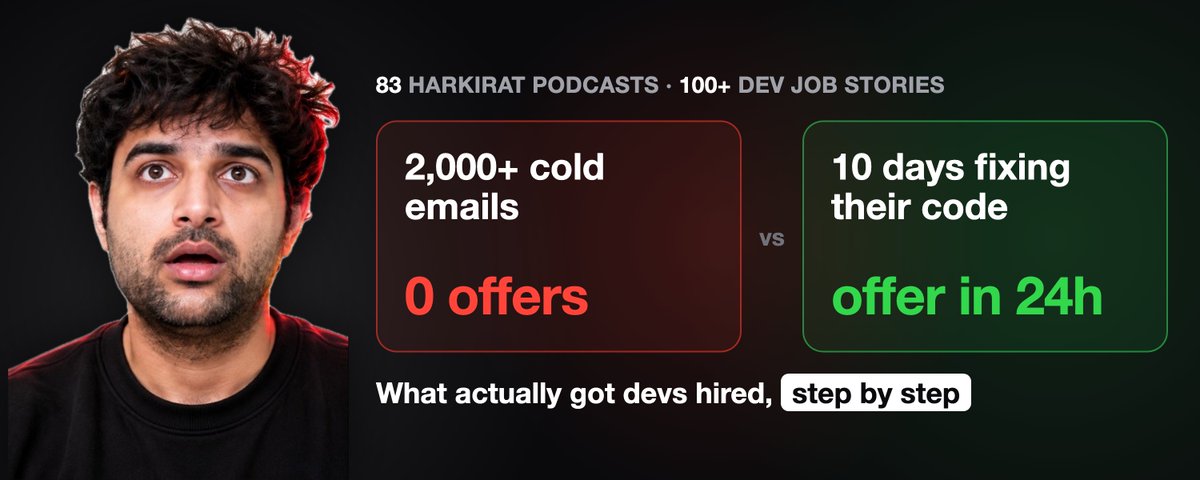
Sending hundreds of applications almost never worked. One person sent 2,000+ cold emails, another sent 400–600 applications, another 200+, and one did 34 free assignments. All of them got zero offers this way. The offers came through people.
Harkirat's own story is a good example. He messaged the CEO of Backpack and got no reply. Then he spent 10 days fixing things in their code and sending it to them, and got an offer in 24 hours. In his words: "Don't tell me you can do it, show me."
Where the offers came from, most common first:
-
Someone referred them. That person had already seen their work in a project, a Discord or a class.
-
They messaged a founder. Small startups that just raised money hire fast, and the founder decides. One reply to a founder's hiring tweet turned into a ~$100k remote offer in 10 days.
-
Open source. The people who run the project see your work before you even ask.
-
Posting their work on X or LinkedIn. One tweet with a resume got 100k views and 2 offers. When people come to you, you skip the screening round.
-
Hackathons, grants and bounties. You get money, proof, and founder contacts.
-
Small online communities and meetups. If you help people where hirers hang out, they come to you.
-
Freelancing. Real clients count as real experience.
-
DSA and careers pages. Still the way into Google and other big companies.
What mattered was work anyone could check, like live links and merged code. One project you can explain line by line. A warm intro instead of a cold application. Speed, like applying minutes after a post goes up. Being honest about what you know, and sticking with it, since many people waited 4–6 months for the first yes.
What barely mattered was college name, branch, age, years of experience, certificates, and how many projects you had. Civil, metallurgy, chemical, EEE, BCA and history students all got in, and 18- and 19-year-olds got US remote jobs.
Harkirat does give one warning. A degree still helps for some first jobs, visas (like Japan), master's programs and government exams. Several people kept a cheap online degree as a backup. He says don't drop out unless you already have a strong offer.
Step 1: pick one lane (week 1)
The biggest regret people had was jumping between DSA, ML, blockchain, Android and web, and finishing none of them. Harkirat says spend your first 6 months on full stack: JS/TS, React or Next.js, Node, Postgres and some DevOps. Most companies hire for this, and you can always fall back on it. After that, go deep in one area you like that companies also want.
The areas that came up, and a project that got people hired in each:
-
AI and agents. Startups want these people fast. What they pay for is testing the AI (evals), making it reliable, and keeping costs low. Build a coding agent that runs in the cloud, a chatbot with evals, or a voice agent.
-
Web3 (Solana, Rust). Few people do it, it pays globally, and there are lots of grants and hackathons for students. Build an indexer, a staking or escrow contract, or an exchange order book.
-
Backend. This is where demand is right now, and there are few jobs that are only UI. Build a crypto exchange backend (order book, Redis queues, websockets) or a Vercel clone.
-
DevOps. Few people know it well, and freelance work exists from day one. Build CI/CD, Docker and Kubernetes for a real app.
-
Mobile (React Native). Fewer people than web, so you stand out. Build a mobile version of a common project, and learn how React Native works inside.
-
Go or Rust as a second language. When one company needed Go, it found the two people who had learned it. Build a P2P file-sharing app, a fast downloader, or CLI tools.
A simple rule: 3–4 months of building every day makes you decent in any area. If you can't pick one within a month, go back to full stack and get really good at it. If you want any job fast, be good at the basics of everything. If you want a big remote offer (50 LPA+), go deep in one area.
Step 2: build real skill (months 0–3)
Code every day. Harkirat says loving to code daily is the #1 trait of people who get remote jobs, and one person in the episodes coded 365 days in a row. Learn from docs and by building your own app, even an ugly one, so you don't get stuck watching tutorials. Some people spent 20–30 days on one tutorial project until they could explain every file in it.
Build two projects by hand before you lean on AI, because interviewers now check if you can code without it. Learn what's happening underneath: how useEffect works, why a CDN is faster, what "stateless" means. Read code written by senior engineers too. Harkirat calls it "the most underrated way to learn."
How much DSA you need depends on where you want to go. For Google, big companies, campus drives and Japan, you need a lot, and the Google interns in the episodes solved problems every day for years. For startups and remote jobs, they mostly look at your projects and give you a trial, and many people never got a single DSA question. To be safe, Harkirat says ~100 LeetCode problems puts you above average, since ~70% of companies still have a DSA round. Do about 2 hours a day in the weeks before interviews.
The AI rule is simple. Use AI a lot once you understand the topic, and never to skip understanding it. "AI writes the code, but it's your job to know what it's doing."
Step 3: make proof of work (months 2–5)
Founders decide fast. Harkirat says a founder with 500+ applications looks at each one for about seven seconds. They want to see one thing: a deep project, a public streak, or real code in someone else's project. Your job is to make that easy to find.
One deep project
One great project beats many small ones. "It's okay to not have a lot of projects, but whatever you have should have real depth." Build something real that people use. One person's site got 5,000 users in 3 days, then got attacked (a DDoS), and fixing it became his whole interview. 100 real users beats a beautiful project nobody uses.
Make it a bit infra-heavy. A Vercel clone got one person an instant referral, and a trading backend carried someone else through two offers. Be ready for three levels of "why": why a CDN, does it work for every user, do you even need Kafka at this size? And polish it. People got rejected for "not polished enough", and one recruiter checked if a site looked right on every screen size before anything else.
Help on someone else's code
Harkirat: "Contributing to a project someone else wrote is much harder and more impressive than building your own. Everyone has projects now." This was the strongest signal in the episodes. How people did it:
-
Pick the right project. Startups that just raised money and have public code, small open-source projects with few helpers, or projects with lots of open issues.
-
Run it on your laptop first. This took some people 3 days to a month. Don't paste an issue into ChatGPT and paste the answer back.
-
Do what others skip. Small ugly bugs, docs, tests, setup guides, and issues that are years old.
-
Make it easy for the owner. Test it fully, add a short video, and write a clear description. A few big PRs beat many tiny ones.
-
Show up. Join their calls, help new people, and review other people's code. One person cleaned 600 spam PRs down to 71 and got noticed for it.
Put everything in one link
Make a Notion page or a simple site with all your projects. For each one, add the live link, the code, one line on the problem it solves, and a simple diagram. Put this link in your X and LinkedIn bio so a recruiter is one click from your work. Have it ready before anyone asks, because one person lost a referral when theirs wasn't.
On your resume, put experience first and count open-source work as experience. One person got 5 offers with a resume like that.
Post in public
Share your progress with numbers: users, money, PRs merged. Plan your posts and keep them clear. A daily streak is proof by itself: one person streamed himself learning every day to zero viewers, and that video link is what the founder who hired him liked. Another student commented on a US founder's posts for months and got an internship trial.
Win something
Hackathons, grants, bounties and programs like GSoC, Summer of Bitcoin, Outreachy and LFX all count. Harkirat: "Grants and hackathons are the best thing a student can do now." Post a little during the last week of a hackathon so judges can see people using what you built.
Step 4: reach the people who hire (months 4–6)
Most people skip this step. Harkirat: "Referrals were the hard part, skills are not too hard." And: "Resumes don't get shortlisted. A referral through proof of work beats 500 applications."
Who to go after
-
Startups that just raised money. "The best time to get hired from India for the biggest offer is when they have just raised." Watch funding news, new YC batches and founders' tweets.
-
Small teams of 5–50 people. The founder decides, often after a trial.
-
Foreign and YC-backed founders. They pay more. For Japan, try japan-dev.com and tokyodev.com and filter for "no Japanese required".
-
Boring businesses like hotel software and B2B SaaS. They last longer than hype.
-
Job lists on GitHub, Wellfound and Superteam Earn.
Best ways in, in order
-
Someone who knows your work refers you.
-
A founder posts about hiring, and you reply or DM within the hour.
-
Job channels in communities: Discords, WhatsApp founder groups, Superteam.
-
Meeting people in person at meetups and events.
-
A personal email to the founder or CTO.
-
Job sites. Apply within minutes, then message a real person at the company.
Messages that got replies
-
Show something that works. One person built mini versions of YC startups' products, added one feature, and sent them to the founders. 70–80% replied.
-
Don't ask for a job in the first message. Ask if you can help in any way.
-
Offer what they actually need. One person applied for one role, found out they needed front end, offered that instead, and got hired at $30k.
-
Follow up somewhere else. If a founder is quiet for 7–10 days, try another app. One person commented "check the DM" on the founder's latest post.
-
Message the contact on old job posts. In one case the contact was the founder, and it got the job.
-
Be early. One person applied at 4 AM, minutes after the post went up.
-
Go through the CTO. Message the CTO, let them nudge HR, then email HR with "Referred by CTO" in the subject.
-
Call instead of DMing. After 100+ LinkedIn DMs got no reply, one person phoned a senior, and that led to a Google referral.
-
Target one small company. About 40 LinkedIn requests to people at one 50-person company got one reply six months later, and it led to a ~45 LPA remote job.
-
Help people where hirers hang out. Answering questions in a Discord turned into DMs asking "are you free? what's your rate?"
How people decide who to refer
Harkirat refers people who are always visible, help the community, finish small bounties, and come with a demo ready. Copy-paste messages "sound spammy", so say exactly how you can help. He also says only about 20% of a batch is ready for a referral at any time. Don't use a referral before you're ready, because people who did failed on the basics.
Step 5: interviews and trials
Different companies ask different things, so know which one you're walking into:
-
Early startup: a chat with the founder, then you walk them through your project and code. Maybe one easy DSA question, then a take-home or a paid trial.
-
Funded startup: a 1–5 day take-home, then questions on every choice you made, a round on designing their own product, and a chat with the founders.
-
Indian product company: JS basics (closures, promises), how frameworks work inside, building a feature in an hour, designing a system like food-delivery orders, and databases and scaling.
-
Web3: designing a contract, writing Rust live, security questions, and often a paid 10-day trial.
-
Google and big tech: 2–3 DSA rounds, with 2–3 medium problems in 45 minutes. Waiting 2–3 months for a result is normal.
-
Frontend: debounce, fewer re-renders, infinite scroll, and fixing a slow page live.
-
Research roles: deep questions on your past research, working in a huge codebase, maths and stats.
In the room, share your portfolio link in the first minute and demo it. One person spent most of his first interview demoing and got the job. Think out loud, and ask questions before you start. Be honest, and rate yourself a bit lower than you think you are, because "people hate bluffing" (Harkirat). Saying "I don't know, I'd need to learn it" went down well with founders.
If AI wrote parts of your code, be ready to explain every line. Have one great answer to "what's the hardest problem you solved?" And stay relaxed: show you want to be part of their team, and listen without cutting in.
Winning the trial
Many startups skip interviews and give you a paid trial of 1–4 weeks. The people who won it:
-
Sent their first PR on day 2. One person sent 20–22 PRs in 2 weeks.
-
Finished their tasks, then fixed bugs real users were hitting.
-
Asked: "What is the most troublesome thing in the codebase?"
-
Did more than their role. "They didn't have a UI person; I made sure they didn't need one."
-
Asked for feedback again and again.
-
Learned new tools overnight when needed.
-
On take-homes, did a bit more than asked and put it live with its own domain.
Only do free assignments for real, funded companies. Harkirat: "Instead of 30–40 assignments, do 30–40 open-source contributions."
Step 6: the offer and the next jump
Take the first decent job fast, even if it pays less. Something like 10–15 LPA or ₹70–80k a month is a fine start. "25 will come, then you'll want 50." Every story grew step by step, like 6.5 LPA, then double, then double again, to 45 LPA.
Ask for a modest amount as a fresher, and raise it later. ₹20–50k a month was normal for a first remote job, and asking ₹1 lakh "kills interviews". Don't go too low either: one person asked ~$300 a month and later wished he'd asked $800–900.
Interview at a few places at once so you can negotiate. Never announce an offer or quit anything before the offer is signed. One person did and got ghosted for 2 months. Keep a backup too, since several people took a campus job first and went remote later. Avoid long bonds, and early on pick a team you'll learn from: one person chose a great team over double the pay. Stay 1–3 years unless you stop growing.
Other routes that kept coming up
GSoC and open-source programs
About 50 GSoC selectees shared their stories, many from tier-3 colleges and some only months into coding. Harkirat says GSoC gets you the interview, but you still need to code well live to get the job. Their tips:
-
Start early. Contribute from December or January for the March deadline. This was the #1 tip.
-
Pick orgs with less competition: new orgs, big orgs with many slots, "boring" orgs, and stacks you already know.
-
Apply to up to 3 orgs. If one drops out, pick another.
-
Talk to people. Join their calls, talk to the mentor early, and send your draft 2+ days before the deadline.
-
Write a clear plan. Show what you'll build, PR by PR, with a working demo. "People with 70 PRs still failed" because their proposals were weak.
-
Fix the old, hard issues. One person fixed a 10-year-old speed problem.
-
Keep going after a rejection. One person was rejected 3 times, kept contributing, and got in.
Also look at Summer of Bitcoin (about 33 picked from 5,000+), Outreachy, LFX and Hacktoberfest. Low-effort Hacktoberfest PRs are "not worth your time".
Remote jobs at foreign companies
The highest pay in the episodes (~$30k–$100k) came from remote jobs at US, EU, Dubai, Australian and Japanese startups. Harkirat's 8 traits of people who get them:
-
They love coding daily, like going to the gym
-
They've built a lot of projects
-
They get past "no experience" through someone vouching, a trial, or an internship
-
They keep going and never quit
-
They ask for modest pay at first
-
They stay grounded, because the excitement fades
-
They're ready for a long ride (4 months to 2 years)
-
They speak good English, since the clients aren't Indian
There's another side to this. Don't skip campus jobs to chase remote work right out of college. Get any job first, learn how real systems work, then go remote. Harkirat also says remote pays more because of the currency, while the skill stays the same. One company pays 8 LPA and another pays 30 LPA for the same skills, so "find the right company."
Gaps and no degree
Many people had weak campus placements because of low CGPA, a non-CS branch, or a college with one placement a batch. They applied off-campus from day one. Gaps can be fixed too: the person who was jobless for 2 years still got in through visible work and community. Join a group of people learning like you, like an online cohort, a college tech club or a local meetup. "Smart people put together are 100× better than smart people kept in their houses."
Google and big companies
The two Google interns did it the classic way: years of daily DSA, coding contests, full projects, and a referral from a senior. One habit to copy is to email HR or the hiring manager after you fill a form, because "forms rarely work." One more tip from the episodes: you need just one big-company or well-known startup name in your first 7–8 years. After that, try new areas, ship fast, and judge yourself by results instead of lines of code.
What changed with AI in 2026
The old formula, a bit of DSA plus one project, doesn't get people hired anymore. Startups are still hiring though. The students in Harkirat's Super 30 batch who worked hard for about 6 months all got something, mostly at startups.
What companies expect now:
-
You already use AI well. You can run agents, write specs and check their work. Harkirat says to set up "loops that prompt your agents" instead of babysitting them.
-
You know the basics. "If you don't know the subject, you're blind to the LLM's subtle mistakes." One wrong > instead of >= can cost a finance company a lot.
-
You can code without AI. Founders reject people who can't write a simple Express server by hand.
-
You can test, debug and write docs. This is more and more of the job.
The biggest offers went to AI research, building agents and evals, and people deep in full stack or DevOps. The hot areas named were coding agents, sandboxing, voice AI, AI memory, and small local models. Jobs that work closely with customers (like forward-deployed engineers and devrel) pay well too, and need good English. Knowing some marketing or sales also helps. One founder question is worth remembering: "I can build the same thing with a $100 plan. What do you bring to the table as a human?"
So build two projects without AI first, then use AI a lot and check everything it writes. Show tests and reliability work in your portfolio. And write down why you made each choice, in a Notion doc next to the project. It "makes a huge difference."
The 15 most common mistakes
-
Getting stuck in tutorials. Watching 90-hour courses. One person stayed stuck for 3 years.
-
Jumping between stacks. "Juggling Python/Go/Rust gets you nowhere."
-
Mass-applying. See the first section.
-
Only DSA, no projects. Months of LeetCode for FAANG, then quitting out of boredom.
-
Free work for startups with no money. 34 assignments for nothing.
-
Acting on an unsigned offer. See Step 6.
-
No portfolio when the chance comes. A referral's email went unanswered because of it.
-
Using a referral too early. Failing on the basics.
-
Letting AI think for you. AI-written spam PRs just get closed.
-
Asking for too much too early. Asking $100k as a fresher got no reply.
-
Staying comfortable too long. 3 years at 8 LPA without learning anything new.
-
Quitting with no plan, or signing a long bond. One person was stuck in a 2-year bond at 3 LPA.
-
Learning alone. "When you're at home alone you think you're next-level; in the community your bubble bursts."
-
Burning out. 3–4 jobs at once, 17-hour days.
-
Waiting to feel ready. One person waited 2–3 days to reply to a CEO. You'll never feel fully ready, so apply anyway.
Templates you can copy
Keep messages short and clear, and always add links.
1. DM to a founder who posted about hiring
Hi [Name], saw your post about hiring a [role]. I build with [stack]. Most relevant: [project] ([live link]): [one line on the problem and what I built, with a number if you have one]. I also [sent X PRs to / built a small version of] [their product]: [link]. Happy to do a short paid trial. Portfolio: [one link]
2. Email to a startup that just raised money
Subject: Built a small version of [Product] + [one feature idea]
Hi [Founder], congrats on the [round]. I like the problem you're solving with [product]. To understand it, I built a mini version over the weekend: [link + 30-second video]. I added [extra feature], because [what you noticed about users]. Would love a 15-minute chat about it, and about whether I could help in any way. [Name] · [portfolio] · [GitHub]
3. Asking someone who knows your work for a referral
Hey [Name], I've been [contributing to X / building Y] for [N weeks]. Latest: [demo link]. I'm now applying for [type of role]. If you know a team that needs [skill], I'd be grateful for an intro. Here's a 1-page summary you can forward: [Notion link]
4. Follow-up after 7–10 days of silence, on a different app
Hi [Name], following up on my DM from last week. Since then I shipped [new thing]: [link]. Still keen to help with [their problem].
A 6-month plan
-
Month 1: Pick one stack. Learn JS/TS basics and React. Code every day and post your progress every week. Join one good community, like a cohort, a Discord or a local meetup.
-
Month 2: Learn backend: Node, Postgres, login, websockets. Build two small apps without AI. Start 1 DSA problem a day if you want product companies or big tech.
-
Month 3: Learn DevOps basics: Docker, putting an app live on AWS with SSL, CI/CD. Get one real open-source project running on your laptop and send your first 3–5 PRs. Take a small paid gig or bounty.
-
Month 4: Start your main project in your area (an exchange, an indexer, an agent, a deploy platform). Put version 1 live. Make your Notion portfolio. Join a hackathon or apply for a grant.
-
Month 5: Go deeper: scale, tests, a write-up, a diagram. Send 10–20 good PRs to one project or company. Start reaching out: 5 personal messages to founders a week, meetups, and community job channels.
-
Month 6: Interview at a few places at once. Practise explaining your project three levels deep, plus the topics for your role. Take the first decent offer or trial, do more than asked, and plan your next jump.
Readiness checklist
-
I can explain every line of my main project, including the parts AI wrote
-
My main project is live, works on every screen, and has no bugs on the first click
-
I have merged PRs in code I didn't write
-
One link shows all my work, and it's in my X and LinkedIn bio
-
My resume starts with experience, and counts open source as experience
-
I've posted my work in public every week for a month
-
I can write a basic server, component and database query without AI
-
I can explain stateless vs stateful, caching, CDNs, database indexes and connection pooling
-
I've done about 100 DSA problems (more if I want big tech)
-
I'm in at least one active community where people share job openings
-
I have a list of 20 startups that just raised money, and I know who their founders are
-
I know what pay I'm asking for, and I won't quit anything until an offer is signed
You don't have to do all of this at once. Go through the checklist, find the first box you can't tick, and start on that one this week.