How to take back control of your life (do these 5 things)

文章目录
You need a routine.
If you don’t have one, then your “routine” is not having a routine.
I’m a very boring person.
I do the same things every day. I write, build, do research, pick up heavy things in the gym, run, read, drink an unhealthy amount of caffeine, repeat.
Whenever I speak to my mother, she always asks: “Hussain what did you do this weekend?”
I’d reply with, “Oh, you know, the same old stuff.”
Then she’d go on about how I should go out more, have more fun, and be like everyone else.
But honestly?
I love how boring my life is. If I didn’t love it, then I wouldn’t be doing it every day. I’m lucky enough to be living my “perfect day” every day.
It didn’t happen by accident. I’ve put a lot of attention, care, and effort into achieving it. It took me almost 3 years to get to where I am now.
One thing I hated the most about my previous job was that I was always exhausted.
Even though I did “nothing” for 8-9 hours a day, I was still tired. I didn’t have energy to think, to build, to be creative, or to even read. All I wanted to do was scroll my phone and do nothing.
That’s the ironic part about energy: It’s created from effort.
The more you do, the more energy you have.
If you spend the majority of your productive hours doing the bare minimum and on a job you don’t care about, you’ll have a low-energy lifestyle. When your energy is low, it’s extremely hard for you to build anything meaningful in your life. I’m not just talking about business. I’m talking about your health, your relationships, finding new interests, or learning any new skill. Everything is downstream from the routine you have.
I’m not here to tell you to create a routine like the Instagram influencers’ productive morning routines that you see on your FYP where they spend 4 hours “getting ready for the day”.
Frankly, that’s highly impractical, unrealistic, and ironically, highly unproductive.
You need a short but effective routine that allows you to achieve your goals, feel better, and grow as a person.
I - Psychic Entropy: Why your life always feels chaotic
Psychic = Mental
Entropy = the total chaos and randomness in a system
The default state of the universe is that entropy is always increasing unless external energy is put into the system to maintain order.
Your body’s health degrades unless you take care of it by exercising, eating properly, and sleeping.
Let’s take your bedroom for example.
When you don’t clean it for a day or two, you might have one or two shirts lying around. No big deal. But the longer your room goes uncleaned, the messier it becomes. It reaches a level where you can barely walk in, the room stinks, and then your mom will come and scold you for not cleaning it.
It’s only then that you’ll put in the effort to clean.
The same happens to your mind.
When you wake up, entropy is low. Your mind is clear and your mood is generally good. But then you remember it’s Monday. Then you start thinking about work, the deadlines you need to meet, how bad traffic is gonna be, the bills you need to pay, and before you know it, your day is ruined and you haven’t even gotten out of bed.
Most people have poor control over their consciousness. When you can’t control your attention, entropy increases.
This is why you need a routine.
A routine reduces entropy. It’s the effort you put into maintaining order. The less psychic entropy you have, the calmer, more productive, and in general, happier you are.
The more psychic entropy you have, the harder it is for you to focus or even achieve anything. Your mind is too distracted by problems, trivial topics, political issues (that have nothing to do with you), and keeping up with the latest celebrity gossip.
The problem is that most people don’t choose their own routines. They get assigned one (mostly from their jobs).
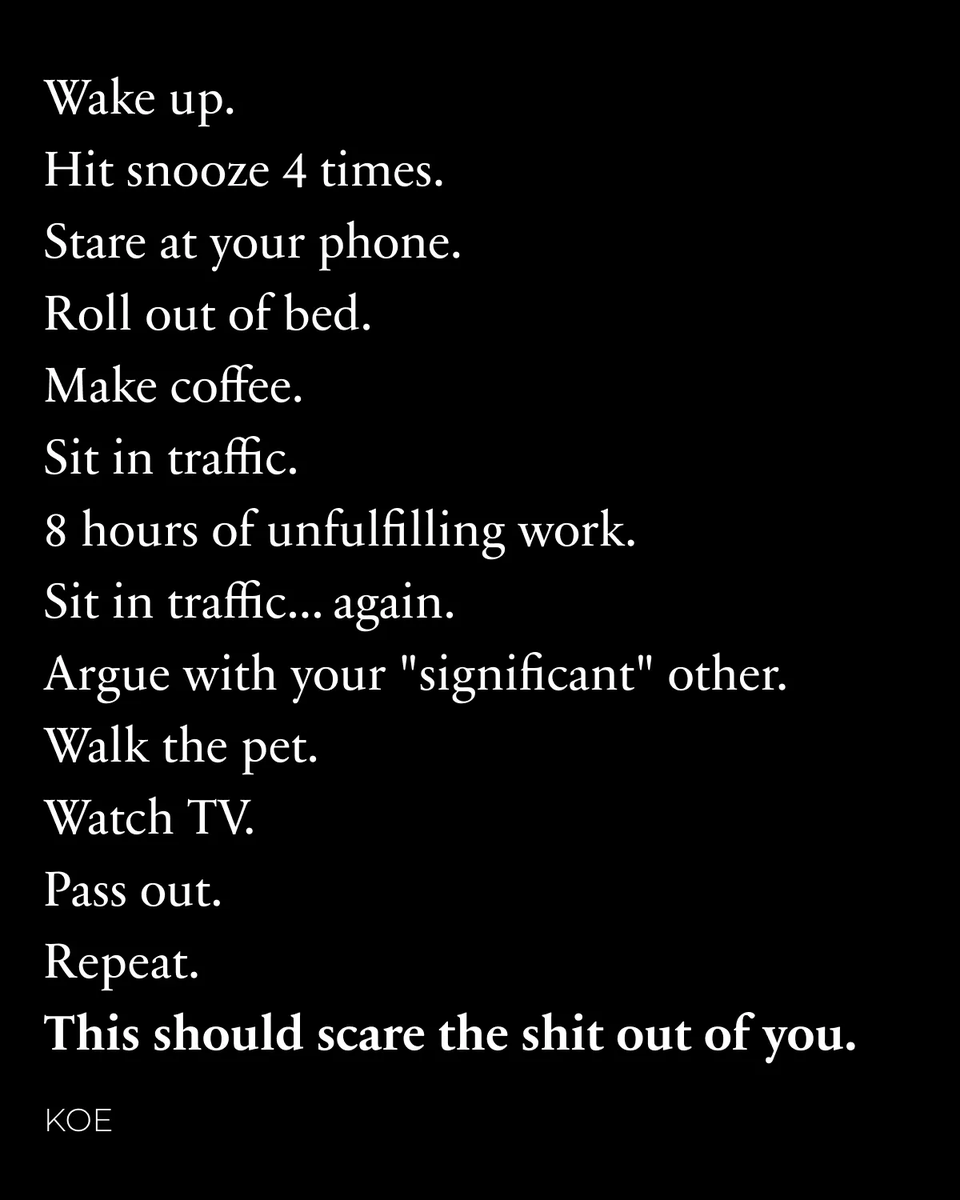
And since most people don’t care about the outcome their routine achieves, they simply don’t care. They want to do the bare minimum to get their paychecks and then numb their minds through cheap dopamine. They fail to put any effort into maintaining order in their psyche. And before they know it, their entire life gets thrown in the gutter.
Your actions create your future.
And if your actions are made on autopilot (without you consciously thinking about them), and you’re not the one who set the destination, that’s a recipe for disaster. One day, usually when you’re in your 40s or 50s, you’ll wake up feeling disgusted because you’ll realize you weren’t the one in control of your life.
If you don’t know what you want to do in life, you’ll be told what to do.
If you don’t set your own goals, you’ll be assigned goals (that don’t benefit you).
If you don’t create a routine, you’ll be assigned one.
If you’re “useless,” someone else will come and take advantage of you, and you won’t even know it.
Life is a very efficient place. There is no place for useless people. You either work towards your own goals or someone else’s.
II - How to take back control of your life
A lesson that took me far too long to learn:The most dangerous thing you can do is to look forward to vacation.
First, it takes away the joy from everyday experience because your mind is living in the future. And when you finally have your vacation, you can’t enjoy it because your mind is occupied by the fact that after your little holiday, you’ll go back to your job.
Second, it also means you accept your current way of life (which means suffering becomes your default state of living) and that is no way to live life.
I have a very simple rule I live by: If I don’t want to do something, then I don’t do it.
If I don’t want to wake up at 6 am every day, then I won’t. It does not make sense to have things you don’t enjoy doing as part of your daily routine. It just creates more entropy.
If you want to live a happy, meaningful, and peaceful life, you need to minimize entropy and maximize order.
The best way to do this is to create a routine that you genuinely enjoy doing and wouldn’t want to change.
Here’s how I’ve designed my perfect day, achieved it, and now live it every day:
1) Create A Vision
You can’t go anywhere unless you first know where you want to go.
You need direction.
You need to create a vision so big that every long-term gain outweighs every short-term pleasure.
Most people don’t achieve their goals because they aren’t the ones setting them, so they have no reason to sleep early, take care of their health, learn, or even improve themselves.
You need to set goals that demand you be at your best at all times, in all domains of life (health, wealth, relationships, mind, body, and spirit).
The more goals you achieve, the more you grow as a person, and the more complex your consciousness becomes. To achieve bigger, harder goals, you need to upskill. You need to learn, experiment, fail, come up with your own conclusions, and stretch your mind to its absolute limits. All of this makes you a much more complex and interesting person.
Grab a notebook and write your dream life.
-
If you had to live the perfect day, every day, what would it look like?
-
If money wasn’t a problem, what would you do for work? (Everyone has to work, you can either be assigned a job you hate, or you can create one yourself).
-
How long would you want to work per day?
-
Where do you want to live? In front of a beach? In a city?
-
What car do you want to drive?
-
What do you want to look like?
-
How much are you earning?
-
How do you act, speak, think, and behave?
-
How is your energy throughout the day?
You need to be specific. Otherwise, how will you live your dream day if you don’t know what it is?
You need to know where you’re aiming.
2) Create An Anti-Vision
I made the most of progress in my life after a period where I was absolutely disgusted with the lack of progress I was making.
Every game has rules and restrictions on what you can and cannot do.
Your vision is also a game that needs restrictions.
Your anti-vision is your nightmare. It’s where everything that could go wrong goes wrong. It helps if you’ve lived your anti-vision.
Direct the negative energy you have to launch yourself into a completely new reality.
3) Work Like A Lion, Not A Cow
There are two groups of people when it comes to how they work.
The first are the cows. It looks something like this:
-
Consistent long hours every day
-
Predictable output
-
Trading time for money
-
Don’t care about your energy, just do
-
Burnout in 3-6 months
The second are the lions.
-
Intense bursts of energy
-
Long periods of rest and recovery in between
-
Work according to creativity levels
-
Prioritize results over effort
-
Works with leverage
-
Seeks asymmetrical risks and results
Humans, by nature, are closer to lions than cows.
The person who adopts a lion’s work ethic is considered lazy and unmotivated when it’s the complete opposite.
Hustle culture loves to talk about grinding for 12 hours, but if you look at how they work, most of what they do is actually useless.
What most people fail to recognize is that if you want to make disproportionately big results, you need creativity. Creativity isn’t a light switch that you get to turn on and off. It requires long periods of rest and play.
Your goal is to work in sprints.
Minimum time spent on task, maximum results.
Parkinson’s Law: Work expands so as to fill the time available for its completion.
To get into a creative state, you need to prioritize rest and play.
When you’re in a creative state, you can get into a state of consciousness that all the yogis, high-performers, and athletes swear by as the reason for their success.
That state is called Flow State.
It’s a state of effortless effort. Time moves differently. 5 hours pass but feel like it’s only been 5 minutes. Your mind is entirely consumed by the task at hand and becomes one-pointed.
The biggest problem people make is that they jump into the deep end, thinking they’ll progress faster.
That’s not how it works.
The Challenge-Skill-Ratio
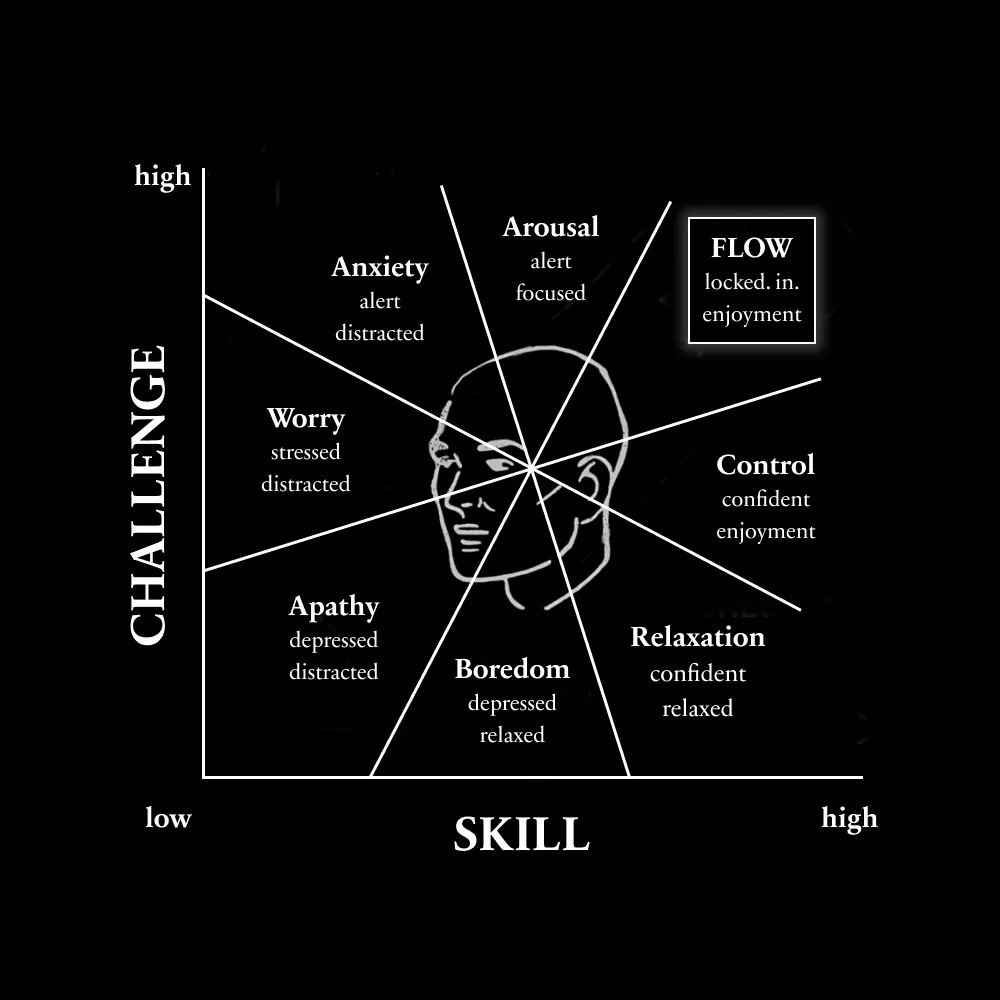
If the task at hand is too difficult, you’ll get anxious.
If it is too easy, you’ll get bored.
You need something that is just right outside your skill level. This will force you to stretch your mind, focus on the task at hand, and actually develop the necessary skills to improve.
If you’ve never written before, the worst thing you can do is start writing a book.
You don’t have the density of ideas, or writing skill, or the articulation to write a 50,000-word book. Start by writing tweets. Once writing tweets is easy, write Twitter threads, then a newsletter, then a short book. Once you’ve got the writing habit down and ideas come to you naturally, writing a book is the next logical step. You’ve built the skills to write, to generate, to capture, and to hold attention.
The goal is to stretch, not snap.
Completing a project should put you closer to actualizing your vision.
If you want to start a business, the first project you might create is building an audience. Once you have an audience, the next project becomes creating a digital product, then getting beta-testers, then customers, then launching the product, refining it, and so on.
With each project, you gain new skills, specific knowledge, and experience that is unique to you. You are learning by being in the arena. Each project makes you a more complex person.
4) Dedicate 2 hours of your day to building your life
2 hours a day or 730 hours a year, is more than enough time for you to build the body you want, the business you want, write the book you want, find the partner you want.
The problem is most people think 2 hours a day is a lot.
It’s not.
You spend 4 hours scrolling your phone. 8 hours doing a job you hate (where you’re building your boss’s dream, not your own). You’re telling me spending 2 hours building your dream life is a lot?
You can spend your life becoming the person you’re meant to be, or spend a lifetime thinking of the person you could’ve become.
Humans have 3-4 hours of potent creative energy.
The best thing you can do is to use the most productive hours of your day to build your dream, not someone else’s.
Choose either early morning or late at night.
My advice?
Work early in the morning. That’s when the world demands the least from you. Your mind isn’t drowning in noise. Entropy is at its lowest. Also, there’s no better way to use your most productive hours of your day to work on your dreams instead of your boss’s.
When you sit down, knock out the 3-5 needle-moving tasks (yes, what you actually need to do on a daily basis is much less than what you think).
Execute like a madman.
It does not matter if you have the perfect plan, or the perfect morning routine, or the potential to become a Greek god, if you don’t do then nothing happens.
It’s a very simple concept, but so many people get trapped in this mental masturbation cycle of just consuming video after video, planning, creating diagrams, mood boards, taking notes, reading books, buying courses, getting more certifications, and nothing happens because they never do anything.
They’re just going around in circles and enjoy the cheap dopamine hit they get from doing “work” that isn’t leading them anywhere.
Education is important and very useful, but only when it’s being directly used towards a goal you’re chasing.
5) Evaluate, Calibrate, Iterate
Your mind is a cybernetic system.
Cybernetics comes from the Greek word kybernetes which stands for steersman.
-
The Objective — a clear, well-defined goal that the operator (you) sets and needs to achieve.
-
Error Detection & Negative Feedback Loops — tools and sensors that monitor the progress made against the objective. Mistakes and failures are treated as negative feedback. Success is treated as neutral.
-
Control Action — Uses negative feedback to adjust action, refine the approach, or change strategy.
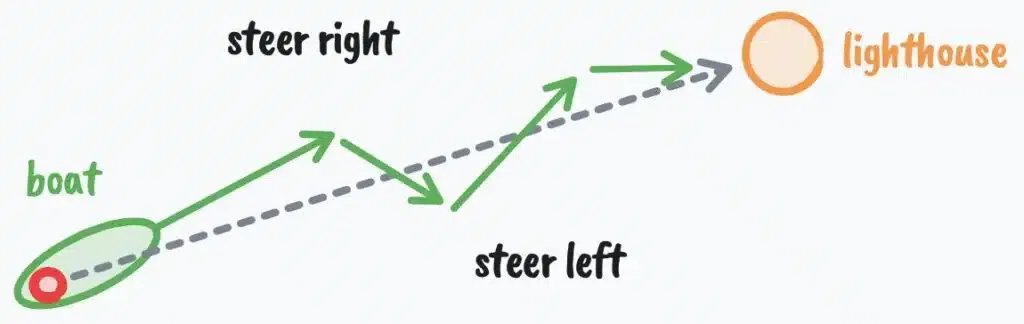
A boat at sea is an example of a cybernetic system. It has an objective (reach shore), it also has feedback loops (a compass). The compass tells them if they’re going in the right direction or not. If the sailor steers to the left too much, he course-corrects and steers right. If he drifts right too much, he steers left. He keeps course-correcting until the sailor reaches his goal.
Your mind operates in the same way.
Your conscious mind sets a goal, you start working towards it, you use your senses, intellect, and mind to determine whether you’re getting closer to your goals or not. Once you have all the information you need, you make a decision, either course-correct (if you’re not getting closer to your goals) or “do nothing” (if you’re on the right path).
You need to always check the actions you’re taking and where you are when it comes to your goals. It doesn’t matter if you’re making progress if the progress you’re making is in the opposite direction.
Every week, every month, every quarter, every year, check your progress. Be brutally honest with where you are, where you want to be, and fix anything that needs fixing.
Your vision should become more of a reality year after year.
This also means you’re evaluating your vision.
Humans are notoriously bad at knowing what they want and what’s actually good for them.
You say you want to be rich, but what you actually want is to stop stressing about money. Those are two completely different goals. The number that gives you financial stability is much, much lower than “being rich”.
The same thing with happiness: you don’t want “happiness” in the traditional sense of dopaminemaxxing where you’re partying, drinking, chasing pleasures, always being in ecstasy, and increasing entropy in your life. What you mean to say is you want peace of mind.
The only way to truly know what you want is to get what you think you want and then evaluate if that’s actually what you wanted in the first place.
The ultimate goal in life is to stop sacrificing today for an imaginary tomorrow.
That’s all for today.
Thank you for reading.
Enjoy the rest of your day.
Hussain