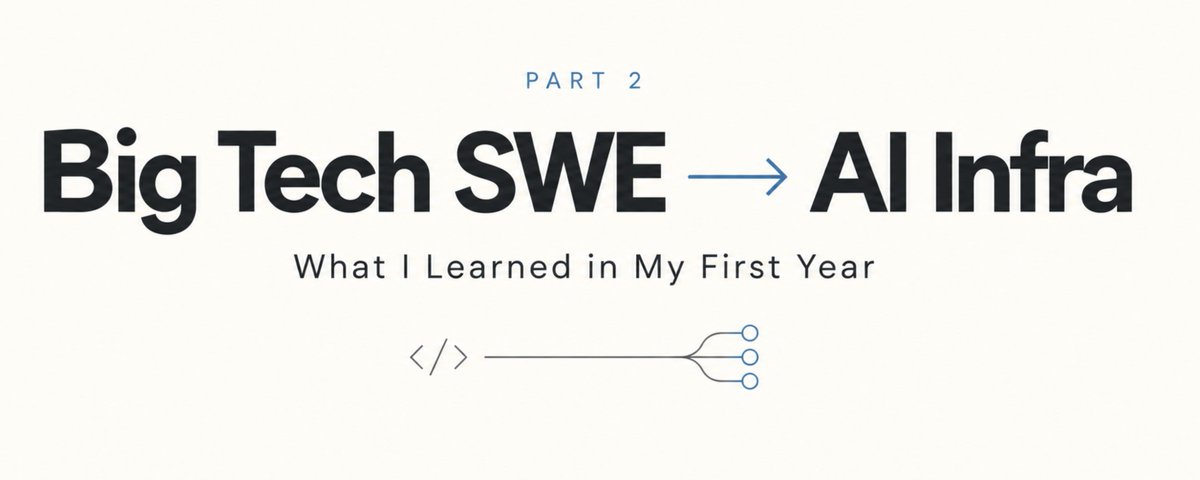
From Big Tech SWE to AI Infra (Part 2): What I Learned in My First Year
文章目录
(I wrote the original Chinese version entirely by hand to keep this as honest and personal as possible.)
This July, I shared my first post about moving from a software engineering role at a big tech company into AI infrastructure. It received much more attention than I expected—even some of my friends came across it in their feeds. Thank you to everyone who read it.
It has now been a full year since I started learning AI infra, and a few months since I joined a great AI infra startup. This feels like a good milestone to share the learning path that worked for me, along with some reflections on working in the field.
If you’re learning AI infra too, or have questions about getting started, I’d love to hear from you in the comments.
My learning timeline
Here’s the full journey, in chronological order.
May 2025
A little background first. If you followed the daily learning notes I used to post, you might remember that I double-majored in CS and Math. I eventually decided to pursue software engineering and followed the familiar path: recruiting, an internship, a return offer, and a SWE role at the big tech company I had dreamed of joining.
I graduated in May. At that point, my exposure to machine learning consisted of a few undergraduate courses and some related lab experience. My math background probably helped a little, too.
July 2025
I officially started my job in July. But life at a big tech company turned out to be very different from what I had imagined.
For one thing, I found it difficult to take initiative. Most of the time, tasks were assigned from above. Working with the same technologies day after day also left me feeling bored, with little room to create something new.
One night, just three months into the job, I started questioning the path I had laid out for myself. It didn’t seem to lead to the kind of life I wanted. I wanted to do work that was meaningful, challenging, and valuable to humanity.
That naturally led me toward open source and AI—and eventually to SGLang.
October 2025
So, three months into my first job, I started learning the fundamentals of AI infra.
My limited ML background and lab experience helped me get started reasonably quickly. But without a structured curriculum to follow, I spent a long time trying to figure out what was actually worth learning.
I ended up learning a bit of this and a bit of that, documenting the process in my early Xiaohongshu posts. I later hid those posts because I no longer thought they were good enough, and I didn’t want to mislead anyone.
January 2026
By January, I felt I had worked through much of the introductory material and many of the blog posts I could find. But understanding concepts and writing real code were still two very different things.
That was when I opened the SGLang codebase and started studying it in depth.
Honestly, reading the source code exposed me to countless concepts and optimization techniques I had never even heard of. Until then, I had mostly learned about things like parallelism strategies, quantization, and radix caching. Suddenly, I was looking at CPU–GPU overlap in the scheduler, CUDA Graphs, HiCache, and so much more.
These concepts feel familiar now. But for a newcomer without the surrounding context, they were overwhelming.
I also started helping out with small tasks in the SGLang community, gaining experience as I learned.
March–April 2026
By this point, my theoretical foundation was coming together. Those early contributions had also helped me build some trust and get to know people in the SGLang community.
Around this time, 吉他猫LLM, whom many people in the community will know, brought me into the SGLang-Omni project. That was where I started doing substantial development work.
The rest followed from there: keep building, keep learning, gradually gain experience, and eventually find my footing as a newcomer in the industry.
The year since October 2025 has been one of the highest-ROI years of my life. Through all those days and nights of studying, I met many people I deeply respect, and I’m grateful for how generously they shared their knowledge.
This year also made me increasingly aware of how limited any one person’s knowledge is, and how much further there is to go in understanding the technology. In the coming year, I hope to keep approaching the work as an apprentice: stay curious, keep learning, and keep getting better.
That’s why I’m sharing my full learning path openly. I hope it gives us something to discuss and build on together. AI infra is a technically demanding field, but I hope my experience can help others who are considering this path or are already on it.
Reflections on moving from SWE to AI infra
To be honest, while traditional database infrastructure and AI infrastructure share some similarities, my experience has been that there is still an enormous amount to learn from scratch.
This field is also full of exceptionally capable people. Whenever I start feeling a little too pleased with myself, I’m reminded of how far I still have to go and how much I still need to learn.
That said, I wouldn’t recommend that everyone make the switch.
At my previous job, I could work nine to five, fully disconnect afterward, and spend my evenings playing board games or go hiking in my free time. In AI, where competition is intense and the pace of change is relentless, every minute feels spoken for.
For me, what matters most is the meaning behind the work and the value it can bring to humanity. That gives me a strong drive to take initiative—almost an instinctive sense of purpose.
Whether the trade-off is worthwhile depends on the person. For me, at least, this work makes me happy and gives me a real sense of accomplishment.
Looking back, that covers most of what I wanted to share from this past year. What stands out most is just how quickly the AI era is unfolding.
For those of us born in the 2000s, this may be both the best and the worst time of our lives.
The good part is that we get to witness humanity enter another new era, taking productivity—and even our ability to do research—to another level. A new generation will ride this wave and build extraordinary careers and lives.
But working in the field, I also have to acknowledge that AI as a productivity tool is widening the gap between people with resources and those without.
People with access to the most advanced models and the harnesses built around them can accomplish what once took a hundred people. Those without that access have to settle for less, and some may not even realize how much AI can improve their productivity.
This is why I’ve always believed open source matters so much.
If tools this powerful remain in the hands of a few dominant companies or the top 0.1%, perhaps Arasaka from Cyberpunk 2077 won’t remain confined to fiction.
Finally, thank you to everyone contributing to open source. I hope more people will join these communities and contribute.
And again, if you have questions, leave a comment. I’d love for us to learn from one another.
沿着这个主题继续读
从一篇文章,找到相关的教程、经验和阅读路径。