Bloom Energy Report - A technical deep dive and valuation model

文章目录
My thesis
Last quarter, I bought Bloom Energy at $177. The market punished the stock heavily after they reported another strong double beat. I work as a commercial manager at a technical company, and I have always admired the unique technology of Bloom Energy. I thought I was too late to buy the company, but when it dropped 12% after a double beat, I took my chance.
This quarter, the company is punished again for its double beat. Bloom is down 11% again the day after earnings. I think it is still a very interesting company to buy after the last quarter. Bloom’s revenue grew 138% YoY and reported an operating income of $225 million. It also raised its full-year revenue outlook to $4.6 billion. This is the third time that Bloom is raising its guidance this year. On the other hand, operating cash flow was still negative at $27 million, and capital expenditure reached $153 million. You certainly don’t buy Bloom for free; the company is now valued at 42 times the forward P/E. But at the current rate, the forward P/E for Bloom will drop to 24, which makes it very attractive. The PEG ratio is also at 0.5, which suggests that Bloom is trading at an attractive valuation.
So depending on which measure you use, Bloom can be attractive or not. As I said, I think the valuation is very attractive because of the unique product that Bloom is offering.
Table of content
-
Revenue streams
-
The technology
-
The financial thesis
-
Valuation model
-
My conclusion
Revenue streams
Bloom’s is primarily known for its Energy Server, which is a stationary solid oxide fuel-cell system that converts fuel into electricity through electrochemistry. Main customers for this technology include data centers, industrial manufacturers, utilities, hospitals, and other commercial and institutional users.
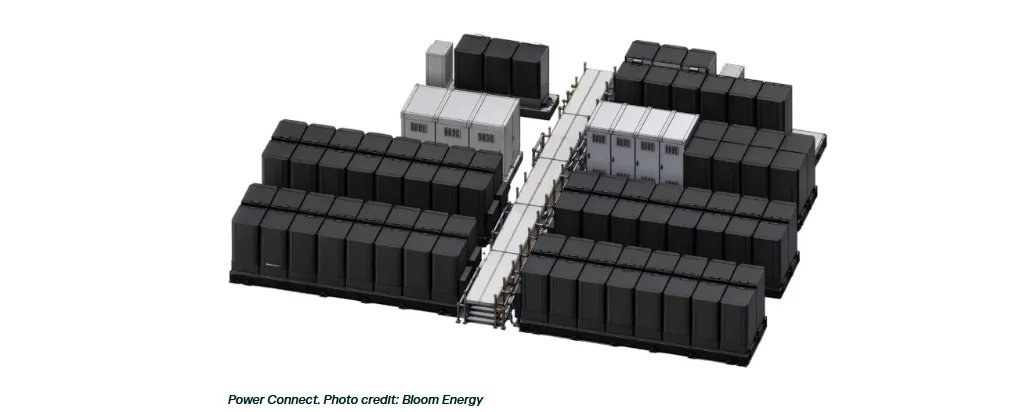
Bloom also sells electrolyzers. Electrolyzers are used to produce hydrogen out of steam. The hydrogen market is another exciting but difficult market with competitors as Plug Power. The main focus of Bloom is now on the Energy Server, which generates almost all the product revenue this year. Therefore, this thesis will mainly focus on the Energy Server market.
Bloom reports four different revenue streams: product, installation, service, and electricity. In the latest quarter, the product revenue represented 87% of the total revenue with service at only 5.5%. This shows that Bloom is still in the early phase. I work for a company in a similar industry, and when you mature, service becomes your main income. The main reason for making service your main drive is that you will have a stable income. When the market matures for Bloom Energy, the product sales will become more cyclical, while the service department will give them a stable growth factor. Investors reward this with a higher P/E, look at subscription businesses for example.
The technology
The Cell
A conventional gas generator burns fuel, converts the resulting heat into mechanical motion, and uses that motion to generate electricity.
Bloom’s fuel cell takes a different route. Each cell contains a solid ceramic electrolyte between two electrodes: the cathode on the air side and the anode on the fuel side. Bloom describes its electrode coatings as proprietary inks.
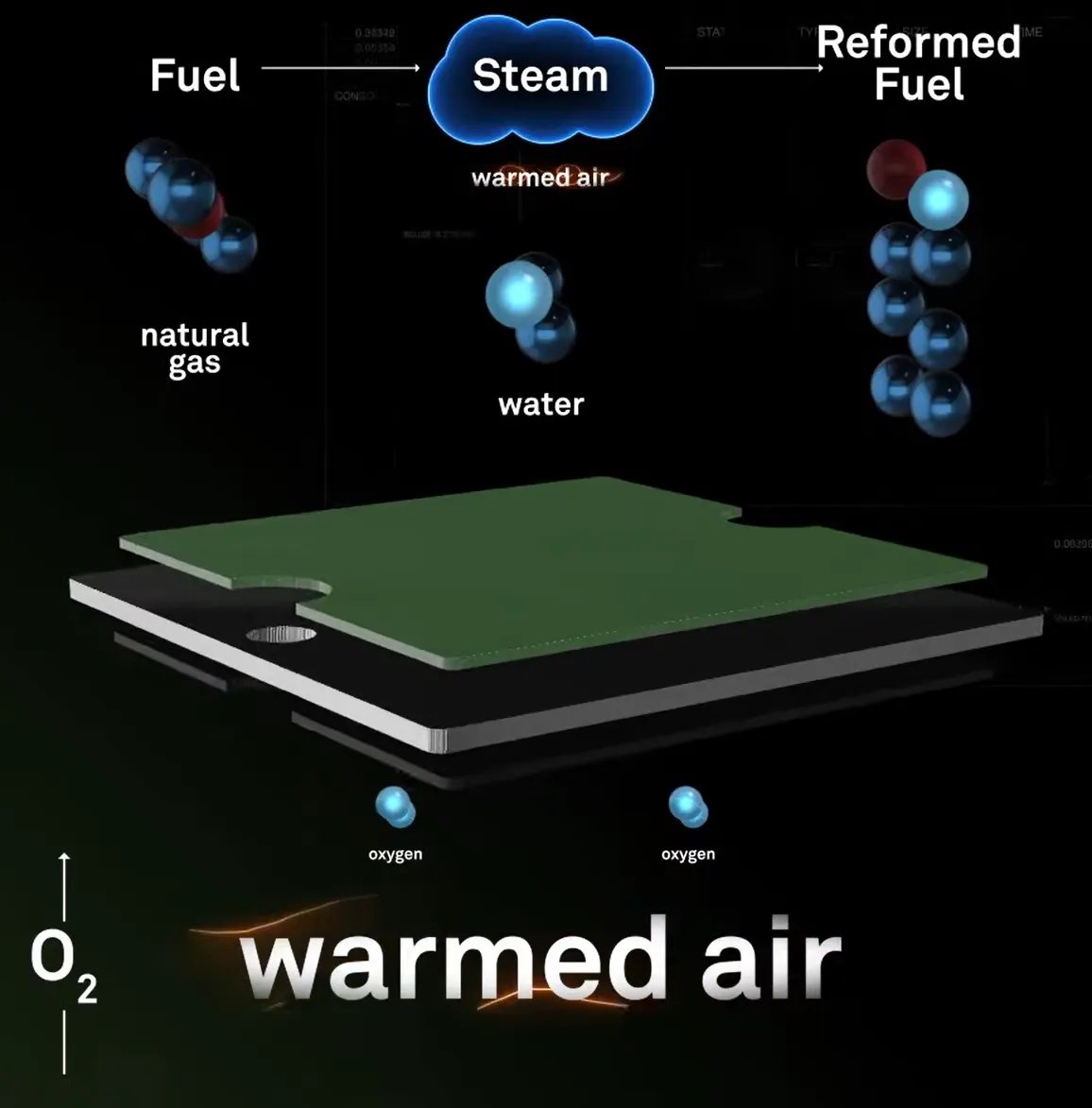
At the cathode, oxygen accepts electrons and forms oxygen ions. Those ions move through the hot ceramic electrolyte. On the fuel side, reactions involving hydrogen and carbon monoxide release electrons, which travel through an external circuit and deliver useful electrical power. Bloom’s description confirms the movement of oxygen ions from the air side to the reformed-fuel side.
For hydrogen, the simplified reactions are:
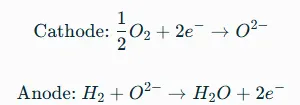
The high operating temperature enables oxygen-ion transport and supports fuel reforming. It also creates demanding requirements for materials, seals, thermal control, and durability. Independent solid-oxide literature describes this as a high-temperature technology.
The investment relevance is straightforward. Electrochemical conversion can deliver high electrical efficiency without relying on a large rotating machine.
The system
To transform this cell into a commercial product, a whole power plant should be built around the cell.
The cell needs fuel at a certain pressure and quality. The Energy Server 6.5 needs natural gas as input, with a nominal inlet pressure of 15psig. Fuel treatment matters because contaminants can damage catalysts and electrodes.
Next comes reforming. Steam reacts with the incoming fuel to produce a gas mixture containing hydrogen and carbon monoxide. Bloom recycles water produced by the electrochemical process to supply steam for reforming and uses internally generated heat to support the process.
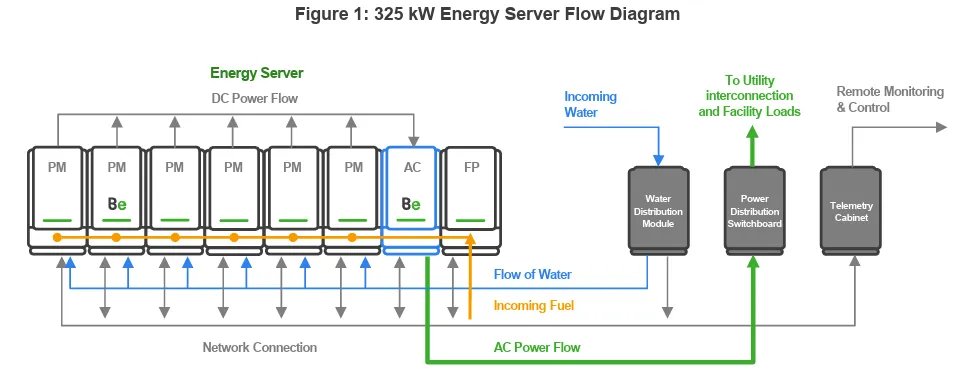
Air must also be moved, heated, and distributed. Cells are assembled into stacks and larger modules, with fuel and air delivered across them. Thermal management keeps the system within suitable operating conditions.
Finally, the electrical output must match the customer’s infrastructure. The standard Energy Server 6.5 needs net alternating-current output, meaning the complete commercial system includes power conversion and associated losses. Controls, protection, instrumentation, communications, and auxiliary equipment complete the package.
The distinction between cell, stack, and system performance is essential. A highly efficient laboratory cell does not establish the efficiency, availability, installation cost, or maintenance burden of a customer’s complete power system.
Efficiency
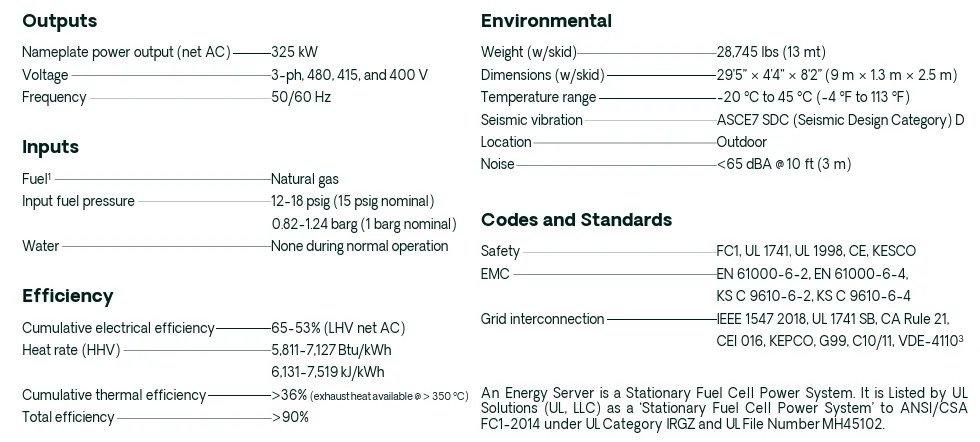
Bloom claims a cumulative electrical efficiency of 65-53% on a lower-heating value, net-AC basis. It also lists a HHV heat rate of 5,811-7,127 Btu per kilowatt-hour.
I think two distinctions matter.
First, electrical efficiency is not combined heat-and-power efficiency. Bloom claims a total efficiency above 90% when useful heat is recovered. That does not mean more than 90% of the fuel becomes electricity. It means electricity plus recoverable useful heat can account for that proportion under the stated configuration.
Second, lower heating value, or LHV, excludes the heat recoverable by condensing water vapor. Higher heating value, or HHV, includes it. The same system therefore displays a higher efficiency percentage on an LHV basis.
For the customer, heat rate is particularly useful because it connects directly to the gas cost: Fuel cost per kWh = Heat rate in MMBtu/kWh x Delivered gas price
If we assume a gas price of $5 per MMBtu, Bloom’s published heat-rate range implies fuel cost of approximately 2.9-3.6 cents per kWh.
Durability
Bloom states that replacement intervals have increased from less than two years to more than five years over the past decade, using a stated efficiency threshold to define useful life. These claims are encouraging, as they can use this to show that the products can last longer if customers accept the right service interval.
The annual report also reports approximately 99.9% fleet availability for non-redundant installations installed after 2020, with higher availability achievable through redundancy.
For shareholders, it is important that Bloom can have a high uptime with the right service intervals. If this continues, I expect the service revenues to further increase.
Data Centers
A data center needs more than just a lot of electricity. It needs voltage quality, rapid response, redundancy, maintenance access, and continuity.
Bloom can run continuously in grid-parallel configurations or as part of an islanded microgrid. “Islanded” means operating independently of the utility grid. The appropriate architecture depends on the site, customer requirements, fuel availability, and protection design.
AI workloads can change rapidly. Bloom’s technical discussion explains that ultracapacitors can supply or absorb immediate power changes while the fuel cells move to a new steady-state output. The fast response therefore belongs to an integrated system.
Ultracapacitors, batteries, and uninterruptible power supplies also solve different-duration problems. Demonstrating short-duration buffering does not prove that every site can eliminate longer-duration backup, black-start provisions, or independent supply routes.
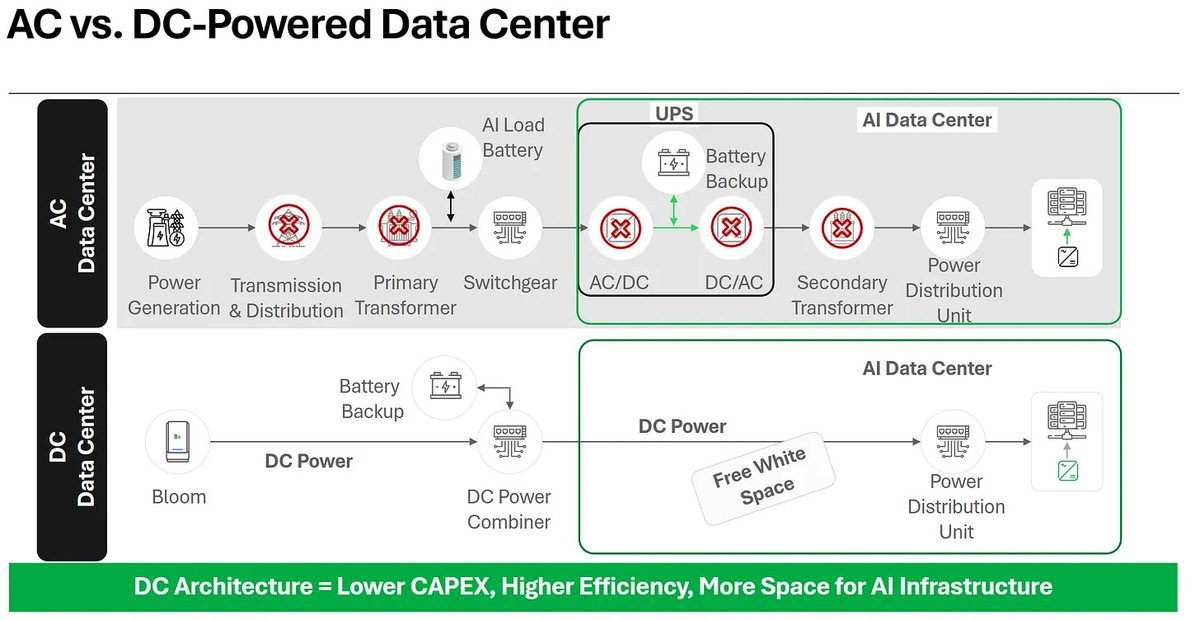
The emerging 800-volt DC architecture is interesting because Bloom already generates DC. Avoiding unnecessary DC-to-AC-to-DC conversions could reduce losses and equipment. Bloom has stated that shipments are 800 VDC-ready.
Competitive advantage
A strong competitive advantage is not only the lowest cost per kWh, but also the value of having reliable, usable power quickly.
Bloom’s April announcement states that its first fully operational Oracle system was delivered in 55 days, ahead of the anticipated 90-day schedule. The same announcement includes an Oracle executive describing the partnership’s role in meeting customer demand.
Sometimes alternatives remain an option. Utility supply is attractive when you have an available connection. Reciprocating gas engines may be seen as more flexible. Sometimes Gas turbines or combined-cycle plants, or renewables, may be more ideal.
My interpretation is that Bloom is particularly well positioned when deployment urgency, local emissions, modular expansion, and efficient continuous generation matter simultaneously.
Financial Thesis
The technology explains my conviction. But do the financials and valuation support it?
Continue reading my financial thesis and three valuation scenarios: https://kaizeninvestor1.substack.com/p/bloom-energy-report