The Art of Memory: How to Remember Everything Forever
文章目录
部分视频或图片暂未收录,已在正文保留提示;需要时可查看原文。查看原文 ↗
there is an old legend:
in the 5th century bc, the poet simonides was said to be hired to sing a poem in honor of the thessalian nobleman scopas, at his own banquet.
simonides did his job. however, in his poem, he devoted a passage to praising the 2 divine twins: castor and pollux.
insulted, scopas told simonides that he would pay him only half of the agreed fee, and that he should go get the rest from the twins.
angry, simonides stayed in the hall for the rest of the feast, and later that night, a messenger came in telling him that two young men were waiting outside to see him.
simonides walked out of the hall, and just behind him, the entire roof collapsed, crushing every guest inside.
all the bodies were mangled beyond recognition, so badly the families couldn’t tell whose body was whose.
as simonides came back, he was the only one who could identify them, as he perfectly remembered the seats.
he could name every one of the guests simply by recalling where each man was sitting.
this one night gave birth to one of the most studied subjects of the ancient world: the art of memory, also known as the method of loci, or the memory palace.
its core technique was connecting whatever you wanted to remember to familiar places, so that you could walk through them in your mind and instill them permanently in memory, the same way you walk through your house or neighbourhood.
and for nearly 2,000 years it was studied and used by the greatest minds of the west.
roman senators memorized entire speeches with it and spoke for hours in the senate without a single piece of paper.
medieval monks carried the whole of scripture in their heads, and walked through it to compose their sermons.
until at last it reached its peak with the renaissance memory masters, who turned the art into something far greater: a tool to create, visualize and memorize the future instead of the past.
one of the greatest memory masters of all time, giordano bruno, was burned at the stake, as his powers terrified the church more than any heresy.
the rabbit hole goes deep, and these last days I devoted myself to understanding the art completely.
my lab is buried in material: frances yates’ the art of memory, the rhetorica ad herennium, aquinas’ summa, bruno’s de umbris idearum, a printout of fludd’s memory theatre.
and finally: hours spent creating and deliberately walking through the palaces of my own creation.
a brass pendulum swinging through my hallway, next to napoleon paddling a tiny boat in my kitchen sink.
from the outside, it wouldn’t make any sense. but for me, every image sits exactly where it should be, and each one holds an idea I’ll never forget.
the beauty of building a memory palace is that only you know its rooms. it’s your inner sanctuary, where no one else can ever enter.
so let’s open the vault. in this article you’ll learn exactly what memory palaces are, what they can be used for beyond simply storing information & how to build one yourself using the step-by-step techniques of the greatest memory masters in history.
let’s get into it.
THE ART OF MEMORY: WHAT IT IS AND WHY IT WORKS
“memory, the treasury of all things.” — cicero, de oratore
but what is it at its core?
in the simplest, most practical terms, the art of memory is the art of connecting images and ideas to well-known physical locations you can walk through like the corridor of your own home.
instead of forcing yourself to memorize completely unfamiliar and unconnected pieces of information, you are connecting them into a whole, so that each one has its anchor attached to a familiar place.
as I said, this method was used by some of the greatest minds that ever stepped on this earth.
why?
because it is the most effective method discovered so far to instill information into your head.
YOUR BRAIN THINKS IN PLACES
and it comes straight from thousands of years of evolution.
our ancestors didn’t have a need to memorize definitions or the date of some skirmish battle in 1429.
they needed to memorize where the water was, which valley hid the predators, and the escape routes back to the shelter.
there are no longer saber-tooth tigers around the corner, but our brains are still working in the same exact way.
the hippocampus, the part of the brain responsible for memory, is literally built around cells that fire for places. and the brain holds images far better than words: in a 1973 experiment, people shown 10,000 pictures, each for just a few seconds, could still recognize over 80% of them days later.
modern students are spending hours reciting notes over and over again, but it’s pretty much like hitting your head against the wall.
you are forcing yourself to remember in a language your brain doesn’t speak, while all it takes is a gentle translation: turn the idea into an image, and give the image a place.
work with your brain, not against it.
THE 3 CORNERSTONES
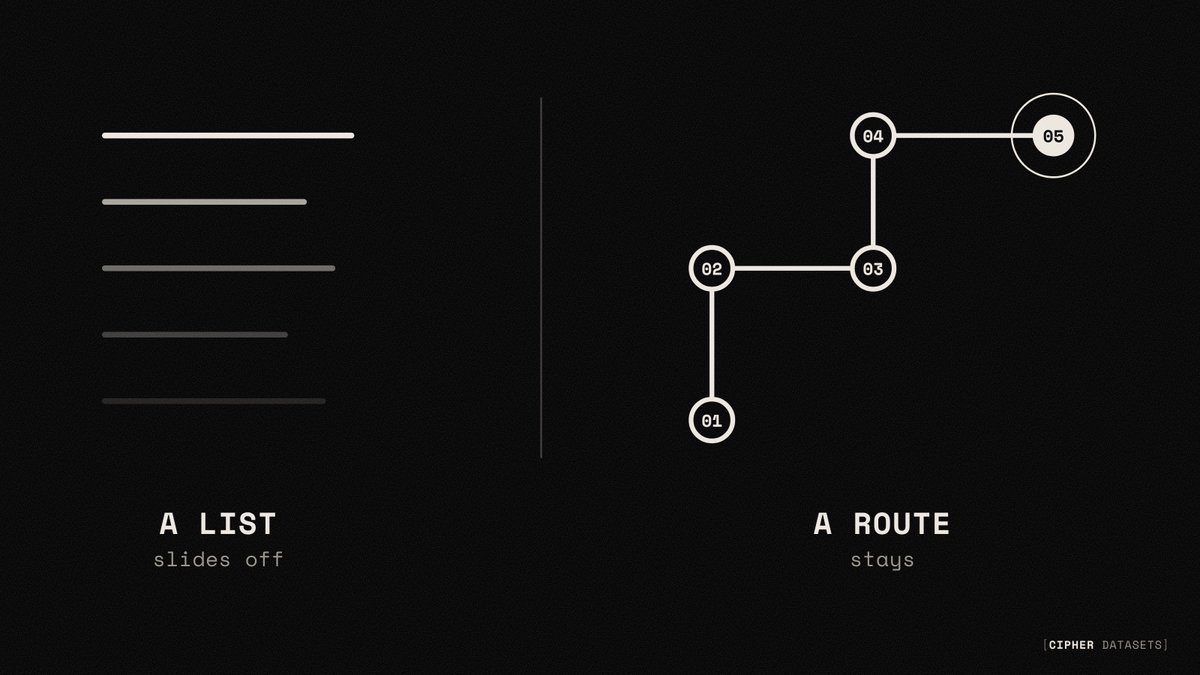
the entire art relies on 3 cornerstones:
-
places (loci): a building or route you know by heart. they hold the order.
-
images (imagines): one picture per thing to remember. they hold the content.
-
walking: moving through the route in your mind. that’s recall.
first, you pick the palace. in the beginning, it is advised to pick a place you are as familiar with as your own house. then you pick pitstops along the way, depending on how many items you want to memorize.
secondly, you want to transform the concepts you want to memorize into real, vivid images.
the oldest surviving manual of the art, the rhetorica ad herennium, gives the rule: the more absurd, the better. make each image either grotesquely ugly or exceptionally beautiful. bloodied, crowned, ridiculous. the ordinary slides off the mind, the extraordinary sticks. vivid beats abstract, every single time.
until at last, you place your images along the route, one at each pitstop.
the final product is a route you can walk with your eyes closed, at any time of the day, in any situation. you want to walk it as often as you can, first forwards, then backwards, preferably right before sleep.
now let’s put it to work.
THE VAULT: A PALACE TO STORE
“memory... not without reason called the treasure-house of eloquence.” — quintilian, institutio oratoria
THE DYSLEXIC CHAMPION
in 2002, in london, dominic o’brien memorized 2,808 cards from 54 shuffled decks, each card seen only once, and recited them back in order. a guinness world record.
later asked in an interview how he did it, he said he had no special abilities at all. he was dyslexic, dropped out of school at 16, and failed most of his exams. but at 30, he sat in front of the tv and watched a man memorize an entire deck of cards in under three minutes. he dug into how it was done, and simply taught himself the method.
so what was the method?
it was the exact same one simonides used 2,500 years ago to memorize the seats of the guests. o’brien turned every card into a person doing something, and placed them one by one along routes through places he knew by heart.
BUILD YOUR FIRST PALACE
the same method can be used to store any topic you want to memorize.
simply take the concept, however complex it might seem, and simplify it into a visual representation of it. (remember, the more absurd the better.)
say you want to memorize the 4 cardinal virtues: prudence, justice, fortitude and temperance.
-
at your front door stands an old man with three heads, one looking back down the street, one at you, one into the house. prudence.
-
in the hallway, a judge in blood-red robes holds a giant pair of scales, one pan scraping the floor. justice.
-
in the living room, a lion holds up the collapsing ceiling on its back. fortitude.
-
at the kitchen sink, a woman calmly pours water from one jug into another, not spilling a drop. temperance.
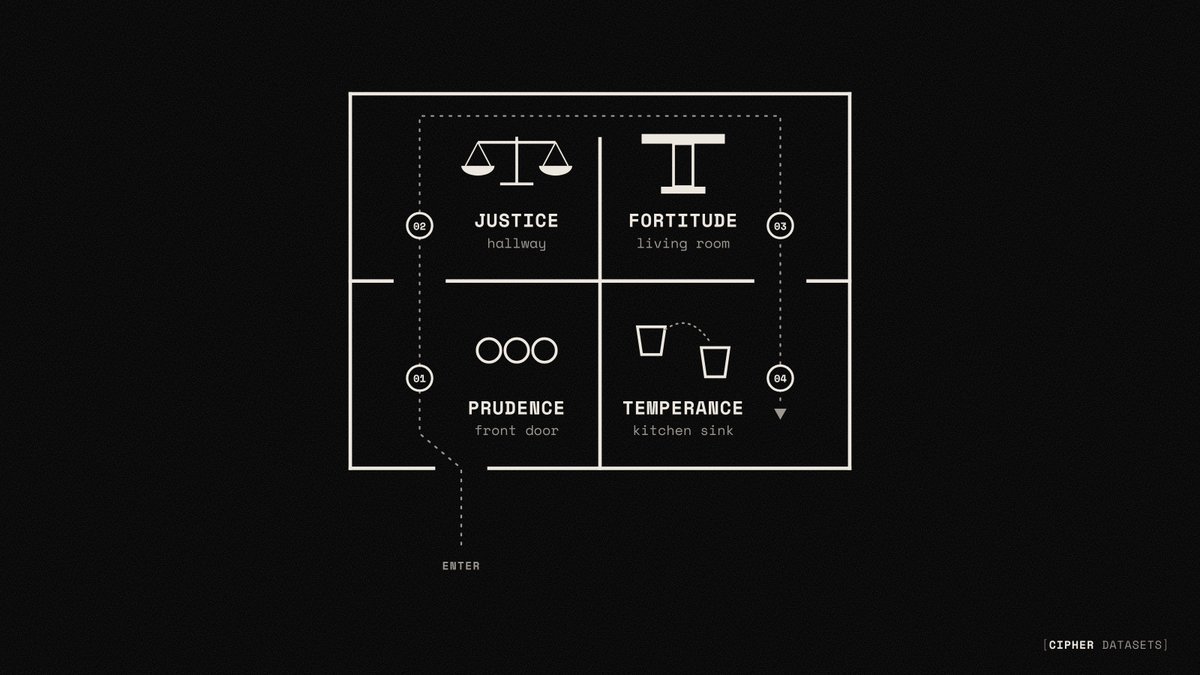
your palace can have as many pitstops as you have material to remember. just try to arrange it in order, so that one image somehow connects with the next.
this turns a list into a story, and your mind follows a story on its own.
the idea of the palace is simple: you don’t remember the list. you remember the walk, and the walk hands you the list.
as you have your palace ready, instead of cramming and repeating it for hours, you walk through it a couple of times, and simply go back to doing something else entirely so your subconscious can store what you’ve placed. after some time, walk through your palace again, and over again.
THE PYTHAGOREAN SANDWICH
when you need to memorize something as fast as possible, make sure to walk through it before sleep, as it is the most important moment for consolidation.
the pythagoreans built their entire day around this. in the mastery of learning, I called it the pythagorean sandwich:
-
bottom: night recall. before sleep, walk the palace one last time.
-
middle: sleep. throughout the night, the hippocampus replays what you touched last, burning it into long-term memory.
-
top: morning recall. iamblichus wrote that the pythagoreans wouldn’t rise from bed before recalling what they had learned the day before.
alright, this was the foundation, and the most mainstream use of the technique.
now you know how to build your first palace and store information quickly & easily, instead of mindlessly repeating your notes for hours.
but what if I told you that memory palaces were never meant to solely store information?
they were meant to mix their contents into new ideas. to hold the laws and the council of advisers that rule your character. and ultimately: to reach beyond the present and memorize FUTURE timelines.
this was the knowledge the most advanced renaissance masters came to after years of practice, and the most prominent of them all was burnt at the stake for it.
beyond the vault, you can build palaces that serve as workshops, throne rooms and war rooms for your mind.
we’ll go through 3 more palaces, and they’re about to get increasingly deeper.
FULL POST ONLY ON SUBSTACK // CIPHER DATASETS
沿着这个主题继续读
从一篇文章,找到相关的教程、经验和阅读路径。