The $PEARL Bear Case
The narrative is strong. The fundamentals aren’t.
I’ll just go ahead and say it. I don’t like Pearl. I am a $PEARL bear and will continue to be, even if it runs to $10B. The thing is, its fundamentals are just objectively bad, and I am a fundamental investor. If you are a PEARL holder solely for the narrative and the short term, I understand. If you hold it for the fundamentals, you are wrong. (And if you hate that I said that, don’t worry, we have a full Pearl research piece dropping soon).
But let me steelman the bull case before I give my bear case.
Pearl’s Proof of Useful Work is a genuinely innovative and novel security model. As it stands, Bitcoin mining burns electricity on hashes that serve no other purpose, while Pearl uses the matrix multiplications from AI training and inference to secure its blockchain. Also, Bitcoin’s block rewards most likely won’t cover rising mining costs, especially after the 2028 halving, which is why many miners are already switching to AI. But switching means giving up mining, since Bitcoin ASICs can’t run AI workloads. On Pearl, the same GPUs can serve AI customers and mine at the same time.
An AI provider can mine PEARL on the GPUs it already has, without building dedicated infrastructure, and the proposed FP8 upgrade aligns mining even more closely with modern AI workloads. AI revenue pays for the machines, and PEARL becomes extra income. That’s the best answer to the sell-pressure argument: a miner whose GPU is already paid for doesn’t have to dump coins to cover power.
On top of this, the team is stacked. It is built by Omri Weinstein (ex-Nvidia/Microsoft/Vast Data, Professor of CS at Hebrew University, and on leave from Columbia) and Ilan Komargodski (cryptographer at NTT Research and Professor of CS at Hebrew University). PEARL’s was also a fair launch (per the team) with no VC rounds, team allocation, or unlock cliff (though roughly a third of today’s circulating supply was mined in the first six days, and we don’t know how much of that went to the team).
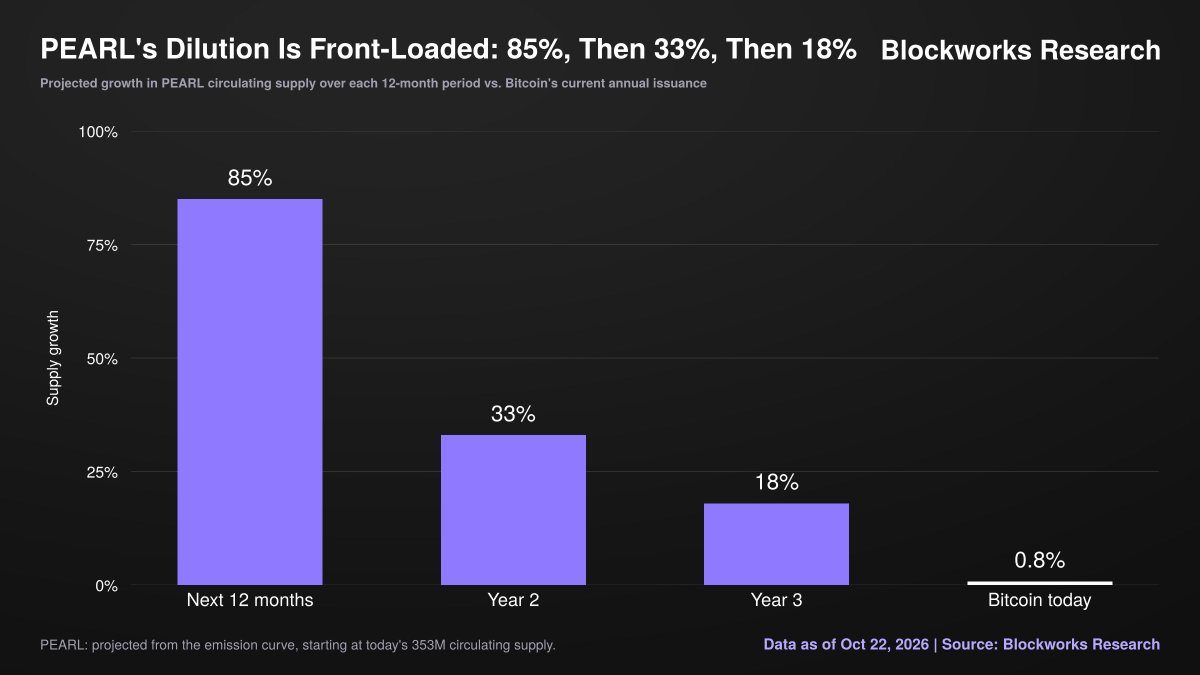
Then there’s the monetary premium case. Like BTC, PEARL has no cash flows, so its value comes from a monetary premium (what people will pay to hold a scarce, neutral, PoW-secured asset). PEARL has a 2.1B hard cap, and since AI customers cover much of miners’ costs, its security doesn’t have to shrink as issuance does. Dilution is also front-loaded (~85% this year, ~33% next year, and ~18% the year after), so the market is arguably pricing the worst year right now. And the momentum is continuously growing. Price is up ~8x from its ~$0.27 August low, weekly volume went from $2M to $3M in August to $51M last week, and Coinbase added PEARL to its listing roadmap on October 19.
Okay, let’s move on to the bear case.
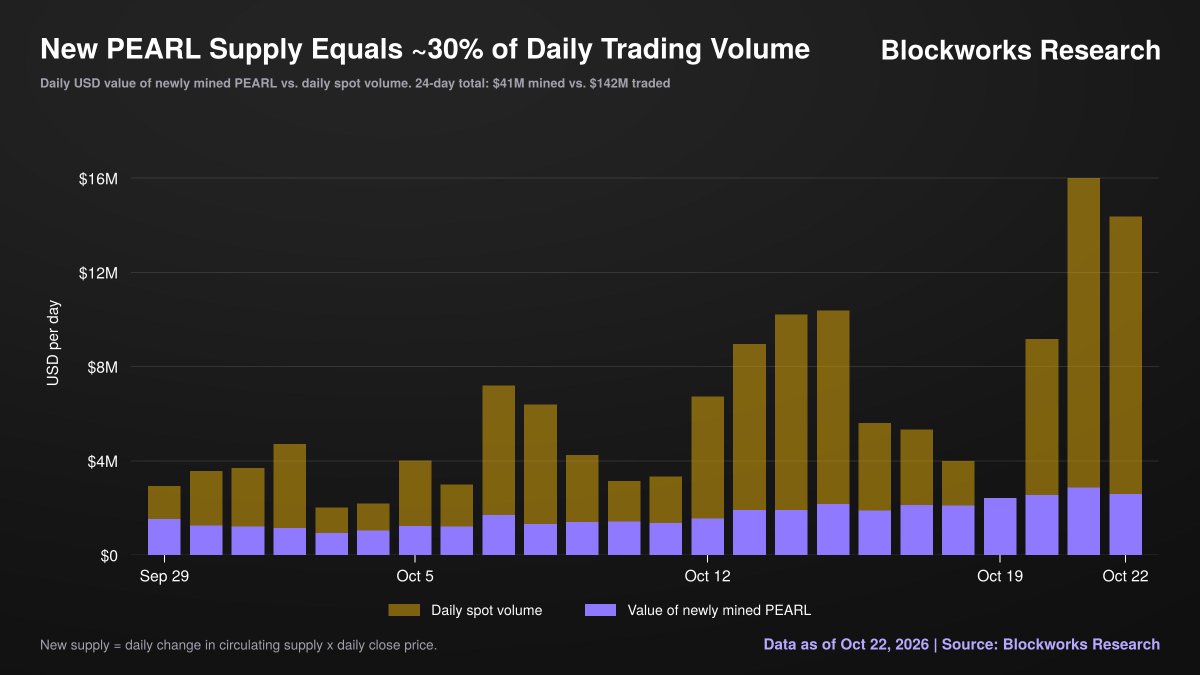
First, a monetary premium only works if the asset is actually scarce, and right now PEARL isn’t. BTC’s supply grows ~0.8% a year, while PEARL’s will grow ~85% over the next year. At $2.17, that’s ~$2.2M/day of new supply going to miners with GPUs and electricity bills to pay, against ~$8.5M of average daily volume. New coins alone are worth roughly 30% of daily trading. Over a year, that’s ~$654M of issuance against a ~$768M market cap, so the market has to find almost a full market cap of new buying just to hold the price.
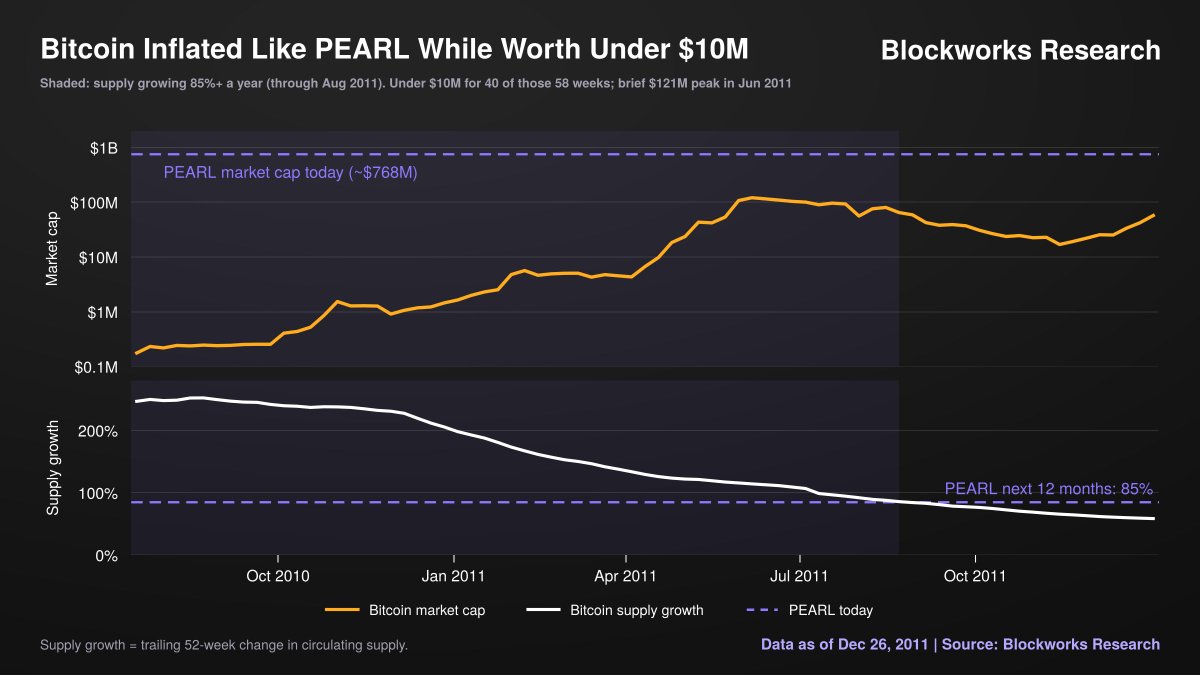
Inflation is the most common (and most valid) argument against PEARL, and the usual rebuttal is “Well, that’s the same as Bitcoin! It inflated that much in the early stages. Would you not have bought Bitcoin in 2011?” Sure, but the Bitcoin trade worked because nobody knew how to price it. When Bitcoin’s supply grew at PEARL’s inflation rate in 2010 and 2011, it was worth a few million dollars. PEARL is doing it at a ~$768M market cap and a ~$4.6B FDV, 6 months in. Markets price new crypto way faster now, so the mispricing that made early BTC a great trade is already gone.
Second, AI customers pay for inference in USD, not PEARL, so the useful work doesn’t create demand for the token. Bulls will say Bitcoin has no token sink either, and that Together AI’s 25% inference discount shows the subsidy reaching real users. But that discount is paid for by selling PEARL. Miners mine, sell the token, and pass the dollars on to inference buyers. That’s a subsidy flowing out of the token, not demand flowing in. Until inference is actually priced or settled in PEARL, more usage means more sell pressure, not more buying. And since Pearl Research Labs earns from selling inference in USD, the company can do fine even if the token doesn’t. That also means there’s no moat yet, since anyone can fork Bitcoin and swap in their own proof of useful work, and customers would still pay in USD.
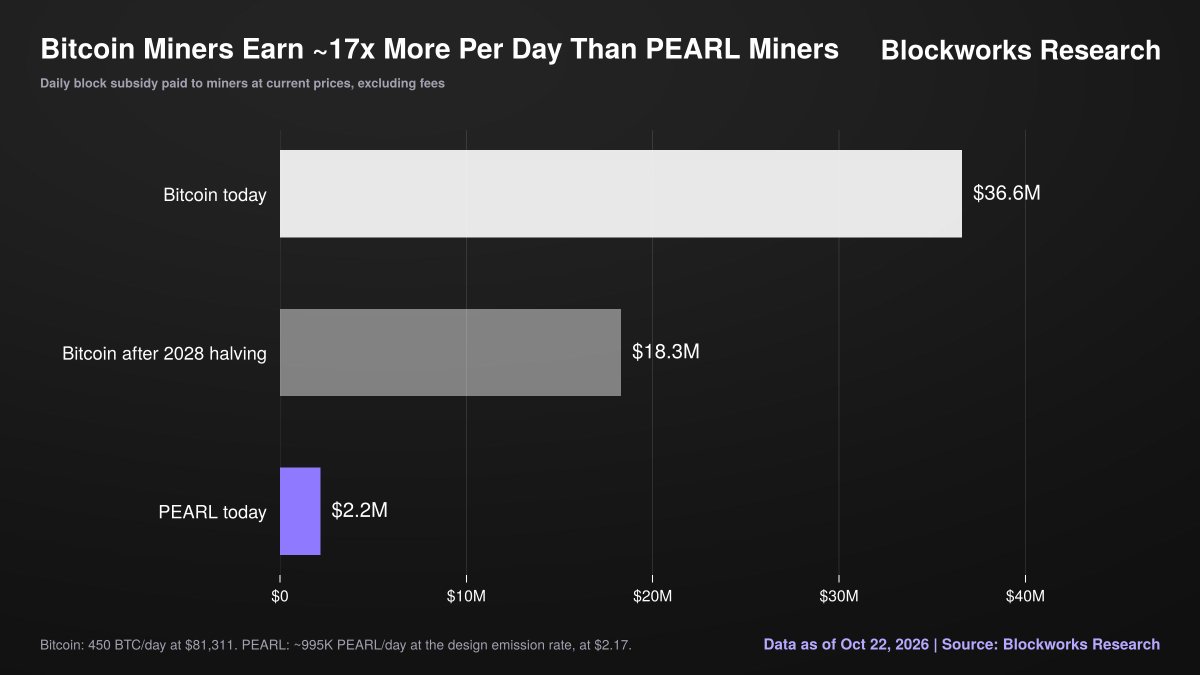
Third, even if Pearl ends up with “more hashrate than Bitcoin,” that doesn’t make it more secure. Almost every Bitcoin-capable ASIC in the world already mines Bitcoin, so an attacker would have to build or buy a fleet that loses its value the moment the attack works. Pearl runs on the same datacenter GPUs the AI industry uses, so there are far more GPUs available to rent than there are mining PEARL. That is the exact setup behind the 51% attacks on Ethereum Classic, Bitcoin Gold, and Vertcoin between 2018 and 2020, which were all small chains whose hardware could be rented away from something much bigger. Also, Bitcoin miners earn ~$36.6M/day from the subsidy alone, while PEARL miners earn ~$2.2M/day. PEARL’s price would need to rise ~17x just to match Bitcoin’s security budget, and that bar rises as emissions per block fall.
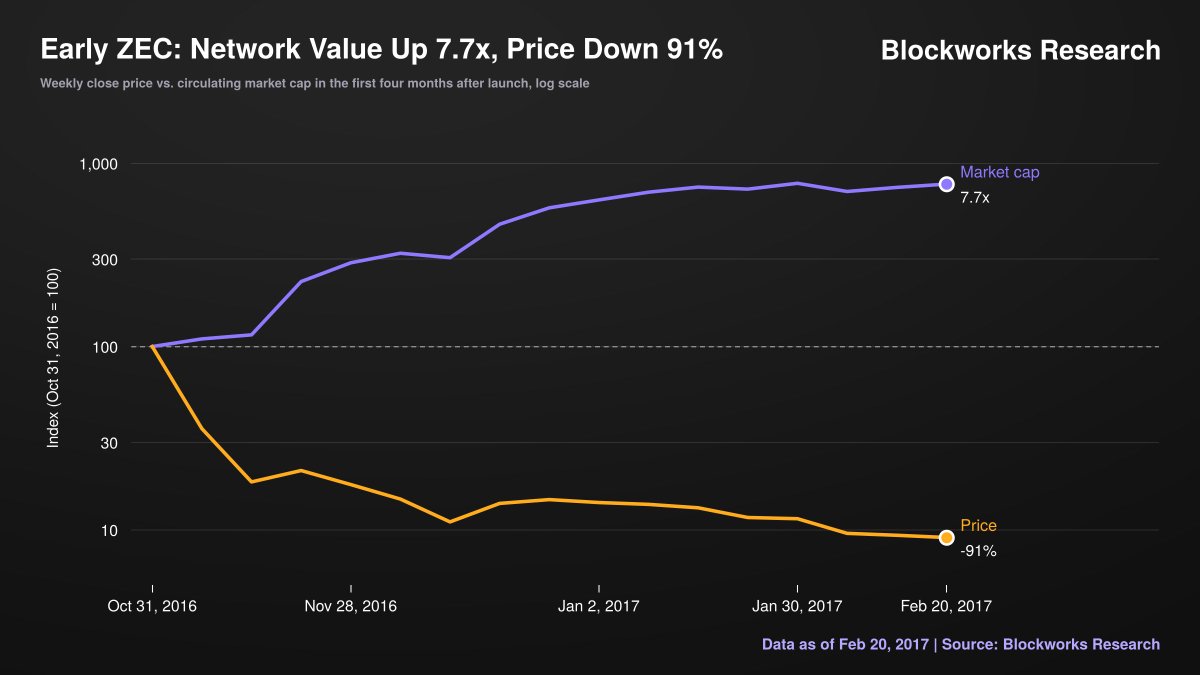
Fourth, early Zcash shows how this ends, even if it’s not where PEARL is today. From October 31, 2016 to February 20, 2017, ZEC’s price fell 91% (from $328 to $29.80) while its market cap grew from ~$2.9M to ~$22M. The network grew about 8x, but supply grew about 84x, so holders still got rekt. I’m sure they had the same “but BTC had high inflation” arguments too.
Even with all of these flaws in fundamentals, unfortunately the crypto market still generally prices tokens on narratives rather than fundamentals (though this is starting to change). So, since I’m mid-curving, the token can still run, but it will be running with me screaming on the sidelines about its poor fundamentals.
--
This article was published in @blockworksres daily 0xResearch newsletter. You may subscribe and read it here: https://blockworks-research.beehiiv.com/p/the-pearl-bear-case.