All Roads Lead to Nautilus Biotechnology
The entire AI<>Biology revolutions hinges on a single $240M company: $NAUT.
The intersection of AI and Biology will drive some of the largest stock-market returns of the next few decades. And that intersection runs through the proteomic data layer, which only Nautilus can currently read at proteoform resolution.
I believe Nautilus Biotechnology is worth several billion dollars today, despite the fact that the company is still pre-commercial. The reason is not that proteomics is a large market, or that Voyager is simply a better laboratory instrument.
It is that Nautilus is beginning to expose a layer of biological information that AI has never had access to at meaningful scale: the exact molecular state of proteins inside the human body.
This matters because disease does not happen at the DNA level. DNA provides the instructions, but proteins are the machinery that actually runs the body. They form receptors, enzymes, antibodies, ion channels, structural scaffolds and signaling systems.
And the same underlying protein can behave very differently depending on which chemical modifications are attached to it, where those modifications sit, and which combinations coexist on the same molecule.
Those distinct functional states are called proteoforms.
If genomics tells us what the body could build, the proteome tells us what it has actually built and what those machines are doing right now. That makes proteomic state one of the closest digital representations we can obtain of real biological function.
The problem is that our current tools throw away much of this information before they ever read it.
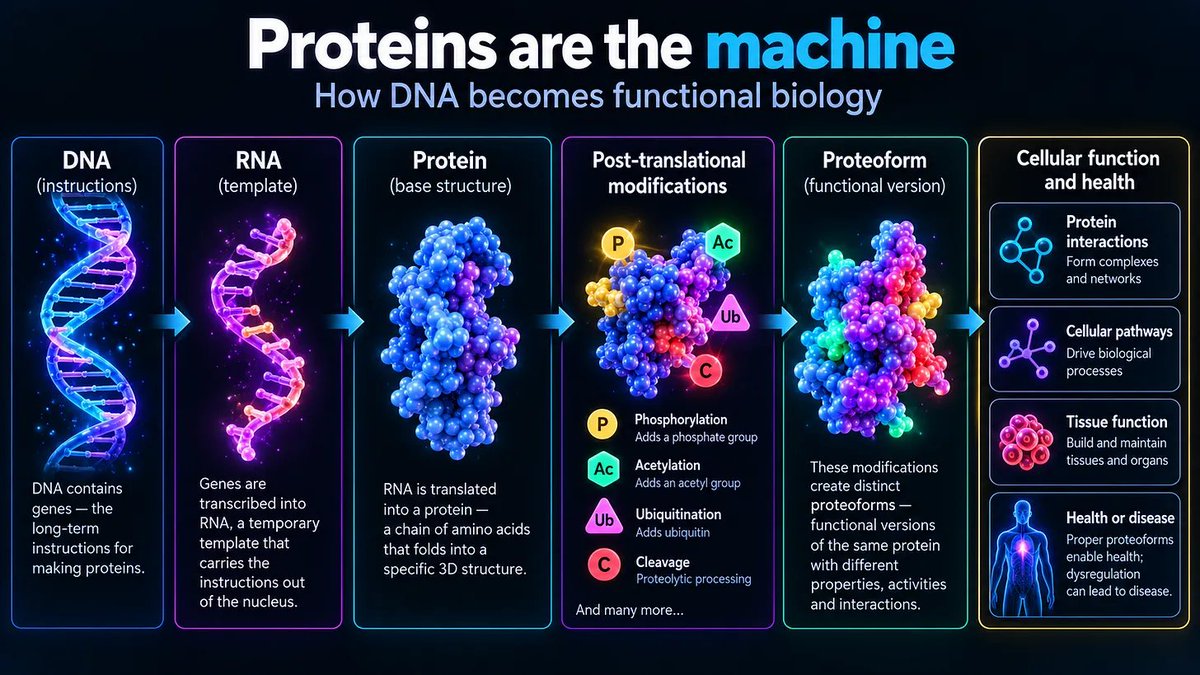
DNA contains the long-term instructions for building the machinery of life. Those instructions are transcribed into RNA, which is then translated into proteins. But even that description is still too simple, because the protein that first comes off the ribosome is not necessarily the protein that ultimately performs the biological function.
After translation, proteins are modified. Phosphate groups are added. Acetyl groups are attached. Proteins are cleaved, ubiquitinated and chemically altered in many other ways. Each of those changes can alter the protein’s shape, charge, stability, binding affinity and behavior.
That means one protein sequence can produce many different functional versions of itself, and those functional versions can participate in completely different cellular states.
This is why proteoforms matter so much. A proteoform is not merely a protein with decoration added on top. It is the actual working version of that protein inside the cell. Two molecules with the same amino-acid sequence can behave as two different machines if they carry different combinations of modifications.
To illustrate, consider how tau stabilises the neuronal railway.
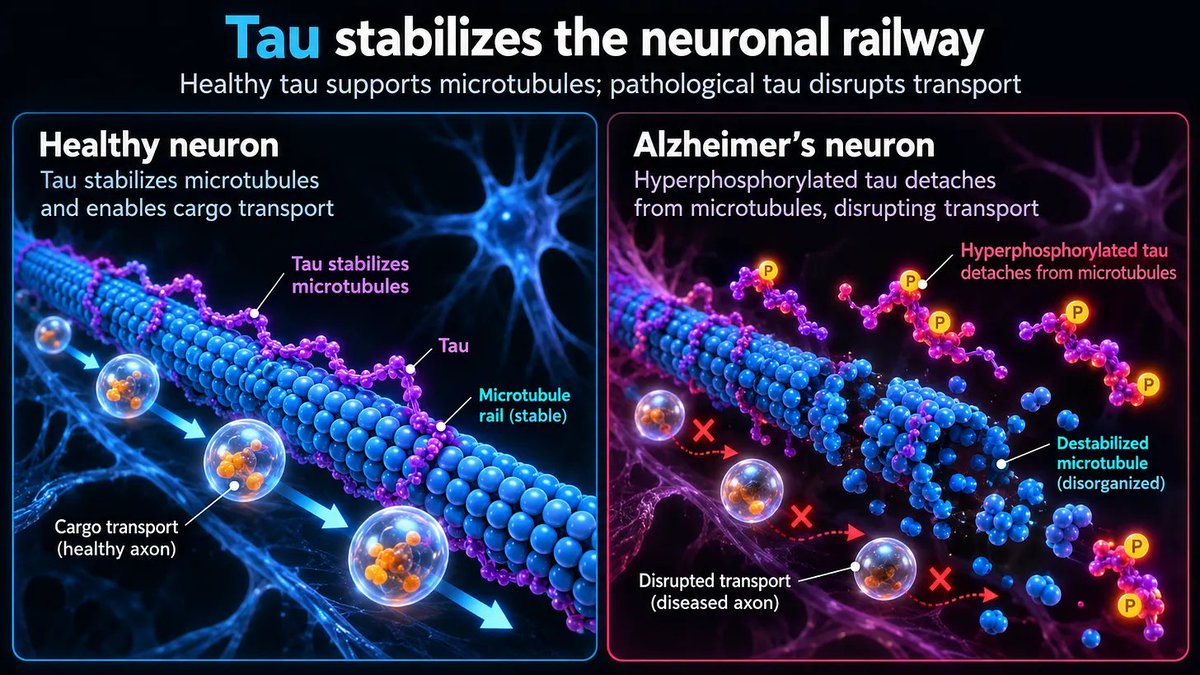
Tau is a perfect example because its normal function is remarkably physical. Neurons are extremely long cells and rely on microtubules as internal transport rails. These microtubules allow essential cargo to move through the axon over long distances, which is critical for neuronal survival and function.
Tau binds along these microtubules and helps stabilise them. You can think of tau as part of the support system that keeps the railway intact.
When tau is functioning normally, the microtubule architecture remains stable and intracellular cargo can move efficiently through the neuron.
In Alzheimer’s disease, this system begins to break down. Tau becomes abnormally phosphorylated, its affinity for microtubules changes, and tau can detach from the structures it is supposed to stabilize. As microtubules become less stable, neuronal transport deteriorates.
Eventually, pathological tau can aggregate into the neurofibrillary tangles that are one of the defining features of Alzheimer’s.
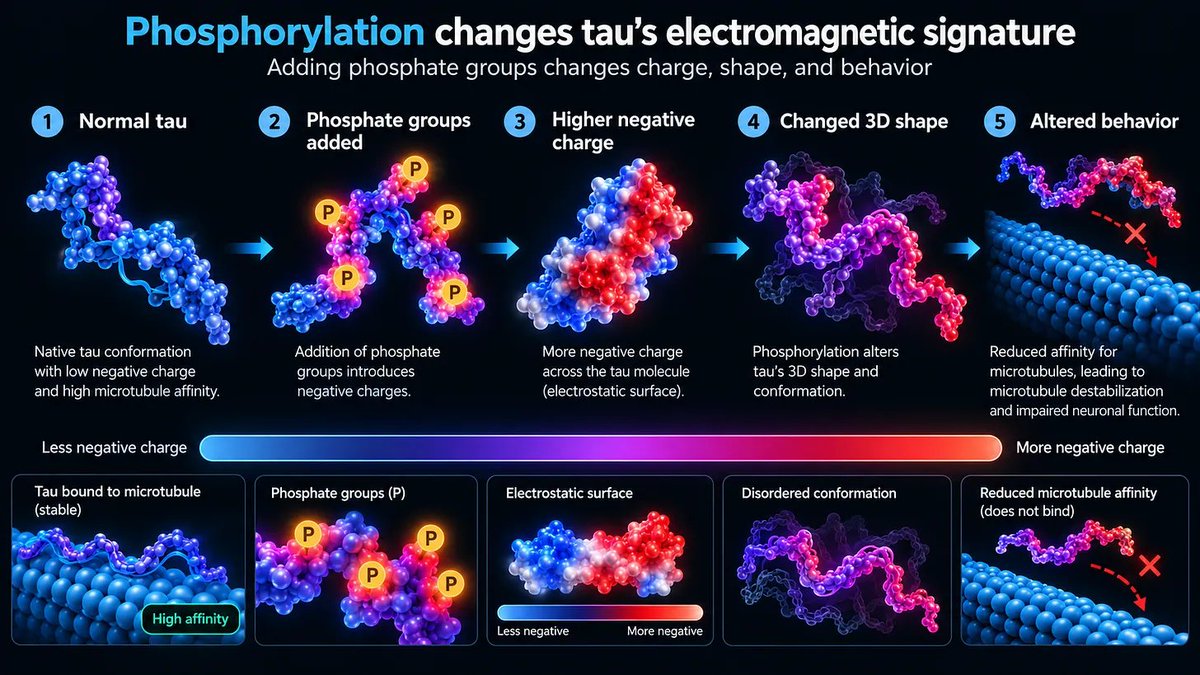
The important point is that the disease process is not simply “tau exists” or even “tau is phosphorylated.” The disease process emerges from the precise physical state of tau and the way that state changes how the molecule behaves.
On a first principles, the body is essentially one enormous electromagnetic LEGO puzzle. Proteins do not “know” what to bind to. They interact because their surfaces have compatible shapes, charge distributions and chemical properties.
One molecule presents a particular three-dimensional contour and electromagnetic field; another presents the complementary configuration. When those two configurations line up closely enough, they bind.
Receptors bind ligands, antibodies bind antigens, enzymes bind substrates and structural proteins bind one another through different versions of the same underlying physical logic.
This is why changing shape changes function. Modify a protein’s charge distribution and you can change the way it folds; change the fold and you change the surface it presents to the rest of the cell; change that surface and you change what it can bind to, how strongly it binds and what downstream machinery it affects.
In tau, phosphorylation adds negative charge, which changes the molecule’s electromagnetic configuration and therefore its shape and binding behavior. That changes how tau interacts with microtubules.
Once that interaction changes enough, the structure of the neuronal railway changes with it.
This is where the Nautilus tau paper becomes extremely interesting.
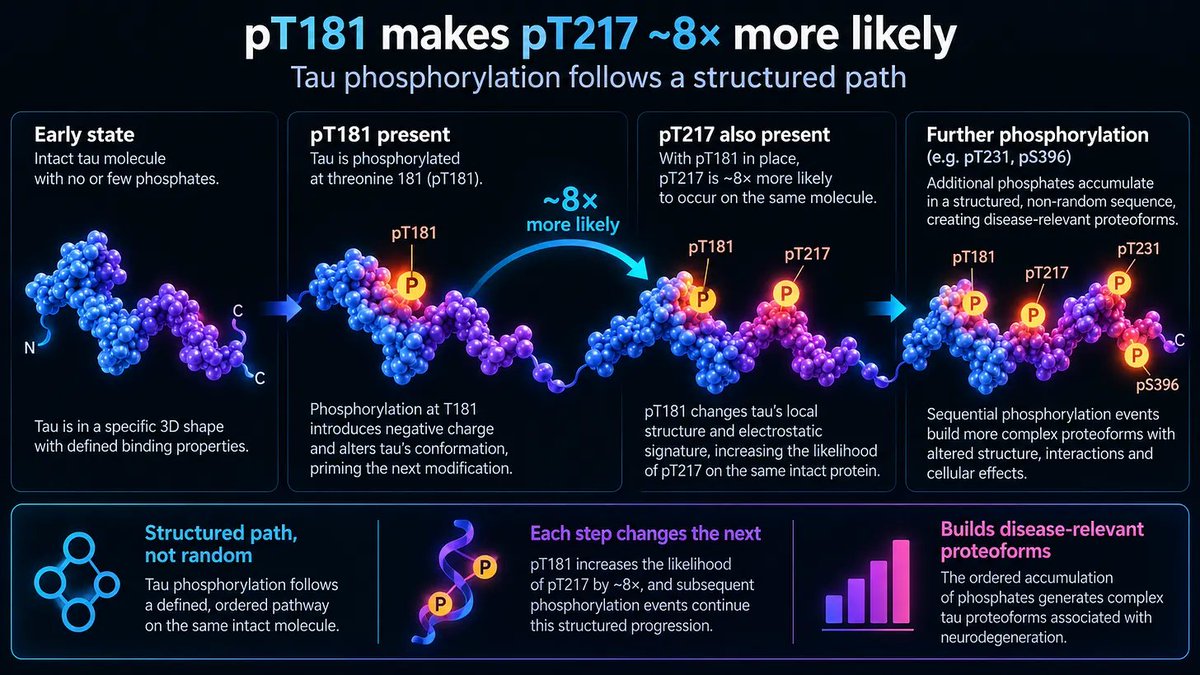
Researchers already knew that pT181 and pT217 are important Alzheimer’s biomarkers. What Nautilus adds is the ability to ask whether those modifications coexist on the same intact molecule, rather than simply measuring their abundance somewhere in a sample.
The answer was striking. When pT181 was present, pT217 became roughly eight times more likely to appear on the same tau molecule. Other phosphorylation sites also showed non-random relationships.
In other words, phosphorylation was not appearing as a cloud of independent errors. Tau seemed to occupy a constrained set of molecular states, with some states making subsequent states far more likely.
That is a completely different way to think about neurodegeneration. Instead of viewing Alzheimer’s as a disease in which “tau becomes abnormal,” we can begin to imagine tau moving through a structured state space.
Healthy tau occupies one region. Intermediate proteoforms occupy another. Pathological proteoforms occupy another.
If those transitions are ordered and reproducible, then the problem becomes increasingly computational: identify which transitions matter, determine what pushes the molecule through them, and find the intervention that redirects the system before it reaches the pathological state.
This is the deeper implication of the paper.
The conventional framing is effectively that Alzheimer’s patients have abnormal tau. But that is an extremely low-resolution description. It would be like trying to debug software knowing only that some bits inside the computer have become corrupted.
What you actually want to know is which bits changed, in what order, which changes tend to follow others and which transition marks the point where the system begins to fail.
Tau now starts to look much more like this. Rather than occupying every theoretically possible proteoform configuration, the molecule appears to move through a much smaller set of biologically relevant states.
That suggests the cell is not producing random modification noise. It is moving tau through preferred molecular trajectories.
If disease emerges from a specific trajectory through that state space, then preventing disease becomes conceptually simpler. You do not necessarily need to remove all tau. You need to prevent the system from crossing the transition that pushes tau into the pathological regime.
That reframes Alzheimer’s as a control problem.
The question becomes: what molecular intervention changes the trajectory?
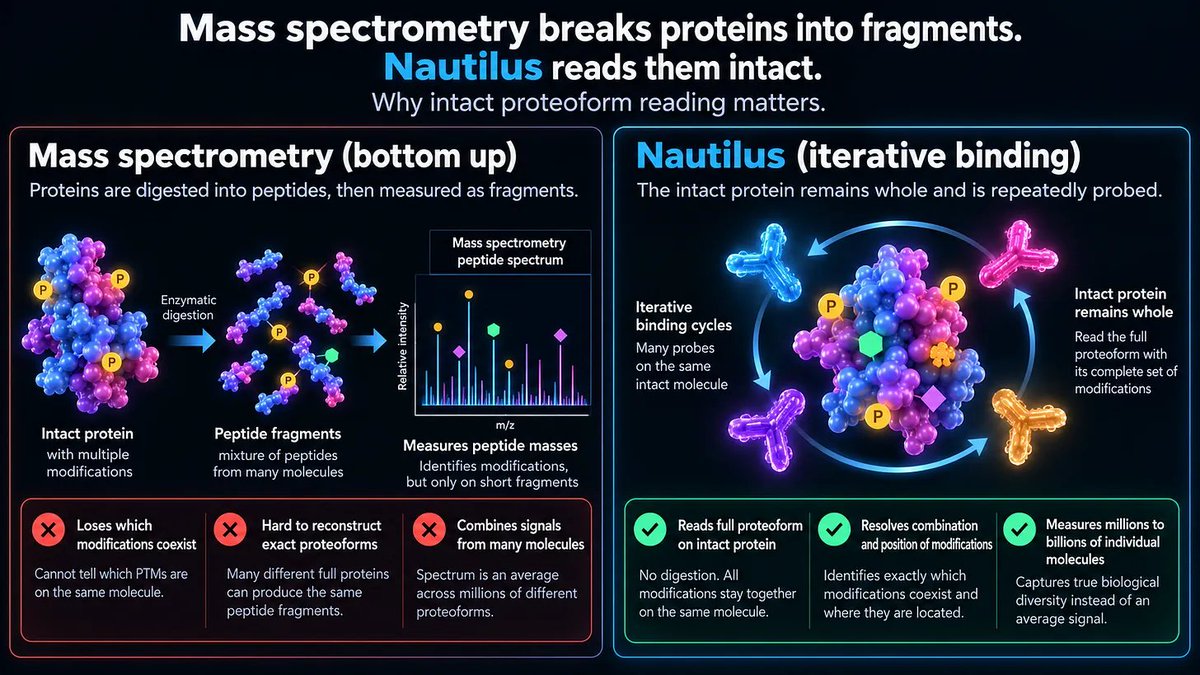
Mass spectrometry remains one of the most powerful tools in biology, but conventional bottom-up proteomics introduces a fundamental limitation for this specific problem: the protein is digested into peptides before it is read.
You can measure an enormous amount of information about those fragments, including many post-translational modifications, but you have partially destroyed the original combinatorial object.
If one region of a tau molecule carries pT181 and another region carries pT217, digestion may place those modifications on separate peptides.
You can establish that both existed somewhere in the sample, but reconstructing whether they originally belonged to the same molecule becomes difficult or impossible in many cases.
That is precisely the information Nautilus preserves. Its Iterative Mapping architecture keeps the protein intact and repeatedly probes the same molecule, allowing multiple features to be resolved as one proteoform rather than as disconnected fragments.
That is precisely the information Nautilus preserves. Its Iterative Mapping architecture keeps the protein intact and repeatedly probes the same molecule, allowing multiple features to be resolved as one proteoform rather than as disconnected fragments.
This distinction sounds subtle until you realise that the proteoform is the biological state. Knowing the ingredients is not the same as knowing how they were assembled.
Traditional measurements often tell you that a protein is abundant, or that a modification exists somewhere in a sample. Nautilus can increasingly tell you which modifications coexist on the same molecule and how frequently those exact molecular configurations appear.
That changes the data from something like:
pT181 = high pT217 = high
into something more like:
proteoform A = 12% proteoform B = 4% proteoform C = 0.8%
Once you can represent proteomic state at this level, the long-term implication is much larger than Alzheimer’s. You can begin generating the type of dataset required for predictive biology. Imagine reading a patient’s proteomic state before treatment.
That gives you an initial state. You then administer a drug, antibody, peptide, gene therapy or combination of interventions and read the proteome again. That gives you a final state.
Every experiment becomes a training example:
initial biological state + intervention → resulting biological state
Repeating this across enough patients, diseases, genotypes, drugs, doses and time points creates gigantic database of biological state transitions. AI no longer has to learn from broad labels like “responded” or “did not respond.”
It can learn how specific molecular configurations move through state space in response to specific interventions.
At sufficient scale, the question changes from:
Does this drug tend to work in Alzheimer’s?
to:
Given this exact proteomic configuration, which intervention is most likely to move this patient toward the desired molecular state?
That is the proteomic equivalent of finding the correct key for a specific lock.
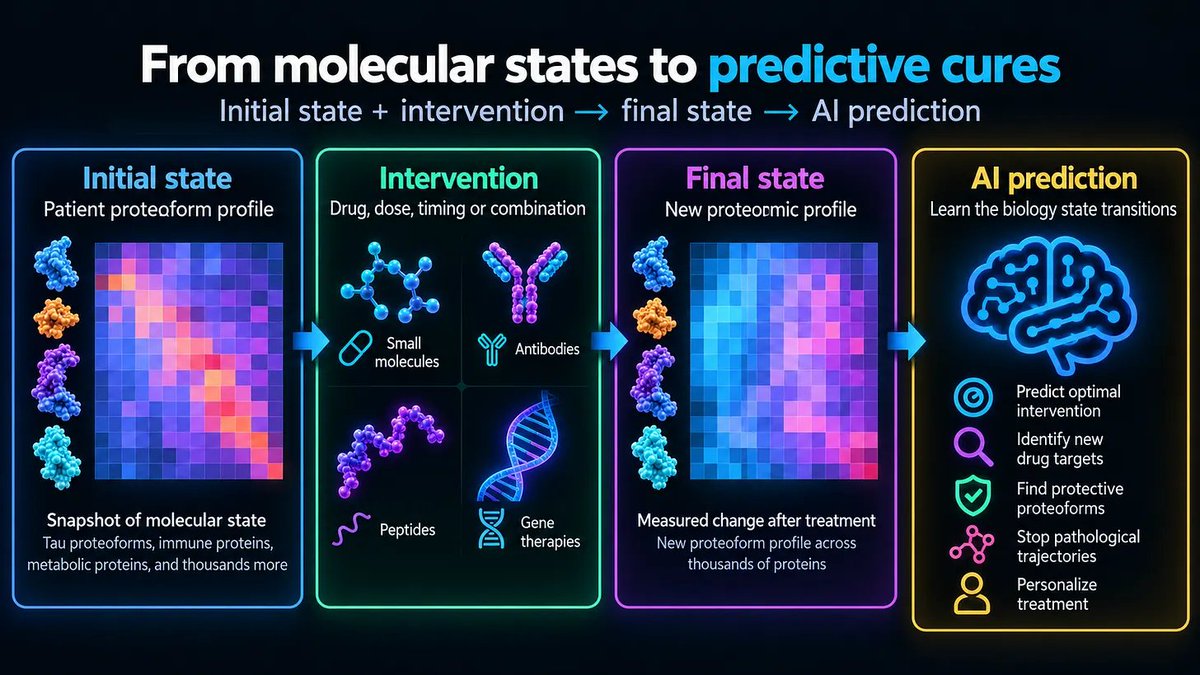
Large models become useful when they are trained on enormous numbers of relationships between inputs and outputs. In biology, the highest-value version of that dataset would be a record of state transitions.
You could imagine millions of examples like:
state A + drug X → state Bstate A + drug Y → state Cstate D + antibody Z → state Estate F + peptide Q → state G
Every row becomes a biological key:value pair. Once the model has enough of those examples, it can begin inferring which interventions are likely to move an unseen patient from their current molecular state into a healthier one.
That is when medicine stops being purely trial and error and starts becoming an optimisation problem, which is where AI excels.
Now expand the same idea beyond tau, which we may argue is in fact an emerging feature of lower level dysfunction and perhaps only concerns microtubules - a single building block out of many in neurology.
Further, neurology itself is arguably an emergent feature of other systems required to support the brain in the first place, like the immune system for example.
The brain does not exist as an isolated machine. Its function depends on immune signaling, vascular integrity, metabolism, mitochondrial output, liver function, endocrine balance and countless other systems that continuously shape the environment in which neurons operate.
A pathological tau state may therefore be the visible output of dysfunction that began much further upstream.
If the immune system is chronically dysregulated, if metabolic signaling is impaired, if vascular delivery deteriorates, or if protein clearance mechanisms fail, the resulting pressure can eventually manifest inside the neuron as altered proteoform states.
This is why the real opportunity is not simply to map tau. It is to map the proteomic state of the entire body and learn how these systems interact over time. In that framework, tau becomes one node in a much larger biological graph.
mmune proteins, metabolic enzymes, signaling molecules, structural proteins and disease-related proteoforms all become part of the same state representation.
The end state is a full-body proteomic digital twin: a high-dimensional map of the functional state of every major protein system in the body at a given moment.
Not just the genome, which tells us what the body could build. Not just RNA, which tells us what the cell is trying to express.
And not just a handful of biomarkers, which give us isolated snapshots. The objective is to reconstruct enough of the actual protein-state landscape that AI can model how one system pushes another into dysfunction.
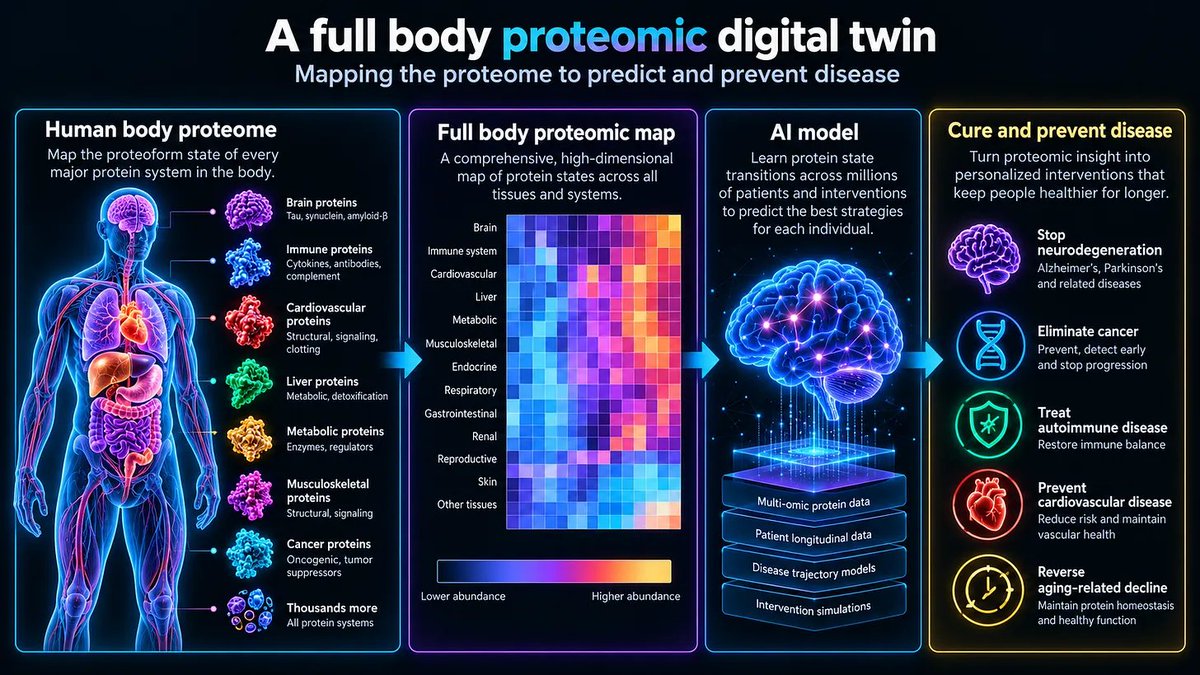
Once that exists, medicine becomes far more causal. Instead of seeing Alzheimer’s as a brain disease, we can ask which combination of immune, metabolic, vascular and neuronal states is pushing a given patient toward neurodegeneration.
Instead of treating cancer as a single tumor state, we can model the broader proteomic environment that allows that tumor to survive. Instead of classifying autoimmune disease by symptoms, we can identify the molecular state transitions that drive immune misfiring in the first place.
At that point, the digital twin becomes the substrate for intervention. The AI sees the current proteomic configuration, predicts how different interventions will reshape that state, and searches for the path that moves the system back toward health.
Tau is then just one early example of a much larger principle: disease is what emerges when enough protein states move into the wrong configuration, and the cure is to identify the sequence of changes required to move them back.
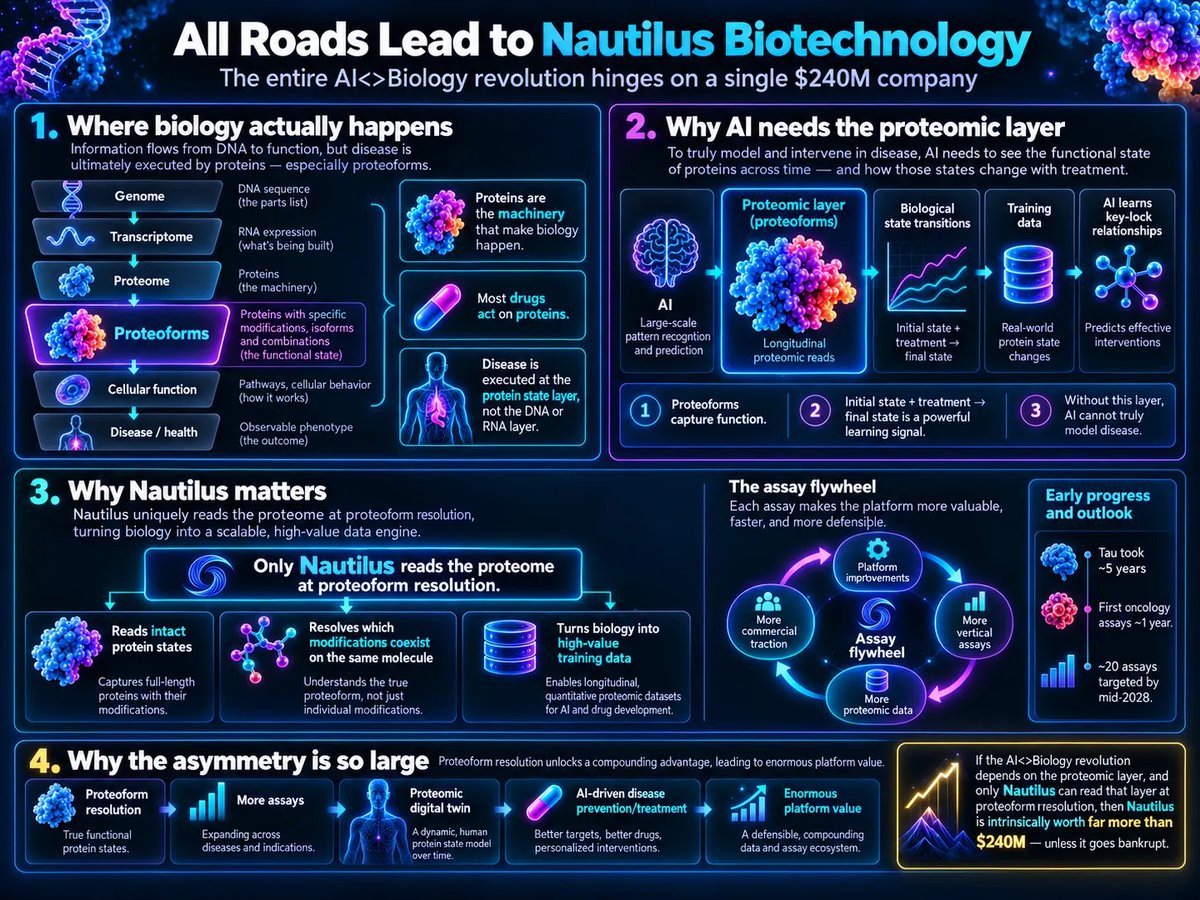
Nautilus matters because it sits at the point where biology becomes legible to AI. DNA tells us what could be built. RNA tells us what is being expressed. But proteins and more specifically proteoforms are where function actually happens.
They are the machinery that binds, signals, structures, transports and ultimately produces health or disease.
If AI is going to do more than correlate outcomes and instead learn how to prevent or reverse disease, it needs access to this functional layer in a form that preserves the true molecular state.
That is what makes Nautilus unique. It is currently the only platform able to read the proteome at proteoform resolution at scale, preserving which modifications coexist on the same intact protein rather than reducing biology to disconnected fragments or bulk averages.
This turns the proteome into a structured state representation that can be read repeatedly across time, treatment and disease progression.
The second piece is that this capability is becoming more scalable. As I discussed in my recent update, Nautilus is no longer building every assay as a bespoke five-year science project. The first tau proteoform assay took roughly five years. T
he first oncology assays reached the same technical bar in about a year, and management is now targeting a much faster cadence with roughly 20 vertical proteoform assays by mid-2028.
That is the beginning of a flywheel: more assays create more proteomic data, more data improves the platform, the platform supports more commercial use, and that capital and learning accelerate the next wave of assays.
This is why I think the entire AI<>Biology revolution ultimately converges on the proteomic layer. AI can already reason over genomes, imaging, clinical records and transcriptomics, but none of those directly capture the full functional state of the biological machinery.
Most drugs act on proteins. Disease is executed through proteins. The effect of an intervention is ultimately expressed as a change in protein state.
Without longitudinal proteoform data, AI is still missing the layer that connects
initial state + intervention → final biological state.
Once that layer becomes readable, the economics change dramatically. Each additional assay expands the fraction of human biology Nautilus can map. Each longitudinal read creates another training example.
Each new disease vertical increases the addressable state space. Eventually, the platform is no longer just selling proteomics instruments: it is generating the data substrate required for predictive biology.
That is why all roads lead back to Nautilus Biotechnology. If the AI<>Biology revolution depends on learning how to move the human body from diseased molecular states into healthy ones, then the company that can read those states at proteoform resolution sits at the center of the stack.
And at a market cap of roughly $240M, the asymmetry is extreme. There is obvious financing and execution risk, and bankruptcy would break the thesis.
But if Nautilus survives long enough to keep compounding assay coverage, the intrinsic value of owning the read layer for the proteomic economy should be dramatically higher than where the company trades today.
Disclosure
These are opinions only of the individual author. The contents of this piece do not contain investment advice and the information provided is for educational purposes only and no discussions constitute an offer to sell or the solicitation of an offer to buy any securities of any company. All content is purely subjective and you should do your own due diligence.
Antonio Linares makes no representation, warranty or undertaking, express or implied, as to the accuracy, reliability, completeness or reasonableness of the information contained in the piece. Any assumptions, opinions and estimates expressed in the piece constitute judgments of the author as of the date thereof and are subject to change without notice. Any projections contained in the Information are based on a number of assumptions as to market conditions and there can be no guarantee that any projected outcomes will be achieved. Antonio Linares does not accept any liability for any direct, consequential or other loss arising from reliance on the contents of this presentation. Antonio Linares is not acting as your financial, legal, accounting, tax or other adviser or in any fiduciary capacity.