Dear SEC: Nobody made you do this
We made it to mid-October. Miami is No. 1 in the AP poll. BYU is No. 2. Texas Tech and Utah are in the top 10.
After everything that has happened to the Big 12 over the last couple of gray-hair-producing decades, I hope its fans take a minute to enjoy that.
BYU beating Notre Dame on Saturday night was a big deal for a conference that has spent most of my career explaining why it still deserves a seat at the table. The Cougars gave the Big 12 a win it can point to when the conversation inevitably turns back to who belongs here in a couple of months.
The Big 12 has half of the country's six remaining unbeaten teams. There is good football being played in this league, and I think this is as strong as the conference has been in a really long time.
That brings me to something I have very little patience for right now.
All of the bitching about how hard it is to win in the SEC.
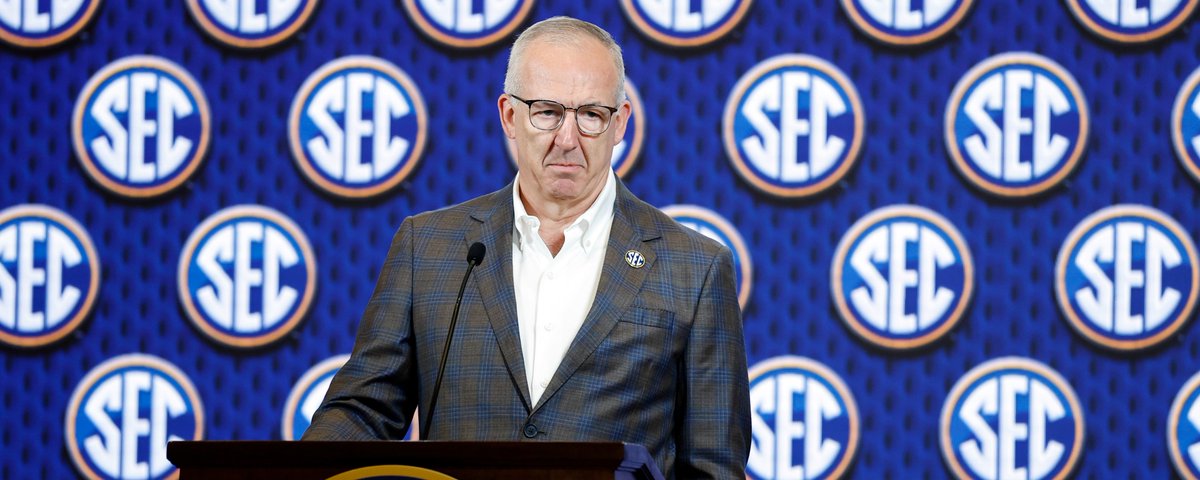
Dear Greg Sankey, SEC presidents and shills across our great country:
Nobody made you do this.
It started when the SEC took Texas A&M and Missouri out of the Big 12 in 2012. Then it came back for Texas and Oklahoma. The league wanted more brands, money and power.
The SEC got all of those things, and now it is harvesting the consequences.
College football's power brokers have spent years making the sport more like the NFL. These are the same people who for decades told us that a playoff would ruin the regular season because we had to protect the precious bowl system.
They built giant leagues, destroyed regional rivalries and made most of those very bowl games irrelevant.
Now we are expanding the postseason again - this time to 24 teams. Fine. But if you want an NFL structure, you eventually have to accept NFL outcomes.
Example: The 2021 Los Angeles Rams went 12-5 in the regular season and won the Super Bowl. Nobody asked them to apologize for losing five games. The NFL lets excellent teams absorb losses and still compete for a championship if they get hot at the right time.
College football was not created that way. It spent more than a century training its biggest fan bases to see one loss as a threat, two as a disappointment and four as grounds for firing somebody.
An expanded playoff will naturally change some of that psychology over time. But it will not retrain Alabama, Georgia, Texas, Oklahoma, LSU and Florida fans overnight. These people are not used to looking at 8-4 and calling it a good year.
The SEC's 16 teams will play nine conference games and produce 72 regular-season conference wins and 72 losses. Not everybody can win 10 games. The standings still have to balance.
It's math.
For the 2024-25 season, the SEC paid nearly $72.4 million on average to its full-share members. The comparable Big 12 average was about $39.5 million.
The SEC played bully ball for decades, strong-arming the little guy and leveraging every possible detail in the sport to its own advantage.
Awesome. Now play the damn schedule that you created and shut up about it.
You do not get to count every SEC win as proof of superiority and every SEC loss as proof that the schedule is unfair.
Either reset expectations so 8-4 can represent a genuinely good football team, or look in the mirror and admit the chase for more money built a league that your own fan bases are not prepared to live with.
While all of that has been happening, Big 12 schools have been improving their own situations.
Big 12 schools have upped the ante over the last few years, and we are finally seeing it pay off.
I also think there is a point of diminishing returns on roster spending with the big boys.
Money helps build a great starting lineup with quality backups. But spending twice as much does not automatically make a football team twice as good. Eventually, keeping all of those players happy becomes its own problem. At some point, you run out of available snaps before you run out of money.
A talented player can take the bigger check and wait his turn, but he has a short college career. A Big 12 school can offer competitive money and a more meaningful role.
A player might arrive after two or three years in another program's weight room, having practiced against elite competition and learned how to handle college football. The original school paid for much of that development. Another program can put it on the field.
Conner Weigman went from Texas A&M to Houston. Devon Dampier arrived at Utah after making 13 starts at New Mexico. Different paths, but both gave ranked Big 12 programs quarterbacks who had already learned how to play college football.
The SEC has terrific football teams, and strength of schedule belongs in any serious playoff discussion. But a difficult SEC schedule does not tell us how good BYU is or what Texas Tech and Utah can accomplish. Those programs get to establish that on the field.
For a league that was supposed to be fighting for its life, the Big 12 is doing a pretty good job of giving everybody else something to worry about.
Photo Courtesy of IMAGN IMAGES via Reuters Connect