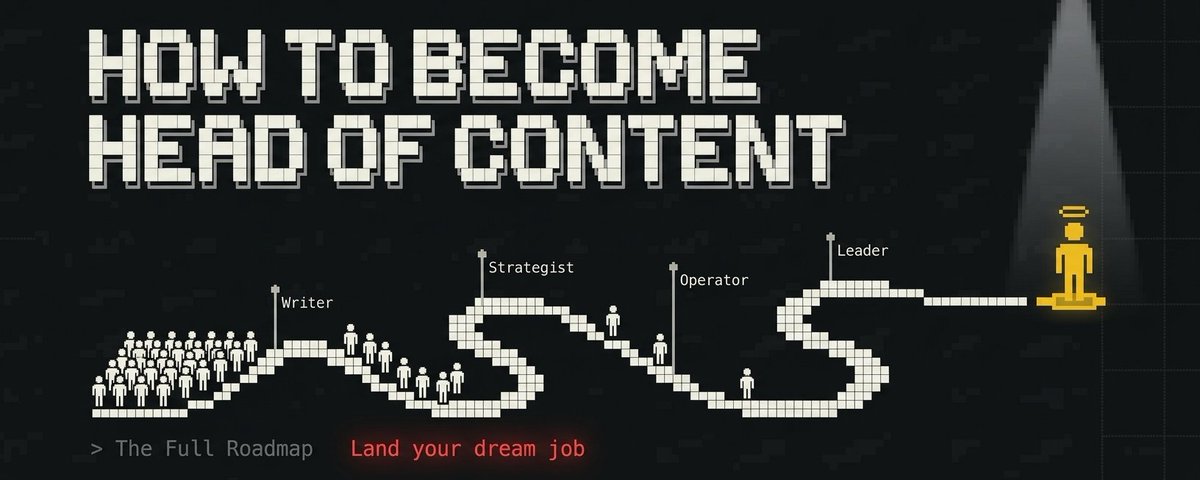
How to Become a Head of Content (step-by-step roadmap)
文章目录
Every company wants a Head of Content right now.
Tech startups, founders, personal brands. They all need someone who can turn content into growth, and there aren't enough good ones to go around.
So, I wrote this piece to produce the #1 quickbook on how to become a Head of Content. No fluff, no theory, and only practical, actionable advice.
In today's read:
-
Understanding the Process of Development
-
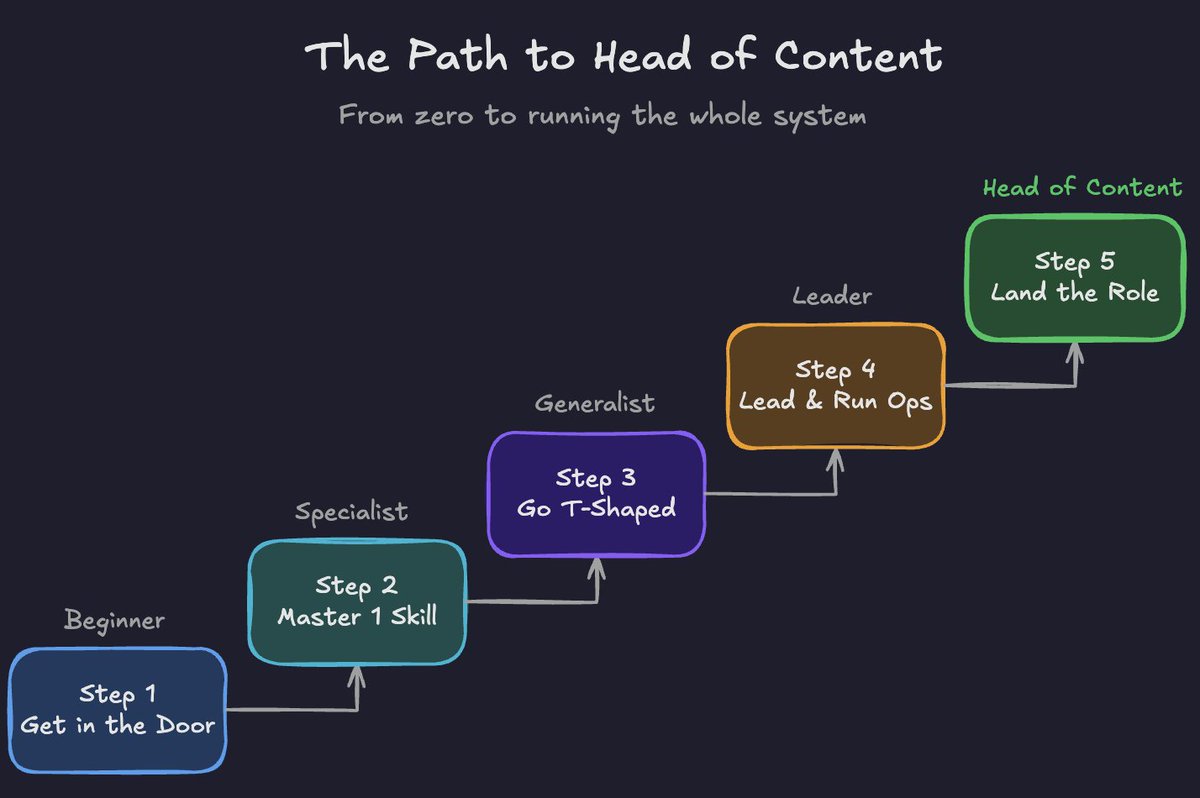
Step One: Breaking In
-
Step Two: Mastering One Hard Skill
-
Step Three: Becoming T-Shaped
-
Step Four: Leadership & Ops
-
Step Five: Officially Landing the Role
If you genuinely follow the steps I outline, you'll gain a skill set that can literally become a pathway to your dream life.
Understanding the Process of Development
First, some context. Heads of Content are in demand for one simple reason: the skill set is genuinely hard to build.
Companies can't really train for it because it's so new, good Heads of Content rarely publish resources on how they got where they are, and it isn't taught in traditional education. On top of that, "Head of Content" practically means something different at every company.
That said, we need to cover some prereqs and what to expect if you're serious about acting on what I cover here today.
You need to think of this as a full-blown process that requires serious creative energy, mental bandwidth, critical thinking, and the ability to work hard. Your mindset will also need to shift at various stages in the journey - which we'll cover.
To be a great Head of Content, you need to develop a rare mix of skills:
-
Creative: storytelling, taste, innovation
-
Analytical: data literacy, knowing what's working and why
-
Strategic: positioning, distribution, funnel thinking
-
Leadership: hiring, managing people, running systems
A few common traits I've noticed in successful Heads of Content:
-
Athletic background
-
Ability to self-teach
-
Deeply involved in internet culture
-
Entrepreneurial mindset
-
Built their own audience (even a small one)
-
High-agency/ability to iterate fast
None of these are requirements, but the more of these that sound like you, the higher your chance of success (imo).
TL;DR
Step One: Breaking In
This role is all about proximity. The crux is that you need to learn how to produce good content, either by teaching yourself or by joining an organization that already understands media.
I'll teach you how to execute both:
Path One: Teaching yourself
- Build your own account
This can be 𝕏, YouTube, Instagram - doesn't matter.
This is personally how I got introduced to content. At 16, I blew up on Instagram and taught myself how to film, pick viral topics, etc.
If you can, hire a coach to help you build your account.
Don't just hire someone who makes content for you. You want someone who can teach you the fundamentals of hooks, topic selection, packaging, and so on.
- Study the best
If you can't hire someone, you need to build your account by teaching yourself everything from scratch.
Pick 5 to 10 creators or brands you admire. Break down their hooks, formats, and packaging into actionable takeaways for your brand. If you're smart, you can leverage AI to help you.
We won't dive too deep into brand-building here *(I have other articles that cover how to make good content, so feel free to read them). *
- Get reps
Post consistently. Most of your early stuff will be bad. Just get reps and create the fastest feedback loop possible. Aim for 1% better on every post.
Path 2: Join an Organization
Your second option is to join a media org.
Make a list of 100 creators, brands, and media companies you want to work for, then reach out to every single one. Ideally, you find employees and reach out to them too.
Here's how to go about this properly:
- Build an outreach list
Creators you already consume, brands in niches you understand, startups that are clearly investing in content. Put them all in a spreadsheet.
Advice: Focus on smaller brands that are quickly growing. The bigger accounts already have top talent.
- Do the work upfront
Don't just ask for an opportunity. Pick one thing they could do better and fix it.
Examples:
-
Rewrite a few posts
-
Clip a couple of videos
-
Redesign a thumbnail
-
Suggest new hooks
You get the idea. Actually be useful upfront. And if you have no existing skills but are interested in content, well, just tell them that. You never know who is looking for a mentee/intern.
What NOT to do:
-
Send them your bloated portfolio and tell them to go through it (puts all the load on them)
-
Send AI messages/slop
-
Lie about your credentials
This first phase is all about just getting your foot in the door with content. Again, either by building an account yourself and leveraging it later, or by starting as a low-level employee (researcher, assistant, clipper, etc.) at an existing media company.
The reality is nearly every company is producing content now, so if you present yourself as high-agency, human, and coachable, you just need to put in the outreach reps to land something.
Step Two: Mastering One Hard Skill
Once you get your foot in the door with content, either by getting some traction on a personal account or joining an existing brand, you need to shift your focus to mastering one hard skill.
Every single HOC I know started with mastering one content hard skill, then expanding.
Some common hard skills:
-
Copywriting (my route)
-
Video editing (ideally long-form)
-
Design (thumbnails)
-
Production (filming, videography, lighting)
How to pick:
-
What interests you?
-
What experience do you already have?
-
How close are you to others who can teach you that skill?
How to master a hard skill:
- Volume
There's no way around this. You need hundreds of reps. Write every day, edit every day, design every day.
- Study the best
Find the top 1% in your skill and consume and reverse-engineer them. Why does that hook work? Why is that cut there? Why does that thumbnail pop? I perpetually studied the best copywriters to get good.
If you can, join Skools, Discords, and other communities where you can learn about [x] hard skill.
-
**Get feedback **
Get feedback from people better than you.
For example, there are so many good copywriters, editors, etc on 𝕏 with 0-10k followers. I guarantee you can ask them for advice. I even fall into this bucket; I literally answer every DM.
Mastering a hard skill will be the most time-consuming step in your journey, and it's the one most people skip. It took me years to master copy, and becoming good at one thing showed others I had the competence to take on more work.
The good news is, you can get paid in the meantime for your hard skill, while keeping the macro vision of becoming a Creative Director / Head of Content.
Step Three: Becoming T-Shaped
At this stage, you have two options:
a) Scale your hard skill to make money (for example, if you're a good writer or editor, you can easily scale to ~30k/mo)
b) Pursue the Head of Content route
Understand this: if you pursue HOC, your mindset needs to shift at this stage. Instead of becoming a specialist, you now need to become a generalist.
A T-shaped person has one deep skill (the vertical line) and a broad understanding of everything around it (the horizontal line).
 Packaging · Distribution · Data · Strategy · Other formats
  ─────────────────────────────────────────────────────────
                            │
                            │
                      Your hard skill
                            │
                            │
You're basically transitioning from someone who plays one role to someone who understands all the pieces in a content engine.
The exact skills you learn will depend on where you want to become Head of Content. For consumer apps, that might include learning UGC and ads; for personal brands, it might mean learning all the various social channels.
What to learn no matter what:
- Packaging
Hooks, titles, appealing visuals.
- Distribution
How each platform works, what it rewards
- Data
Which metrics actually matter, and how to turn them into actionable insights.
- Other media formats
If you write, learn video basics. If you edit, learn to write. You don't need to be great, just fluent at both written and visual media production.
- Strategy Positioning
Funnels (TOF/MOF/BOF), and how content ties back to business goals like followers, subscribers, and revenue.
- AI tools
Learn how to inject your taste into AI tools for more efficiency and better outputs.
The goal here is just to become fluent, not perfect.
Step Four: Leadership & Ops
Biggest shift in the whole journey. Up until now, you've exclusively focused on creative, output-driven skills.
Once again, you need to shift your focus. You need to learn how to lead.
Some things to focus on when leading creative teams:
1. Run lean: It's often better to pay one A-player than hire 3 B-players.
2. Practice giving feedback: Specific, honest, and fast feedback loops.
3. Document: Write SOPs for everything you've learned.
4. Build a pipeline dashboard: A place to store all data (Notion)
5. Learn to hire: Prioritize traits over skills.
6. Protect the quality bar: Keep people accountable, and make great work the bare minimum.
You land leadership positions by proving competence up until this point.
If you're a personal brand: You can learn leadership skills by managing small creative teams (let's say 1-2 contract editors).
Step Five: Officially Landing the Role
At this point, you're already doing most of the job.
There are a few ways to land a Head of Content job:
1. Get promoted from within
If you're already on a content team, tell your org you feel ready to take the next step. Give them a full proposal on what results they can expect if you step into a new leadership role. Also propose a risk management plan in case things don't work out.
2. Create the role
Some companies don't have a Head of Content. They have a founder posting inconsistently and one or two freelancers. Pitch them a plan on how impactful a Head of Content would be.
3. Get headhunted
Building a personal brand is the highest-leverage thing you can do.
If you're good, posting about content, sharing results, and breaking down what's working should be easy.
You'll naturally attract a ton of opportunities.
Closing
I genuinely think if you follow this guide, you'll be able to a) build your own content business or b) land a top 1% Head of Content role
If you made it this far, thank you for reading.
If you found even one valuable point from this piece, a like, repost, and follow go a long way.
If you have any questions, feel free to leave them in the comments below, and I'll respond to every one.
I plan to write 1-2 articles/week on this new account. If you have any ideas on what you'd like me to cover next, drop them below.
Keep crushing 👊🏼