Collector Crypt Built the Best Money Printer in Crypto (and no one understands it)

文章目录
I was gonna write a long piece on how Ripmart could be Collector Crypt’s breakout moment, but then I realized that it is just a part of a much bigger story. I want to spend this article explaining that story and diving into why I think $CARDS is the most undervalued (and misunderstood) onchain business in the world.
TLDR: The gacha business model is a money printer and Collector Crypt has the best version of this money printer. They are on the precipice of onboarding a couple massive partners that will potentially 10x their entire business and I think no one understands what’s about to happen. Everyone views CC like a niche pokemon app when in reality they are becoming the liquidity layer for all tokenized collectables.
Gacha: The Best Business Model in Crypto
I strongly believe that gacha is the next major primitive in crypto and we are in the very early innings. One of the main reasons people don't understand Collector Crypt is because they don't understand gacha and the economics behind it. So let me quickly explain the economics behind a gacha machine:
-
A user deposits $100 and buys a pack. The platform takes its fee on that $100.
-
A real card is revealed. The platform offers to buy it back instantly for about $90 in cash.
-
The user takes the $90 and buys another pack 10 seconds later. The platform takes its fee again on that $90.
-
Repeat until the money is gone
A $100 deposit ends up generating $1,000 in pack sales. The idea of a small real dollar amount generating massive amounts of volume might sound familiar because it is the exact model of perps (one of best business models in crypto). The difference is the leverage comes from the venue being willing to buy back the card every time vs. perps where the leverage comes from borrowing.
The other major difference is the take rate. On the same $1000 of volume a perps venue might make 30 cents. A gacha platform will make about $100
That’s why gacha makes more per user than anything else onchain and it’s not close. Here’s the proof.
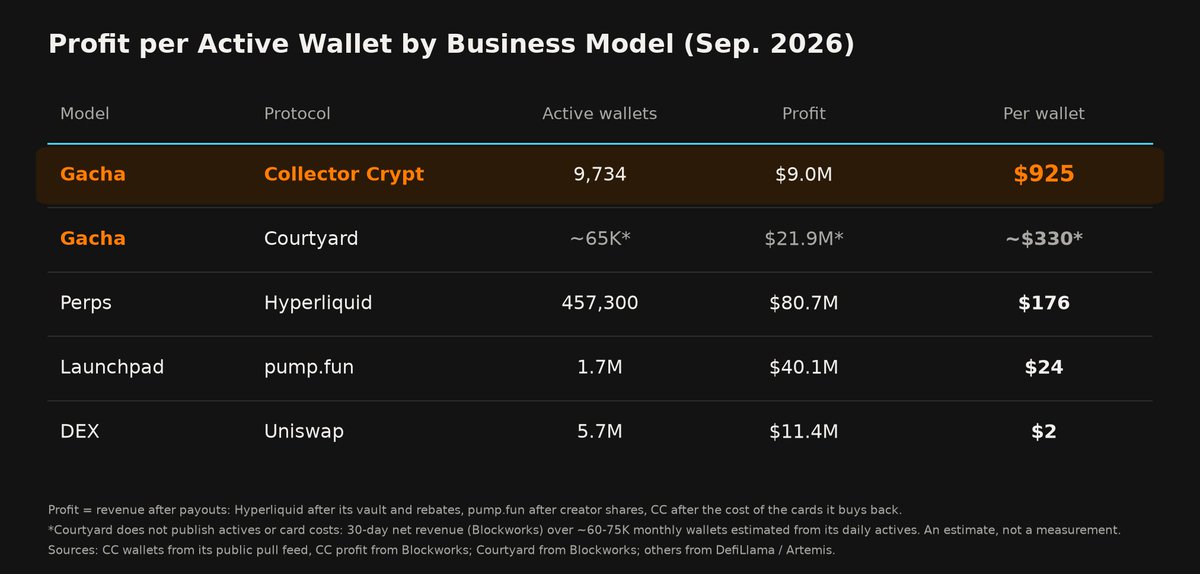
The two leading gacha platforms blow the best revenue generating protocols in crypto out of the water when it comes to profit per wallet. Please take a second to look at the chart again.
The reason for this is structural. The gacha model is the only business in crypto where the platform’s payout is its own next sale. Every other model gets paid once per dollar. Gacha gets paid every time the dollar comes back and on a good machine it comes back ten times.
But Does it Scale? Yes
The $925 profit per wallet number from earlier is carried by whales and it will come down as users scale. However, we have data to prove that even as this number comes down it will still remain higher than anything in crypto.
Courtyard has 65k+ monthly users who are mostly non crypto and much smaller spenders. Half of pack spend is on packs below $100 and a third come from credit card purchases. They still generate ~$250-300 profit per wallet.
So yes, the gacha model does keep its amazing economics as it scales.
That’s the primitive. Now the obvious question: if gacha is the best model in crypto, which gacha is the best?
CC is the Best Machine in Gacha
Every gacha platform runs the same loop and benefits from the same incredible economics. But some are able to benefit more than others.
It mostly boils down to this: whichever platform that is best able to balance how much they are willing to give back to their users per gacha spin vs fees extracted per spin are going to end up with the best versions.
I think Collector Crypt has mastered this tight rope.
On every spin, CC offers the user back 90% (on average) of their cost. Instantly. So a $100 spin gets a $90 offer to buy back the card right away.
Paying back more is what keeps people spinning. Since CC pays back such a high % it allows their users to keep going longer while they take a smaller % fee. What CC loses on the lower fees per spin gets made up on the increase of total spins.
This is why CC ends up generating the most amount of volume per dollar deposited compared to any other gacha platform.
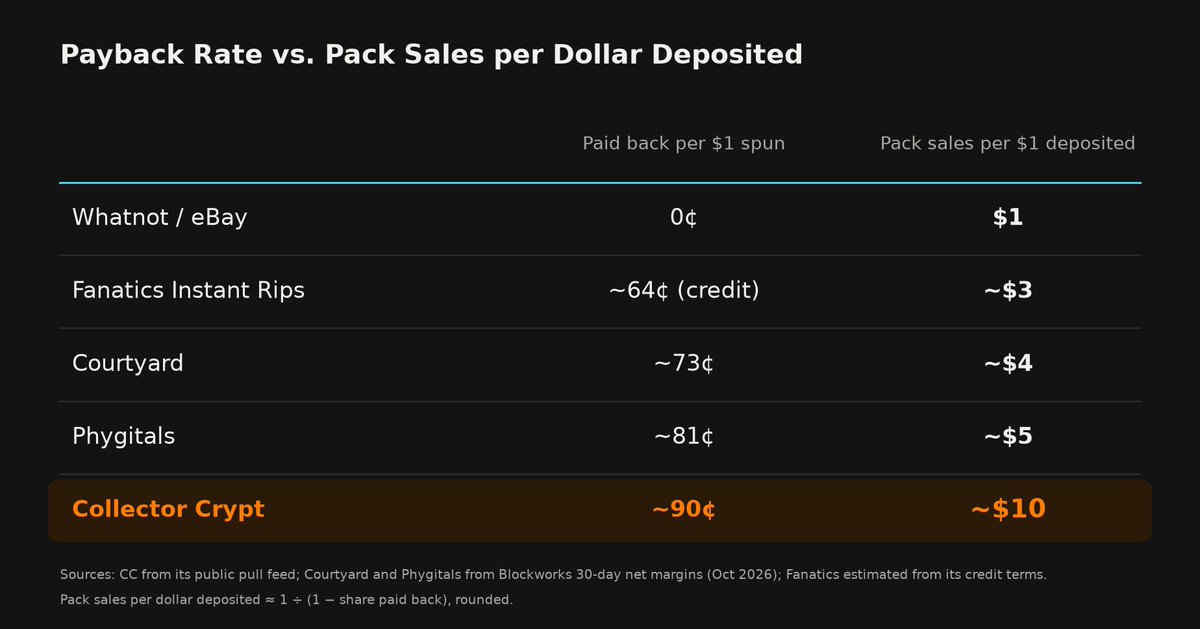
From a user’s perspective, what would they prefer? A venue where your $100 buys $300 of packs or one where it buys $1,000?
So how does CC give back more than anyone and still make money? It depends who you compare them to.
CC vs. the offchain copies
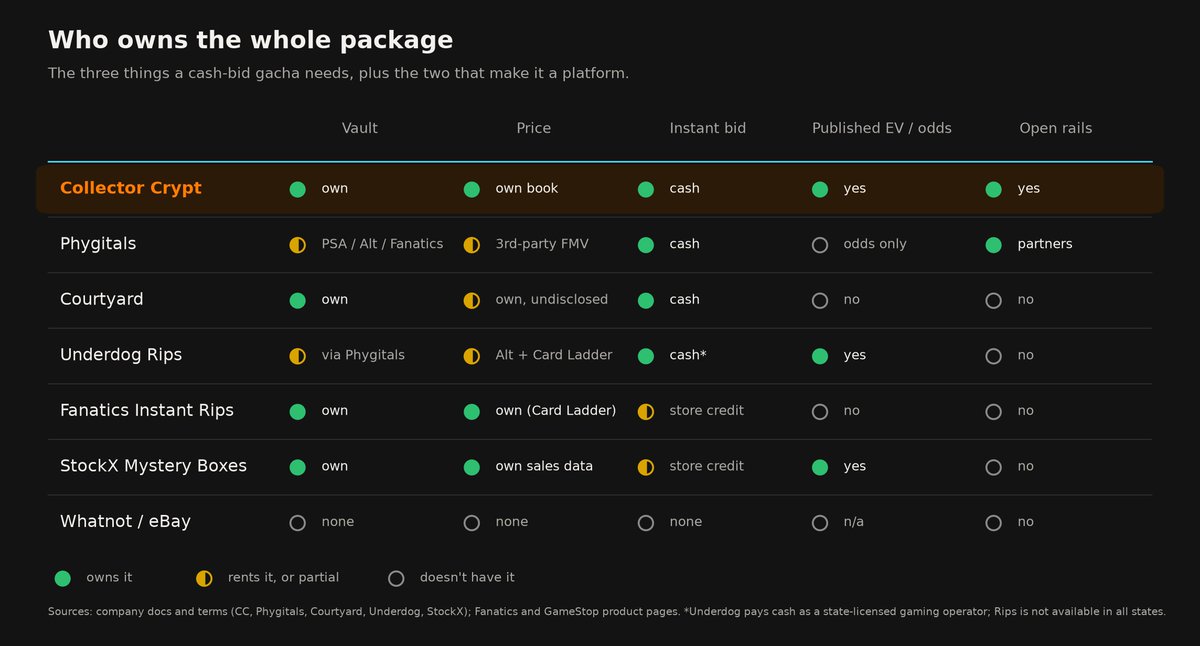
Fanatics, GameStop and StockX have all shipped a digital pack with an instant offer in the last 18 months but none of them pay cash. They pay store credit that can’t leave the app so the dollar turns a few times and dies. Their issue is they are structurally unable to offer a more competitive payback rate because they are missing 4 important things that CC has:
A pricing oracle it owns
Every card in CC’s vault carries a live price built from about $150 million a month of packs ripped and cards sold back at prices CC set. Nobody sees more trades for these cards than CC does and CC owns the data. The offchain platforms rent a price from a third party like Card Ladder. A rented price is a reference someone else maintains and it lags the market.
A balance sheet that takes the other side
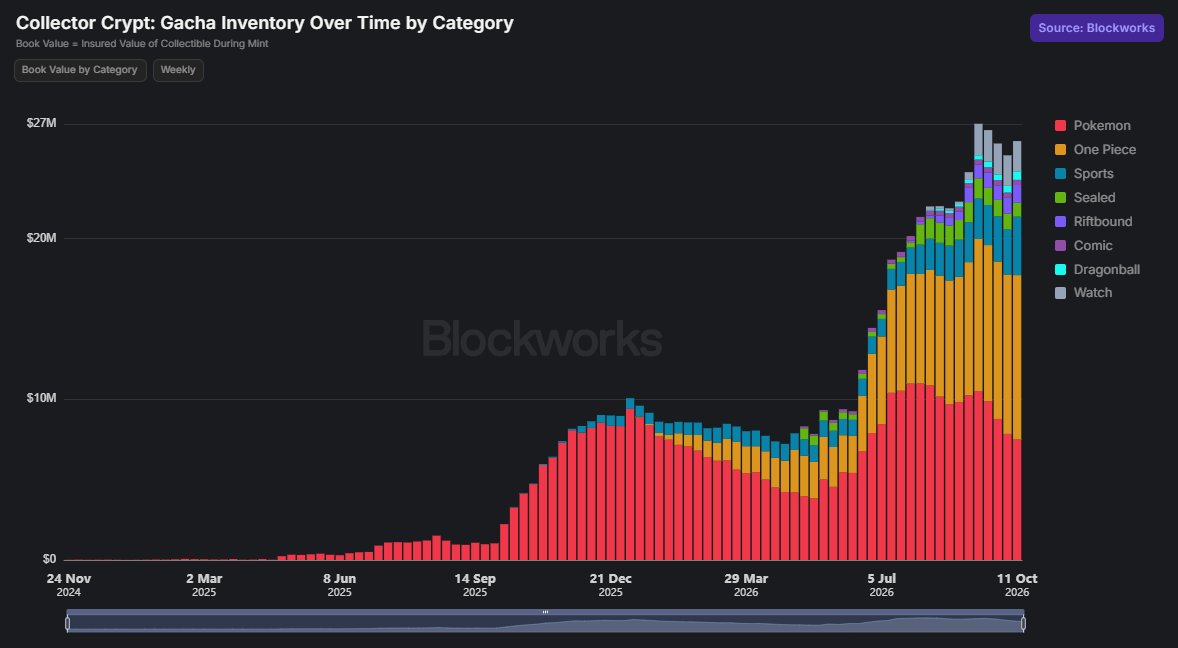
CC owns 66,000 cards worth about $26 million and pays cash for anything you pull. About 90% of pulls get sold back within days and a sold back card goes straight into the next pack, so the same card can go through the machine over and over. The offchain platforms get far fewer cards back because credit payouts mean more pulls get kept or shipped, and a shipped card is gone. So they’re constantly buying new inventory at market to refill.
It’s also harder to copy than it looks. A gacha machine needs thousands of cards at every price tier at the same time. From $30 commons to $40,000 legendaries or the published odds don’t hold. And anyone trying to build that inventory today has to buy it from a market where CC is already the biggest continuous buyer.
A vault that’s onchain
173,000 cards sit in CC’s vault (66k owned by CC plus 107k owned by users). The physical card rarely moves but the token does. Your pull is in your wallet the second it’s revealed and you can sell it back the next second. The offchain platforms vault the card too, but they pay you in credit that can’t leave the app. That’s why their dollar turns three times instead of ten.
A proven (and fair) engine
Published odds, published EV, provably fair pulls and more than a billion dollars of them. Users can check the math before they spin and after. The offchain platforms show you none of that.
CC vs. the other onchain gachas
The onchain players pay cash too so this isn’t about whether they can. It’s about what they’re optimizing for.
Courtyard keeps almost three times as much of every dollar as CC, which is why its dollar turns four times instead of ten. That’s a choice and it’s clear what they are optimizing for: profit. This is fine as a short term strategy, but it is also why CC has been able to come in and steal a majority of the gacha marketshare in a short amount of time.
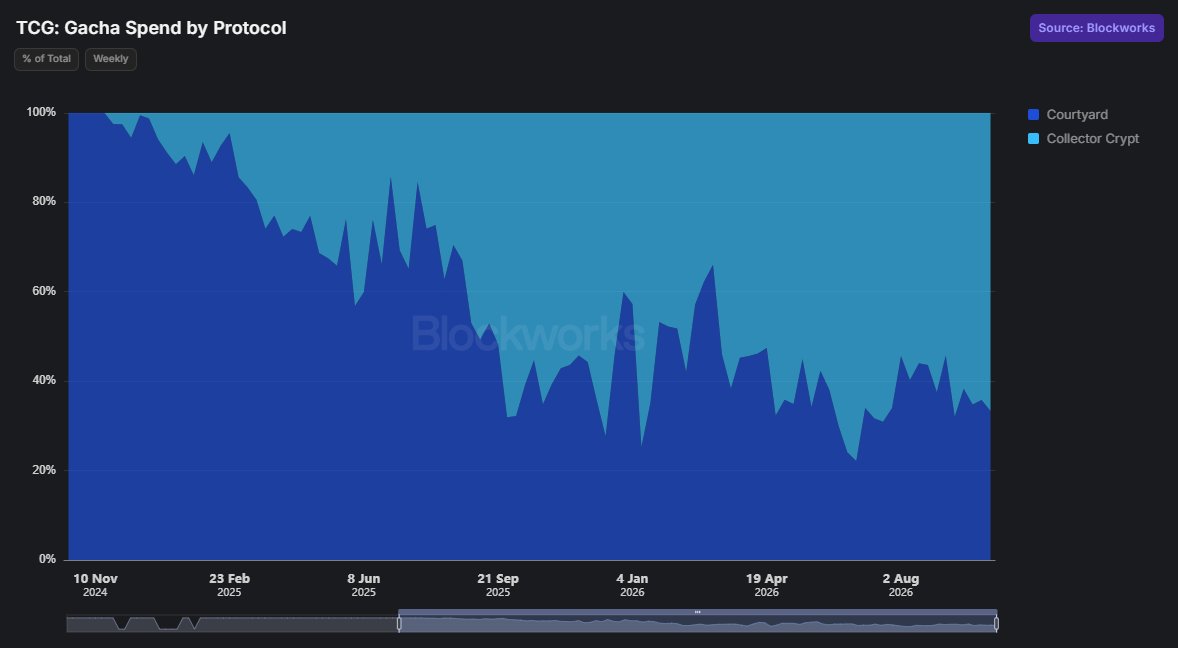
CC made the opposite choice because it’s building a platform. They care most about flow through their venue. More flow makes CC’s price oracle better. A better price oracle makes for better packs. Better packs brings more users and more partners (because every partner wants to plug into the best price in the category).
Courtyard is winning the margin game (the battle), but losing market share rapidly (the war) where CC is now 2/3rds the market share and growing twice as fast.
Same product. One is optimizing for an app. The other is optimizing a platform. That’s the long game CC is playing and the rest of this article is about it paying off.
Where the Next 10x Users Come From
Up to this point we have established that gacha is the most profitable primitive in crypto AND that Collector Crypt is the best version of gacha.
To put it simply: CC is the best money printer in crypto
Now I want to explain how this printer is going to scale 10x.
Ripmart: The Live Stream Venue Built on CC’s Rails
Note: Nothing about Ripmart has been announced by either company. Everything below is what I could find myself, but it is not hard to find if you look in the right places.
What is Ripmart?
Ripmart is going to be a lot of things, but at its core it is very similar to whatnot where people live stream themselves opening packs and selling cards. MerryGoRound, the company behind ripmart, is a big player in the TCG/collectables space that owns consumer facing brands that collectively have over 1m followers and close to 6m items sold.
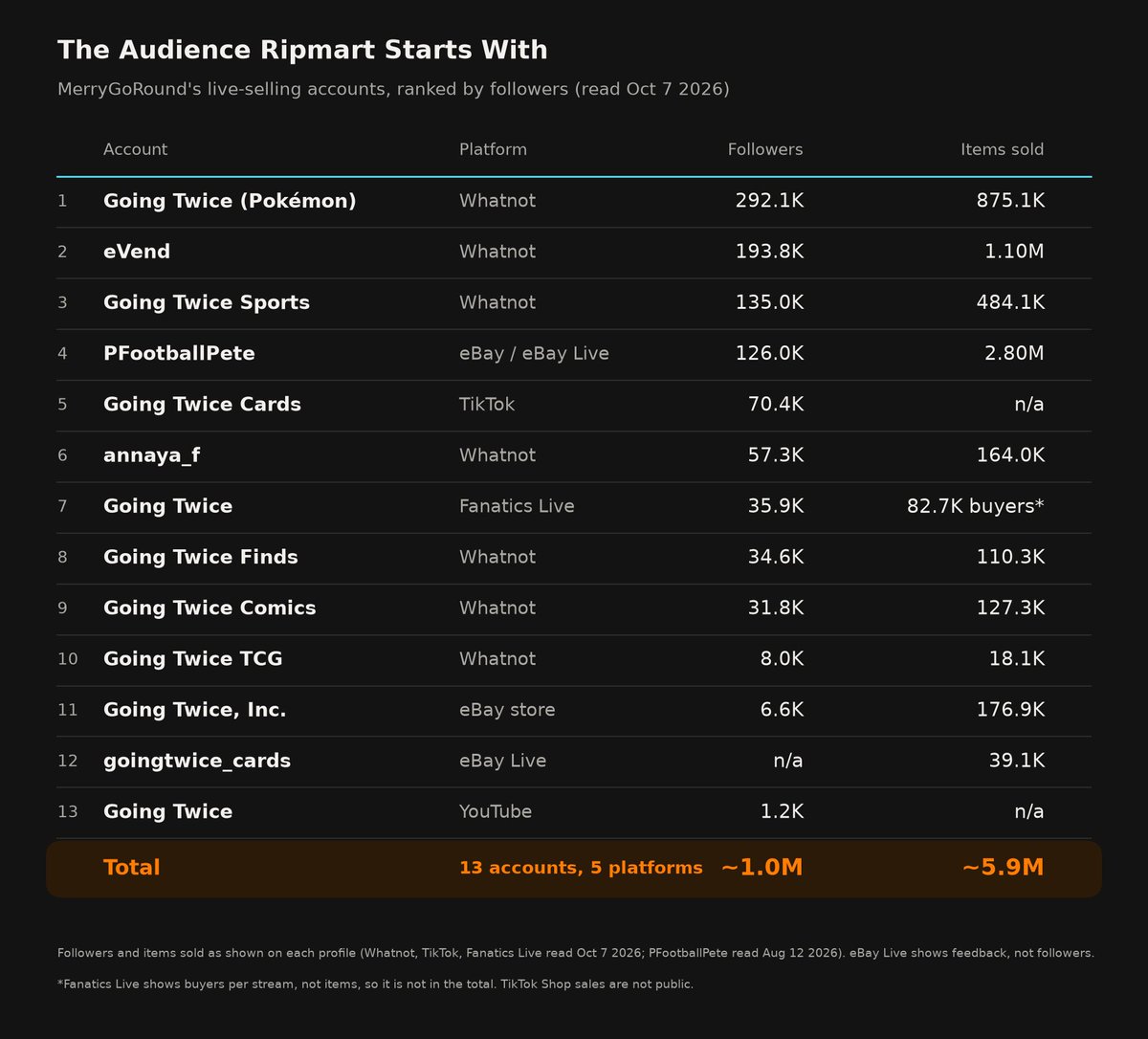
Brand accounts owned by Merrygoround
On top of the built in audience, they also have the proper infra to accompany it. A newly built 400k sq foot studio and fulfillment center in Virginia that opened in July. It houses ebay live and tiktok shop studios along with over 100 staff (with plans to double in the next year)
This is a serious operation that has a real shot at taking market share from whatnot.
Built on CC Rails
The key part here is that Ripmart is fully built on top of CC’s rails. And they made this decision because of what it uniquely enables: the ability to sell your cards back instantly after ripping.
Below is the tagline from their website

As we have already touched on, this difference actually changes the whole game for both the users and the venue. The only reason this is possible is because Ripmart is fully built on top of CC’s rails.
How Big Is This?
Very big.
Live pack rips are the fastest growing format in cards and the audience already pays for a worse version of this product. Fanatics digital pack line did $118 million over 19 months paying back about 64 cents on the dollar in store credit. The thesis has already been proven via a much worse product. Ripmart is the first live show where that pack comes with an instant cash bid combined with a mainstream audience.
Chart below shows growth of live pack rips. 2026 is on pace for close to $7b in live card sales.
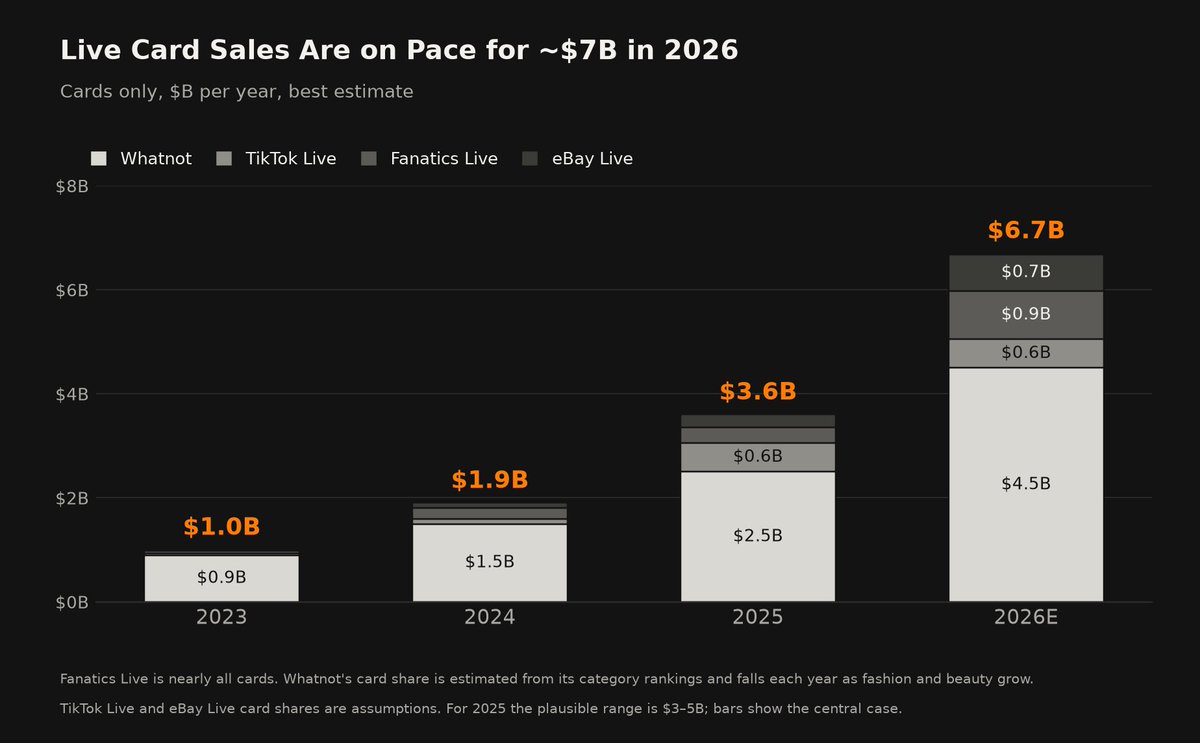
CC gets to tap into the mainstream collectables space in a way they would have never been able to do otherwise, at least in this short amount of time. This is taking the best of both worlds (offchain vs onchain) and combining them into one superior product
I think this is Collector Crypt’s tradexyz moment. Meaning, this is where the market begins to understand that it is more than just an app and is a platform. Real businesses are being built on top of CC and attracting users they wouldn't have been able to otherwise.
Potential Revenue Impact
A lot of the value Ripmart brings is showing that CC is a platform, not an app. But I also think there is potential for a massive increase in gross profit back to CC.
Let’s look at some numbers.
I estimate that there is roughly $600m worth of live card spending per month across the top venues. This is the market Ripmart is coming for. They already own 1-2% of it via their owned accounts across whatnot, ebay and fanatics. So at bare minimum I think you should expect to see $6-$12m worth of monthly deposits.
And remember, $1 into collector crypt turns into $10 worth of volume. However, Ripmart is offering a slightly different product (live streams vs pure gacha) so I do think the rate will be lower than the 10x multiplier. Let’s use 5x.
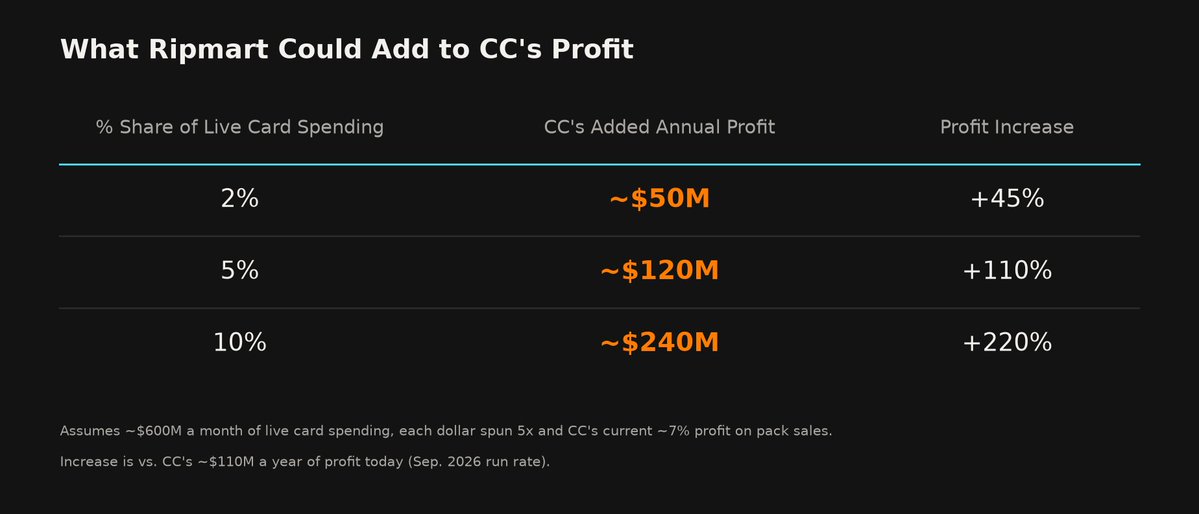
You get to some pretty crazy numbers pretty quickly. What’s even crazier is I think there is a real shot ripmart gets a much bigger share of 10% (and not to mention the whole category also probably doubles in the next year)
So can Ripmart actually benefit CC’s bottom line? Yes and in a significant way. And this is just one (major) partner. Many more are coming.
Coinbase
Coinbase announced they are throwing their hat into the gacha ring via this tweet.
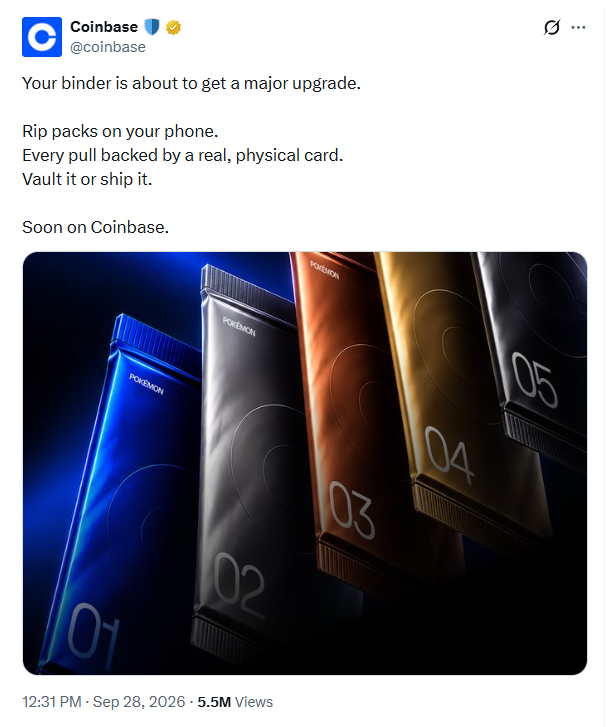
There is no official confirmation who Coinbase is using or partnering with for this, but I'm 99% confident that CC is being used. See my reasoning why here.
So one of the biggest companies in crypto is entering into this space and will be leveraging CC’s rails to do it.
This is another example (like ripmart) where Coinbase building on top of CC proves that it is becoming a platform and no longer just a standalone app. But also like Ripmart, I think the market is underestimating how impactful this could be for CC’s bottomline.
How big is this?
We already have a good comp for what to expect from this launch.
Jupiter launched their gacha machines via partnering with CC back in July. Jupiter’s has the same kind of user as cb (crypto native, wallet already funded), same kind of product (a page/tab inside an app people already open every day) and built on the same rails (CC’s). I think this is a near perfect preview.
So how did JUP’s launch go?
Very well. Over $59m in pack sales and 10k new wallets (88% of them net new to CC). Jup is now accounting for ~10% of CC’s total volume. Each Jup user generates about $300/mo profit.
Net net, it was a huge success.
And the uptake was almost immediate. As soon as jup launched the frontend for the gacha machines the users and volume came right away. The demand for this sort of product is massive.
I think we will see a very similar story play out with coinbase, but on a much larger scale. Let’s run through some estimates to see what this could look like.
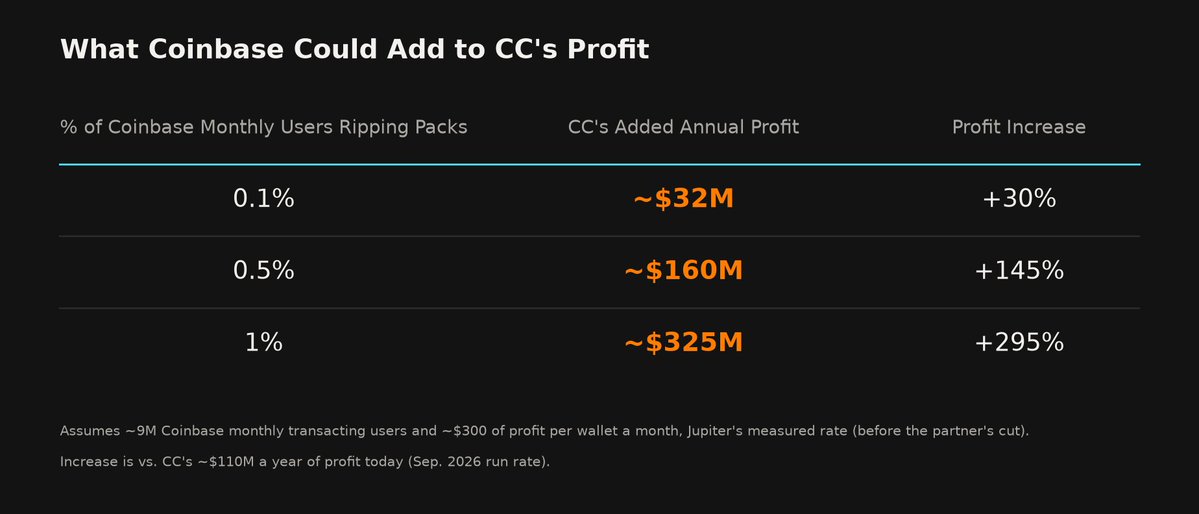
There is a reasonable path where CC’s profit doubles overnight once Coinbase launches this. The demand for this product is clearly there. We will have to wait and see how the launch goes but there is potential for this to be massive.
Everyone Else: The hyperliquid playbook
We have already seen this play out with HL. They built the best perps engine and then opened it up to anyone that wanted to tap into this via their own users and front end.
CC is running the same playbook but on steroids. Let me explain why.
CC’s secret sauce is their own proprietary internal oracle they use to price every single card in their vault and stock gacha machines in the most effective manner possible. This is the whole game.
Why is their oracle so good?
Because they see more flow than anyone else (at least in terms of the cards they vault). Period. And that includes major players like ebay, psa, etc.
And it compounds. More volume = better oracle accuracy = better gacha packs = more demand to spin = more volume (repeat)
The benefit of having the best oracle is that it means partners can tack on their own builder fee while still giving the users a higher cash back rate than the competition.
Let’s look at the data:
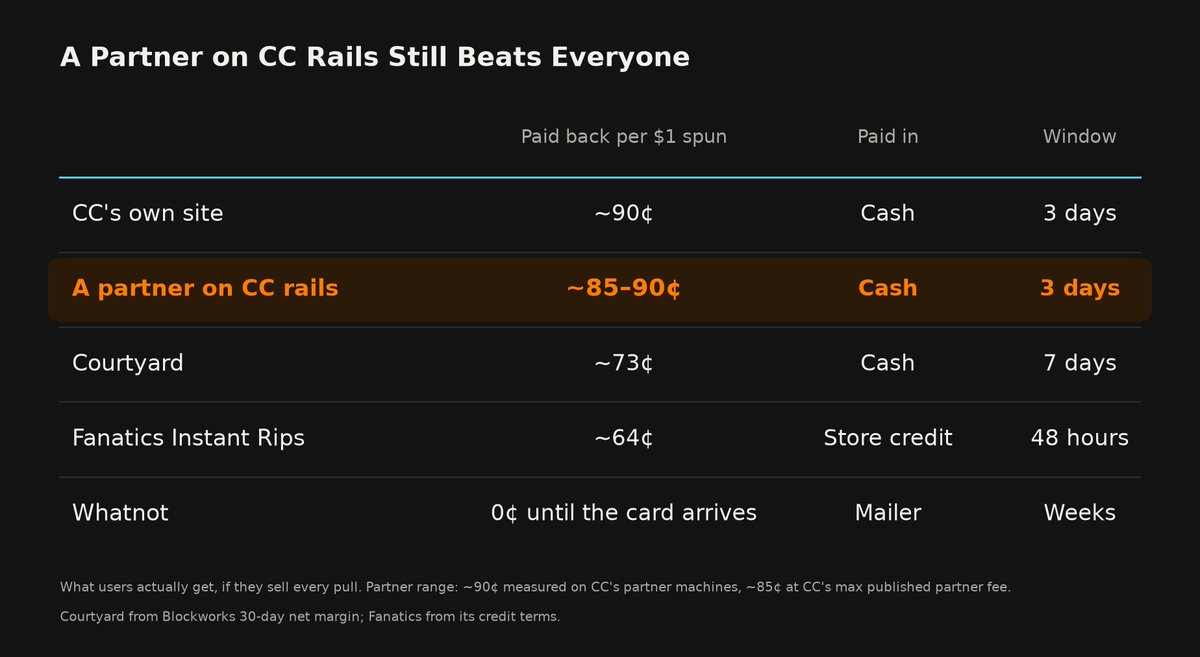
This is a big deal. The partners get their fees, CC gets their fees and the end user still gets the best experience in gacha (outside of CC).
Let’s look at an example of what $100 deposited into the partner’s app looks like:
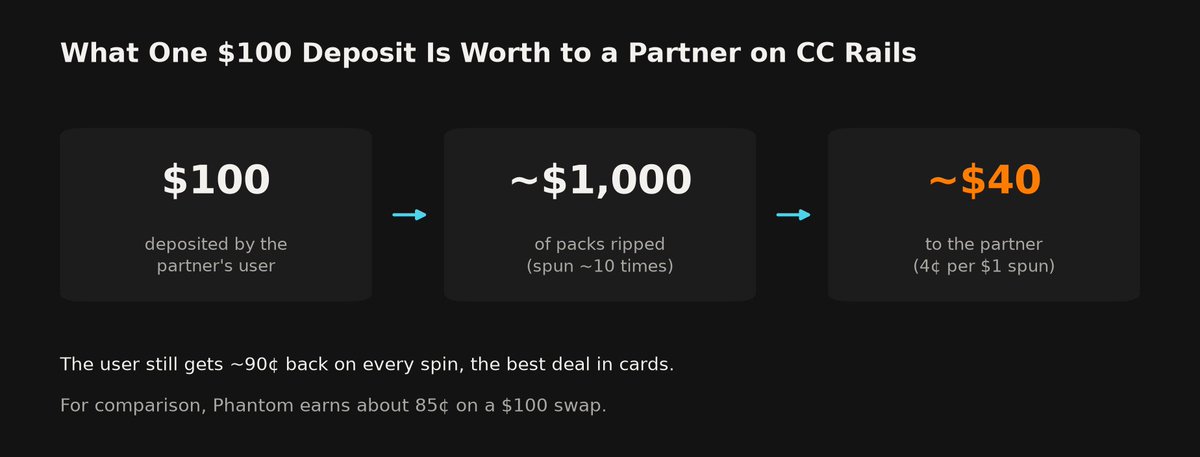
Nobody renting a price oracle can offer that. If you buy your pricing from a third party then your entire profit margin is already gone before you can even split it with a partner.
When you’re the best price in the category, you become the default rails for it.
Success so far
We already have data to show the partner program is a huge success. 15-20% of all CC volume is now being generated via 3rd parties and trending in the right direction.
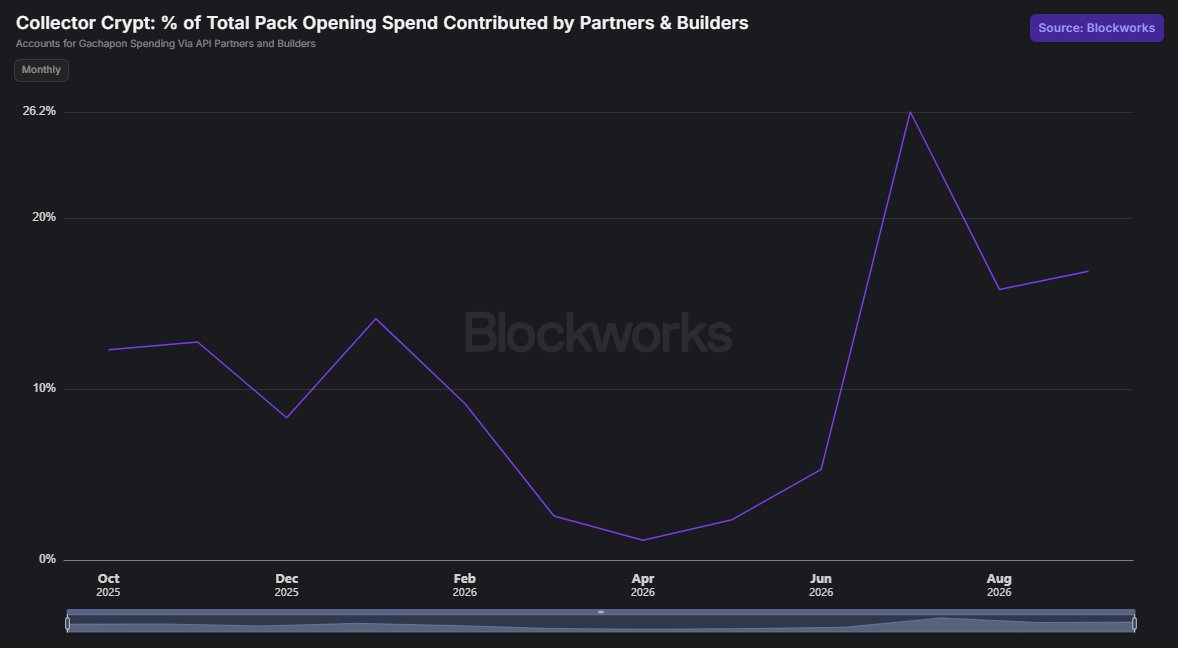
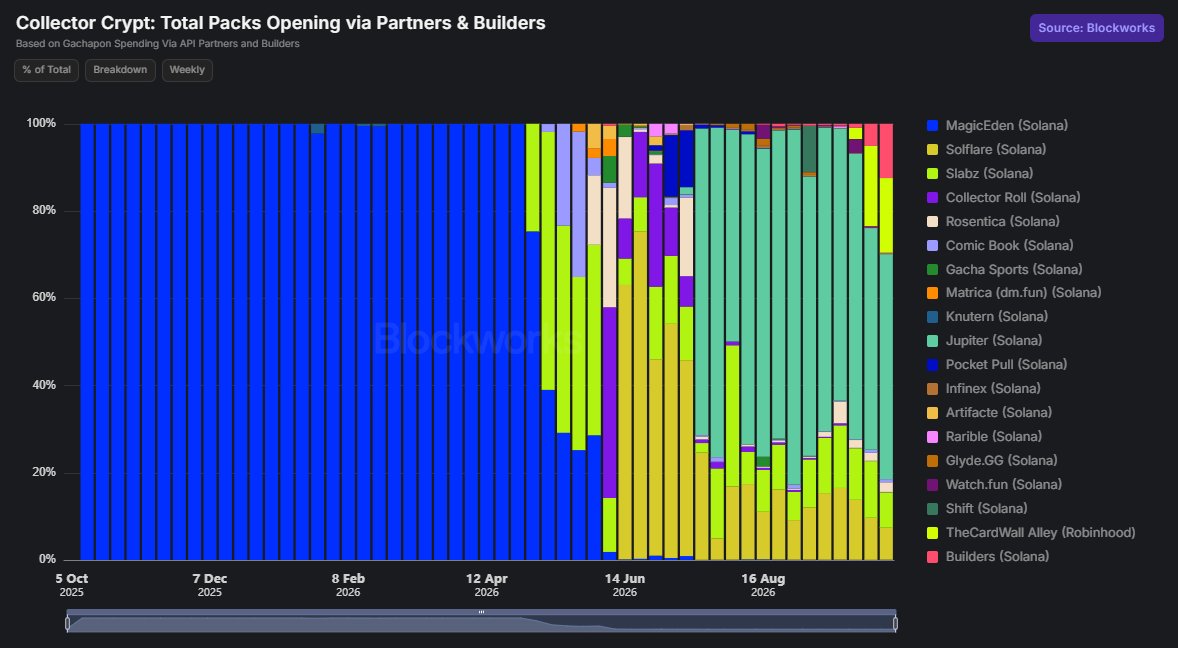
Jupiter has been the biggest success so far but the other partners arent slouches either. You can see a broad and diverse mixture of partners in the chart below also doing meaninful volume. Very healthy to see.
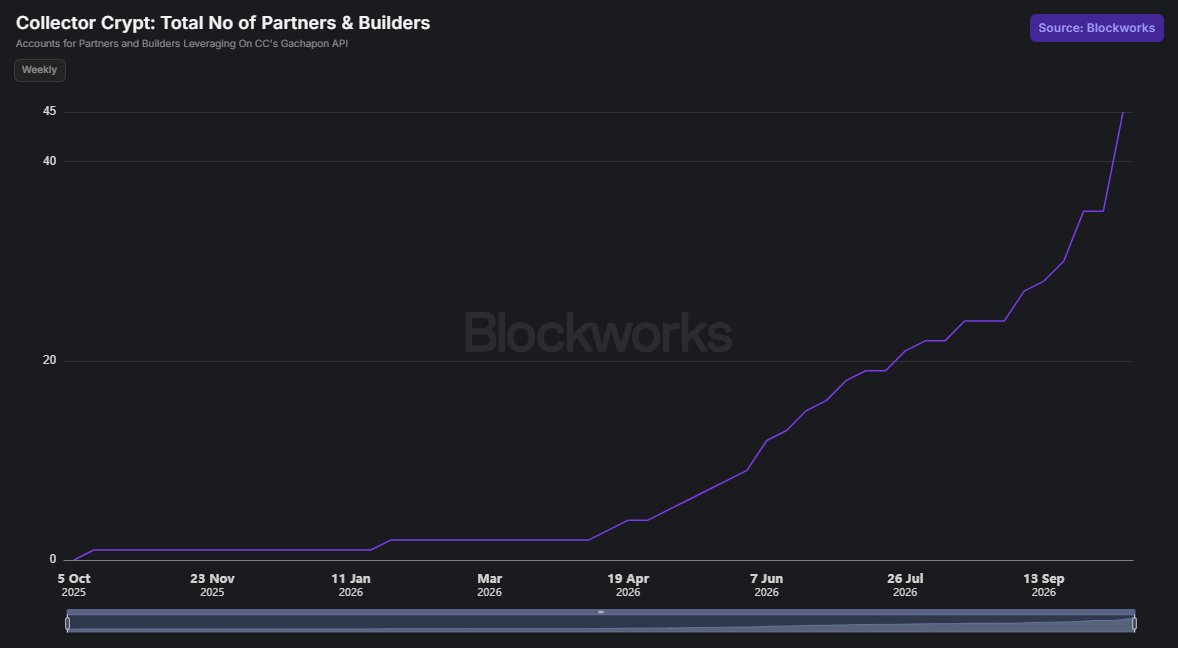
The partner program up to this point has been gated. Only approved partners have full access to the CC engine. But this is opening up to the public soon and I'd expect 3rd party volume to really ramp up.
Already 45 partners are using their API and it’s growing rapidly.
All signs point to the partner program being a massive success so far.
So how does this play out from here?
Incentives show you how this is going to play out and why CC will have people lining up around the corner to partner with them. If you are a crypto app your main KPI is how do you generate the most amount of revenue from each customer. CC is handing these companies a golden goose that requires a simple frontend and an API, but will be a literal cash printer for them while still giving the end user a great experience.
Short term, any crypto app with users will be the first to partner with CC. But I also expect many non crypto apps to explore this idea as well (gambling sites, betting sites, tcg sites, collectable apps, etc). Jupiter, Ripmart and Coinbase are just the first through the door.
How $CARDS Can 10x
Today CARDS trades at about 5.5x annual profit. The question is what multiple a business like this deserves.
Here’s what the two best cash printers in crypto trade at:
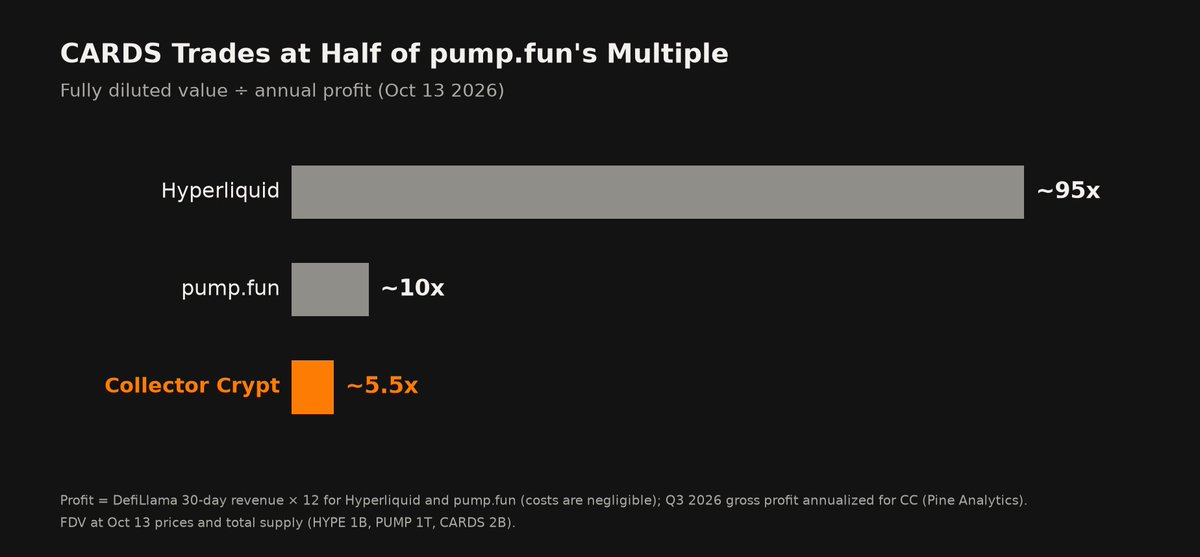
I’m not asking for Hyperliquid’s multiple. I’m asking for pump.fun’s.
CC is the infrastructure layer of a category that’s growing, where it owns 2/3rds of the market share, coming off a record quarter and has the biggest retail app in crypto about to plug in. That’s worth 10x at the low end and 15x if you believe the platform story, which this whole article has been showing you is already true.
Where the profit goes from here
The multiple is half the story. The other half is the number it gets applied to.
CC made about $100 million of profit on an annualized basis last quarter. That’s before Ripmart, before Coinbase and before the partner program begins ramping up. Here’s what those add in a bear, base and bull case, using the same assumptions from earlier in the article:
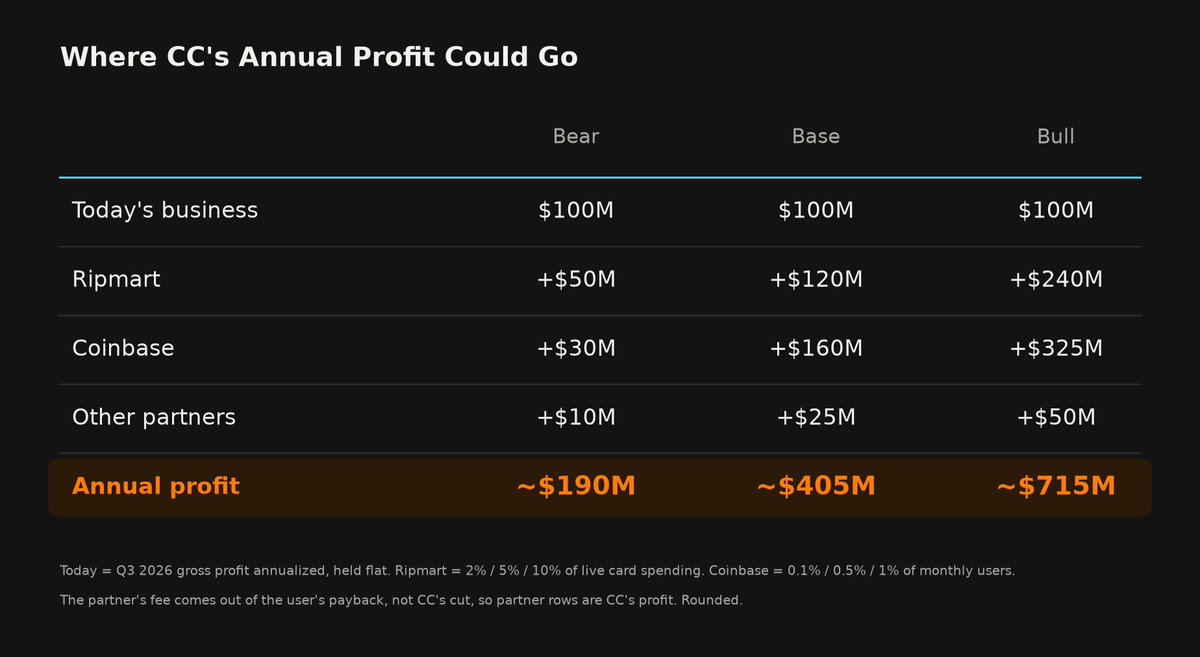
The bear case is Ripmart only bringing the audience its hosts already have, Coinbase converting one in a thousand users and the API adding a little. That still gets CC to $190 million.
The base case is Ripmart taking 5% of live card spending and Coinbase converting one in two hundred. That’s $405 million, 4x today’s profit. The bull case is Ripmart at 10% and Coinbase at 1%, which is what Jupiter did on its own mobile app. That gets you to $715m of profit per year. More than the FDV it is today!
There is also an ultra bull case that blow these numbers out of the water but I will try to not get too crazy in this article. When you have the best money printer in crypto I think it is OK to dream a little bit.
Now let’s put the two together: revised multiple and profit projections
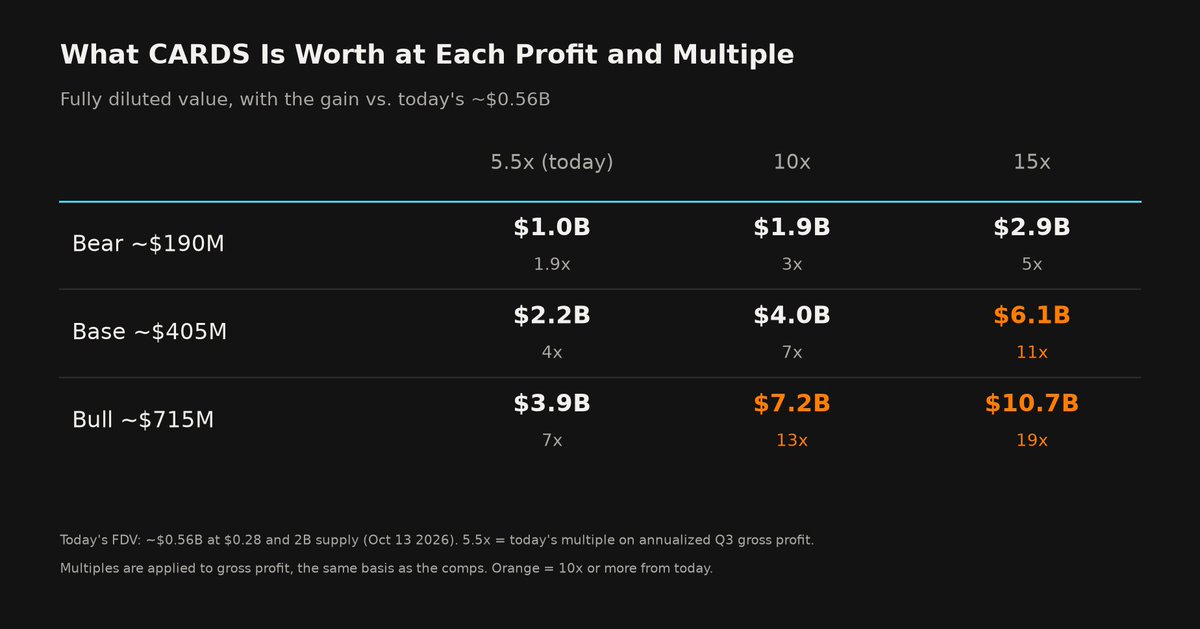
Even if you give CC no credit for a higher multiple, the base case is 4x from here just on profit growth. Give it pump’s multiple and the base case is 7x. Give it the platform multiple and the bull case is 19x.
The market is pricing CARDS as a $100 million a year niche Pokemon app that stays a $100 million a year Pokemon app. Every section of this article is evidence it’s something else. That’s why I think CARDS is the most undervalued onchain business in the world and why 10x from here isn’t a stretch, it’s simply the thesis playing out.
"b..b..but wen buybacks"
This is everyone favorite rebuttal to the CARDS thesis and I get it. HL spoiled us with 99% buybacks. Before we talk about buybacks, I think it is important to understand that Tuom and the team have repeatedly said that they are treating the CARDS token like equity.

And the structure and actions all align with this too. A Panama foundation owns the operating company, the cards and the treasury, and its job is to govern the token and build the CARDS ecosystem. The Delaware devco is paid in fiat and holds no economics, so the team is incentivized by the token and treats it the way a normal company treats equity.
On top of this, we have seen the following from the team:
-
said they would eventually do buybacks and now are actively doing buybacks
-
bought out VCs as their tokens vested
-
in the last month some team members burned a chunk of their vested tokens
-
team has sold zero tokens
-
foundation has sold zero tokens
Every action from the team aligns with what they are saying they are going to do. You can choose not to believe them, but this is also what makes this an opportunity for the people that are paying attention.
You may not be happy with size of the buybacks or dont trust the team or whatever and that's fine. But you can't ignore the signal they are sending via their actions.
Scale vs buybacks
The idea of using ALL profits to buyback the token is a dream that only people who have no idea how a business works think is possible. Like I said, HL spoiled us here but that is a very very rare situation. The team has been very clear they are choosing to spend their profits to grow their inventory and continue to scale the business over dumping all profits back into buying the token. Tuom has said the order out loud: inventory first, treasury second, buybacks third.
And this decision has proven to be correct if you look at their metrics. It is very easy to make the switch and start buying back more tokens. It is VERY difficult to build a good business and scale it. Id prefer to have the latter that can ramp up buybacks at any moment vs a dying business with 100% buybacks.
Bullish Extras
I wanted the core focus of this article to be around CC's incredible engine they built, their path to scaling via partners and how they are becoming core infra for a rapidly growing net new sector in crypto. But I wanted to briefly mention some other things im excited about as well as a way to end this
Marketplace Growth
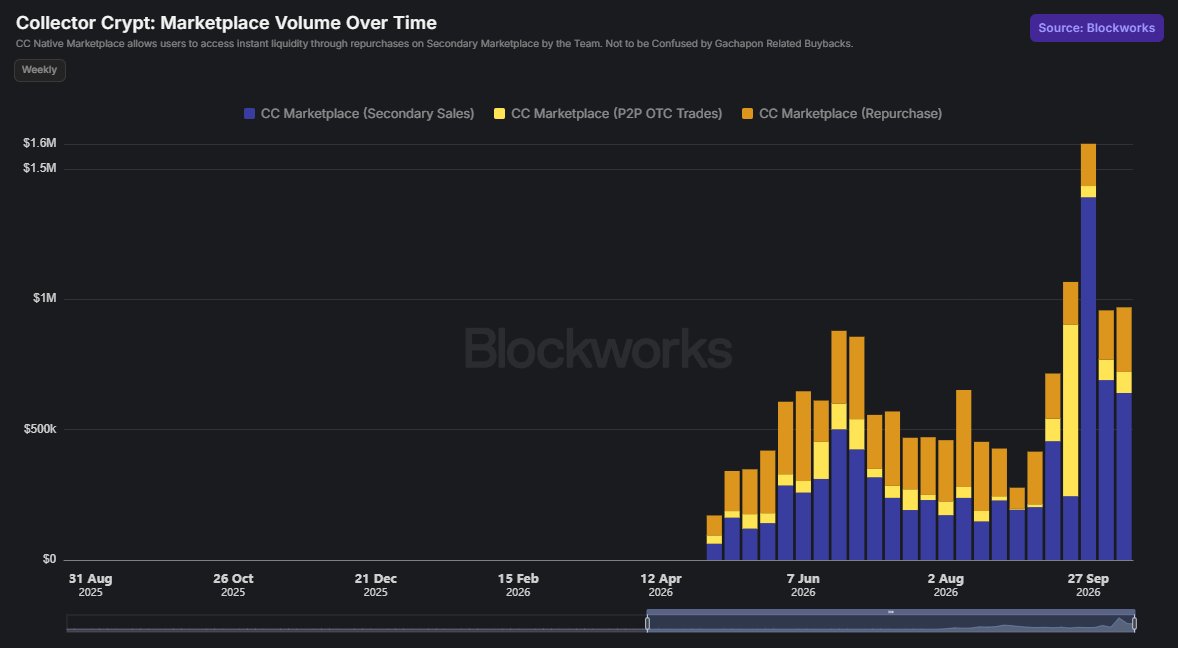
This is a HUGE opportunity and everything written in this article helps bootstrap and grow the marketplace. I expect the volume here to 100x over the next 12 months.
Fundamentally, the most important component to reach the tipping point is to source deep inventory. For a particular collectible category, if a Tokenized Marketplace can become the 'default' platform to discover and trade a collectibles it's game over for physical marketplaces - 6th man ventures
Tokenizing Raw Cards
This has many 2nd order effects that are all very bullish the whole CC ecosystem. This could massively scale inventory and make live rips tokenizable the hour they are opened (important for ripmart!)
New Token Utility
A new idea called "spearfishing" recently rolled out at small scale that allows people to spend CARDS to increase their chances at getting specific cards.
https://x.com/Kunallegendd/status/2109589346118684742
I expect the team will continue to roll out more token utility and ways to bring value back to the token holders.
Cross Chain Expansion
The CC engine has been rolled out to a couple of blockchains outside of Solana and we are starting to see some traction on Robinhood.
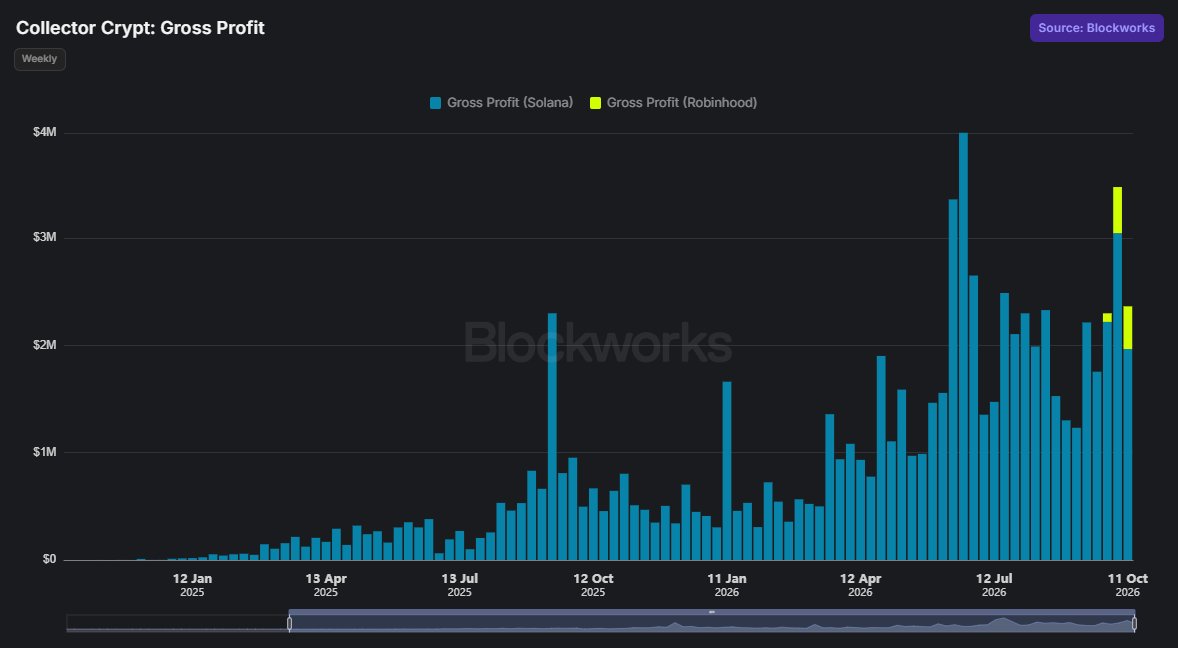
I would expect non-solana volume to see lots of growth over the next few months.
The "true" FDV is much lower
Tuom makes this argument and I agree with him. The 37% of supply owned by foundation tokens should not be counted because the CARDS token owns the foundation. And the team has been very clear that the foundation will never sell a token (unless it was net accreditive to the CARDS token).
This takes the FDV from 550m down to around 345m. I think there is a very soldi argument here, but I still used the default FDV throughout the article.
Wrapping it up
Thanks for reading. I hope I was able to get you to view CC and CARDS through a new lens. And understand the vision for what it has the potential to become. S/o blockworks for their amazing dashboards on CC. Check it out here.