India's Existential Material Trap, Part Two: Banking Swadeshi

文章目录
Banking Swadeshi. India's Central Bankers Learned a Western Creed That Is Deindustrialising the West Itself. Now* India follows the West into the Trap. *
India holds US$734.6 billion in foreign reserves. It is one of the richest treasuries on earth. Its factories make 13.1% of GDP. In 2006 they made 17.3%1.
The money grew. The material matter shrank. As part one showed, India cannot make the seven inputs its own build depends on, from rare-earth magnets to APIs. When Beijing slowed magnet licences in 2025, Indian electric scooter lines slowed within three months. A treasury that size could not buy a single extra magnet.
It is not bad luck. It is a rulebook: the Western banking rulebook, which financialises everything and de-industrialises the nation that adopts it. Here is how it works.
Read what follows carefully, because it is the most important thing no one in Delhi will tell you. India's fate this century will not be decided by its elections, its armies or its software. A handful of rules in Mumbai, which almost no voter has heard of, will decide it.
Those rules decide whether a rupee becomes a flat or a factory, a bond or a blast furnace. For a decade they have chosen the flat and the bond. If they do not change, India will grow old before it grows strong, a rich treasury guarding a hollow nation. The rules were not written in India. They can be rewritten in India. This essay shows you how they work, who installed them, and how to break them.
How the Rulebook Works, in Plain English
Take two factory owners. One is in Pune, the other in Guangdong. Each wants to borrow to build a new press line. What happens next depends less on their skill than on their central bank.
The rulebook in one sentence: India's central bank makes money cheap for houses and the government, and dear for factories.
-
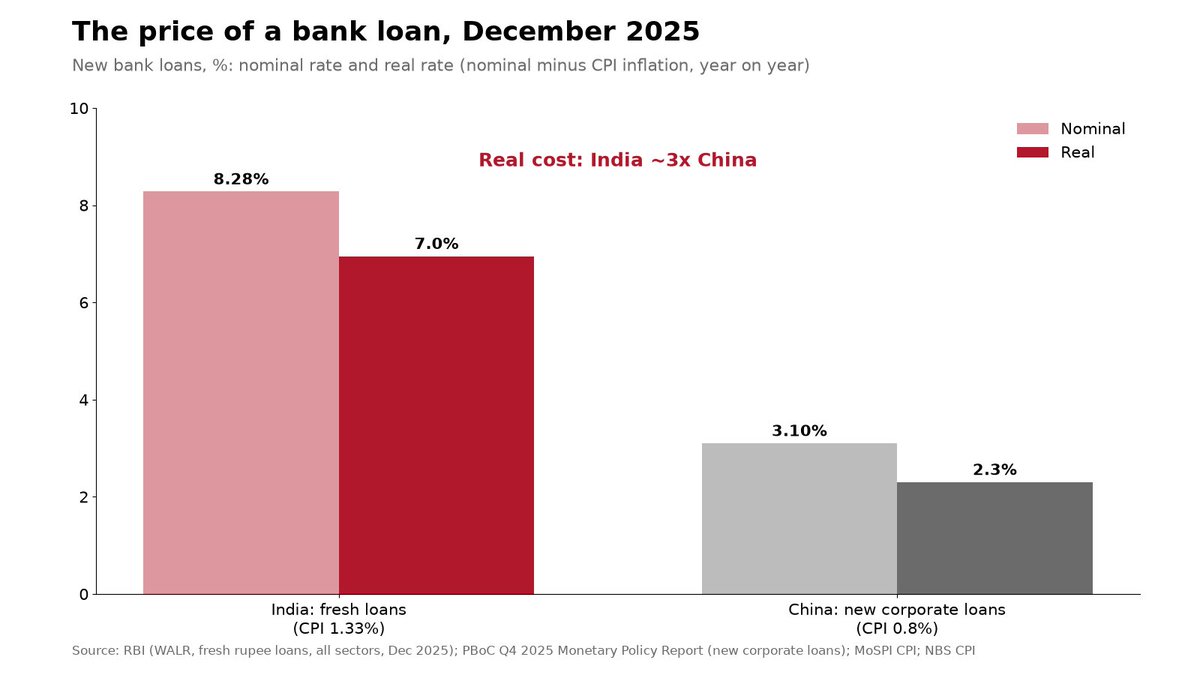
The inflation target sets the price of money high. The RBI's first duty is a 4% consumer-price target. It keeps rates high enough to hit it, whatever that does to the factory. In December 2025, Indian banks charged an average 8.28% on fresh loans2 while inflation ran at 1.33%3: a real rate of about 7%. That month Chinese banks charged companies 3.10% on new loans4, with inflation at 0.8%5: about 2.3% real. The Pune owner pays roughly three times the Guangdong owner's real price for credit. In 2018-19 the gap was nearly five times. A listed giant can also raise equity, and China's volatile stock market makes capital dearer. But most Indian factories are not listed. For them, the bank rate is the cost of capital.
-
Who the rulebook starves. Measure the full cost of capital for India's listed giants, mixing bank debt with equity, and India looks no dearer than China: Chinese shares swing so wildly that equity there is expensive. But only 2,720 companies6 are listed on the National Stock Exchange. India has 19.7 million small manufacturing enterprises7, and they cannot sell shares. These are the workshops that should become India's Toyotas and Samsungs. They live on bank credit, when they can get it at all, and in real terms that credit costs them about three times what it costs a Chinese rival. The rulebook does not starve Reliance or Tata. It starves the firms that would have grown into the next Reliance and Tata. That is how a country ends up with a few world-class conglomerates and an industrial floor that never rises.
-
Government bonds set the bar every project must clear. The state decides how much it borrows. The RBI's rate regime decides what that borrowing pays, and the SLR makes banks hold it. A bank can earn a safe return by lending to the state. A factory must beat that return before the bank will consider it. Most cannot.
-
The capital rules tell banks what to fund. Under Basel III, a loan to an unrated manufacturer carries a 100% risk weight, rising to 150% for large exposures. A home loan carries 20% to 40%. Government bonds need almost no capital. For the bank, the factory loan ties up two and a half to seven times the capital of a mortgage. So the bank lends for houses, consumption and the government.
-
The reserve hoard tightens the screw. Every rupee printed to buy dollars for the US$734.6 billion war chest must be soaked up again to protect the inflation target. State borrowing sets the floor; sterilisation keeps money tight above it.
-
The factory loses, and China fills the gap. For every rupee of new bank credit to industry, two and a half went to consumption and housing. Add government paper and the ratio nears five to one. Manufacturing fell from 17.3% of GDP to 13.1%. India buys from Guangdong what Pune could not afford to make. That is the material trap of part one.
Map 1. The five rules in red each squeeze a stage of building a factory. The bounty arrives only after output, too late to help.
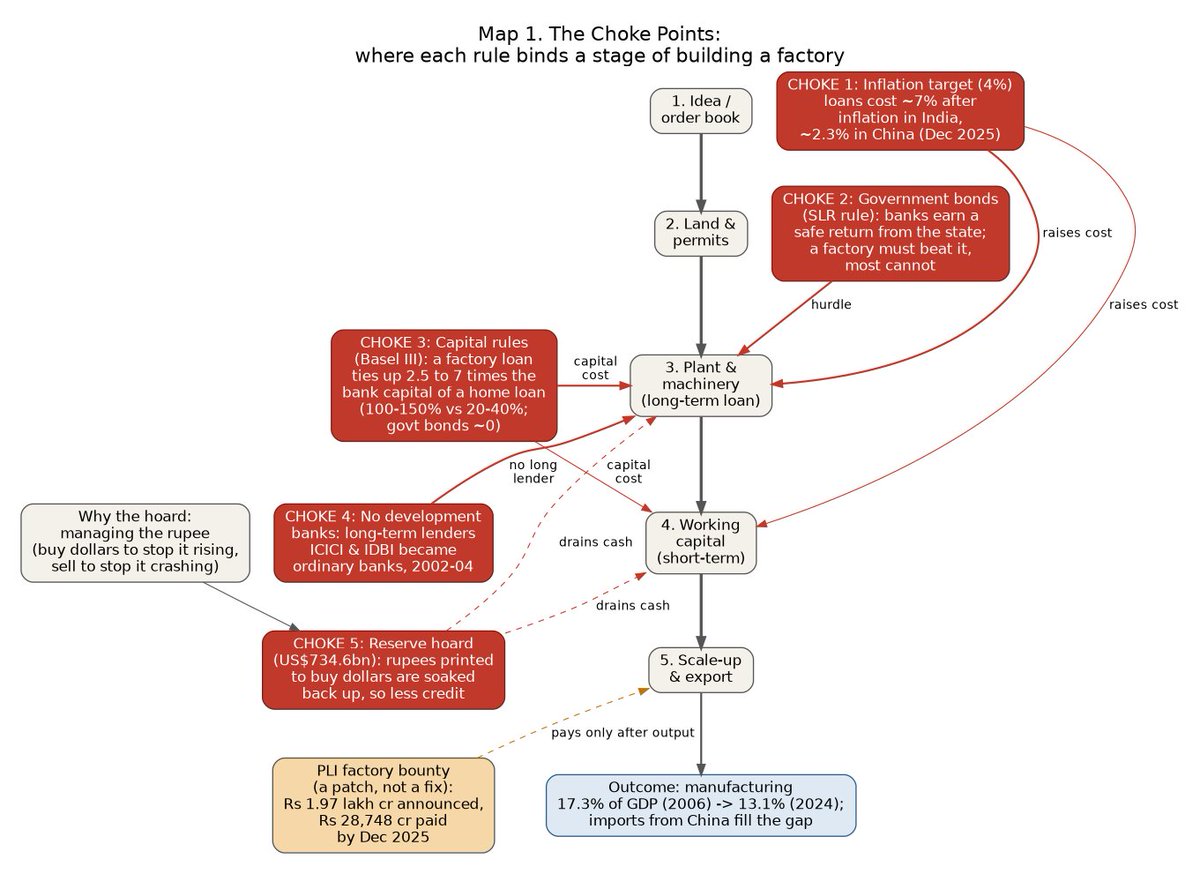
None of these steps is a market accident. Each is a rule the state writes, and the central bank sets or enforces. Fiscal deficits, land, power and the bad-loan clean-up add weight. But central banking is not one cause among any. It is the load-bearing wall.
What I am explaining is for the love of India. It is the formula that has undone the West, and it will undo India if left unchecked.
This is not a window India missed. The rulebook is present tense: it keeps the window shut every year. It's the delusional rulebook of 21st-century central banking; it is a monetary virus that destroys the industrial economy.
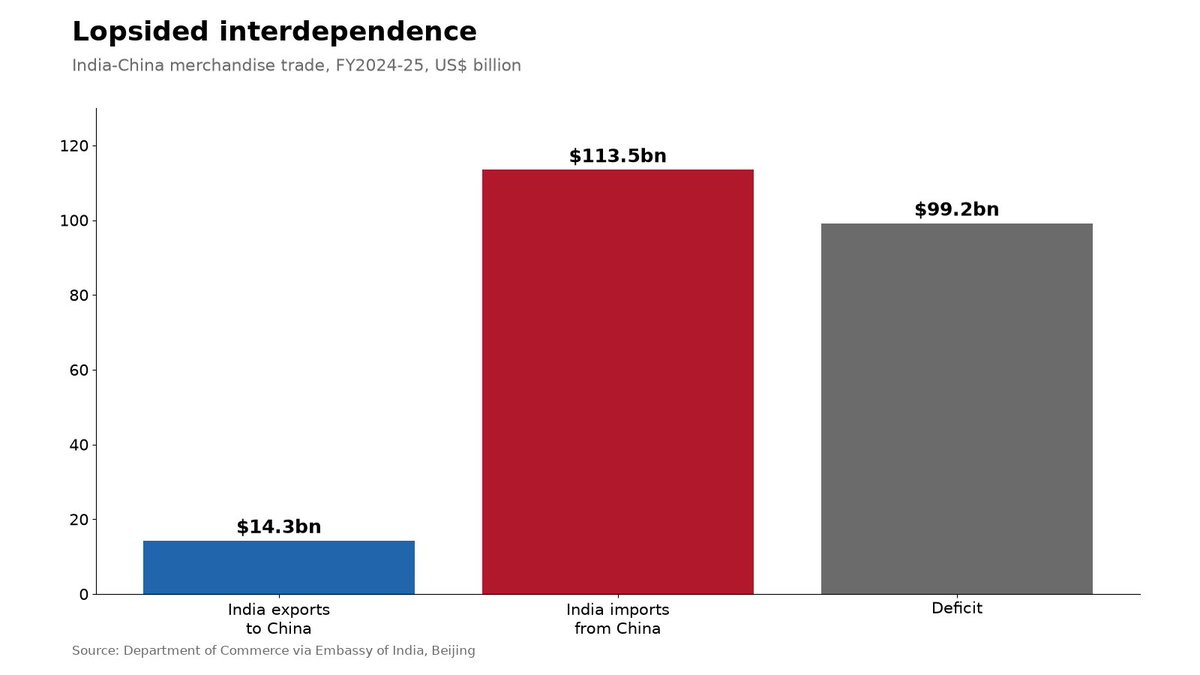
Interdependence does not answer it: it is lopsided when one side holds the money, and the other holds the matter. The state is building infrastructure. The Union spent Rs 9.49 lakh crore on capital works in 2023-248. But the rules starve the private factories that would plug into it.
India-China trade, FY2024-25. Source: Department of Commerce.
A nation keeps two sets of accounts. One counts money. The other counts what the country can make. India keeps both, and runs them as two ledgers.
The Financial Ledger: credit, bond portfolios, asset prices, foreign exchange reserves, and paper wealth.
The Material Ledger: factories that make complex goods, the smelters, the supplier networks, and the skilled hands that run them.
A healthy system expands the first to serve the second. The Tindale Trap springs when the official rules cut that link. India secures the Financial Ledger and liquidates the Material Ledger. The mechanism is entirely self-inflicted.
The Mechanical Trap
In 1998, the Narasimham Committee on banking reform9 recommended that development finance institutions become banks. Between 2002 and 2004, India converted its dedicated development banks, ICICI and IDBI, into standard commercial banks.
The CPI Blind Spot
The trap begins with the anchor. In 2016, Parliament amended the RBI Act to mandate a flexible headline consumer price inflation target of 4%.
India's headline CPI is dominated by food. Food and beverages carried a weight of 45.86%10 in the 2012-base index that governed the entire inflation-targeting decade. Food prices in India jump with monsoon failures, onion harvests, and global edible-oil shocks.
Raising the policy rate does not make it rain. It does not grow onions. Mehangai pyaz ki, sazaa factory ko: the inflation is in onions, but the factory takes the punishment. But the rulebook binds the monetary committee to the headline number. When food prices spike, rates go up. The cost lands directly on the borrower trying to build a factory.
This creates a real cost of capital that East Asia's builders never tolerated. Measure the rate builders actually pay, using the RBI's weighted average lending rate (WALR) on fresh rupee loans11. In 2016-17, the WALR stood at 9.74% against an average CPI inflation12 of 4.5%. That is a real borrowing cost of 5.2%. In 2018-19, WALR was 9.69% against 3.4% CPI, pushing the real rate to 6.3%. In 2023-24, WALR stood at 9.37% against 5.4% inflation. That is still 4.0% real.
Real lending rates. Sources: RBI; World Bank; PBOC LPR.
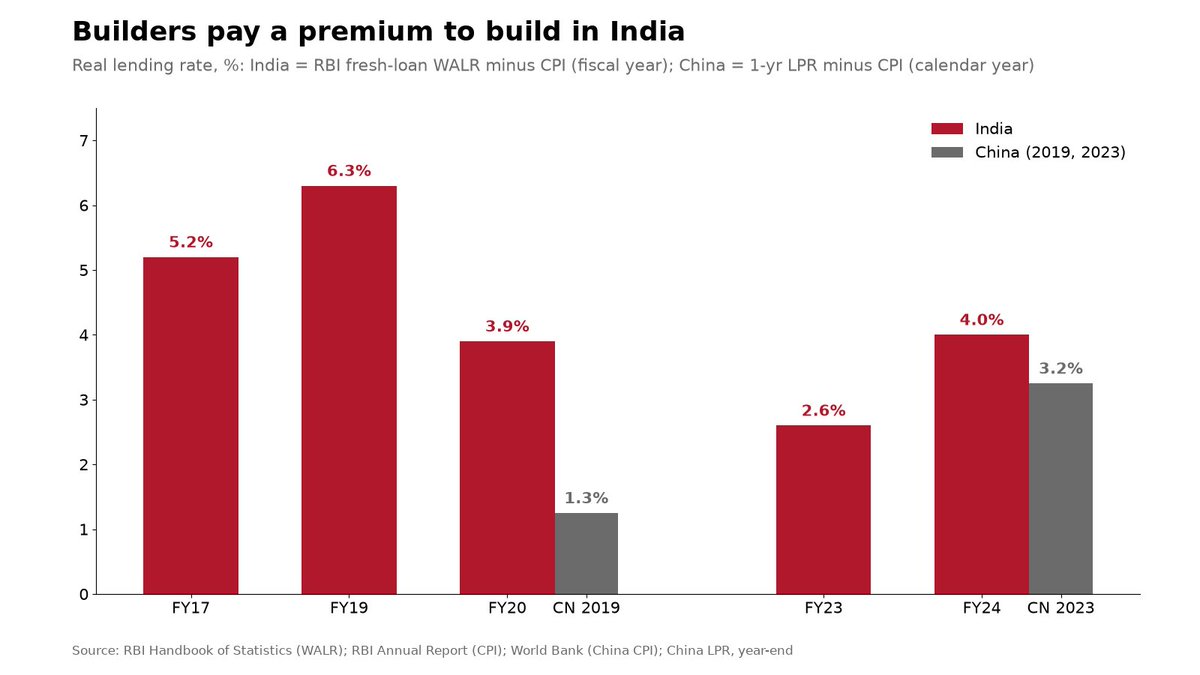
Compare that to the country holding the reins. China's benchmark one-year loan prime rate was 4.15% at the end of 2019 against 2.9% inflation13. The real cost to build in China was roughly 1.3%. In 2018-19, India's builders paid nearly five times China's real price for credit. That premium sits in the margin banks charge over the policy rate, and the rulebook sets it: capital charges on industrial loans, and a sovereign that soaks up bank balance sheets.
In plain English: India punishes the factory for the price of onions.
The Regulatory Funnel
The RBI enforces Basel III capital rules on Indian banks. These rules weight lending entirely by perceived financial risk, blinding themselves to productive capability.
Under the RBI's Master Direction on Basel III14, a loan to an unrated corporate manufacturer carries a 100% risk weight. If the banking system's aggregate exposure to that company exceeds Rs 500 crore, the penalty jumps to a 150% risk weight.
RBI Basel III risk weights. Source: RBI Master Direction; RBI circulars.
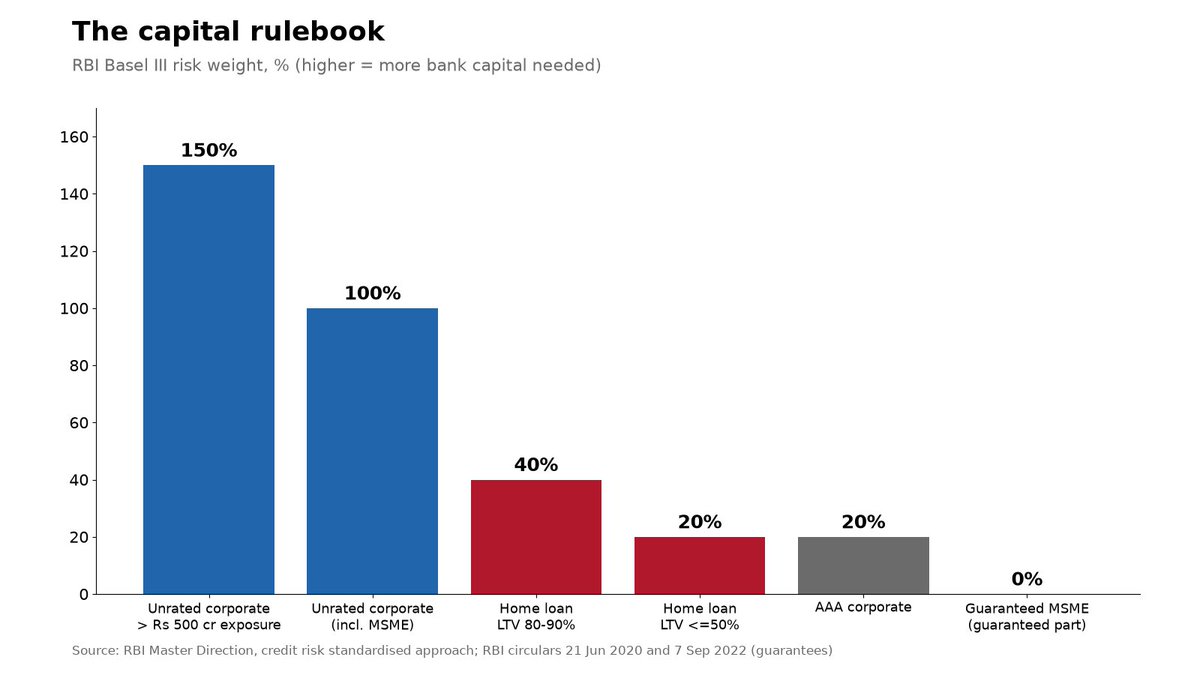
Zero-weight state guarantees for small firms prove the rule: the state must stand behind the loan before the bank will fund the builder.
Manufacturing was 17.3% of GDP in 200615, as part one showed, and 13.1% by 2024. India's post-2013 bad-loan clean-up and corporate deleveraging deepened the slump. The rules rightly tightened during that clean-up. Then they jammed shut on the clean firms that followed. The credit gap widened; the cost gap persisted.
The human count is starker. On CMIE data analysed by Ashoka University's CEDA16, manufacturing employed 51 million Indians in 2016-17, the year the inflation target became law. By 2020-21 it employed 27.3 million. Some 24 million factory jobs were gone in four years.
Conversely, loans for individual housing carry incredibly light capital charges. They sit at just 20% for conservative loan-to-value ratios, scaling gently to 40% for 80-90% LTVs17. Government bonds require virtually no capital at all.
The rational bank follows the maths: government bonds, top-rated corporate paper and a tidal wave of retail and housing debt. A AAA conglomerate can issue bonds or borrow abroad. The small manufacturer has one door, the bank, and Basel III narrows it. The RBI's own expert committee on MSMEs18, chaired by U.K. Sinha, put the sector's credit gap at Rs 20 to 25 lakh crore in June 2019.
In plain English: a factory loan costs a bank up to seven times the capital of a home loan, so the bank builds houses.
The Reserve Hoard Hurdle Rate
India buys dollars. It built a massive war chest to reassure foreign capital.
Heavy government borrowing and the bonds banks must hold under the SLR set a high floor under the cost of capital: the Rs 22.7 lakh crore of new bank lending to the government counted below.
A bank earns a safe return on that paper. It does not need to fund a smelter. The reserve hoard is the new Lagaan, the old colonial land tax: a permanent tribute, paid in lost factories, to reassure Western bondholders.
In plain English: when the government pays banks a safe return, the factory must beat it, and most cannot.
The Bank Substitution Ratio
The bank substitution ratio measures how the rulebook diverts credit away from the factories that have only the bank.
The RBI's Sectoral Deployment of Bank Credit19 exposes the trap. Capital flows to paper. Adjust for the accounting noise of the July 2023 HDFC merger, and the scale is staggering. Between March 2021 and March 2025, outstanding personal loans grew by about Rs 25.3 lakh crore. Credit to industry grew by just Rs 10.0 lakh crore. For every rupee that went to building capacity, two and a half went to consumption and housing.
The bank substitution ratio. Sources: RBI Handbook Table 45; RBI ulletin.
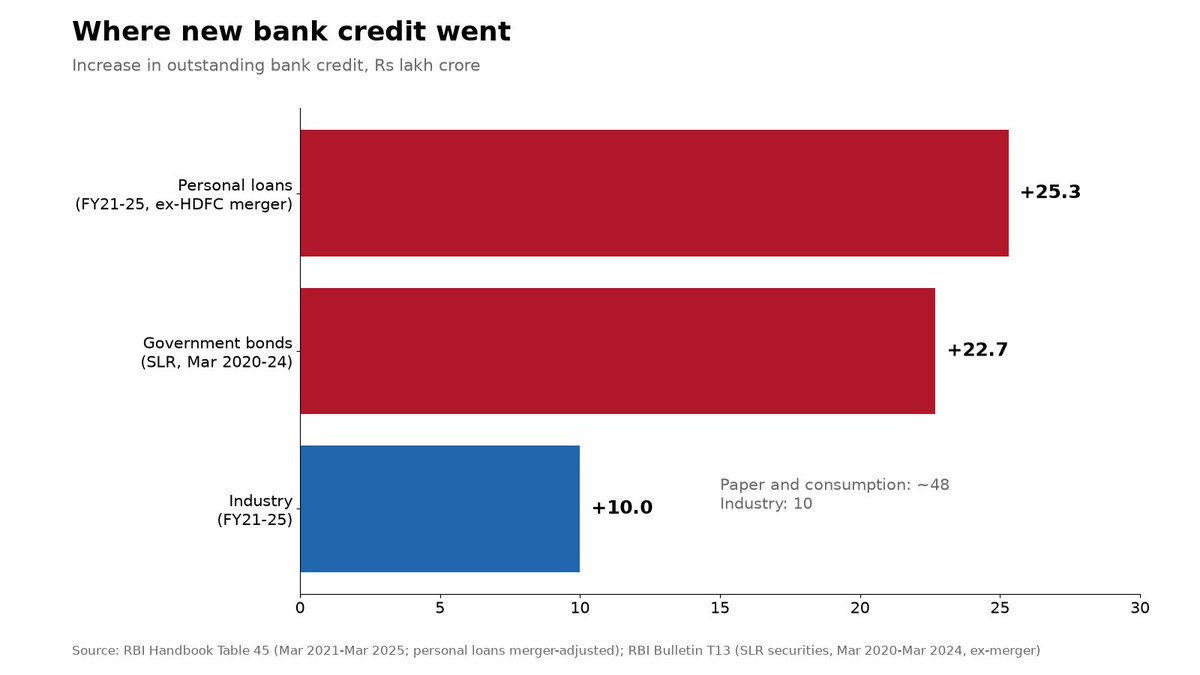
Then add government paper. Banks' SLR securities20 stood at Rs 37.5 lakh crore in March 2020. By March 2024 they were Rs 60.2 lakh crore21, excluding the merger. That is Rs 22.7 lakh crore of new lending to the sovereign in four years.
Combine the two. New bank credit to personal loans and government securities totalled roughly Rs 48 lakh crore. The substitution ratio approaches five to one. The inevitable result: industry's share of non-food bank credit collapsed from 45.8% in 2013 to about 22-23% in 2025.
Map 2. Where India's savings go: to housing, consumption, government bonds and US Treasuries, with little left for factories.
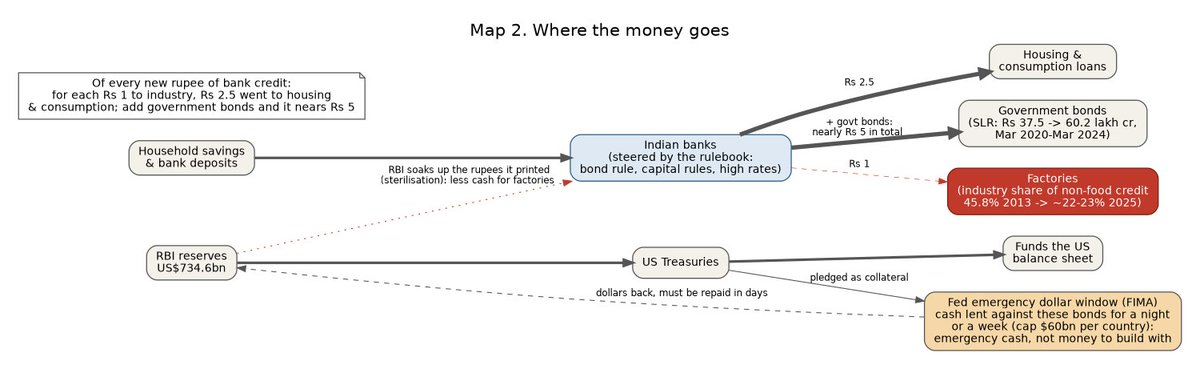
In plain English: two and a half rupees to housing and consumption for every one to industry.
The Bounty vs. The Rulebook
India knows its factories are starving. Its answer is the Production Linked Incentive (PLI) scheme.
This is a bounty: a fiscal band-aid over a monetary wound. The state announced a Rs 1.97 lakh crore outlay22. By December 2025, the scheme disbursed just Rs 28,748 crore23. Oonth ke munh mein jeera: a cumin seed in a camel's mouth.
PLI promised vs paid. Source: PIB.
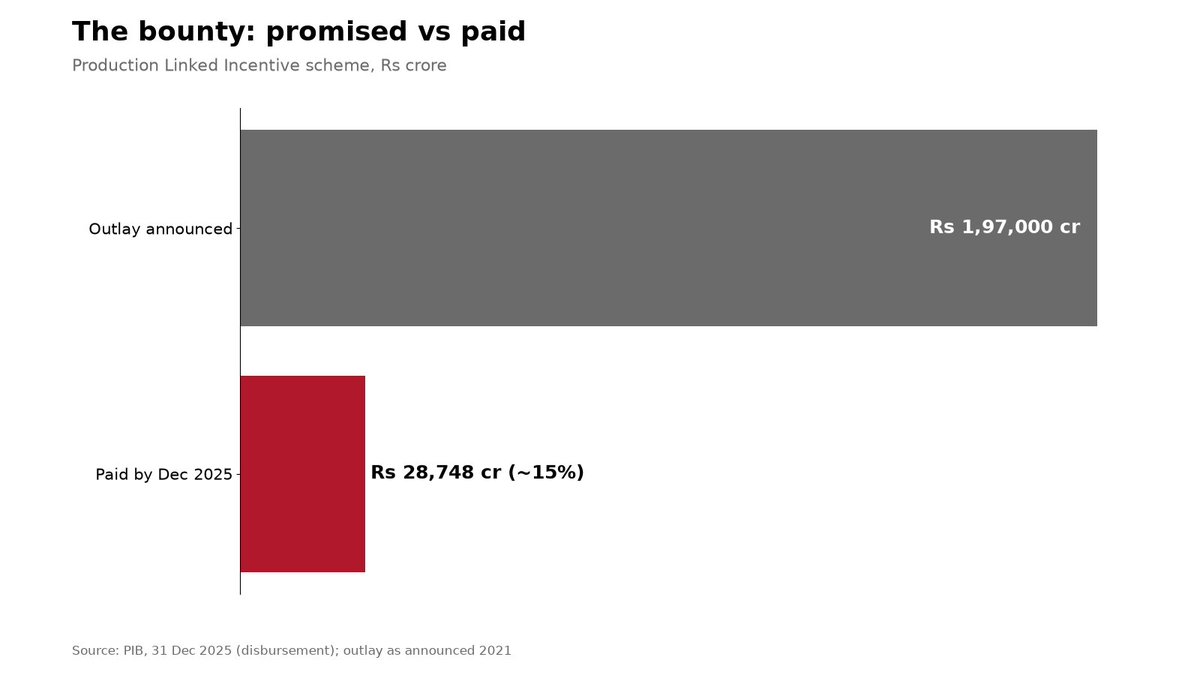
Measure that subsidy against the lending. The state handed out Rs 28,748 crore in PLI bounties while the banking system pumped Rs 48 lakh crore of new credit into personal loans and government securities. The bounty is about 0.6% of the paper credit surge. That is a subsidy set against a lending flow; the point is scale, not equivalence.
You cannot subsidise your way out of a monetary trap. A fiscal incentive cannot overcome a permanent penalty on industrial capital created by the banking rules themselves.
In plain English: the state hands out rupees with one hand while the rulebook takes far more with the other.
The Imported Creed
Why would a nation with India's industrial tradition adopt rules that starve its own factories?
Because its central bankers were taught to believe in them. The rulebook is not a neutral technology. It is a creed, and India's monetary leadership was indoctrinated in it through Western education.
The West is no different; the US has also been blinded by wrong-headed delulu ideas . The idea that it only makes sense to make things where prices are lowest eventually leads to total deindustrialisation. It leaves a country at the behest of its foreign rival.
Look at who built the regime. Raghuram Rajan, governor from 2013, earned his doctorate at MIT, taught finance at the University of Chicago, and served as chief economist at the International Monetary Fund. Eight days into the job, he set up the committee that rewrote India's monetary framework. Its chair, Urjit Patel, studied at the University of London and Oxford, took his doctorate at Yale and spent five years at the IMF. The committee's January 2014 report asked for a 4% consumer-price target. Parliament wrote it into law in 2016, and Patel became governor that September to run it. Sanjay Malhotra, today's governor, holds a Princeton master's in public policy.
The creed no longer needs a foreign degree to survive. Shaktikanta Das, a St Stephen's postgraduate and career civil servant, kept the regime intact for six years. That is how a belief system works: once installed, people defend it as dogma, even if they never studied it. The dogma hardens; then questioning it becomes apadharma.
Its record in the West is plain. The same creed, price stability first, capital rules that favour paper over plant, and money that counts reserves but not smelters, has hollowed out the democracies that wrote it. I have shown the pattern in Australia and South Africa: the financial ledger grew while the factory floor shrank. India's central bankers keep the faith while the evidence runs the other way. That is not prudence. It is delusion.
Washington has already walked away. At the World Economic Forum on 21 January 2022, Treasury Secretary Janet Yellen named a new American strategy, "modern supply side economics"24, and said deregulation "has a similarly poor track record". Congress then passed the CHIPS and Science Act, authorising about US$280 billion, and the Inflation Reduction Act, about US$391 billion for energy and climate25 by the Congressional Budget Office's final count, to steer capital into American plant. India still keeps a creed its teachers have abandoned.
Washington Breaks Its Own Rules, in Plain English
Map 3. Left: how Washington props up its own bonds. Right: India's ther path, moving reserves into industry.
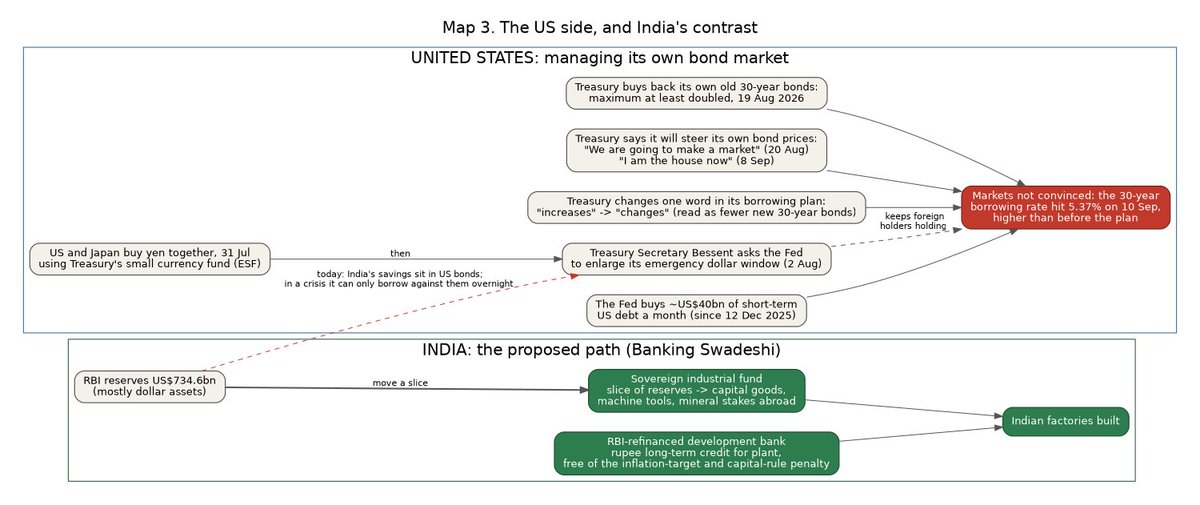
India is told to keep its savings safe in American government bonds. Look at what America is doing to them.
On 19 August 2026, the US Treasury said it would at least double the maximum it buys back of its own long-dated bonds. The next day Treasury Secretary Scott Bessent said: "We are going to make a market in these." On 8 September he said: "I am the house now." Treasury's borrowing plan changed one word, from "increases" to "changes", which markets read as fewer new 30-year bonds. Bessent also asked the Fed to enlarge its emergency window that lends foreign central banks dollars, overnight or for a week, against the US bonds they already hold. That is emergency cash, not money to build with. The market was not convinced. On 10 September the 30-year rate closed at 5.37%, higher than before the plan began.
The rulebook's own authors bend it when their bonds are at stake. India's US$734.6 billion helps fund that balance sheet. India could instead move a slice into a sovereign industrial fund for machine tools and mineral stakes, and lend long to its factories in rupees through a development bank refinanced by the RBI.
In plain English: America manages its own bond market to protect itself. India should spend its savings building itself.
It came the way colonial authority always came: through the classroom. In his 1835 Minute on Education, Thomas Macaulay set out to form "a class of persons Indian in blood and colour, but English in tastes, in opinions, in morals and in intellect."26 The deference he planted survives as an inferiority complex, manasik gulami, mental slavery: if Washington, Basel and Chicago say it, it must be right. That is the opposite of Swadeshi.
The Warning of Hamilton, Coxe, and List
Breaking this trap requires structural finance.
Alexander Hamilton laid this out in his Report on the Subject of Manufactures27, sent to the US Congress in 1791. "To maintain, between the recent establishments of one country and the long-matured establishments of another country, a competition upon equal terms, both as to quality and price, is in most cases impracticable. The disparity in the one or in the other or in both must necessarily be so considerable as to forbid a successful rivalship without the extraordinary aid and protection of government."
Alexander Hamilton, by John Trumbull, 1806. Public domain.

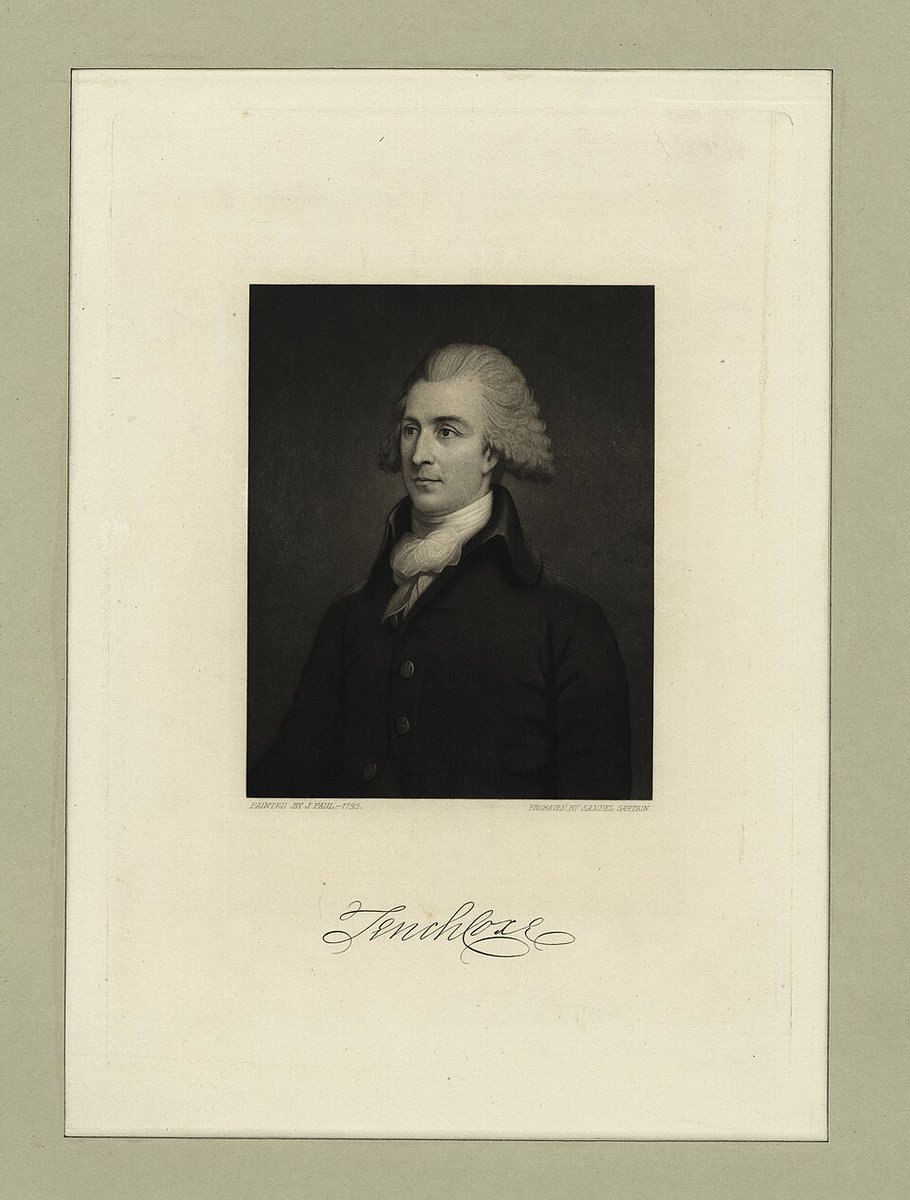
Tench Coxe, Hamilton's assistant at the Treasury, argued in 1787 that true independence required physical production and certain supplies in time of war.
Tench Coxe, engraving. NYPL. Public domain.
Friedrich List, who lived in Hamilton's America from 1825, turned it into a theory of national productive power in his 1827 Outlines of American Political Economy28.
Friedrich List, by Josef Kriehuber, 1845. Public domain.

India's Hamiltonians
India had its own Hamiltonian tradition. It forgot it.
That tradition predates Hamilton by some two thousand years. The Arthashastra, attributed to Kautilya, puts the Material Ledger first. In R. Shamasastry's 1915 translation29, the king's treasury and army are "obtained solely through Varta": agriculture, cattle-breeding and trade (Book I, ch. IV). Book II is blunter still: "Mines are the source of treasury; from treasury comes the power of government; and the earth whose ornament is treasury is acquired by means of treasury and army."30 (ch. XII).
Arthashastra palm-leaf manuscript, Grantha script, c. 16th century, found 1905 (Oriental Research Institute, Mysore). Public domain, Wikimedia Commons. No authentic portrait of Kautilya exists.

For two millennia, Indian statecraft understood that you cannot worship Lakshmi, wealth, while starving Vishwakarma, the builder. Today's central bankers have banished Vishwakarma entirely.
Dadabhai Naoroji identified the original Material-vs-Financial ledger imbalance in his 1901 work Poverty and Un-British Rule in India. His drain was imperial extraction. Today's drain is domestic financialisation.
Dadabhai Naoroji, 1892. R.M. Richardson & Co.

M.G. Ranade served as the intellectual bridge. In his 1892 lecture on Indian Political Economy, Ranade drew on List to dismantle the British imposition of free-market orthodoxy on a backward economy. "There is a decided reaction in Europe against the laissez-faire system," Ranade declared. "It was the writings of List, which gave the fullest expression to this rebellion against the orthodox creed."
M.G. Ranade, before c.1900. .

M. Visvesvaraya, India's great engineer, spent his life warning his country of its structural flaw. His oft-repeated slogan31 was "Industrialise or Perish." Surveying the colonial economy in the 1930s, he identified the core disease: "While industrialisation is being discouraged in one direction, ruralization is growing without any attempt to arrest it in the other."

M. Visvesvaraya, c.1890..
Structural finance is often written off as a socialist error of the Nehru era. That misreads Indian economic history. India's leading capitalists demanded it. Even Nehru, opening India's first rare-earths plant at Alwaye in 1952, called money "terribly overrated" as a way to buy industry.
The 1944 Bombay Plan32, signed by industrialists including J.R.D. Tata and G.D. Birla, demanded directed investment and money created through the Reserve Bank. They set a massive physical target: raise industry to approximately five times the present output.
J.R.D. Tata, 1955. ).

G.D. Birla (left) with Vallabhbhai and Manibehn Patel, 1946. Margaret Bourke-White.

They knowingly accepted the price risk. Financing development "by means of 'created money' on this scale is likely to lead to a gap between the volume of purchasing power in the hands of the people and the volume of goods available."
Their answer: "How to bridge this gap and to keep prices within limits will be a constant problem which the planning authority will have to tackle."
The capitalists of 1944 put the Material Ledger first. Today's regulators put the Financial Ledger first.
Five Terms in Plain Words
-
Risk weight: the share of a loan a bank must back with its own capital, so a high weight makes a loan expensive for the bank to hold.
-
SLR (statutory liquidity ratio): the rule that makes Indian banks keep a set share of their deposits in government bonds and other approved safe assets.
-
Sterilisation: the central bank soaking up the rupees it printed to buy dollars, so its reserve building does not loosen money at home.
-
Real interest rate: the interest rate minus inflation, the true price a borrower pays for credit.
-
Inflation targeting: a regime in which the central bank's first duty is to hold consumer-price inflation at a set number, 4% in India, and it moves interest rates to get there.
The Choice
China retained the modern equivalents of the instruments Hamilton, Coxe, and List recommended. It directed credit. It protected industry. It tolerated financial friction to build physical dominance. Korea did the same. Its 1973 National Investment Fund law, in force from 1974, made banks and savings institutions put money into a fund that lent long and cheap to steel, shipbuilding, machinery and petrochemicals. India adopted a financial architecture built for fully industrialised Western economies, but with the opposite hierarchy.
The RBI’s mandate today is price stability. It cannot fix this alone. The trap requires deliberate, coordinated action to break the rules:
-
Retarget the Anchor: Shift the mandate to core inflation. A failed monsoon must never dictate the cost of building a steel mill.
-
Tilt the Risk Weights: Override Basel III. Slash capital charges for verifiable manufacturing capex. Raise them punitively for unsecured retail lending. Zero-weight guarantees are not enough; the default weight itself must change.
-
Make Priority Lending Real: Eliminate the paper trading of priority sector certificates. Force banks to finance measured physical capacity. Tie directed credit to export and output targets, and withdraw it on failure.
-
Defensive Trade Architecture: Deploy targeted tariffs to protect infant capacity in electronics, solar, and pharmaceuticals until scale is achieved.
-
Manage the Capital Account: Treat portfolio hot money as a destabilising cost to the real economy, not a central banking trophy.
India won the prize of the Financial Ledger: a record reserve hoard, global bond index inclusion, and credibility with Western bondholders.
The cost of that prize is a starved factory: two to three weeks of rare-earth magnets, and APIs that cross the border from a rival. You cannot buy a signature from Beijing with US$734.6 billion. You can only render that signature irrelevant by building the physical capacity yourself. To do that, India must tear up the rules that forbid it to build.
India needs a new nationalism, and it must be material. Not the nationalism of flags, parties or faith. The older swadeshi line runs from Kautilya's treasury filled by varta, through Naoroji's drain, Ranade's case for state aid and Visvesvaraya's engineers, to the capitalists who signed the Bombay Plan. None of them asked who governed. They asked what the country could make.
In a January 1908 speech, Sri Aurobindo, the firebrand behind Bande Mataram, put it plainly: "Swadeshi is the method, the way, the road by which the nation advances."33 He meant goods made by Indian labour in India, not sentiment.
He is a man dear to my heart: I studied at his ashram in Pondicherry in the 1980s, which is where I fell in love with India . His road ran through looms and workshops. Today it runs through smelters, and the Western banking rulebook blocks it.
Clearing it takes a banking Swadeshi: India writing its own banking rules that count the material ledger, with capital weights that stop punishing factory loans, a policy rate set for builders as well as prices, and credit steered to plant and machinery. It begins as a Swadeshi of the mind: judging the rulebook by what it builds in India, not by who taught it.
Sri Aurobindo in Baroda, 1908. Public domain.

True Atmanirbhar Bharat is not counted in foreign exchange reserves or credit ratings. It is counted in furnaces, fabs, presses and the hands that run them.
Self-reliance moves only when credit moves. A material nationalism puts capacity before paper and judges every government, of every party, by the same ledger.
India's next nationalism must be measured in smelters, not slogans.
Visvesvaraya's slogan was a choice, not a prophecy: subordinate the financial rules to capacity building, or accept dependence. India answered it once in 1944. The Western banking rulebook has answered it the other way every year since 2016.
The West built a stateless capitalism. By that I mean capital that owes nothing to any nation's factories: money without a country, credit without a factory, central banks answerable to bond markets rather than to the nation. It hollowed out Detroit, Sheffield and Newcastle, where BHP shut the steelworks in 1999, and it is hollowing out India. Washington is already improvising its way out. India can do better than follow.
A civilisation that wrote the Arthashastra, and gave the world Swadeshi, can write the banking rulebook for the century that comes after this one: credit that counts smelters, a central bank that serves the builder, a ledger of matter beside the ledger of money.
India would not walk out alone. The democracies of the Global South are caught in the same trap. South Africa, Brazil and Indonesia all target inflation, all sit on the Basel Committee, and all ship raw materials out and buy finished goods back. The workers of the hollowed-out West are caught in it too: in Australia, in Britain and in America's rust belt, their governments wrote the rulebook and their towns paid for it.
Banking Swadeshi is not India retreating from the world. It is India leading the world out. The Global South can rise, but it must shed this malaise; it must rid itself of this virus. South Africa is no different to India, and the US is just shedding its virus now #BankingSwadeshi
Industrialise, or perish.
Sources
-
https://data.worldbank.org/indicator/NV.IND.MANF.ZS?locations=IN ↩
-
https://www.rbi.org.in/Scripts/BS_PressReleaseDisplay.aspx?prid=62309 ↩
-
https://www.stats.gov.cn/english/PressRelease/202601/t20260112_1962292.html ↩
-
https://www.nseindia.com/mediacoverage/nse-fy24-25-highlights ↩
-
https://mospi.gov.in/sites/default/files/publication_reports/NSS_KI_73_2.34.pdf ↩
-
https://www.indiabudget.gov.in/budget2025-26/doc/Budget_at_Glance/bag6.pdf ↩
-
https://www.rbi.org.in/Scripts/PublicationReportDetails.aspx?ID=251 ↩
-
https://www.mospi.gov.in/uploads/documents/documents/1770891066052-Annexure_V.pdf ↩
-
https://www.rbi.org.in/Scripts/AnnualReportPublications.aspx?Id=1402 ↩
-
https://data.worldbank.org/indicator/FP.CPI.TOTL.ZG?locations=CN ↩
-
https://www.rbi.org.in/ScriptS/BS_ViewMasDirections.aspx?id=13399 ↩
-
https://data.worldbank.org/indicator/NV.IND.MANF.ZS?locations=IN ↩
-
https://ceda.ashoka.edu.in/ceda-cmie-bulletin-manufacturing-employment-halves-in-5-years/ ↩
-
https://www.rbi.org.in/ScriptS/BS_ViewMasDirections.aspx?id=13399 ↩
-
https://www.rbi.org.in/Scripts/BS_ViewBulletin.aspx?Id=19852 ↩
-
https://www.rbi.org.in/Scripts/BS_ViewBulletin.aspx?Id=23276 ↩
-
https://www.crfb.org/blogs/cbo-scores-ira-238-billion-deficit-reduction ↩
-
http://www.columbia.edu/itc/mealac/pritchett/00generallinks/macaulay/txt_minute_education_1835.html ↩
-
https://founders.archives.gov/documents/Hamilton/01-10-02-0001-0007 ↩
-
https://archive.org/stream/in.ernet.dli.2015.62101/2015.62101.M-V-Drvisvesvaraya-1959_djvu.txt ↩
-
https://aurobindoru.auromaa.org/workings/sa/37_06_07/0306_e.htm ↩