Game of skill
For most of the last two decades, coding was the filter.
If you could write good software, you were “smart” in the way the market cared about. Elite universities, top firms and startups all used it as the test. LeetCode became a rite of passage. Competitive programming became a credential.
That filter is breaking.
AI now writes a large share of the code that ships. Not perfectly, but well enough that “can you code” no longer tells you much about who someone is or how they think. When a skill becomes commoditized, it stops being a signal.
So I’ve been asking myself: what replaces it?
The usual answers
Math is the obvious one. But math, at least the kind that gets tested, has clean problems with clean answers, and models are getting very good at clean problems.
Competitive programming? Same issue, and arguably it’s already fallen.
Aptitude tests? They measure something, but mostly how well you take aptitude tests.
All three share the same weakness. They reward finding the right answer when a right answer exists and all the information is on the table.
Real life rarely works like that.
A memory from college
This took me back to my college days.
Poker wasn’t a big thing on campus. But on most weekends, a small group from my dorm would end up around the same table. And looking back, it was almost always the sharpest people in the building.
It wasn’t about the money. The stakes were tiny. It was about the game itself: figuring out what someone else was holding, deciding how much to risk, and living with the result.
At the time I didn’t think much of it. Now I think they were onto something.
Why poker
Poker tests the things that don’t get easier when AI shows up.
Decisions with incomplete information. You never see the full board. You act on probabilities, not certainties, which is what almost every important decision in life looks like.
Reading people. Every bet tells you something. Every hesitation tells you something. You’re modeling another mind in real time.
Risk sizing. It’s not enough to be right. You have to know how much to put behind being right.
Emotional discipline. You can make the correct decision and still lose. Over a single hand, luck dominates. Over thousands, skill does. The players who last are the ones who can tell the difference and not tilt when variance hits.
That last one might be the rarest skill of all. Most people judge decisions by outcomes. Good poker players judge outcomes by decisions.
It’s no coincidence that trading firms have used poker to train and hire quants for years. The game is a compact version of what they do all day.
The world is catching on
It’s not just me thinking this. The UK recently hosted its first quantitative poker hackathon, where people competed on strategy, probability and the models behind good play.
When the people who build markets and models start treating a card game as a serious testing ground, it’s worth paying attention.
What I’m building
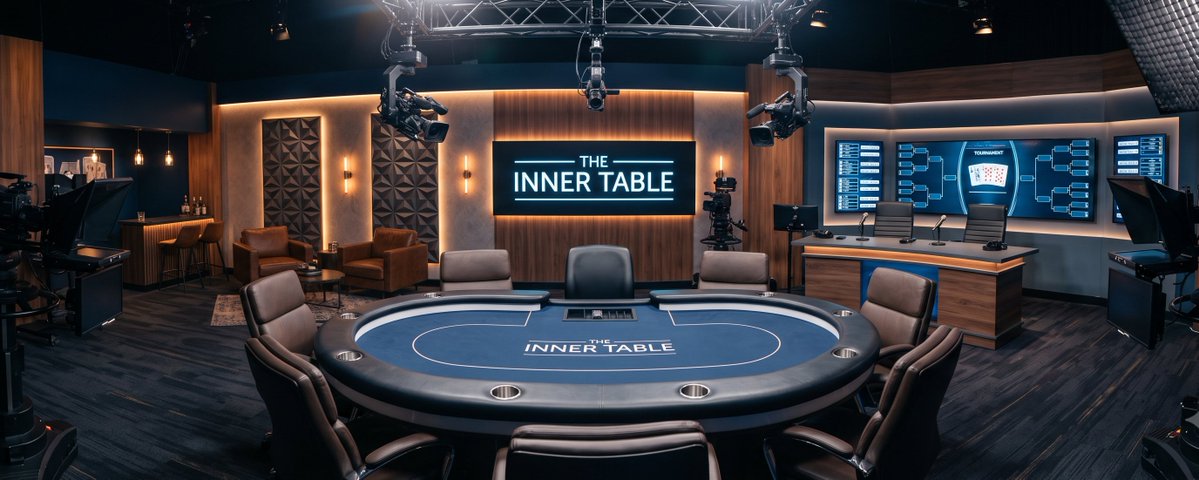
So I’m building The inner table, a poker and entertainment brand focused on one thing - Intelligence
The goal is simple -- make poker a place where people sharpen how they think, not just how they gamble.
Why now
As AI takes over more of the work we used to call “intelligent,” the skills that matter will shift toward judgment, reading people, and handling uncertainty.
Poker has been quietly training those skills for a long time. I want to build the place where that gets taken seriously.
More soon. If this resonates, follow along.