Paper Trade: Game Theory, Strategy, and Outlook
文章目录
Key Findings
-
Papertrade redesigns the peer-to-pool model without LPs. The pool is funded entirely by trader losses, and PAPER, which accrues 50% of fees and all pool earnings above $5 million, incentivizes traders to provide that funding. When the pool cannot pay, winnings convert to first-in, first-out debt.
-
Emissions are countercyclical by design. PAPER mints at 100 per $1 lost, decaying toward 30 as cumulative profit approaches $100 million, but returns back to the maximum whenever the pool falls below $2 million, drawing in losses when solvency is threatened.
-
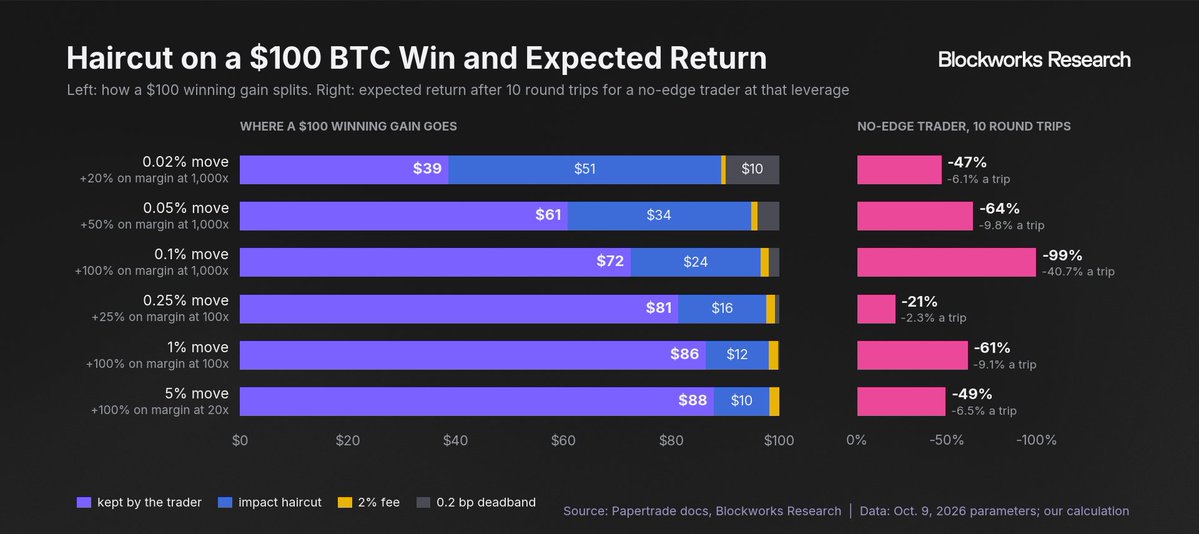
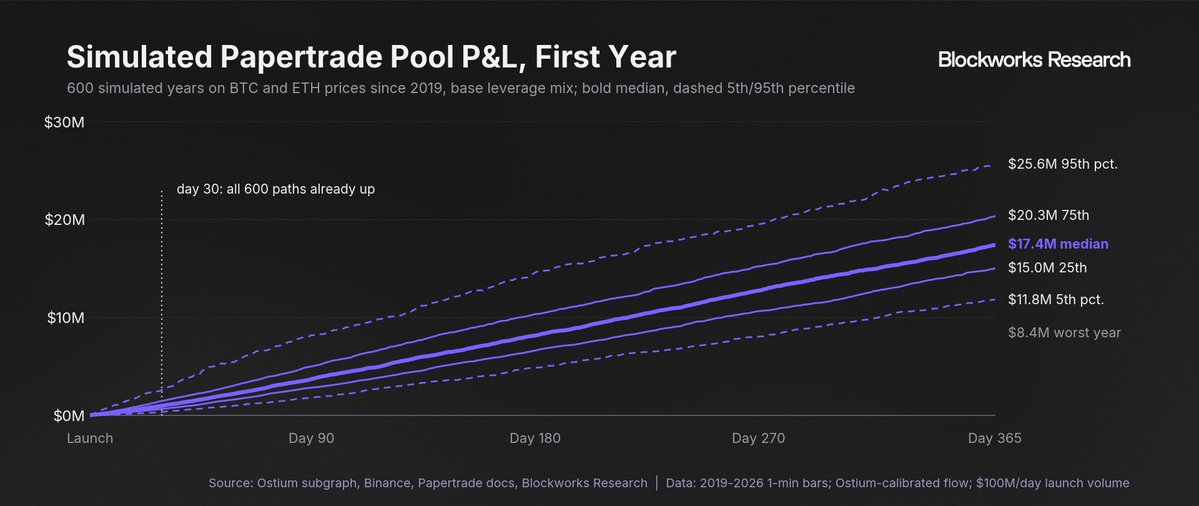
The fee structure gives the pool a structural edge. Winning trades pay 2% of profits plus a 10-50% haircut that rises for smaller moves; in our Monte Carlo simulation, the pool was profitable in all 600 simulated years at a median of $17.4 million annually.
-
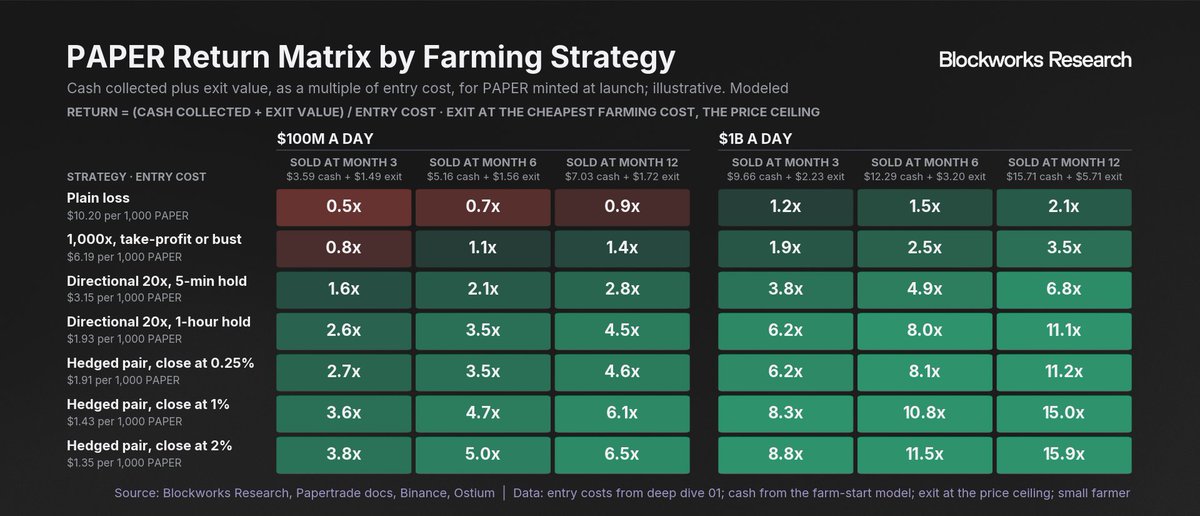
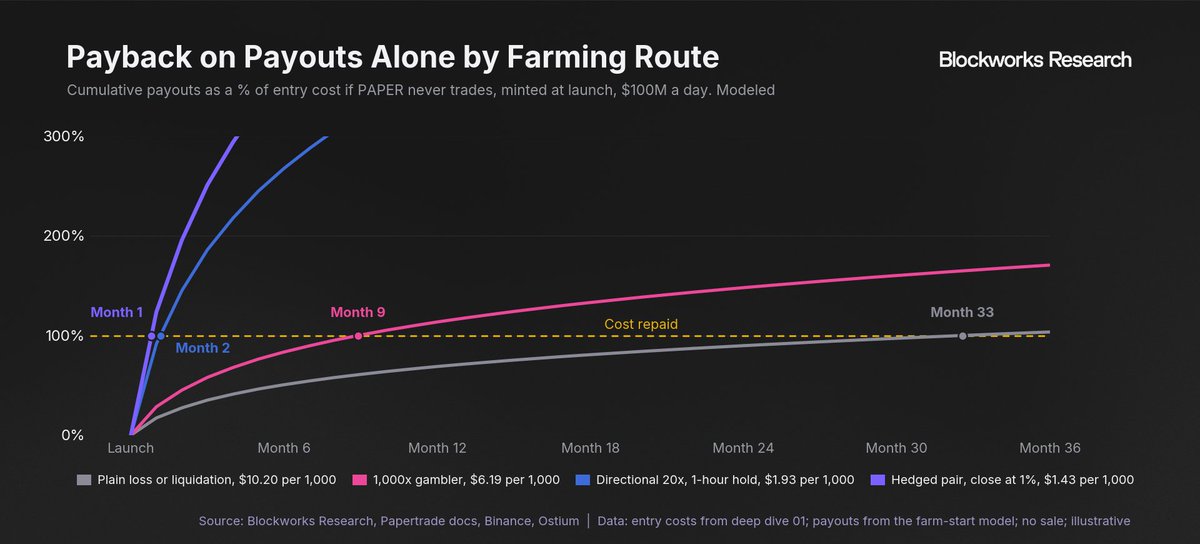
Farming PAPER will likely be lucrative, but only when done strategically. Valuing PAPER at accumulated rewards plus a sale price capped at the cost of farming at the time of sale, delta-neutral pairs return 3.8x their cost on a month-three sale at $100 million of daily volume, and 8.8x at $1 billion. Intentional losses, by contrast, return 0.5x and take 31-33 months to repay on payouts alone.
-
While insolvency risk is reduced, it is not eliminated. The buffer is capped at $5 million, with everything above paid to stakers, so short-term swings can still deplete it; and if queued debt grows large enough to deter trading, the recapitalization incentive fails, leaving the protocol unable to pay in tail events.
Papertrade: Synthetic Liquidity Pool Model
Papertrade is a synthetic perpetual futures platform on Hyperliquid's HyperEVM, offering traders up to 1,000x leverage on BTC and ETH against a synthetic profit pool. Unlike central limit order books, where positions settle between makers and takers, Papertrade employs the pool-based model used by Jupiter's JLP and GMX's GLP, in which synthetic PnL settles between pool depositors and traders.
Pool-based models were prevalent prior to the rise of CLOBs and retain distinct advantages. They are highly liquid, as no market maker is required to take the other side of a trade, and they do not require funding rates. The structure is simple: LPs deposit capital into the pool, and that capital takes the opposite side of traders' synthetic exposure, an arrangement that is generally profitable given that traders tend to lose over time. For example, if a trader opens a 100x long on BTC, there is no price impact and no perpetual position changes hands; the trader's PnL is simply debited from or credited by the pool.
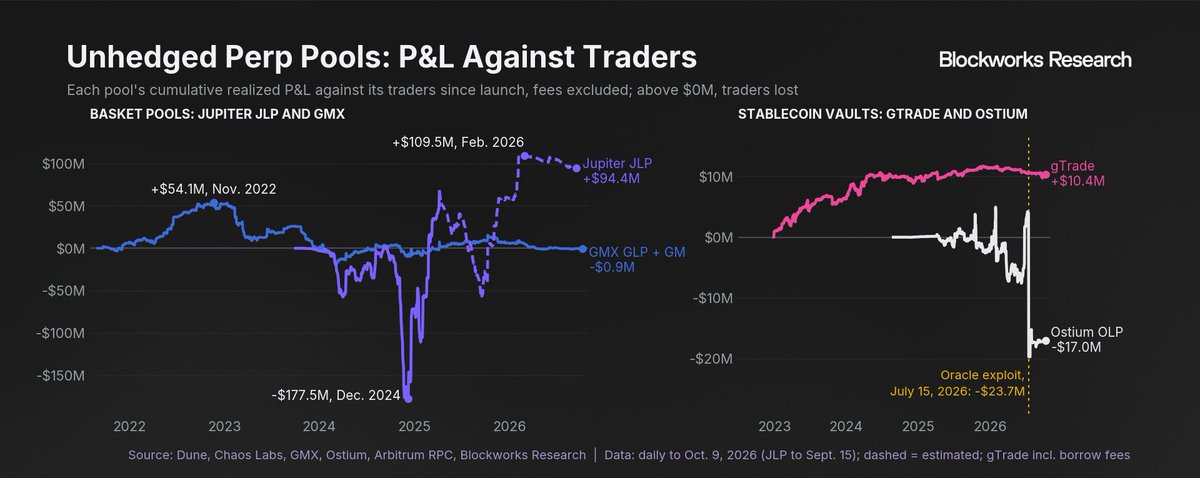
However, the model carries material risks. The pool is entirely passive and cannot react to adverse flow, and its entire premise rests on traders losing over time; in tail events, unhedged exposure can result in substantial losses and, in extreme cases, insolvency, leaving depositors unable to redeem. The model also requires a sufficiently large capital base to reliably pay out profitable traders. As a result, the traditional pool model has largely been superseded by modernized variants, most notably Variational, which nets and hedges positions rather than taking naked directional exposure.
Innovations to the Pool Model
Papertrade, built on Hyperliquid's HyperEVM, is another such modernization: it offers 1,000x perpetuals priced via Hyperliquid's precompiles against HyperCore's BBO. It innovates on the standard pool model in two areas: i) making insolvency survivable, and ii) ensuring liquidity for the counterparty pool.
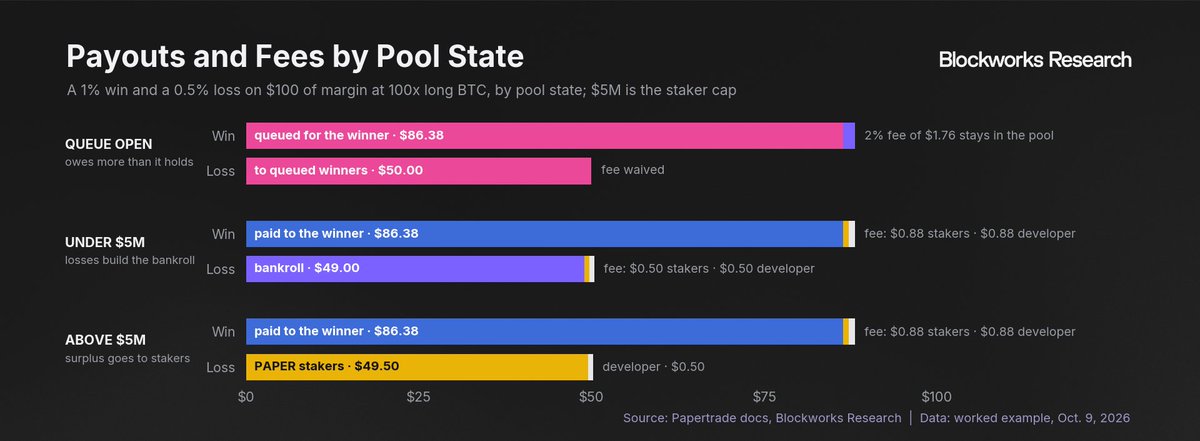
Papertrades counterparty pool accepts no external capital; it is funded entirely by traders' losses. It starts at $0, and since no one can deposit into or withdraw from it, it grows only through losses, which means that even during insolvency, no LP capital is at risk. Losses build the pool up to a $5 million buffer, beyond which further gains are distributed to PAPER stakers.
Traders still take on insolvency risk when trading against the pool; however, the debt owed to them is formalized, and claims are repaid in first-in, first-out order as soon as the pool has capital available.
PAPER's tokenomics create an incentive for traders to subsidize winners' earnings by stepping in to take losses, since PAPER is distributed to losers. Specifically, PAPER is the protocol's native token, launched with zero initial supply and no allocation; it is minted purely to losing traders, in proportion to their losses and at a rate that falls as the pool's cumulative profit grows.
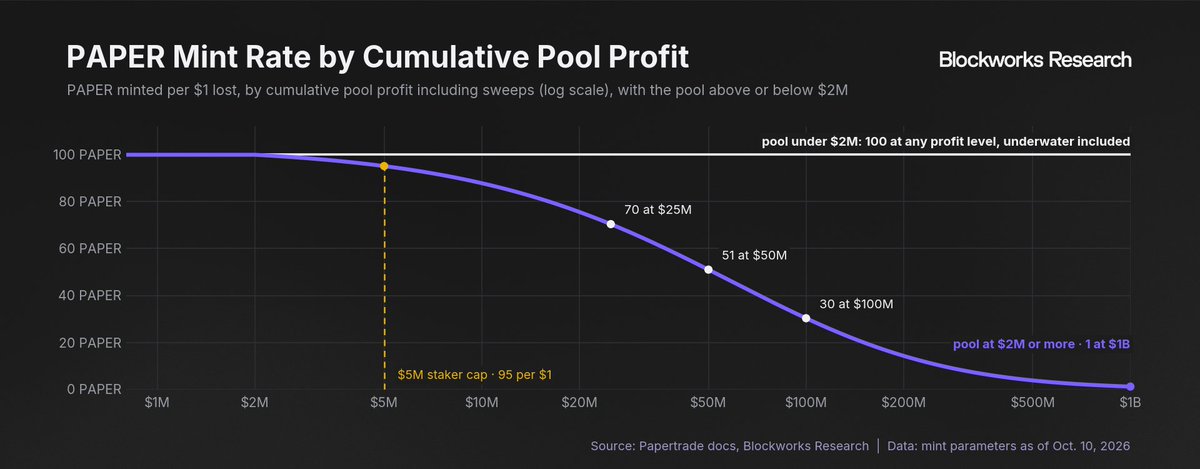
Emissions decay from 100 PAPER per $1 lost toward roughly 30 once cumulative profit reaches $100 million.
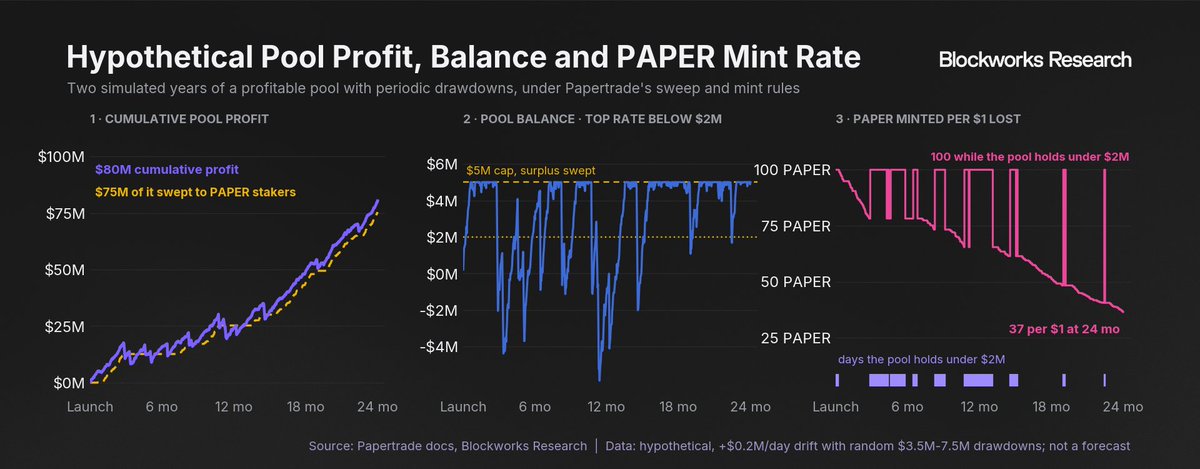
The caveat is that whenever the pool holds less than $2 million and is at risk of insolvency, emissions return to the maximum of 100 PAPER per $1 lost. Because PAPER accrues value, with stakers earning half of every 2% fee and all pool profit above $5 million, the elevated rate incentivizes traders to step in, take losses, and recapitalize the pool whenever it drops to a risky level.
Papertrade Fee Schedule
Alongside the incentive for traders to take on losses, Papertrade's leverage and fee structure make the pool's long-term profitability highly likely.
Papertrade charges no opening, closing, or funding fees; instead, winning closes pay 2% of profits, and a haircut caps the trader's share at 90% of the gain, with the haircut increasing for smaller price moves. For example, consider a trade that earns $100 on $100 of margin: at 1,000x leverage, requiring a 0.1% price move, the trader keeps $72; at 100x, a 1% move, $86; and at 20x, a 5% move, $88.
Over time, this asymmetric payout structure should produce reliably consistent returns for the pool. In a Monte Carlo simulation using Ostium traders' behavior as the sample, scaled to Papertrade's leverage, fee schedule, $74.6 million of pre-deposits, and $100 million of daily volume at launch, the pool finished all 600 simulated years in profit, with a median of $17.4 million ($11.8 million to $25.6 million for the middle 90% of paths), and every path was positive by day 30.
This does not eliminate insolvency risk: everything the pool earns above $5 million is paid out as staking rewards, so its cushion never exceeds that level. Over the long term, however, the pool's cumulative PnL should trend upward, with traders stepping in during periods of shortfall.
PAPER: The Value of PAPER
PAPER receives all pool earnings above $5 million plus half of every 2% fee, so with positive lifetime earnings expected, it is potentially valuable; and because supply starts at zero, the earliest PAPER minted collects the largest share of payouts. It is also structurally inflationary, since the same losses that fund the pool mint new tokens.
PAPER is ultimately worth its future cash flows, diluted by every new token minted, and none of the relevant inputs, from trading volume to the multiple the market will pay, can be known before launch. As an illustration, we test whether early farming pays off under deliberately conservative assumptions: average daily volume of $100 million, and, following deliberate losses until the pool reaches $5 million, pool gains matching those of the Monte Carlo simulation of trader behavior, adjusted for Papertrade's fee schedule. We also include a $1 billion daily volume scenario to show how the dynamics shift at scale.
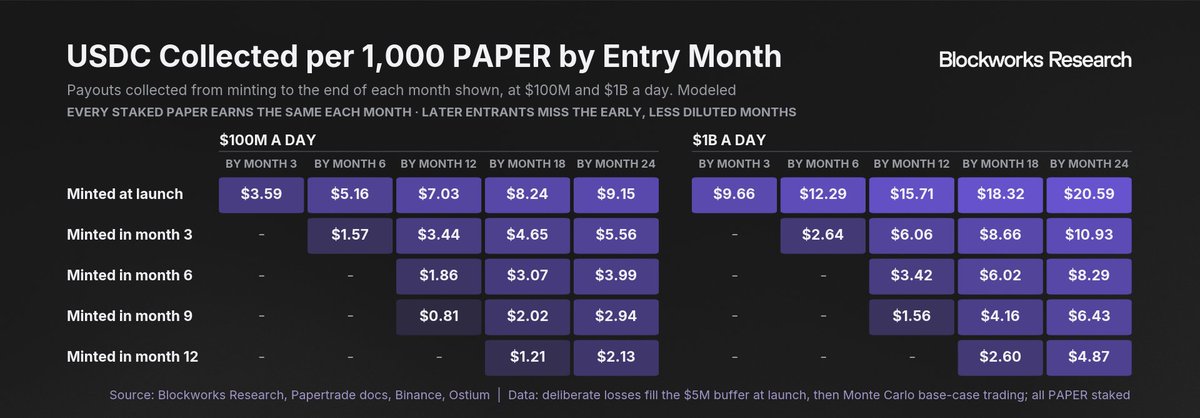
Under these assumptions, payouts are heavily front-loaded: PAPER minted at launch collects half of its first-year payouts within the first three months, before new supply dilutes them. Future cash flows by entry point are shown below.
PAPER is not initially tradable, but assuming it becomes so, its return equals the cash flows received up to the time of exit plus the sale price. We cap the sale price at the cheapest current cost of farming it, on the assumption that PAPER’s price cannot sustainably exceed that cost.
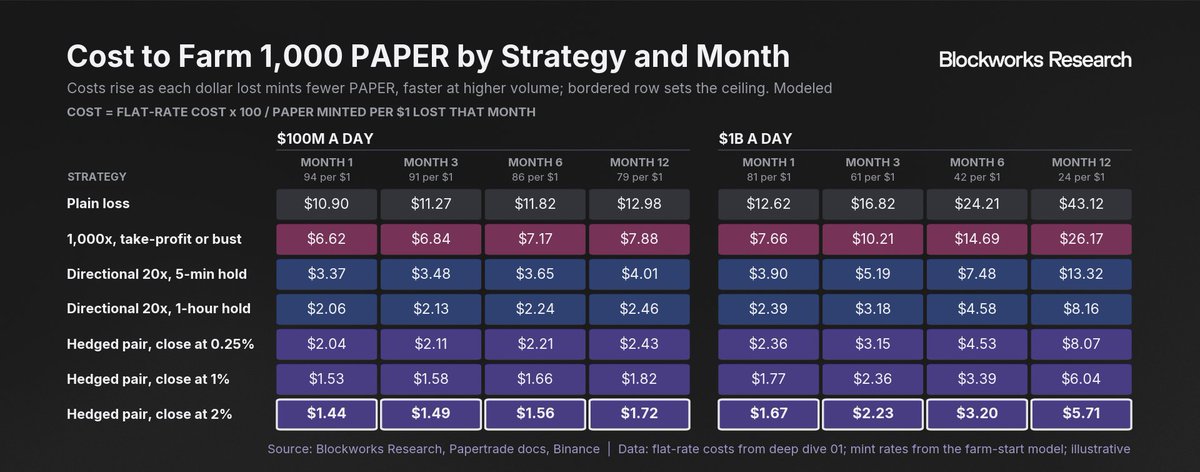
Combining the two, early farming pays only for those who mint cheaply: selling at month three, the cheapest hedged pair returns 3.8x its cost at $100 million of daily volume and 8.8x at $1 billion, while a plain loss returns 0.5x and 1.2x, respectively.
Plain-loss farming carries a further risk: if PAPER never becomes tradable, returns depend solely on payouts, and at $100 million a day a plain loss takes 33 months to repay its cost, against one to two months for hedged pairs and directional trades. Overall, we believe early farming will be profitable, but only with disciplined trades closed at larger moves, ideally hedged to remove price risk; 1,000x gambling or pure loss farming returns little or loses money.
Risks and Strategy
Despite likely positive expected value we still highlight two risks. First, because the pool continuously distributes earnings above $5 million to stakers, there is a risk that it lacks sufficient capital to pay winning traders. This should correct itself as new losses flow in; however, if protocol debt grows large enough, traders may be disincentivized from trading at all, leading to a potential bad-debt scenario in which winners cannot be paid.
Second, activity may be dominated by delta-neutral farming rather than organic trading. Farming provides little net gain to the protocol, since the winning side of a pair redeems roughly what the losing side contributes, while the trade still mints inflationary tokens. That said, we believe organic demand will exist, as traders are effectively subsidized through emissions. In terms of risk, we believe the best strategies are:
-
Migrating existing flow. Provided the pool is sufficiently capitalized, moving trading from a DEX or CEX to Papertrade is generally positive expected value, since the trader's PnL is unchanged but the trade additionally earns emissions.
-
Hedged pairs. For traders bullish on PAPER, paired hedged trades carry positive expected value, though they are not risk-free and depend heavily on sustained volumes.
-
Pure loss farming is not recommended, as it is generally unprofitable.
The information contained in this report by Blockworks Inc. and related affiliates is for general informational purposes only and is not intended to provide legal, financial, or investment advice. The report should not be construed as an offer or solicitation to buy or sell any security, token, or financial instrument and does not represent any recommendation or endorsement of any investment or financial product or service. Blockworks Inc. and related affiliates are not registered as a securities broker-dealer or an investment advisor in any jurisdiction or country.