How to stop working in the next 10 years (the complete guide)

文章目录
Tell me if any of these sound like you:
-
You use AI every day, and you still work the exact same hours.
-
You have more ideas than you will ever execute.
-
You're chasing a goal you never actually chose.
I was all three.
Today my work is only speaking and thinking. This article started as a 12-minute voice message.
Below is the exact system that got us there. All of it, for free.
And when I say stop working, I don't mean doing nothing. I mean never again doing work you don't want to do.
It starts with a question.
When ChatGPT launched, I dropped out of school and started working for founders in AI. For free. I didn't charge anything. I just wanted to learn as much as possible.
One day, one of my first mentors sat me down.
"What do you want in life?"
Easy. "I want to get rich."
"Why?"
"So I can buy everything I want. For me and my family."
He looked at me.
"Why?"
Nothing. I had nothing.
I went home that night and realized I had been completely propagandized by social media. Every goal I had was borrowed. Every belief I had was built on something I didn't even understand.
That was number three. A goal I never chose.
So I started to reinvent myself.
A couple of months later, I came up with a new goal. The first one that was actually mine:
I want to turn my work into only speaking and thinking.
Not "get rich." Not "buy everything."
Speak. Think. That's it.
I've been working toward that goal ever since, half the time without even knowing it.
And I have officially reached it.
You're reading the proof. This article started as a 12-minute voice message.
Here's exactly how we got there. What it cost. And how you can get there a lot faster than we did.
Most people use AI like a library
That's where we started too.
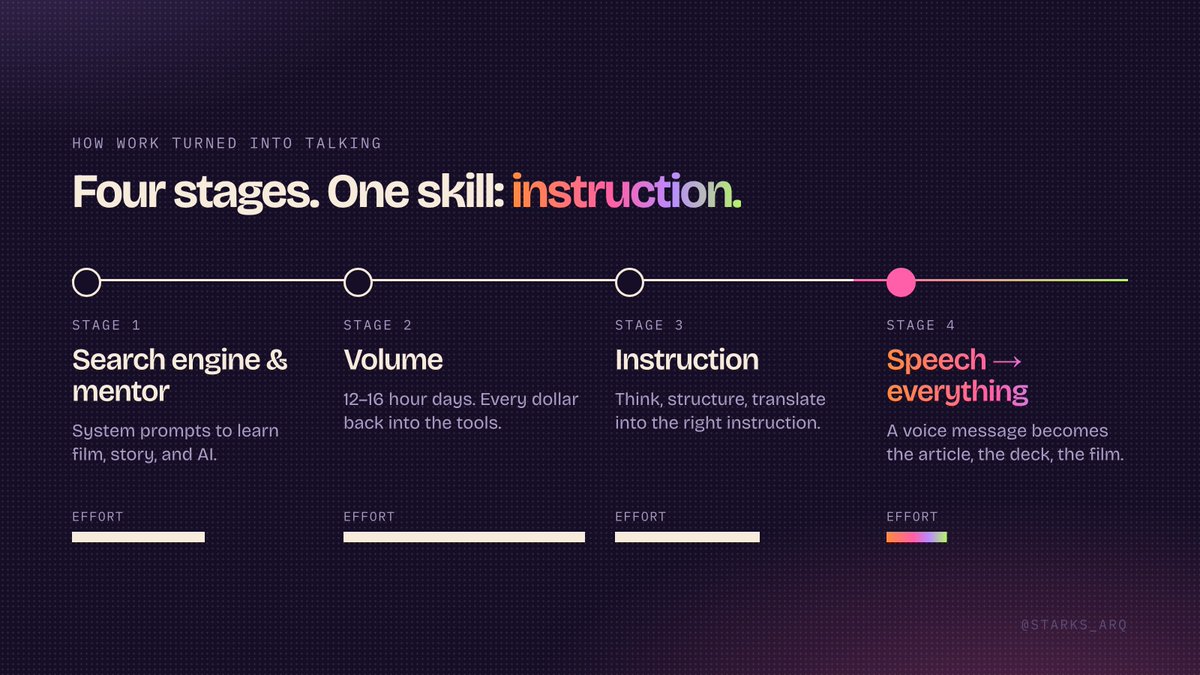
In the beginning, ChatGPT couldn't really do tasks. Not well. But it was the ultimate search engine. And the ultimate mentor.
So we used it to learn. With system prompts, we turned it into a private teacher for everything we wanted to master: filmmaking, cinematography, storytelling, and what AI is doing to society.
Valuable? Absolutely.
But a library doesn't give you your time back.
Then we paid the price
When the image models came out, we generated everything.
When the video models came out, we generated even more.
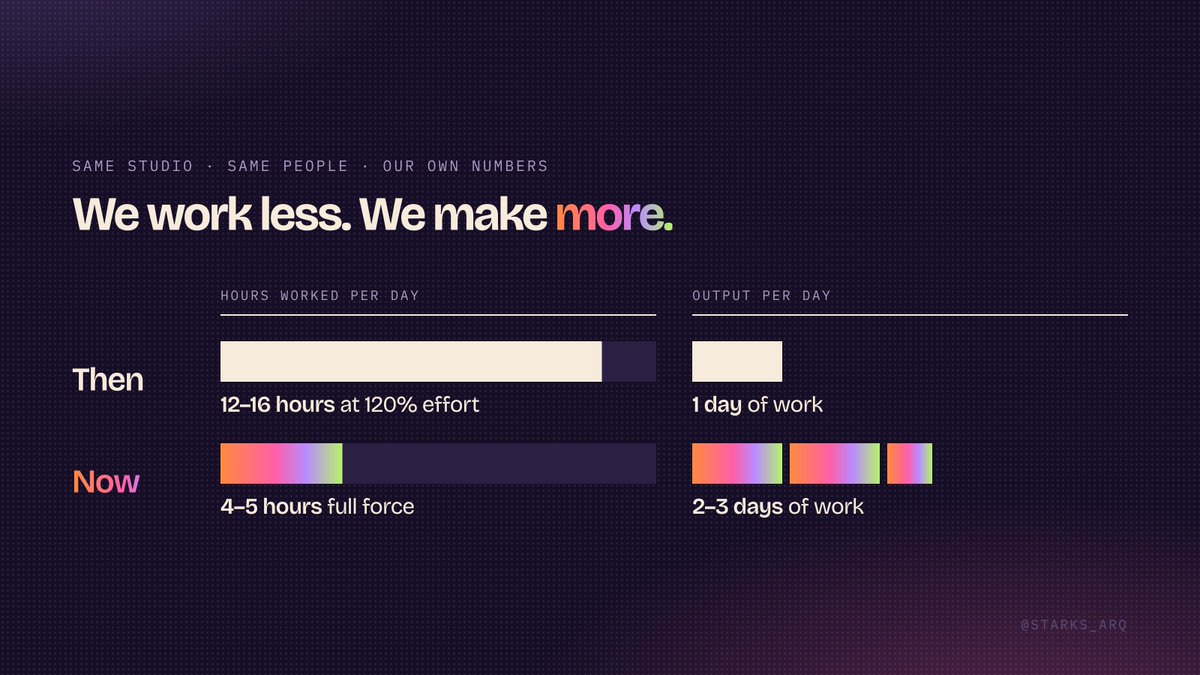
12 to 16 hours a day. Every single day.
Tens of thousands of dollars on tools. Basically every dollar we made went straight back into them.
Our effort was at 120%.
There was no framework. No course. Just volume.
And slowly but surely, through trial and error, we got better at the only three things that matter:
-
Instructing AI
-
Talking to AI
-
Thinking in AI
The biggest skill became instruction
Here's what all that volume taught us.
The ultimate form of creativity is when you do nothing but imagine, think, and speak. Then you structure your idea and translate it into the right instruction.
That's it. That's the whole job.
The biggest skill became instruction.
And once you can instruct, you can point AI at yourself. We compiled our own data. Our routines. Our output. Our results. We reflected on our own lives and improved in ways that would normally take an entire team analyzing you for months.
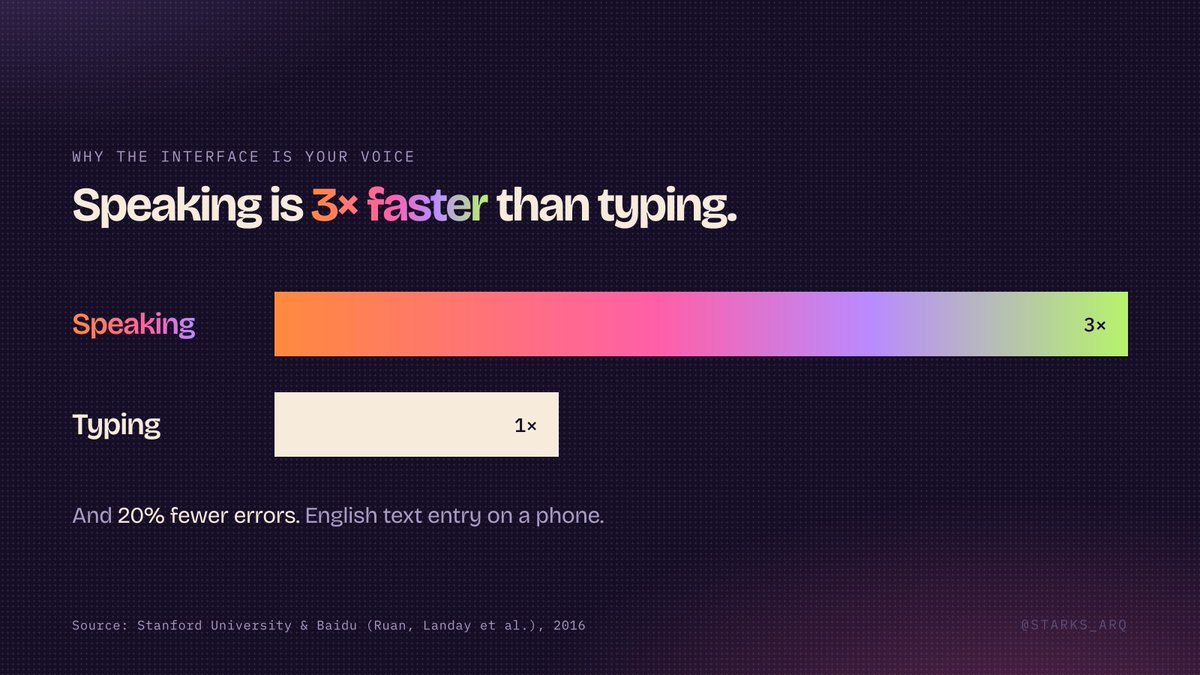
Then we stopped typing
At some point, we started recording voice messages.
For articles. Tweets. Presentations. Negotiations. Films. Commercials. Marketing strategies. Ways to go viral.
I talk. It gets processed. Structured. Drafted.
That's when it clicked. The final interface isn't an app. It isn't a dashboard. It isn't a prompt box.
It's your voice.
Speech → everything.
So, back to the goal I wrote down years ago.
Can I turn my job into just speaking and thinking?
The answer is yes.
What happens when work starts disappearing
Remember number one? Using AI every day and still working the same hours?
This is where that ends.
For the past few months, we've worked less. Every single day.
We automated most of our emails. Our sales outreach. Even finding viral topics on the internet.
Remember when KitKat lost 12 tons of chocolate? It became a meme within minutes. We made a KitKat video in 20 minutes. 1.5 million people watched it.
Today, an agent spots moments like that while they're still at 10,000 impressions.
And no, we don't use Higgsfield or Lovable. We use the foundation models directly and tailor them to our own lives.
The free time came slowly. Three hours a day at first. Then more.
Now four to five hours of full-force work gets done what used to take us two or three days.
But here's the part nobody tells you.
When the work disappeared, nobody told us what to do with the free time.
We automatically went back to telling stories.
That was the answer to my mentor's question. Years later.
What you do when nobody is making you work is what you actually want.
So the play became obvious. If we can make money telling stories, we can completely eliminate work from our lives.
And this is something anyone can do, specific to their own life. That's what the next 10 years are for. Not doing nothing. Getting paid for the thing you'd do for free.
AGI is already here. Just not for everyone.
Here's the take that will make some people angry.
AGI is already here. For the individual.
Train a model, a system, even an open-source model on all of your data the right way, and it can at least fix your current life. It automates most of what needs your attention today. The simple tasks. The service.
And once the service is done, it's time to step up to your next level.
Enterprises aren't there yet. Too many frameworks. Laws written before this revolution even started. MIT found that 95% of organizations saw no measurable return from their generative AI initiatives.
That's their problem. Not yours.
For individuals, it's already here. And it never stops. By the time you've pulled all the value out of today's technology, it has moved so far ahead that you get to start over.
We have entered the singularity. For any individual in the world who wants it.
Ban the interface
This is where most people get stuck.
They use AI through interfaces somebody else built. For somebody else.
Set user interfaces should be banned, basically.
Everyone who is here right now is so incredibly early. Let go of the interfaces. Build what you want.
But you can't build what you want if you don't know what you want.
See? It always comes back to the question.
When interviewers ask Jensen Huang, Elon Musk, or Dario Amodei how AI helps the ordinary American, the answers get complicated. Use cases that have nothing to do with that person's life.
The real answer is simple. Give people an example that fits their life. "You can plan your entire trip with it."
That's how broad this is.
So here's my advice to the world:
Talk to it.
Connect it to your email. Your WhatsApp. Your notes. Your ideas. Your thoughts.
Then ask it why your ideas don't get executed. What's the friction? Why do you keep falling back into the same loops?
Your ultimate accountability partner
Now, number two. All those ideas you never execute.
We've saved our ChatGPT conversations since 2023. Almost four years of ideas, plans, and problems.
When we ran feedback loops on all of it, looking for patterns, I found something that hurt.
Some of the problems I have today, I already solved two years ago.
I just wasn't consistent. Nobody reminded me. There was no accountability.
AI is your ultimate accountability partner.
And there's a confidence that comes with that. The moment I stop a voice message like the one this article came from, I know it gets processed. I know I'll see the first draft. So my head is already free for the next article. The video. Another way to use this idea to teach people.
That freedom is the real product.
Where does this leave you?
By Menlo Ventures' latest numbers, about two in three American adults still don't pay for a single AI product.
In our house, everyone has an intelligence ally in their phone. It makes a big difference.
You're early. Save this, and start today:
-
Ask yourself "why?" twice. If you don't know what you want, you can't build it.
-
Record one voice message a day. An idea, a problem, a plan. Let AI turn it into the first draft.
-
Connect your data. Email, WhatsApp, notes, your old chat history. (In ChatGPT: Settings → Data controls → Export data.)
-
Ask it one question. Why don't my ideas get executed? Where is the friction? Where do I keep looping?
-
Automate the service first. Emails, outreach, admin.
-
Watch what you do with the free time. That's your real answer to "why?"
-
When the technology jumps, start over.
My mentor asked me "why?" and I didn't have an answer.
Now I do.
So let me ask you the same thing.
What do you want?
Now ask yourself why. Twice.
Reply with your second answer.