The Uranium Deal Nobody Sees Coming
文章目录
Full disclosure: I'm an active investor in this space. I hold a significant position in Cameco, positions in numerous other uranium companies, and investments in advanced reactor companies, including Aalo Atomics. That means I have a vested financial interest in the outcome I'm predicting. Nothing here is investment advice.
"I know this cohort, and this cohort doesn't give a shit what anyone says, until they do, and when they do, they will run over people to buy uranium." — Mike Alkin, Sachem Cove Partners, on nuclear fuel buyers (MacroVoices #474, April 2025)
Mike Alkin's line sums up my whole prediction in one sentence. This post is about the question it raises: what finally makes the fuel buyers care?
My answer: the day a hyperscaler walks into the uranium market with a checkbook.
The calls
Here's the whole thesis in five lines. Everything after this is the evidence.
-
Within the next 12 months, at least one hyperscaler will announce a uranium supply deal big enough to shock the market. It could be a long-term offtake, an equity stake plus offtake, or an outright acquisition of one or more major producers.
-
It will be enormous, because the first one has to be. The moment the first deal hits the tape, every buyer and every producer will know the game has changed. The second deal will cost a whole lot more.
-
The prize isn't pounds in the ground. It's enriched fuel, and increasingly HALEU. I predict the smart buyer announces one big deal that secures everything it needs, from mine to conversion to enrichment, for the next quarter century.
-
When that deal is announced, utility fuel buyers will realize the price they've been waiting for is long gone. They'll discover they were front-run by someone who isn't even in their industry.
-
The first hyperscaler to move gets the last good price. Everyone after it pays up for the privilege of being second. Having already lost one bet by waiting, no fuel buyer will wait around to be fourth. That's how the panic starts.
Big Tech bet on reactors. Nobody has locked up the fuel.
Over the past two years the biggest companies on earth have committed billions to nuclear power:
-
Meta: up to 6.6 GW by 2035. That's existing plants from Vistra, up to eight TerraPower Natrium reactors and a 1.2 GW Oklo campus in Ohio, on top of an earlier deal for Constellation's 1.1 GW Clinton plant.
-
Amazon: an investment in X-energy aimed at more than 5 GW of small modular reactors, plus 1.9 GW from Talen's Susquehanna plant.
-
Google: 500 MW with Kairos Power and three sites with Elementl, among others.
-
Microsoft: the restart of Three Mile Island Unit 1 with Constellation.
Add Bill Gates, TerraPower's founder and chairman, and you have some of the richest, smartest people alive betting on nuclear.
Every one of those deals is a bet on reactors and power. Not one of them secures the fuel. I could find no public hyperscaler deal covering any step of the fuel supply chain: mining, conversion or enrichment.
And each company has backed more than one horse. Meta has TerraPower and Oklo. Amazon has X-energy and a Dominion SMR at North Anna. Google has Kairos and Elementl. That's deliberate. There are dozens of advanced reactor designs competing right now, and nobody knows which ones will win. Not the hyperscalers, not me, and not the smartest money in uranium.
That smart money has already drawn the obvious conclusion. Bloomberg reported in late 2024 that Guy Keller of Tribeca and Arthur Hyde of Segra were both taking risk off nuclear stocks. Hyde called nuclear technology valuations "relatively lofty" and moved money into uranium producers. Keller said he wanted to "bring my risk down," with most of his fund in uranium (Hedgeweek). They don't know which reactor wins either. So they own the one thing that's certain: whoever wins will need enriched uranium.
Keller also thinks the hyperscalers already understand this:
"I think from the discussions I've had, these tech companies have done the work on uranium supply and they're very well aware that this deficit is not going to be solved at these prices nor in the current structure of the market." — Guy Keller, Tribeca Investment Partners (Stockhead, April 2025)
In fairness, Guy said in the same interview that he doesn't see the tech companies wanting to buy uranium miners outright. He may be right, which is why my call covers giant offtakes and equity stakes, not just acquisitions.
Even the hyperscalers' small, hedged reactor bets moved markets: Oklo and Vistra shares jumped the day Meta announced (MarketScreener). Now imagine a single deal that locks up a double-digit share of the uranium market for two decades. That's the bet I'm predicting someone makes, all at once, because anyone smart enough to make it is smart enough not to tip off the market by doing it in pieces.
HALEU: the bottleneck hiding in plain sight
Today's reactors burn uranium enriched to about 3–5% U-235. Most of the advanced designs the hyperscalers are backing run on HALEU, high-assay low-enriched uranium, enriched to between about 15% and just under 20%. That includes TerraPower's Natrium, Oklo's Aurora, X-energy's Xe-100 and Kairos.
That difference is enormous, and hardly anyone in the investor market has done the arithmetic. So I had Claude do it, comparing the first fuel load of an AP1000 and a Natrium per kilowatt of generating capacity, not per kilowatt-hour of electricity. A Natrium core lasts longer and burns its fuel more completely, so per kilowatt-hour it uses about the same uranium as an AP1000. But every new reactor has to buy its entire first core before it makes a single kilowatt-hour, and that up-front purchase is what hits the uranium market. Start with the raw material.
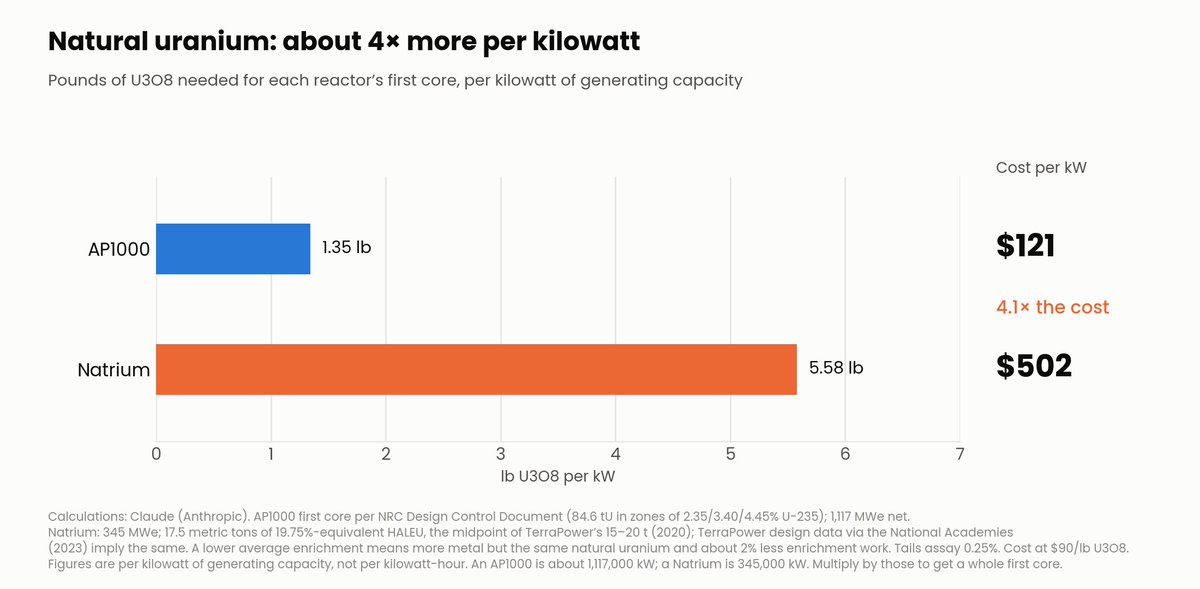
Per kilowatt, a Natrium reactor's first core needs about 4 times the natural uranium of an AP1000's first core.
That's just the raw material. Nearly every reactor in service or in development needs its uranium enriched, and the direction of travel is toward HALEU. Enrichment is where the gap gets wider.
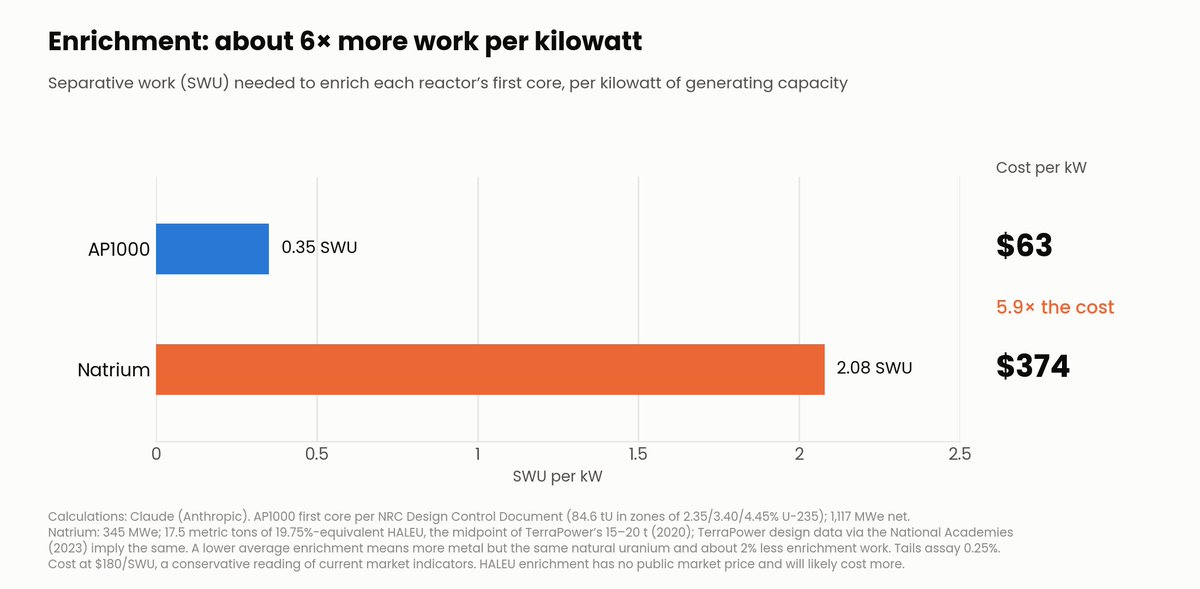
Per kilowatt, the same first core needs about 6 times the enrichment work.
Put the two together and look at what it costs to get each first core ready for fuel fabrication.
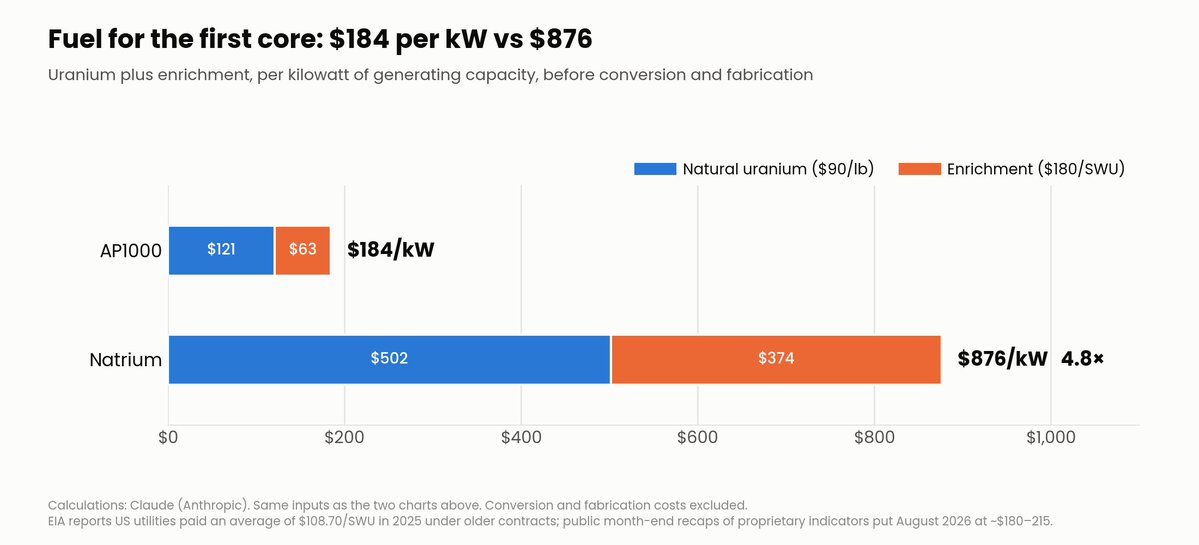
At today's prices, the uranium and enrichment for an AP1000's first core cost about $184 per kilowatt. For a Natrium, it's about $876. That's nearly five times as much, and it uses a conservative enrichment price.
Before anyone concludes that the old reactors are better: they're not. Advanced designs promise factory production, much higher operating temperatures, and far more energy from every ton of fuel over its life. Paying nearly five times as much for a first core is a bargain for all that.
But if you're going to pay several times more per kilowatt of capacity for a first core, the one thing you can't afford is not being able to get it at all. And if you're smart enough to solve that problem, you're smart enough to lock in the price before your own buying changes the market. And when the smartest money in uranium says the market is mispriced because fuel buyers aren't buying enough, a hyperscaler that gets it doesn't see a risk. It sees a market inefficiency to exploit.
Right now, you can't get it at all. There is no Western HALEU supply at commercial scale. TerraPower's first Natrium was delayed because, as TerraPower's Jeff Navin put it, "it was all predicated on having our first coreload of fuel come from Russia" (NEI Magazine). In January, DOE awarded the $2.7 billion Congress set aside in 2024 to rebuild domestic enrichment (DOE).
The Aalo lesson
The sharpest critics will raise this, so I'll raise it first. My own favorite reactor company, Aalo Atomics, deliberately doesn't use HALEU. Its early reactors run on standard LEU, then 8% LEU+. Doesn't that undercut the HALEU thesis?
No. It proves it. The way I'd sum up Aalo's philosophy: never design around fuel the supply chain can't deliver. Aalo President and CTO Yasir Arafat wrote that HALEU "encountered major setbacks when geopolitical tensions disrupted its primary supply route from Russia," and that making it viable "will require significantly more investment, scale, and time" (Aalo). Aalo designed around the HALEU bottleneck precisely because it's real.
And the direction of travel is still up the enrichment curve. CEO Matt Loszak told a House Science subcommittee on September 2 that Aalo sees "a credible pathway toward a future fast-spectrum product line" (testimony), and fast reactors need much higher enrichment. Even 8% LEU+ needs nearly twice the natural uranium per kilogram of fuel that today's 4.5% fuel does.
Whoever wins the reactor race, the trend is the same: more enrichment, and more uranium per kilowatt. The reactor companies can see it and are designing around it. The companies with the balance sheets to fix it should be buying it.
A rounding error for Big Tech. A margin crisis for utilities.
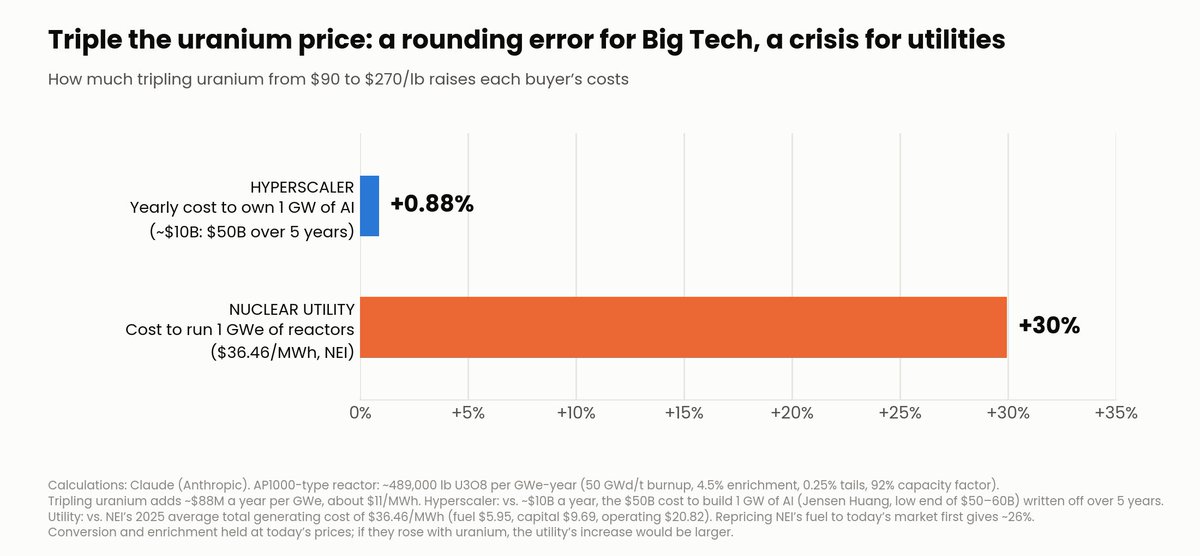
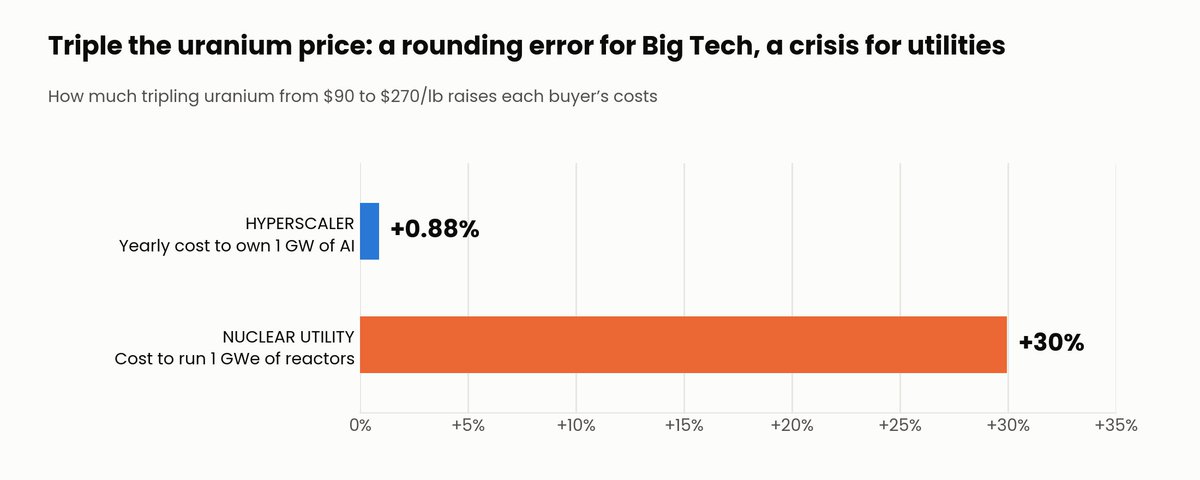
Nvidia's Jensen Huang puts the cost of building 1 GW of AI capacity at $50–60 billion. Now triple the uranium price. For a gigawatt of conventional reactors, that adds about $88 million a year, roughly doubling the complete fuel bill (uranium, conversion, enrichment and fabrication) to about $176 million. Write the $50 billion off over five years, a conservative assumption, and owning that AI capacity costs about $10 billion a year. The added fuel cost is under 1% of that. Even if conversion and enrichment tripled too, the entire fuel bill would be about 2.5%.
Now look at it from a merchant nuclear utility's side. NEI puts the average total generating cost of a US nuclear plant in 2025 at $36.46/MWh, fuel included. Tripling the uranium price adds about $11/MWh. That's a 30% jump in the cost to run the plant. At an illustrative wholesale price of $50/MWh, most of the spread over that cost would be gone. And that's the floor, not the forecast. We tripled only the uranium price and held conversion and enrichment at today's prices. Uranium doesn't triple without a demand surge, and new conversion and enrichment plants take years to build, so those prices would likely climb too. The real numbers for the utility are almost certainly much worse.
That asymmetry is the whole story. The four biggest hyperscalers have guided to $720–745 billion of capex for 2026 (TMT Finance). They can afford to be price-insensitive. Utilities are far more price-sensitive, and they've spent years buying less uranium than their reactors burn, presumably betting that prices will come down. When those two groups start competing for the same pounds, only one of them blinks.
How much fuel are we talking about?
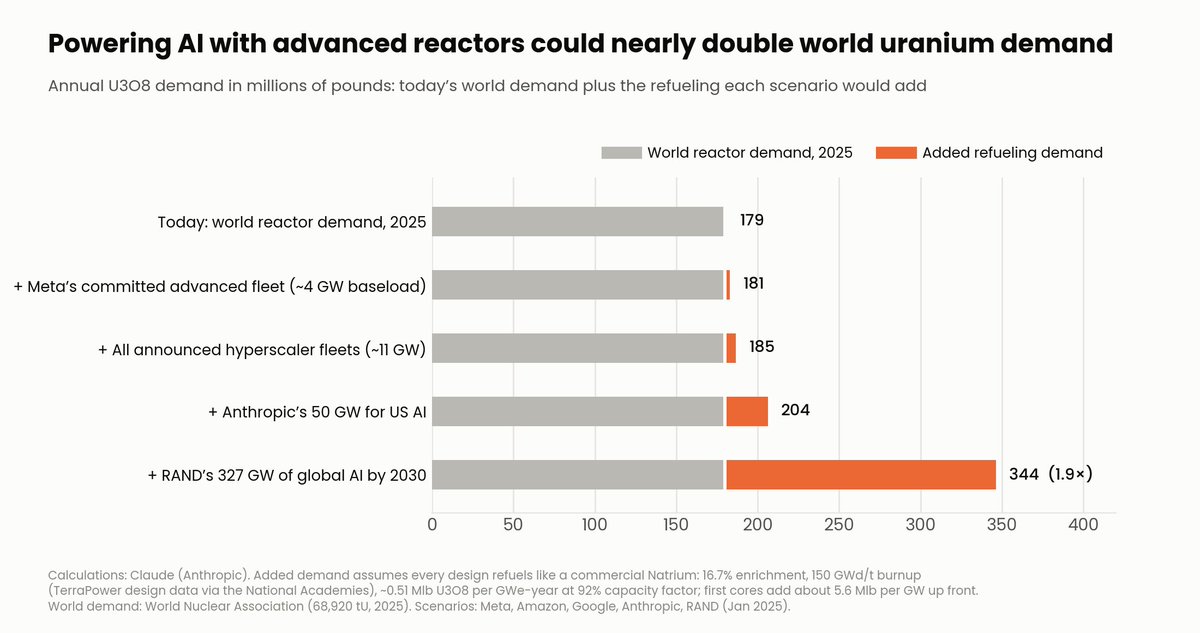
Nobody knows, and anyone who gives you a single number is guessing. So here's a ladder, from what's already signed to what the most credible forecasters say AI could want, stacked on top of what the world's reactors already burn.
-
Rung 1: what's already committed. Meta's advanced fleet, eight Natriums plus Oklo, is about 4 GW of baseload. Refueling it takes about 2 million pounds of U3O8 a year, about a tenth of Cameco's entire 2026 production. The first cores come on top: another 22 million pounds up front, more than a full year of Cameco's output.
-
Rung 2: everything announced. Add Amazon's 5 GW X-energy target and Google's Kairos and Elementl plans. The hyperscalers' announced advanced fleets would need nearly 6 million pounds a year, more than a quarter of what Cameco mines.
-
Rung 3: what Anthropic says America needs. Anthropic estimates the US needs "at least 50GW of electric capacity by 2028" for AI (Anthropic). Nobody is building 50 GW of reactors by 2028. But that number is a proxy for the power the industry wishes it could buy. If that much ran on these reactors, refueling alone would take about 25 million pounds a year, more than Cameco's entire output.
-
Rung 4: the arms race. RAND projected in January 2025 that global AI data centers could need 327 GW by 2030 (RAND). Power that with these reactors and you'd add about 165 million pounds a year, nearly doubling world uranium demand.
Will rung 4 happen by 2030? No. But Washington has made AI leadership a national priority with strong support in both parties, and the race with China isn't slowing down. Demand that can't be served by 2030 doesn't disappear. It rolls into the 2030s. My own view is that we'll see something like 500 gigawatts of new advanced nuclear demand in the 2030s. That's my speculation, not anyone's official forecast. But it's the scale the hyperscalers should be planning their fuel around.
The light water leapfrog
Why do I think reactors at that scale can actually be built? The market assumes new nuclear means more AP1000s. History teaches that those take at least a decade to build. Plenty of optimists hope to cut both the build time and the cost dramatically, but that remains to be proven.
What the market is missing is that factory-built advanced reactors could leapfrog them. I call it the light water leapfrog, and I've been making this case on MacroVoices and here on Substack.
Aalo is the company I'd point to. Its test reactor reached criticality in July, and its first full-power reactor is targeting power operation next year, running an on-site data center. Aalo's published timeline has its Aalo Pods "electrifying data centers at hundred-MW scale" in 2029 (Aalo). And CEO Matt Loszak says the company "is building a 1M sqft nuclear reactor factory" aiming "to reach 1 GW / yr of hardware output by the end of 2030" (X). Aalo has raised nearly $1 billion to date through its various financing rounds, culminating in a Series C that is closing as this piece goes to print.
**Connect the dots. One gigawatt a year from the factory Aalo is building now. Ten gigawatts a year is the obvious next step. A hundred gigawatts a year by the mid-2030s is what I believe is possible, and hope to see. That's one company.
The reactors won't be what holds this back. The fuel will.**
What if Moscow pulls the plug?
Here's a question every hyperscaler should have on its risk register.
In 2025, Russia supplied 26% of the enrichment services bought by US reactor operators. Kazakhstan, landlocked between Russia and China, supplied 28% of their uranium, and Uzbekistan another 7% (EIA).
The cutoff is already scheduled. US law bans Russian enriched uranium imports, and the waivers that keep it flowing end no later than January 1, 2028 (NRC). Moscow answered in November 2024 with its own temporary ban on enriched uranium exports to the US, allowing shipments only case by case (World Nuclear News).
So ask the hypothetical: what if Moscow doesn't wait for 2028? What if, in some future crisis, it cuts off every contracted pound of enrichment at once, and leans on its neighbors to follow?
Utilities would be scrambling to replace a quarter of their enrichment with capacity the West doesn't have. And every hyperscaler with advanced reactors on order would watch the fuel for its future fleet, which needs several times more enrichment per kilowatt, get scarcer and dearer before the first reactor is even delivered. In that world, secure Western supply from Canada, the US and Australia isn't just valuable. It's priceless. And that makes the case for locking it up now even stronger.
The meeting I'd take if I ran energy at Meta
Let me be very clear before I go further: I have no knowledge that any meeting like the one below has taken place. What follows is my speculation about what a rational executive in that seat would do.
Meta's longtime head of energy, Urvi Parekh, left the company in March (DCD). The executive Meta put forward on its January nuclear announcements was Joel Kaplan, its Chief Global Affairs Officer (Meta). Whoever takes the energy chair next inherits the biggest nuclear portfolio in tech, and the fuel problem that comes with it.
If I were in that seat, I'd ask for a meeting with Cameco's CEO, Tim Gitzel, and its President and COO, Grant Isaac. Here's what I'd say:
"Tim, Grant, first, credit where it's due. Buying 49% of Westinghouse and walking it to an IPO is an incredible deal. We noticed the quieter move too: GLE's Paducah plant just agreed to sell everything it will produce through you.
We're here to talk about something at least an order of magnitude bigger. And it needs to stay very quiet until we've worked it out together.
Grant, you've said utilities still aren't contracting at the rate they consume. You know the day they wake up is coming. Take whatever you think that day does to the uranium price, and then consider that it could be ten times worse. We'll be buying in that same market. That's a risk we won't carry, and when this becomes public it's going to break the market. We're here to hedge it before the word gets out.
Start with just the fleet we've already committed to. Its first cores alone need more than a year of what you mine. After that, about a tenth of your output every year, for decades, all of it as HALEU that nobody in the West can make at scale today. And we're just getting started.
So let's talk about a 25-year take-or-pay agreement across the whole chain: your pounds, your conversion at Port Hope, and enrichment to 19.75%, which means taking GLE from 8% to HALEU. If there's a regulatory reason laser enrichment can't get there, then we need another route, and that means ramping up centrifuge enrichment hard. If it takes acquisitions, we'll help fund them. Tell us the number, and tell us what it takes.
One condition: nothing leaves this room until it's signed. The day this is announced, every fuel buyer on earth reprices the market. We intend to be finished buying before then."
Should investors expect a conversation like this soon? I think a smart investor has to. And the people whose job it is to have it have every reason to start now, before a competitor beats them to it: at Amazon, AWS CEO Matt Garman, who fronted its first nuclear deals; at Google, Michael Terrell, Head of Advanced Energy; and whoever ends up in Meta's energy chair.
Why Cameco, and why not only Cameco
I use Cameco as the example because it's the biggest Western producer, which makes it the most conservative yardstick. Every multiple in this piece gets bigger against anyone smaller. But the deal I'm predicting could happen with any major producer, or with several at once. A smart buyer spreads its risk across geographies.
Could a hyperscaler simply buy Cameco? No. Under the federal law that privatized the company, no non-resident may hold more than 15% of Cameco's voting shares, and all foreign votes together are capped at 25% (Cameco F-10). A Cameco deal would be a contract, an equity stake within those limits, or both. Producers elsewhere could be bought outright.
Westinghouse
Cameco owns 49% of Westinghouse, and Westinghouse confidentially filed for a US IPO on July 31 (Cameco). Bloomberg reports it's seeking a valuation of more than $50 billion (Bloomberg). Let's be conservative and use $30 billion. That makes Cameco's stake worth about $14.7 billion, against the roughly $2.1 billion it paid in 2023.
Skeptics will point to the US government's warrant. Under the October 2025 partnership, Washington gets the right to 20% of Westinghouse's cash distributions above $17.5 billion, which can convert into a warrant at the IPO. But it only vests if the government first commits to at least $80 billion of new Westinghouse reactors in the US (Cameco). If that happens, Cameco owns a slightly smaller slice of a much bigger pie. I'd welcome that kind of dilution.
Westinghouse is a big deal. But if the right hyperscaler deal gets done, I think the bigger story will be fuel, not reactors. And Cameco has a fuel story too.
GLE
Cameco also owns 49% of Global Laser Enrichment. Australia's Silex owns the other 51%, and Cameco holds an option to take its stake to as much as 75% once the technology progresses to commercialization (Cameco). GLE started with the lowest-risk business it could find: re-enriching the US government's depleted uranium at Paducah, Kentucky, back to natural grade. That creates new uranium supply without a new mine. Its NRC license application now goes up to 8% LEU+ (NRC).
In 2024, GLE passed on DOE's HALEU tender because it didn't justify leaving what Cameco called GLE's "lowest-risk path to the market" (World Nuclear News). Then, on September 16, GLE agreed to sell Cameco everything Paducah produces (World Nuclear News).
The next rung is HALEU, and the capital to climb it is exactly what a hyperscaler has. If laser enrichment can get there without a regulatory roadblock, I'm confident Cameco and GLE will.
And if laser enrichment hits a wall?
Then Cameco has another route. It's no stranger to the fuel cycle: it already runs uranium conversion at Port Hope, Ontario. If it needs to buy existing centrifuge enrichment capacity or build new plants from scratch, all it needs is a capital partner with deep pockets and a reason to hurry. I expect that partner to show up soon.
Sana's choice
Anthropic, the company behind Claude, has no reactor partnership. What it has done is hire an Energy Lead, Sana Ouji, who joined from Google in April (Data Centre Magazine). And it has published its own estimate that US AI needs at least 50 GW of power by 2028.
So which is the smarter reading? That Anthropic hasn't even picked a reactor partner, so it can't be part of this story? Or that Anthropic is sharp enough to lock up the fuel first and let the reactor bake-off play out, knowing that whichever design wins will need enriched uranium?
I lean toward the latter. If I were Sana Ouji, I wouldn't spend my first year picking a reactor. I'd spend it making sure that whoever wins, I have the fuel. 500 gigawatts of new nuclear demand in the 2030s is the biggest fuel problem anyone in her job will ever face. Would she wait for Meta to get into that room first?
I'll leave that one with you.
When it hits the tape
Uranium's problem isn't the supply math. The best professional investors in the sector have been warning about it for years:
-
Guy Keller: "Uranium is actually coming from a position where this is a primary mine supply deficit that's been in place for 10 plus years" (Stockhead, January 2024).
-
Mike Alkin: his April 2025 MacroVoices interview was titled "Uranium Supply Is In Structural Deficit And The Fuel Buyers Don't 'Get It'!"
-
Arthur Hyde, on Kazakhstan's supply outlook: "Gonna be lower for longer… Better for the market, better for the Kazakhs, tougher for utilities. Period" (X, August 2024).
The problem is that the people who actually buy fuel for utilities haven't acted on it. Cameco's Grant Isaac has said so for years, most recently on the second-quarter call:
"We still don't have utilities coming forward and collectively buying at a volume that replaces what they consume under existing contracts. And yet we found ourselves back into a mid-$90s long-term uranium price on its way to 3 digits likely. And that's in the absence of replacement rate demand." (transcript)
CEO Tim Gitzel put a number on it a quarter earlier: "We're still not there. I think it's 12 or 13 years in a row, we haven't hit that" (Cameco).
Judging by their behavior, the fuel buyer's thinking seems to go something like this. We saw a spike after Cigar Lake flooded in 2006, and this is just another one. Ride it out on inventory, wait for NexGen's Arrow mine, and buy at $50.
The 2007 precedent they appear to be leaning on actually cuts the other way. Uranium went from about $10/lb in early 2003 to about $136 in June 2007. I'm not aware of a single reactor that shut down because of it: fuel is too small a share of the cost, and there's no substitute. The price then collapsed, and it's worth remembering why. The new buyers who piled in, hedge funds and newly launched uranium funds, were holders, not users. They bought pounds to sell them later, and when sentiment turned, they did. A hyperscaler is a different kind of buyer entirely. It buys uranium to burn it in reactors it has committed to run for decades. Those pounds never come back to the market.
This time, the new kind of buyer is the whole point. The day a hyperscaler signs a 25-year offtake for a big share of a major producer's output, it will shock the market, because the fuel buyers won't see it coming. That's what flips the math.
What happens next is panic. Fuel buyers wake up all at once and realize they've been waiting out the wrong bubble. It's no longer a spike they can afford to sit through. It's a competition for pounds against buyers whose capex is unprecedented in corporate history, and who can afford to ignore price in a way the utilities can't.
That's the moment Mike Alkin has been waiting for. Utilities, he says, "haven't had their come-to-Jesus moment… they're going to meet the uranium god when they're trying to contract at the amount that they're consuming every year. Like now they're half to 60% of that" (YouTube, June 2026). When that happens, they'll all try to front-run each other to be second in line behind the hyperscaler.
Why the first deal will be the biggest
Once the first deal is public, every other buyer knows the game has changed, and every producer knows what its pounds are worth. The first mover gets the last pre-announcement price. That's why I expect the first deal to be as large as the buyer can possibly make it.
What could go wrong
Smart money always asks this, so here are the real risks and why I don't think they change the conclusion.
-
Kazakhstan opens the taps. Kazatomprom could lift its production restraint. Some doubt it has much spare capacity left. And given the section above, would a US hyperscaler bet its fuel supply on Kazakh output?
-
NexGen arrives on time. New mines like NexGen's Arrow will help. But they're already needed just to replace mines that have failed or are running out.
-
Advanced reactors slip. A very real risk. But the most likely reason they'd slip is HALEU itself. That's an argument for securing fuel now, not later. What would Sana do?
-
The AI capex boom busts. Possible, and the market is already debating it. Remember the dot-com bust: investors piled into the internet too fast, the bubble burst, and the internet went on to become bigger than anyone predicted. The premise was never wrong; the market just got ahead of itself. A bust would be a sentiment event. It wouldn't change the fuel math.
Mike Alkin's deficit case doesn't count on AI at all. He models only the reactors already running or under construction. As for AI and small reactors: "we don't use a single pound of it in our modeling. We don't need it. It's nice to have. It's a cherry on top" (MacroVoices #474). The deficit is there before a single AI data center plugs into a new reactor.
And ask yourself which way the hyperscalers are betting. Nobody spends $700 billion a year planning to be wrong. They plan for success, and planning for success means securing the fuel. And they can afford to pay up for it.
Signposts to watch
-
A hyperscaler hiring a nuclear fuel procurement executive
-
Who fills Meta's energy chair
-
A final investment decision at GLE's Paducah plant, and any move toward HALEU licensing
-
Utility term contracting against consumption, on Cameco's quarterly calls
-
How the Westinghouse IPO prices
-
Any change to the Russian enrichment waivers before they expire
How the numbers were done
The calculations are by Claude, Anthropic's AI, using standard enrichment arithmetic. And yes, Anthropic's own AI did the math for a piece that urges Anthropic to move. It didn't ask me to go easy on them.
-
AP1000: 84.6 tU first core in three zones at 2.35/3.40/4.45% U-235 (NRC Design Control Document). We use a net rating of 1,117 MWe; Westinghouse quotes about 1,110, a difference of under 1%.
-
Natrium: 345 MWe. TerraPower has put a first core at 15–20 metric tons of 19.75%-equivalent HALEU (TerraPower, 2020); we use the midpoint, 17.5 metric tons. The National Academies, working from TerraPower's 2022 design data, put a commercial core at 60 metric tons of uranium per gigawatt at 16.7% average enrichment (National Academies), which for a 345 MWe plant is the same 17.5 metric tons of 19.75%-equivalent. TerraPower has said only that enrichment stays below 20% and varies across the core; a lower average means more metal but the same natural uranium, and about 2% less enrichment work. We assume a tails assay of 0.25%, the setting that trades off uranium feed against enrichment work; the conclusions hold across 0.20–0.30%.
-
Why 345 MWe, not 500: Natrium can boost to 500 MWe for a few hours using stored heat. Think of it as a 345 MW engine with a shock absorber: it handles 500 MW loads briefly, then has to refill the tank from its 345 MW supply. The math uses 345 because that's what it produces continuously.
-
Prices: uranium at about $90/lb. Enrichment at $180/SWU. UxC's and TradeTech's enrichment indicators are proprietary; public month-end recaps put August 2026 at roughly $180–215/SWU (@quakes99), and we used the low end. For reference, the EIA reports US utilities paid an average of $108.70/SWU in 2025, mostly under older contracts (ANS). HALEU enrichment has no public market price and will likely cost more. Conversion and fabrication are excluded from the first-core charts.
-
The rounding-error chart: an AP1000-type reactor uses about 489,000 lb U3O8 per GWe-year (50 GWd/t burnup, 4.5% enrichment, 92% capacity factor). Tripling uranium from $90 to $270/lb adds about $88 million a year, or about $11/MWh. The hyperscaler bar compares that yearly increase with about $10 billion a year, the ~$50 billion cost to build 1 GW of AI written off over five years. The utility bar compares it with NEI's 2025 average total generating cost of $36.46/MWh: fuel $5.95, capital $9.69, operating $20.82 (NEI). NEI's fuel figure reflects older, cheaper contracts; repricing it to today's market before tripling gives about 26% instead of 30%. The complete fuel bill in the text adds conversion at $65/kgU (North American spot, August 2026, from the same @quakes99 recap), enrichment at $180/SWU and fabrication at $300/kgU (World Nuclear Association, a 2021 estimate). At today's prices that's about $88 million a year. The $50/MWh wholesale price is illustrative.
-
The ladder assumes every design refuels like a commercial Natrium: 16.7% enrichment burned to 150 GWd/t, per TerraPower's design data (National Academies). That's about 0.5 million pounds of U3O8 per gigawatt-year, roughly what an AP1000 uses; Argonne National Laboratory's modeling comes out within a few percent (Argonne). These are design targets. The first Kemmerer plant starts on an earlier fuel with lower burnup, so its early reloads may need more. Pebble-bed and molten-salt designs will differ.
-
Scale: Cameco's 2026 guidance is 19.5–21.5 million pounds, its share (Cameco Q2 2026). World reactor requirements in 2025 were about 68,920 tU, roughly 179 million pounds (World Nuclear Association).
-
Price history: UxC's spot price was $10.10–10.20/lb in early 2003 (UxC); the June 2007 peak is usually cited as $136.22, with TradeTech reporting $138.
-
Fuel deals so far: No hyperscaler is a party to any uranium, conversion or enrichment contract. Some of their reactor vendors have signed HALEU supply paper: Oklo a letter of intent with Centrus (Oklo), X-energy a definitive enrichment agreement with Centrus (X-energy), and TerraPower a first-core agreement with ASP Isotopes, supplied from a new plant TerraPower is helping to finance (ASP Isotopes). None of it covers mined pounds or conversion.
Sources and the Substack version
The full list of sources is in the Substack version of this article, which some readers may also find easier to read. Key sources are linked throughout the text above.
Best X accounts to follow in this sector
-
@FootnotesFirst: Mike Alkin, founder of Sachem Cove Partners
-
@TribecaIP: Tribeca Investment Partners, home of portfolio manager Guy Keller
-
@JekyllCapital: Arthur Hyde, Segra Capital
-
@UraniumInsider: Justin Huhn, Uranium Insider
-
@quakes99: John Quakes, whose month-end uranium price recaps are cited above
-
@MattLoszak: Matt Loszak, CEO of Aalo Atomics
-
@yasir_fission: Yasir Arafat, President and CTO of Aalo Atomics
-
@AaloAtomics: Aalo Atomics
-
@MacroVoices: MacroVoices, my weekly podcast