History Doesn't Repeat, but It Rhymes

A few days ago I wrote about reflexivity and Chuck Prince's line about dancing while the music plays.
I would like to now share some stats comparing the dot com era to the AI era. With a lot of help from my friend Claude I picked the one corner of the dot-com boom that I think looks most like the neo labs today, and I tried to run the numbers all the way through to the end.
That corner is telecom equipment.
Between 1998 - 2000, teams of engineers left Cisco, Nortel, Lucent and Bell Labs to build optical switches, terabit routers and long-haul DWDM gear, and they were bought, sometimes before the product existed, for billions of dollars in stock. Cerent went to Cisco for $6.9 billion. Xros, a Menlo portfolio company from before my time at the firm, went to Nortel for $3.25 billion with 90 employees and no shipping product. Qtera, also $3.25 billion, same story. Chromatis went to Lucent for $4.5 billion. Siara went to Redback for $4.3 billion while, in the words of one reporter, still in the prototyping phase.
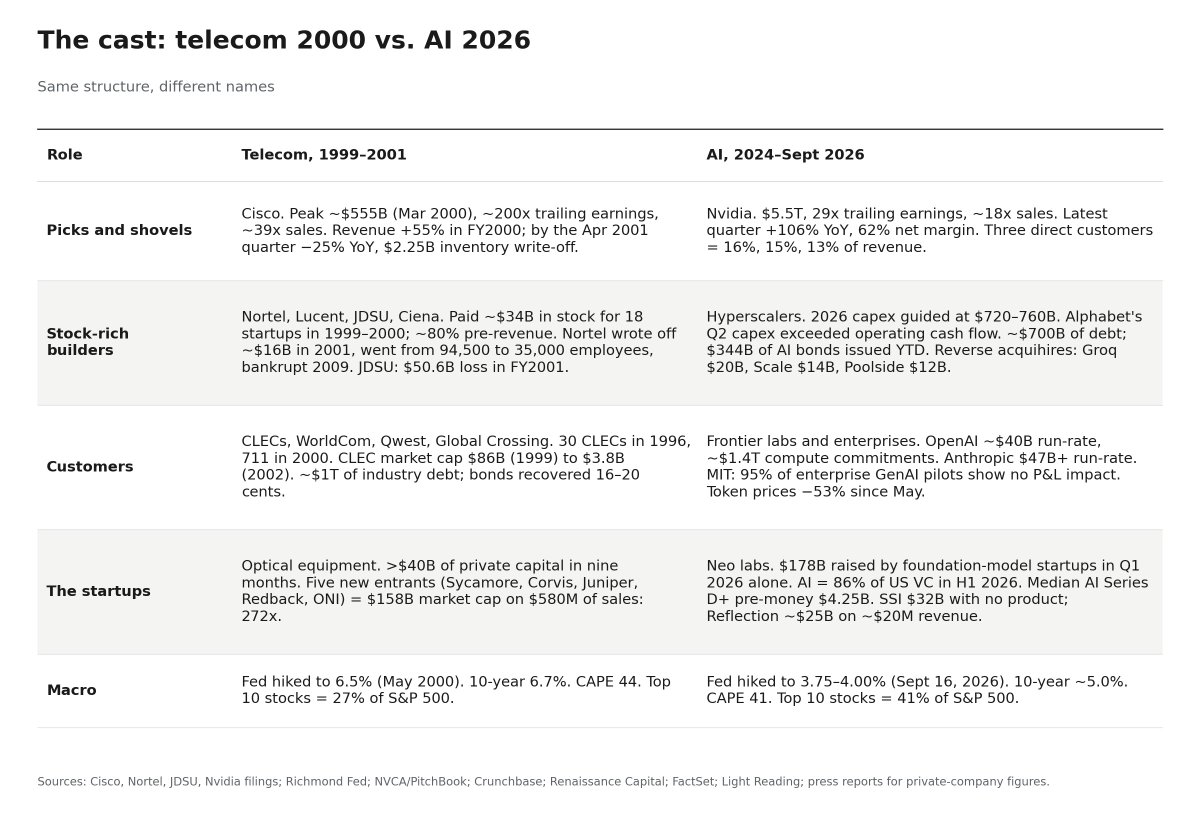
Here is the cast, in case the analogy isn't obvious. Cisco was the Nvidia of its day: the picks-and-shovels company that everyone had to buy from, briefly the most valuable company on earth at around $555 billion and 200 times earnings. Nortel, Lucent, JDSU and Ciena were the hyperscalers: the giants with enormous balance sheets and inflated stock who bought the startups and built the capacity. The CLECs, WorldCom, Qwest and Global Crossing were the customers, the ones actually placing the orders, and they were doing it with about a trillion dollars of borrowed money. And the optical startups were the neo labs.
I built a list of every venture-backed telecom equipment company from that era I could find that raised $100 million or more, or sold for $300 million or more, and tracked what happened to each one.
Here is what the numbers say.
Start with the ones that sold early. Thirteen startups were bought pre-revenue by strategics in 1999 and 2000. Between them they had raised roughly $500 million of venture capital. They sold for about $31 billion. Every investor in every one of those companies made money, and some of the multiples were absurd: Xros returned something like 130 times the capital that went in. Now look at what happened to the products. Ten of the thirteen were killed within about two years. Lucent shut Chromatis down fifteen months after buying it. Cisco killed Monterey's wavelength router. Nortel wrote off Qtera, Xros and CoreTek and took a $12.4 billion goodwill charge in a single quarter. Three products survived: Cerent's box, which became the Cisco ONS 15454, Siara's SmartEdge, and Lightera's CoreDirector. The venture returns had nothing to do with whether the product worked. They had to do with whether somebody with an inflated stock price bought you before the music stopped.
Now look at the ones that didn't sell early. Thirty-two companies raised $100 million or more privately between 1999 and 2002, about $5.9 billion in total. Twenty-two of them, 69 percent, returned roughly nothing. Caspian raised $317 million and shut its doors in 2006. Procket raised $272 million and sold its intellectual property to Cisco for $89 million. Pluris raised $215 million and never shipped a router. Three returned capital back. Two, Amber and Flarion, returned three - four times. Five got public before the window closed. Corvis went out in July 2000 at a $27.6 billion valuation with zero revenue, raised $1.1 billion, and only ever deployed about six switches. Avici, CoSine, Tellium and ONI followed the same path. The public got the loss instead of the VCs, and all five are gone. Zhone raised $500 million from TPG, KKR and NEA in 2000, at over a billion valuation , before it had revenue. That was the two-billion-dollar seed round of its day. It took 25 years to finish dying. Of the 32, the number that exist today as a real, standalone business is zero.
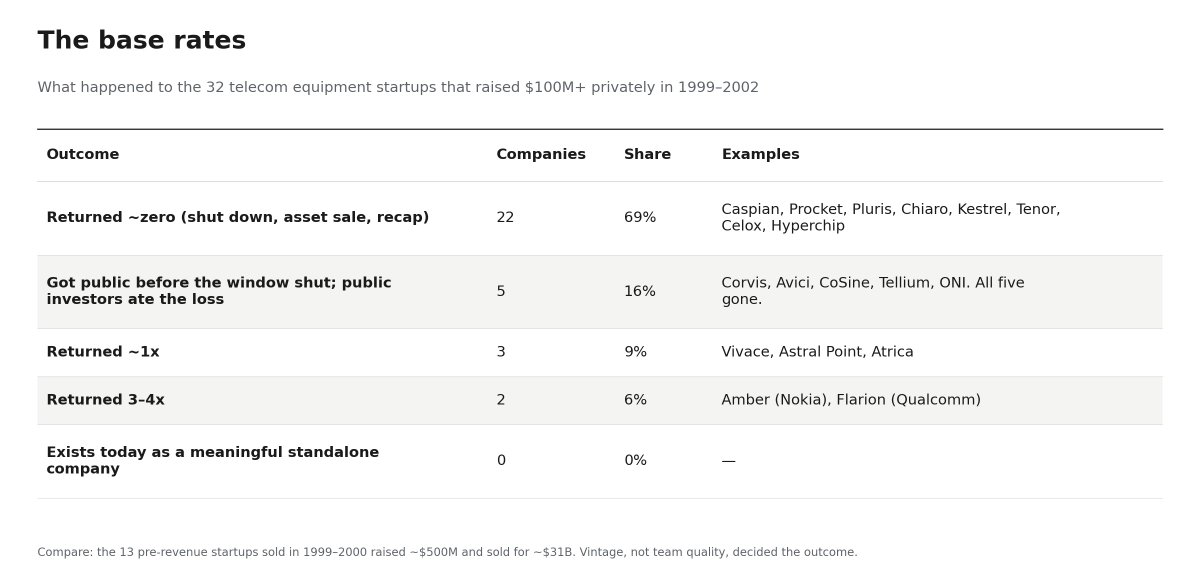
Two things about this list stopped me. The first is that pedigree bought you nothing. Larry Roberts, the man who built the ARPANET, ran Caspian. Tony Li, who wrote the routing code at Cisco and then Juniper, co-founded Procket. These were the Ilya Sutskevers and Mira Muratis of their moment, and the outcomes were zero and $89 million. The second is that the amount of capital raised was inversely correlated with the return. Sycamore raised $40 million before its IPO. Xros raised $25 million. Juniper, the one company from the whole era that is still with us, raised about $100 million. The zeros raised $200 million to $500 million. The extra capital didn't buy them a better product. It bought them a longer runway to nowhere.
Vintage determined who won. Founded in 1996 or 1997 and exited by the middle of 2000, you did great, product or no product. Founded in 1999 or 2000 and still private in 2001, you got nothing, team or no team. Nobody could see the line while they were standing on it. In the summer of 2000 the second group looked exactly as smart as the first. The only difference was the calendar.
The end, when it came, was fast. Ciena agreed to buy Cyras for $2.6 billion in December 2000. The deal closed in March 2001 at $1.1 billion. The price fell 58 percent between the handshake and the check. Cisco's revenue was growing 60 percent through December 2000; by the April 2001 quarter it was down 25 percent and the company wrote off $2.25 billion of inventory. Nortel went from 94,500 employees to 35,000. Telecom bondholders recovered sixteen cents on the dollar. Soros says you never know when reflexivity ends, only that it does. In telecom it ended in about ninety days.
So does it rhyme? Here is my honest read.
The parts that rhyme are the structure. There is a picks-and-shovels monopoly at the center with a handful of customers who are each a huge share of its revenue. There is a layer of giants spending more than they earn to build capacity for demand that hasn't shown up yet: the big four hyperscalers have guided to somewhere between $720 and $760 billion of capex this year, Alphabet's capex exceeded its operating cash flow last quarter for the first time in its history, and the industry has issued about $344 billion of AI-related debt this year alone. There is a customer layer, the labs, whose spending commitments dwarf their revenue: OpenAI at roughly $40 billion of run-rate against around $1.4 trillion of compute commitments. And there is a startup layer priced off the last round rather than off anything built. In September 2000, five new optical companies carried $158 billion of market cap on $580 million of trailing sales. Today the median AI Series D is priced at $4.25 billion pre-money, Safe Superintelligence is worth $32 billion with no announced product, and Reflection is talking to investors at $25 billion on about $20 million of revenue. The Fed just raised rates for the first time since 2023 and the ten-year is at five percent. In May 2000 the Fed raised to six and a half.
The parts that don't repeat matter too, and I don't want to pretend they don't. Nvidia earns money. Cisco was at 200 times trailing earnings; Nvidia is at 29x, with a 62 percent net margin. The customers this time have real revenue growing very fast, not just borrowed money; the CLECs never had anything like $40 billion of run-rate, let alone Anthropic's. The hyperscalers are, for now, cash-generative franchises with businesses that exist independent of AI, which Nortel and Lucent were not. If you had to bet on which layer of this stack survives a downturn, the answer today is much better than it was in 2000.
But here is the lesson I actually take from the telecom cohort, and it's the one that applies to neo labs. The pre-revenue optical startups made money for their investors because someone with inflated currency bought them before the currency deflated. That was the whole trade. Today the equivalent buyers are the hyperscalers and Nvidia, and they are buying: Groq for $20 billion, Scale for $14 billion, Poolside for $12 billion, Windsurf and Character for a couple of billion each. That window is the exit for the neo labs, and it stays open exactly as long as hyperscaler capex keeps growing, which is to say exactly as long as the capex can be financed. When it closes, and Cyras tells you how quickly it can close, a lab valued at $30 billion with no product is Zhone, not Xros.
Which brings me back to where I ended last time. You cannot pick your way out of this. The 2000 telecom investors were good at picking; they picked Larry Roberts and Tony Li. What they didn't do was size for the possibility that the calendar, not the team, would decide the outcome. Own the picks and shovels, own the customers with real revenue, and if you're going to own the pre-product labs, size them so that a Cyras-shaped repricing is a bad quarter and not a bad fund.
History doesn't repeat. Nortel is gone, Lucent is gone, and there won't be a WorldCom this time. But Xros is gone too, and so are Qtera, Chromatis, Caspian and Procket, and the people who funded them were every bit as smart as we are. That's the rhyme.
And who were some of those people who funded those companies? They were VC legends like Vinod Khosla, Pierre Lamond, Paul Ferri, Ed Anderson, and Jim Breyer