A Guide to Game Theory #2: “The Perfect Plan”
文章目录
Most people still think that seeing the end of your goals is enough to get you there. These are, unsurprisingly, the words of those who never really chased their goals.
If they did, they'd know a harsh truth the rest of us all have already experienced: just knowing where things end won't get you there — at all.
And so it is that we're still searching for the perfect plan.
Would it not be nice if there were a method to guide us there, one that would allow us to anticipate, respond to the strategies of others, and finally accomplish our objectives?
Well, this method obviously exists. We wouldn't be writing this article if it didn't. It's called game theory.
Today, you'll learn one of its most powerful applications: using it to plot and scheme.
Contents Include
-
How Sequential Games Rule the World
-
The Tree, and Why You Need It
-
Working Backward (Backward Induction)
-
Two Flats, One Deadline (Example)
1. How Sequential Games Rule the World
In part one, we defined a game as being comprised of four things: players, choice sets, move orders, and payoffs. We then went over how you should optimize splitting a restaurant bill.
It was a game where the move order did not matter. Whether you're moving last or first, the strategy remains the same.
Almost nothing outside a restaurant works that way.
In practically every scenario, move orders exist. Somebody moves, somebody responds, then somebody responds to that again, and then again until the game ends at some point.
Maybe the game doesn't even conclude at all: think of politics or the stock market. Without a major catastrophe, the game just goes on, and so do the players.
Many of the games that matter most in your life unfold through a sequence. You can safely forget something like a bill within a few days, but sequential games have a tendency to stick with you, and we cannot solve them as easily.
Once a game moves into a sequence, the whole thought of a strictly dominant strategy dissolves. You cannot ask, "What should I do?" anymore. You'll be forced to look deeply and to ask, "What will this become?"
2. The Tree, and Why You Need It
In sequential games, things can escalate very quickly. At every step, a player can reassess the situation and choose their next action accordingly, which makes sequential games extremely dynamic and chaotic.
Without a clear visualization, we have no clue which strategies may be best long-term. To solve this issue, we employ tree diagrams. Instead of bombarding you with theory, let's apply it in a scenario:
Imagine you are underpaid and thinking about asking for a raise. The tree would look something like this:
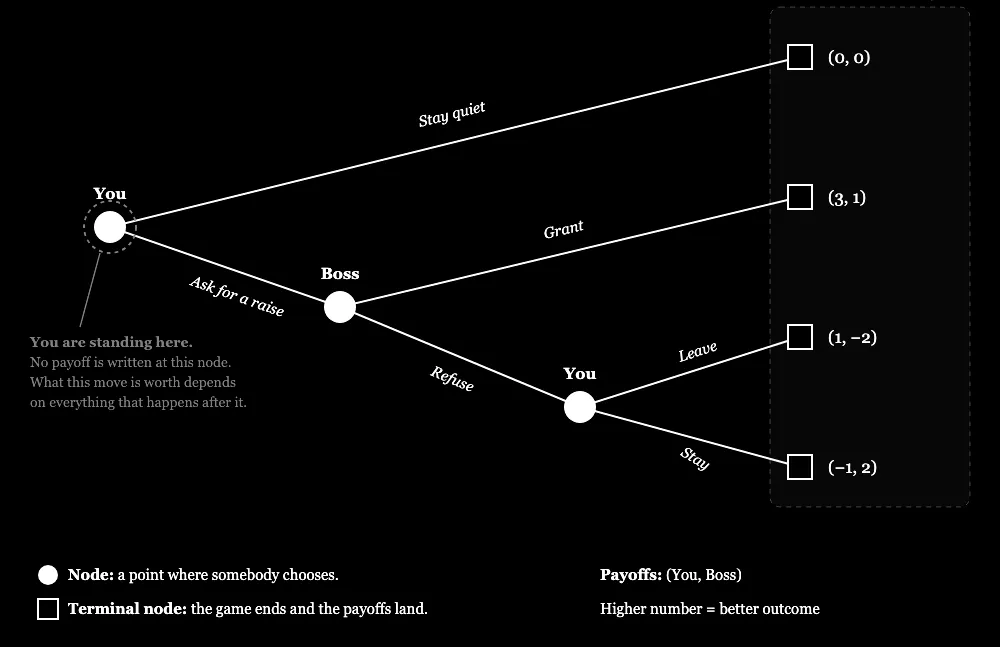
The nodes you see are the points where somebody chooses. In this case, you begin by deciding whether you ask for a raise or stay silent. If you pick the latter, the game ends immediately because you never end up asking.
In contrast, selecting the former will initiate the game's next round, and given that you cannot raise your salary yourself, you have to ask your boss. Essentially, it's his turn now.
Should your boss accept, you receive your raise and "win the game." If he refuses, it's your turn again: you either leave or stand your ground and negotiate further.
This is the move order for this game: you → your boss → you again. We could, of course, expand this game and add countless additional rounds, but you get the point.
Now, we want you to look more closely at the diagram.
There's a vital piece of insight hidden in there: staying quiet is on the tree, and it has its payoff. This is the most crucial rule of game theory: doing nothing is also a strategy, with its very own payoff.
In game theory, everything bears consequences.
About the Numbers at the End
You may have already noticed the two conspicuous numbers at the end of the tree, right next to the terminal nodes:
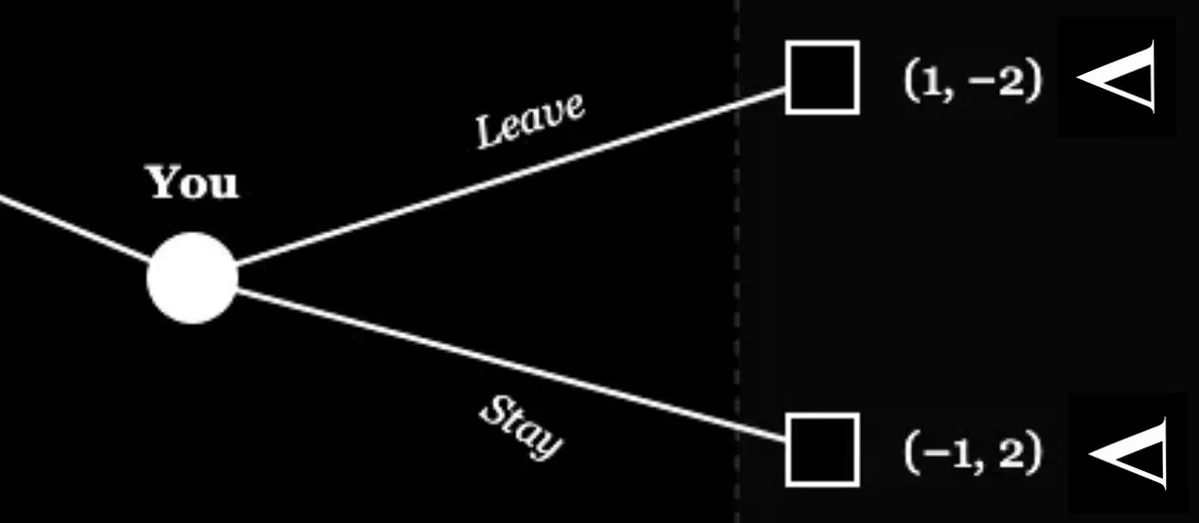
The first number is your payoff; the second is your boss's. In this case, we chose really abstract numbers, but you could also list the actual salary raise here. Either way, writing the boss's number forces two questions: what does refusing cost them if you leave, and what does it gain them if you stay?
Why does it matter? Because these are questions most people never ask. Strategy is not about what you want. You also need to figure out what the other party wants.
3. Why You Start At The Far Edge
As you now see, starting at the first node gets you absolutely nowhere. The game starts with you deciding: "Should I even ask my boss for a raise?"
The outcome depends on whether the boss grants it. Whether he grants it depends on what you do if he refuses. What you would do if he refused depends on what leaving is worth to you.
So what you get out of the situation cannot be answered until you look at where each decision leads you. This is why the start of the tree has no terminal payoff attached to it: it is a decision point, not an outcome.
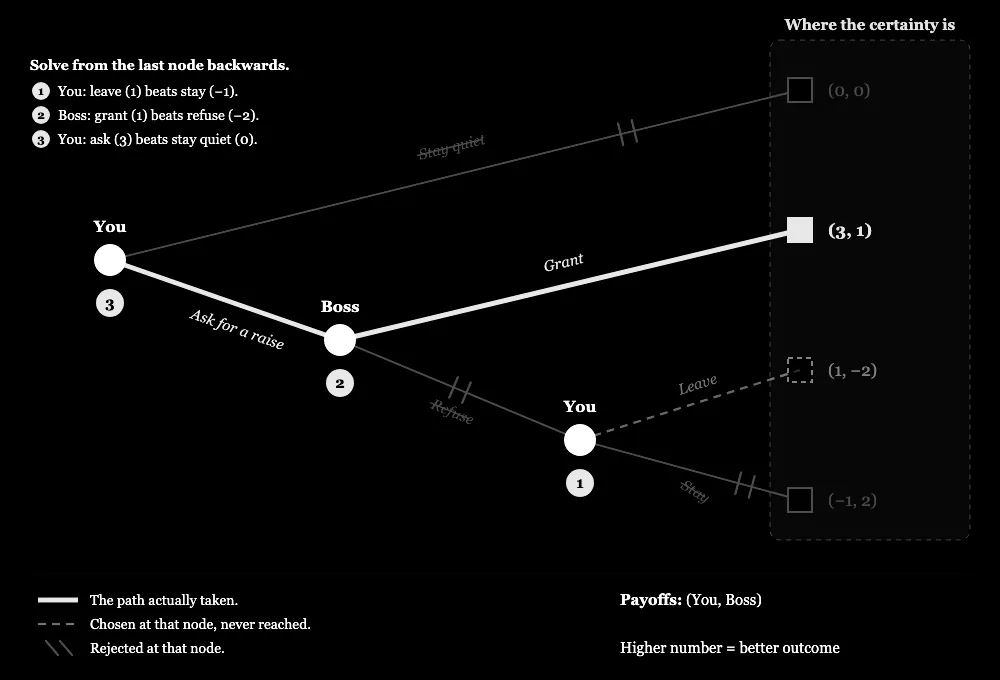
That's why we solve it from the back.
The very last decision on the tree is yours; it's the one that happens after a refusal. Suppose leaving is worth 1 because it decisively ends the situation and cuts your losses for good, and staying is worth -1 because pushing further seems useless right now.
One step back is the boss. He knows what you would do after a refusal because he can anticipate what you would do after a refusal by looking at which continuation gives you the higher payoff.
One more step back is the start. Staying quiet gets you 0. Asking may lead to a grant, which gets you 3. So you ask.
This is backward induction: fix the last decision, step back one, and repeat until you reach the present. We can now see an optimal path along the tree, which guides our decision.
4. Why This Method Keeps Working
There is a plain advantage to going backward: the tree gets smaller. Once you know what somebody chooses at a node, all other branches become redundant. You can now simply ignore them as if they never existed.
If you were to go forward, every step adds branches, regardless of how likely they are. Now you could argue that you don't need to map those, but even the somewhat likely ones will inflate the tree and turn analyzing each step into an utter nightmare.
The last person to move is also far easier to predict, because practically nothing comes after them. There's no next round to protect or anything to bluff about.
In our current tree, the last mover is you, which is why your last move is the one the boss is reading (if he were to think strategically).
Where We Wish We'd Used This Earlier
"Backward induction" sounds academic until you discover how many ordinary decisions are sequential games. There are a few places where we wish we had used it earlier and actually drawn a tree first:
Moving cities. Your brand-new shiny apartment is presumably the first thing you see every morning once you wake up, which is why most people base their decision solely on it. They then end up spending upwards of 2 hours a day commuting, while every ordinary friendship meeting quickly transforms into a logistical project.
Choosing a university or taking a job. What does your choice enable you to do two years from now? Location, network, switching options, postgraduate routes — this list could go on and on.
Buying something expensive. You've heard "buy assets, not liabilities" before, but that's tricky. Suppose you buy a new car. Most people tend to stop their thinking at "Can I afford it?" then proceed to get screwed by maintenance expenses coupled with unforgiving depreciation. What happens if circumstances abruptly change? Start there.
Quitting something (that's where it gets risky). "Should I leave?" is a great question that doesn't answer anything that happens after. What do you do if you leave? Don't let this thought dissuade you from making your decision, but think it through first.
Having a difficult conversation. Write down the likely replies and what you would do after each one. You won't need to channel your inner Napoleon and turn this into a grand strategy. Be prepared for some pushback and know how to react. That should suffice.
Making a public announcement. It may lead to repercussions or unforeseen consequences. We wouldn't be joking if we were to tell you that this has ruined lives before.
But There Is A Limit.
Chess is a sequential game that follows a similar structure to a negotiation. It just happens to also be finite. Once a king is toppled or a stalemate freezes the game, it ends for good.
There's also no hidden information. Because chess is finite and every move is observable, a perfect solution must exist somewhere in the full game tree. "But you don't know what the person you play against thinks!" No, but we can calculate everything they could do. If you were a computer with unlimited RAM, you couldn't be surprised.
So why do we not have a clear solution then? Because the tree is ridiculously long.
The total number of possible game continuations is so vast that it exceeds the total number of atoms in the observable universe. Every sequential game with numerous options could theoretically devolve into this mess. So is game theory suddenly becoming useless?
No. Because at that point, it's not even a question about solving the tree anymore. You'll need to change it completely: making leaving worth more or making staying worth less before the conversation happens.
That's what game theorists call "commitment." It can change the shape of the game before it begins.
Summary (Save this)
The game is not just about what you want or what you intend to do. Your move changes what the other person can and will do next. Self-centeredness is a losing strategy.
Employ game tree diagrams only when feasible. There's no point in spending your whole weekend drawing a tree.
Doing nothing still changes the outcome. If something like "stay silent" or "do nothing" is available, add it to the tree.
Start with the final decision. From there, determine the best continuation, then move one step backward and repeat until you get to your current position. That's backward induction. The reason you should be using it is that once you know what happens later, the optimal path becomes easier to pinpoint.
You now know how to perform backward induction and how you can use it to make better decisions. But what happens in more complex scenarios, when trust is at stake or when the truth is blurred?
That’s what the premium posts cover. They are your ticket to transform high-stakes games into an advantage. You can find them in the paid library (on Substack).