No, Germanic is not from Sweden. The Urheimat of Proto-Germanic and the I1 Lineage
文章目录
The recent paper on the origins of the Germanic People by McColl and his team, titled "Tracing the spread of Germanic languages using ancient genomics" is a monumental work in furthering our understanding of European Pre-history.
However, its conclusions regarding the origin of the Ancestors of Proto-Germanic are fatally flawed.
McColls theory on Palaeo-Germanic
Before we begin, here is an explanation of linguistic terms McColls paper and this article use:
-
Proto-Germanic The linguistic ancestor of all modern Germanic Languages, being spoken as a language from approx. 500bc-50ad.
-
Pre-Proto-Germanic The linguistic ancestor of the Proto-Germanic Language, being spoken as a language from approx. 1500bc-500bc.
-
Palaeo-Germanic The linguistic ancestor of the Pre-Proto-Germanic Language, being spoken as a language from approx. 2500bc-1500bc.
-
Proto-Indo-European The linguistic ancestor of most modern European Languages, including Germanic, being spoken as a language from approx. 3000bc-2500bc.
Based on Admixture and paternal Lineage (Y-DNA/Haplogroups), McColl and his team believe the Palaeo-Germanic Language, existing in the Late Neolithic and Bronze Ages, to have come from the Baltic Region, Finland, or Northeast Sweden.
This is a fundamentally flawed assumption, and we will go into why, and where I1 and Palaeo-Germanic actually come from in this article, combining Genetic and Archaeological data the right way.
Firstly, McColl differentiates three genetic clusters in Prehistoric Scandinavia:
"Within Scandinavia, three clusters are apparent (Extended Data Fig. 8a): (1) an Early Scandinavian cluster, including individuals from the Swedish Battle Axe Culture, some of the oldest Danish individuals, and nearly all Norwegians; (2) a later ‘Southern Scandinavian’ cluster restricted to Denmark and the southern tip of Sweden; and (3) an even later ‘Eastern Scandinavian’ cluster, spanning Sweden and geographically overlapping with the Southern Scandinavian cluster."
These three clusters are not Geographically differentiated, as the names suggest, but Chronologically differentiated. If we take a look at where the samples for this studies clusters are, we can see that only the Early Scandinavian cluster is geographically different, with both the later South Scandinavian and East Scandinavian clusters being centered in Denmark and Scania.
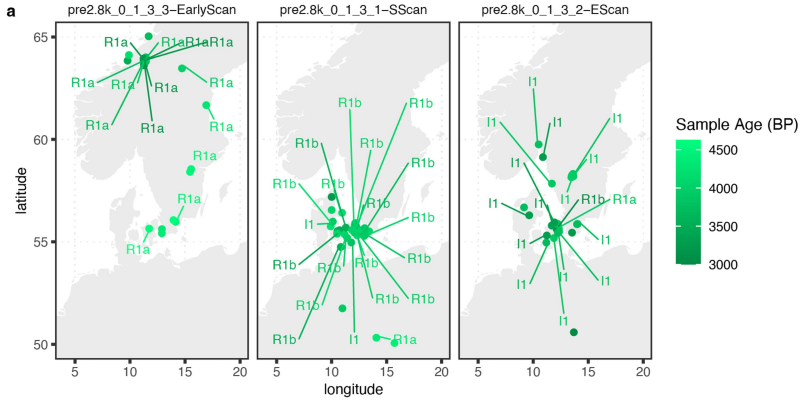
Graphic from McColl et al. "Tracing the spread of Germanic languages using ancient genomics"
These three genetic clusters each correspond to different periods and different material cultures, which are nonetheless closely related:
-
EarlyScan, 2800-2200bc: The Battle Axe culture, part of the Corded Ware culture.
-
SScan, 2500-2000bc: The Jutish Beaker and Dagger Periods.
-
EScan, 2000-1500bc: The late Dagger Period and early Nordic Bronze Age.
The EScan group really just means the Nordic Bronze Age, and the SScan and Escan groups are in reality the same Population undergoing founder effects over time, this population being in continuity with the Single Grave culture, which is largely unsampled but materially ancestral. In contrast, the "Early Scandinavian" group uses the Battle Axe culture samples, or samples that can be attributed to both cultures, not any of the (very few) proper Single Grave samples.
"Together with archaeological and isotopic evidence (Supplementary Note 5.3.4), these results point to the presence of an unsampled hunter-gatherer population, likely carrying I1 haplogroups, admixing with a Corded Ware-related population, similar to those of Scandinavia, to form the Eastern Scandinavians somewhere between Finland and Northeast Sweden. At present, no genomes from this region and time period exist."
This (in bold) is a completely unfounded claim resting entirely on negative evidence (the absence of evidence to the contrary) which is absolutely unsupportable.
Archeologically, There is zero evidence for the population in Southern Scandinavia during 2200-1500~BC to have come from the Baltic or Finland, and indeed the directions of influence are completely the Opposite. During the Early Dagger Period (Corresponding to the SScan Cluster), I1 and R1b-U106 carrying individuals from Southern Scandinavia expand outward carrying Flint Daggers produced in and imported out from the Limfjord and Lolland.
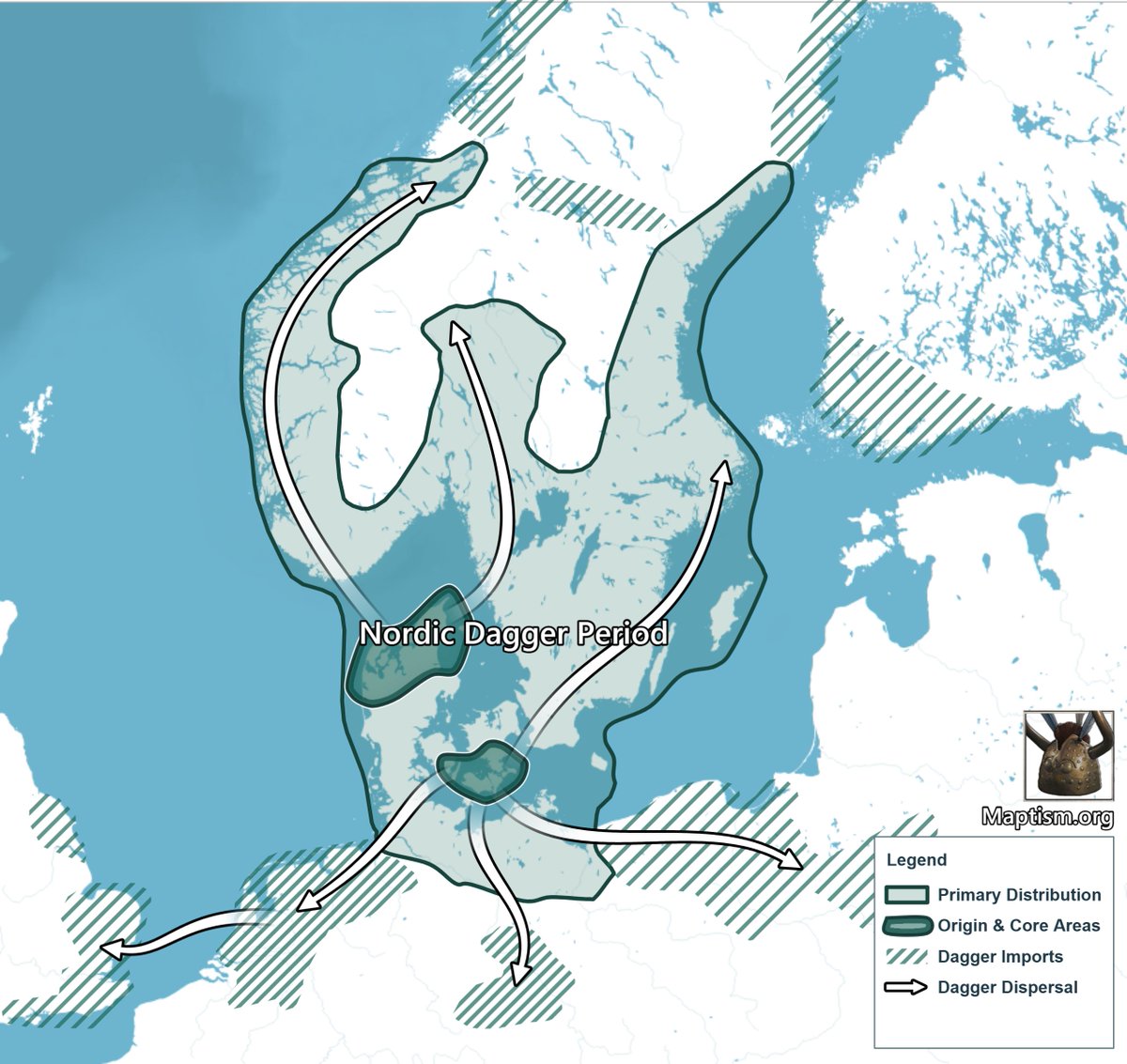
Map of the Nordic Dagger Period and its expansion circa 2400-1800bc
Afterward, in 2000-1800BC Southern Scandinavia receives impulses from the Bronze-working Unetice Culture to its south, leading to the formation of the Nordic Bronze Age. Almost all pre-BA bronze finds in Scandinavia are imported objects from the Unetice Culture, into Denmark and Scania. This Unetician influence is so strong that Unetician Longhouse construction is imitated in Southern Scandinavia, combining with local traditions to serve as the basis for the later NBA Longhouses.
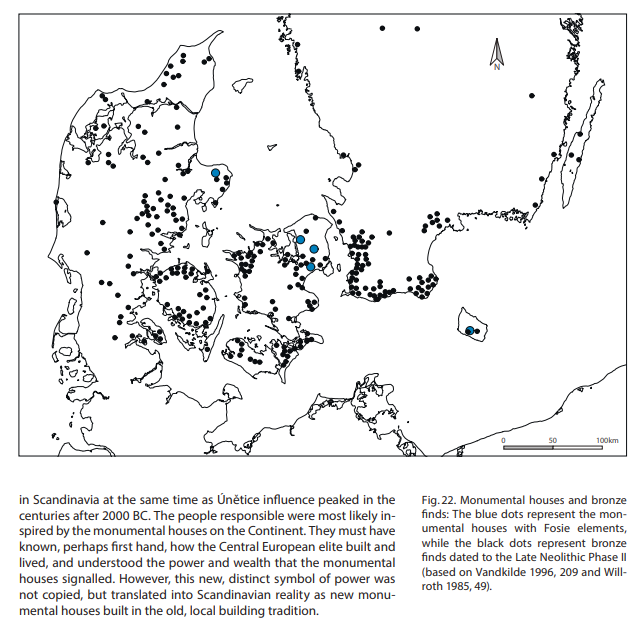
Graphic from "Mansion on the Hill – A Monumental Late Neolithic House at Vinge, Zealand, Denmark" by Jens Winther Johannsen
Therefore, all of the Archaeological evidence points to the Dagger Period in Denmark (SScan Cluster) expanding outward into the rest of Scandinavia, replacing the previous R1a dominated Battle Axe Culture (EarlyScan Cluster), with later influence from the South via the Unetice Culture. That is not to say that the Unetice Culture is ancestral to the Bronze Age Scandinavians of course, as Unetician Y-DNA is not present in either Dagger Period or NBA invidiuals, nor any large amounts of autosomal ancestry. but its material contributions are monumental to the formation and development of palaeo-germanic society.
Now, lets get into the most important part, the Haplogroups:
The origin of Haplogroup I1
The Origin of one of the main paternal lineages of ancient and modern Germanics, I1, is one of the most debated subjects in Archaeogenetics without any clear and exact resolution yet. McColls theory is hardly supportable when looking at the Archaeogenetic record regarding Haplogroup I1.
I1 is not completely invisible, as it does appear in the Archaeogenetic record although rarely:
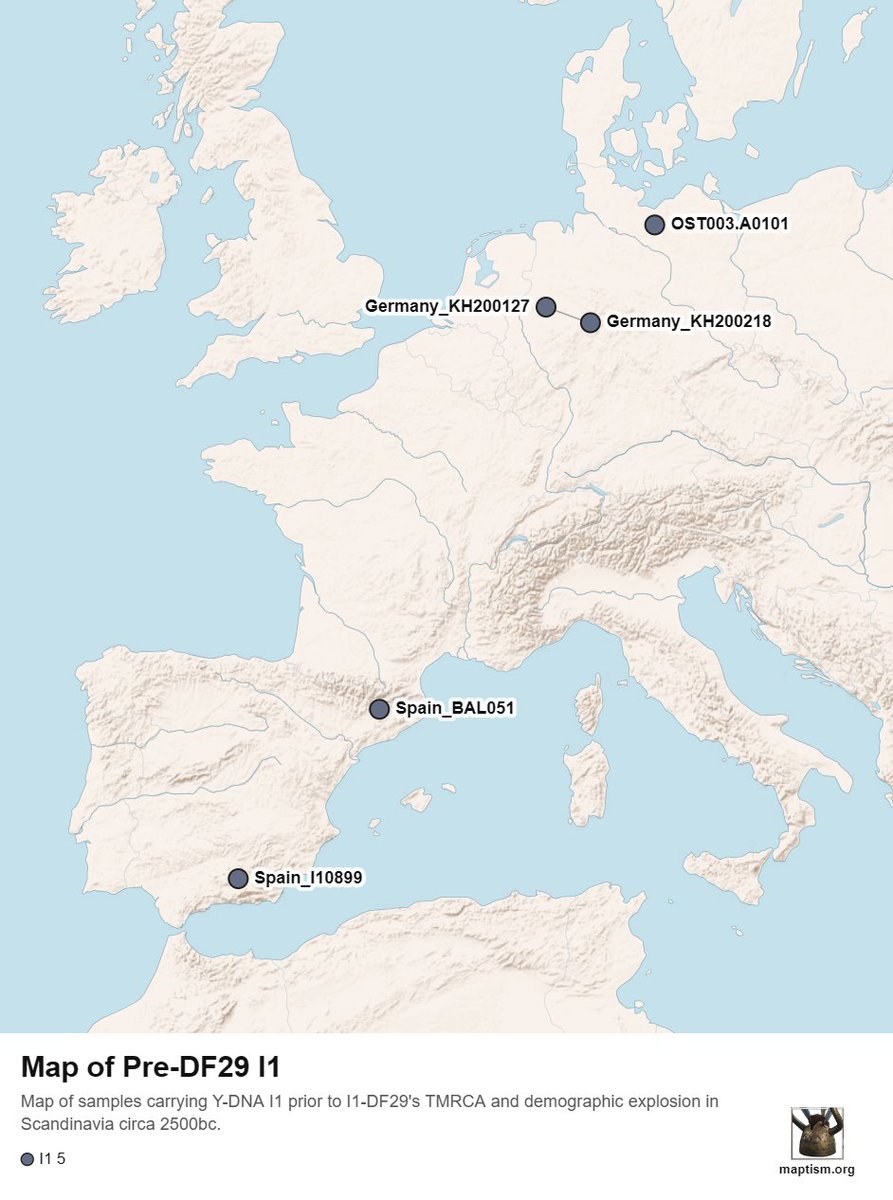
Map of Pre-DF29 I1 samples
As this map shows, Pre-DF29/S63 I1 has been found in Continental Europe, but not Scandianvia, prior to its demographic explosion. Its oldest appearance is in two Spanish samples, I10899 and BAL051. BAL051 is the oldest of these, the site being at Balma Guilanyà. The site dates to 11446-10772 calBC, predating the Neolithic expansion and belonging most probably to the Azilian Industry of Mesolithic Europe. I10899's date is more ambiguous, given as "40000-5000 BCE", which is essentially meaningless. The sample is labeled "Spain_Cariguela_UP", So its likely of a similar age as BAL051.
The next samples of I1 we find are much later and located in Germany. Two individuals (KH200127 & KH2001218) from the Neolithic Wartberg culture from Warburg tested positive for I1-L75, however ended up on a dead end clade, interestingly with 0 modern testers. The most important sample is OST003 from Ostorf, Germany. It dates to 3364-3102 calBC and carries I1-L840, the clade directly ancestral to I1-S63 and DF29, which are the ancestors of all modern I1 clades.
The TMRCAs for S63 and DF29 are estimated to be around 2700b~bc, so we could not expect them to be found in any Pre-Single Grave samples, therefore OST003 is the best possible bet for the origin of Haplogroup I1 and is entirely plausible as its ancestor.
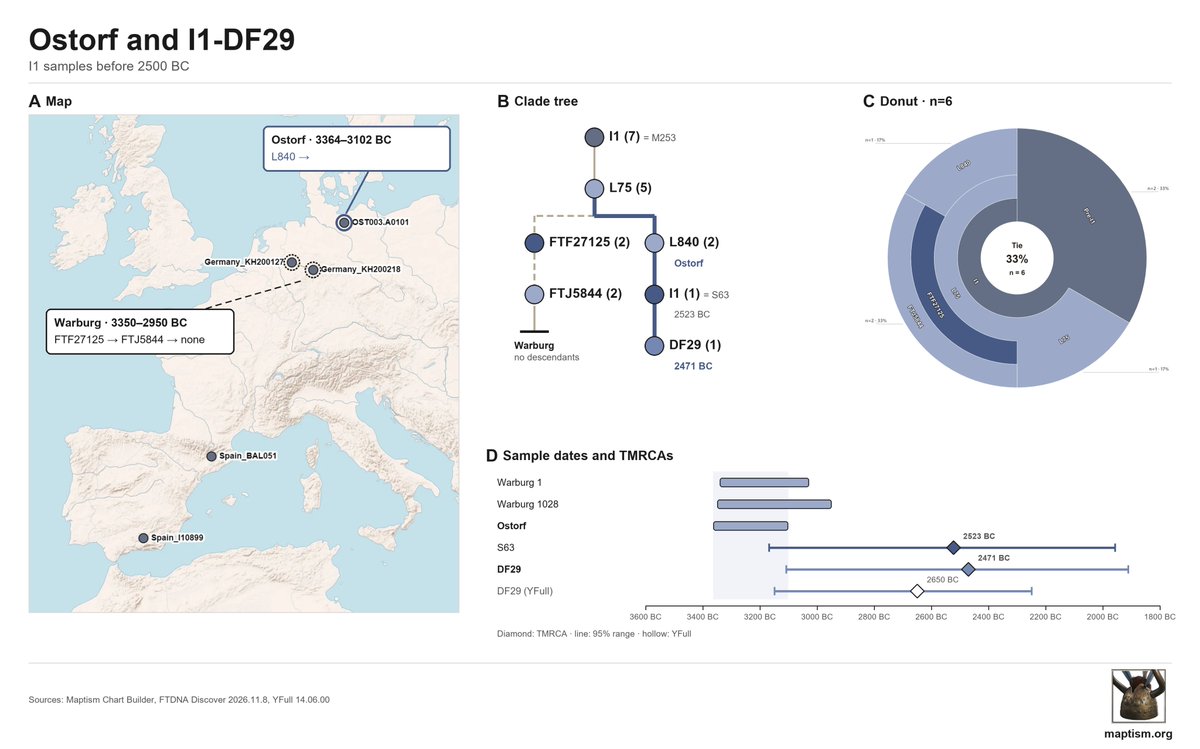
Graph illustration OST003's potential for being the ancestor of modern I1
A single sample, though? And a gap of almost 1000 years until I1s demographic explosion in the EScan cluster? This issue is easily explainable if you look at the Archaeogenetic Record and what areas and periods are actually sampled. Specifically, there exists a massive Sampling Void in just the area where we need to look for the origin of I1:
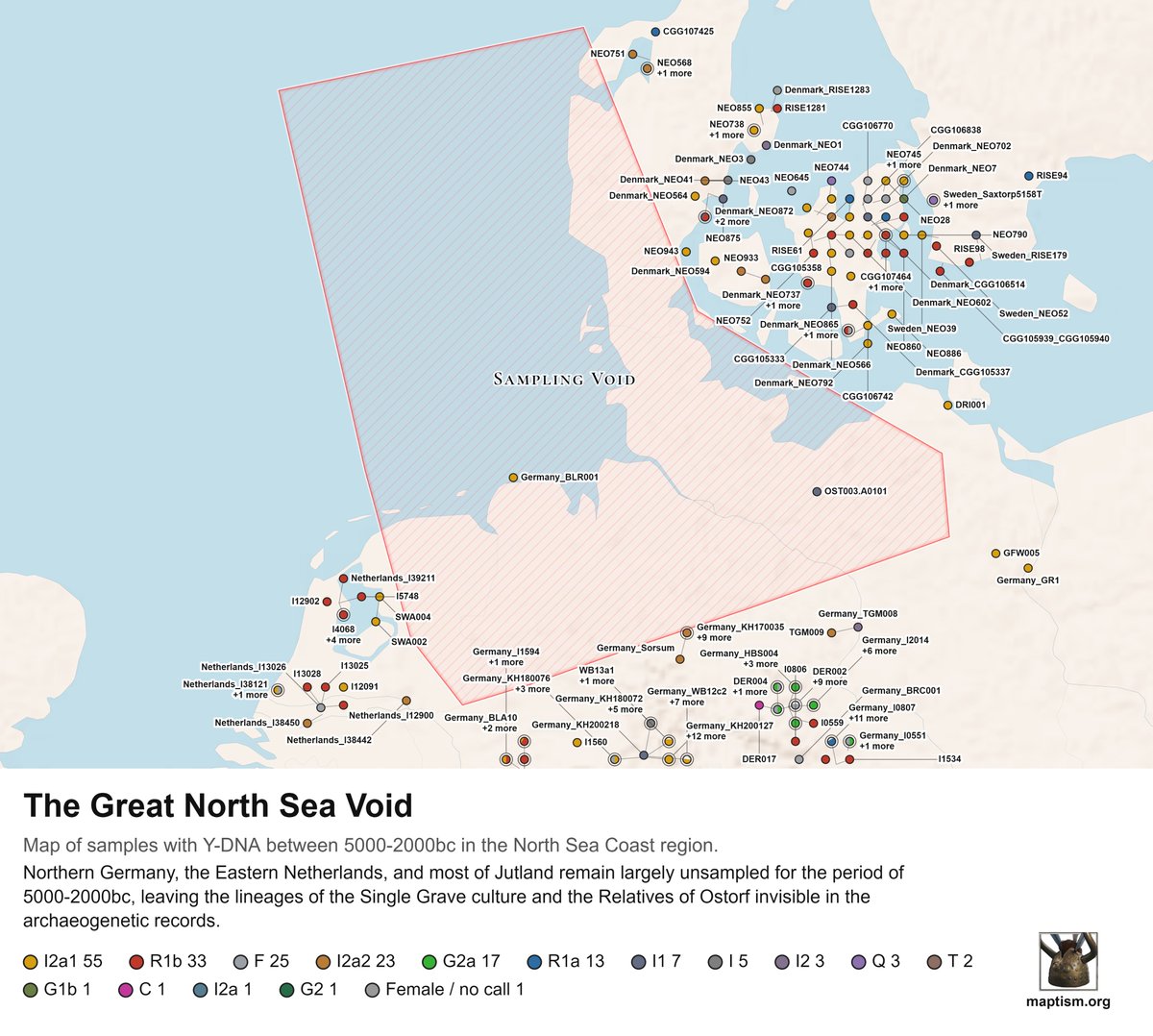
A map illustrating the great north sea sampling void
I1 has already been found on the Periphery of this Area, in OST003 and in the two Warburg individuals. It can be expected that a population carrying or dominated by I1, perhaps of a similar Autosomal Profile to the tested Funnelbeakers (hence we dont see a massive increase in WHG ancestry in I1 carrying EScan individuals), which admixed with the similarly unsampled Single Grave Culture.
The Single Grave culture's core population areas are located right within this Sampling Void, and the samples we do have (NEO876, I12902, RISE94, RISE61, NEO792) of them are on their Periphery:
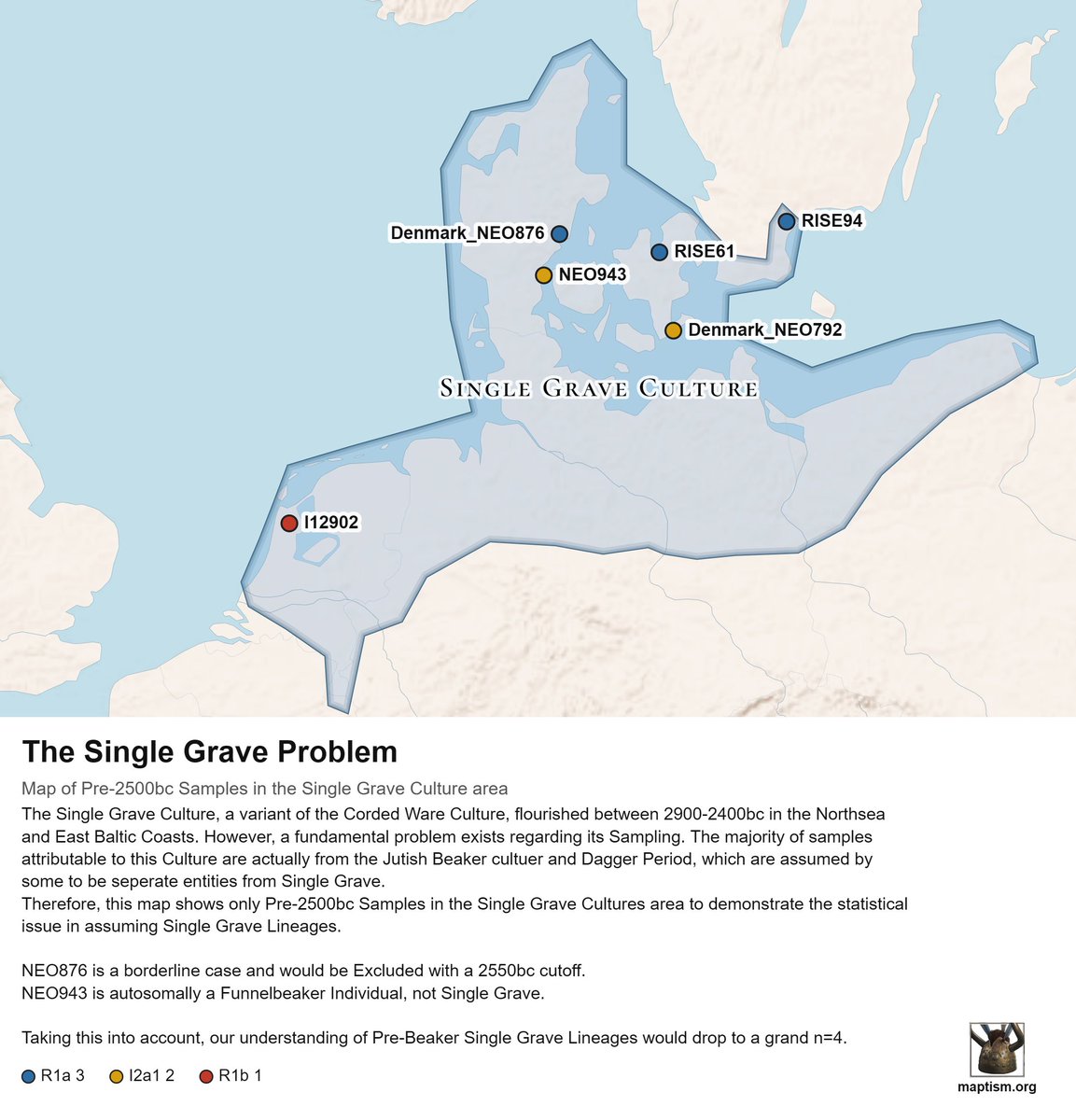
A Map illustrating the issue of Single Grave Sampling
Especially important about this, is that the Single Grave Cultures earliest sites are all located within this Sampling Void:
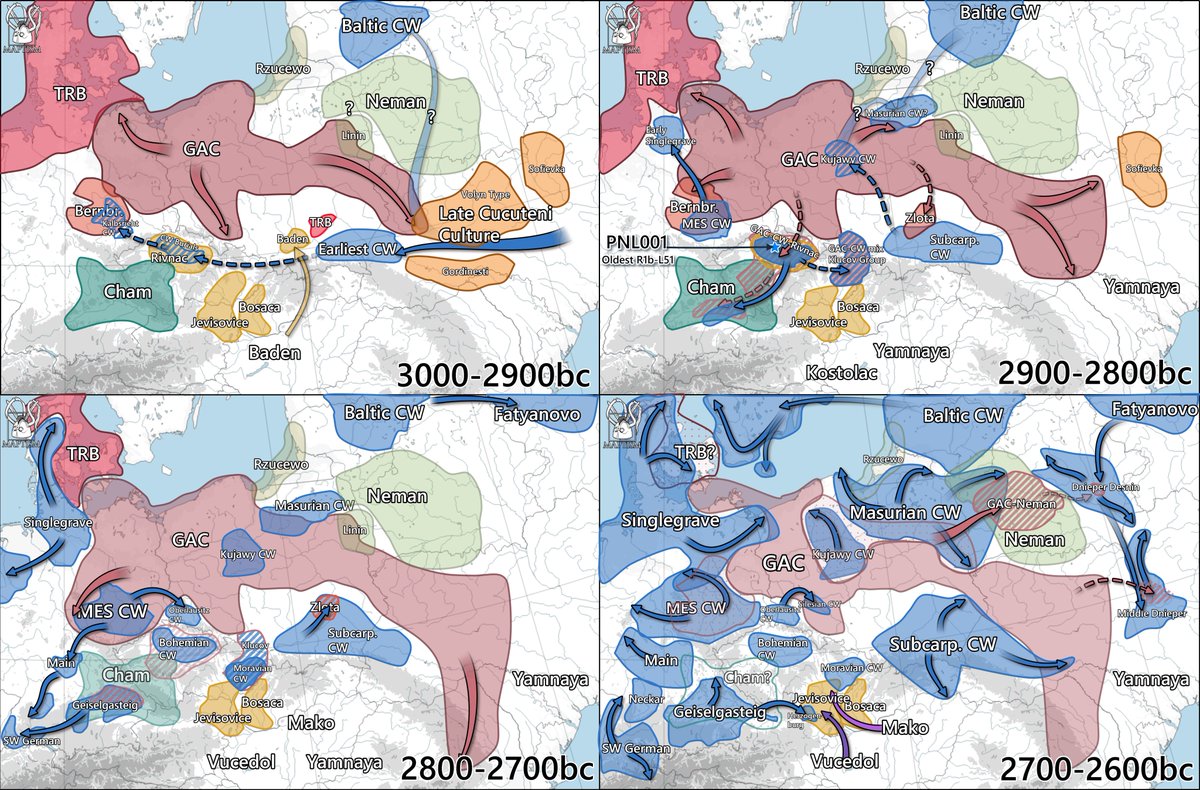
Map illustrating the expansion and formation of the Corded Ware Culture, and by extension the Single Grave Culture.
We can not, with the current state of sampling, accurately predict which Lienages the Single Grave Culture didn't carry. Materially speaking, the Single Grave culture develops into the Nordic Dagger Period with reflux influence from its Dutch Variant, which transformed into the Dutch Beaker Culture. There is no Baltic influence, materially speaking, which facilitated the transition from the SGC to the Dagger Period. The Baltic Influence can be explained entirely as trade-relations to across the Baltic Sea, as both the SGC and Dagger Periods traded with them regularly.
A further clue is how I-DF29's clades developed:
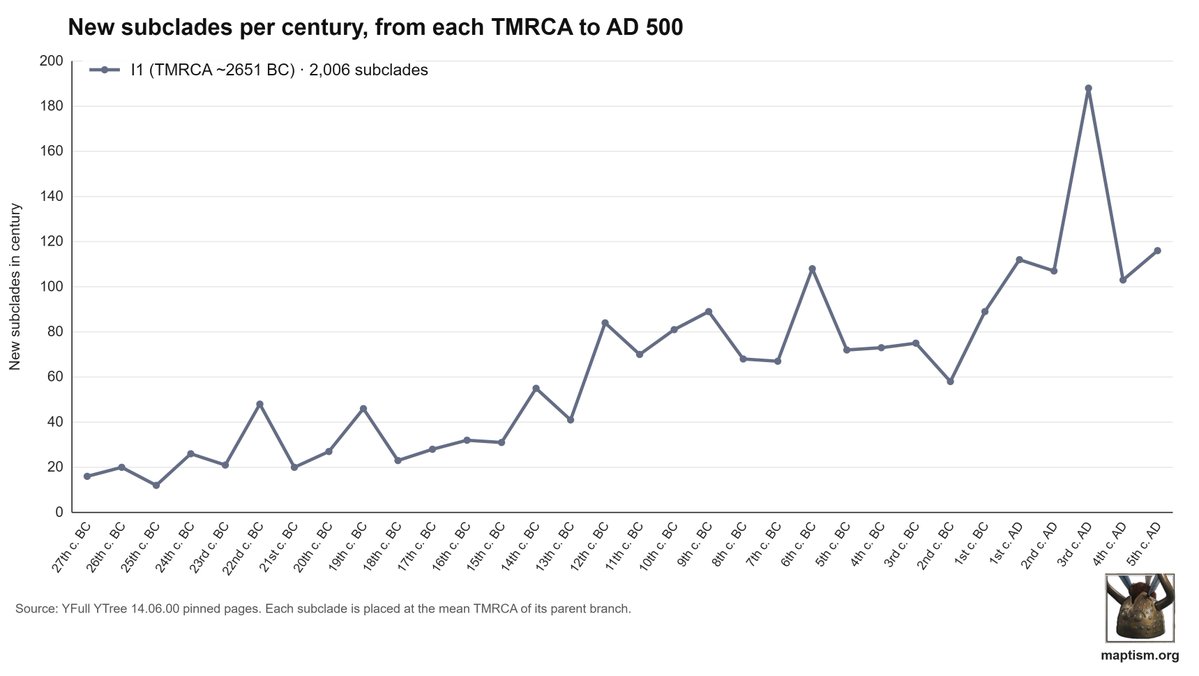
I1-DF29's new Subclades per century
What we would expect to see with a Founder Effect around the 25th century BC is a massive jump in new clades per century, as we do with for example E-V13 in Dacothracians. Instead, I1-DF29 develops gradually and somewhat linearly until the Migration Era, with a jump in the 22nd Century BC, which is after it already appeared as a large portion of the Dagger Period individuals. What this shows, in my opinion, is that DF29's ancestor L840 was already integrated and part of the Early Single Grave population, until DF29 formed as a integrated part of Single Grave Culture, which seamlessly transitioned into the Dagger Period and then the Nordic Bronze Age, while receving small drops of foreign admixture, in this case baltic but in later cases celtic, due to sporadic political and economic exogamy.
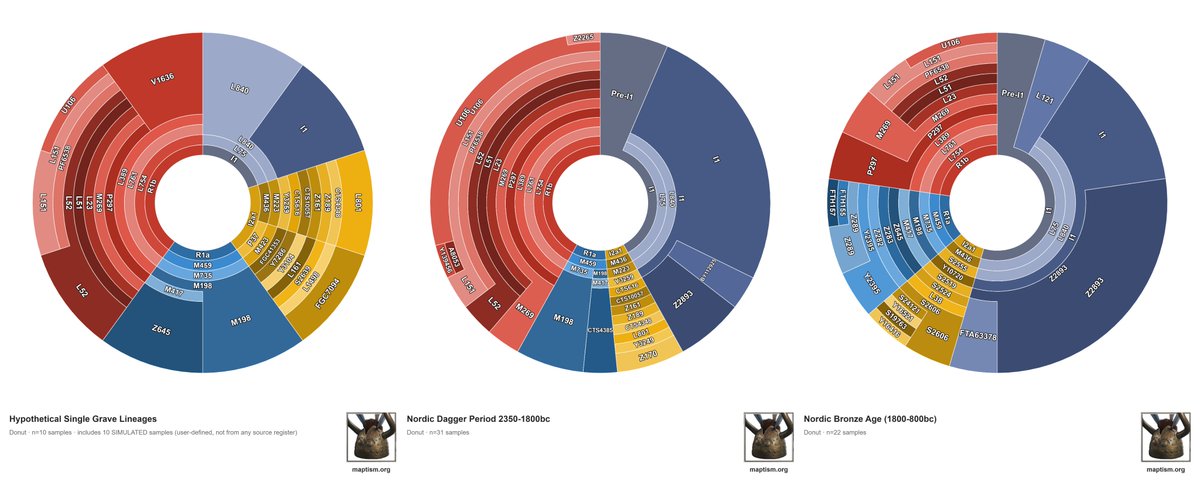
Three Y-DNA charts of the development of Palaeo Germanic to Proto Germanic in Chronological Order
Now that the data has been shown regarding where I1 could have existed, lets get into where we know I1 did not exist.
Firstly, there is no precedent to assume that I1 would exist in Finland or the Baltics, as pre-Iron Age Y-DNA samples with I1 have never been found in the Baltic or Finland, and the ones we find in the Iron Age and in Modern Populations is entirely Germanic I1 downstream of DF29 from the Goths and Vikings.
Instead, Baltic Hunter Gatherers carried primarily R1b-Y13200 and various clades of I2a1. Not a single I1 sample for 25 tested individuals, which is admittedly a small sample size.
Archaeologically, the Baltic area is united with Finland in the Neolithic until the Corded Ware period under the Comb-Ceramic culture, so you would expect to find similar HG Y-Dna in Finland. Therefore there is no reason to suspect that I1 somehow survived in, or even got to, Finland either.
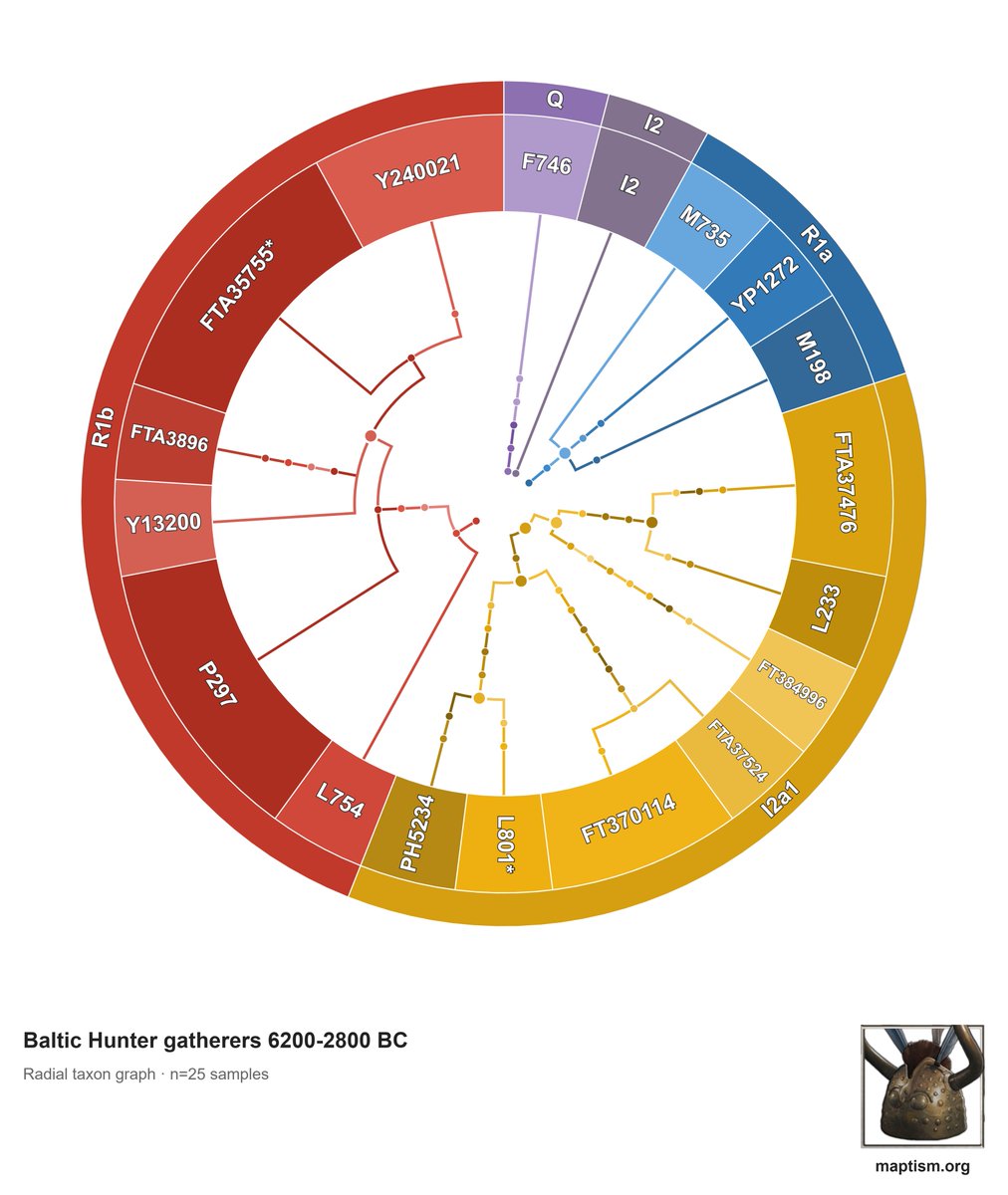
Y-DNA lineages of sequenced Baltic Hunter Gatherer males
Similarly, we do not find ancient I1 in Scandinavian Hunter Gatherers (Samples taken from all of Scandianvia 8000-4000bc), nor the later Pitted Ware Culture (a descended from Scandinavian Hunter Gatherers), nor the Danish Funnelbeaker Culture. Instead, all of these cultures were dominated by various clades of I2a1, with the PWC and Danish Funnelbeakers being especially Homogenous, domianted by FT344596 and AMM061 respectively.
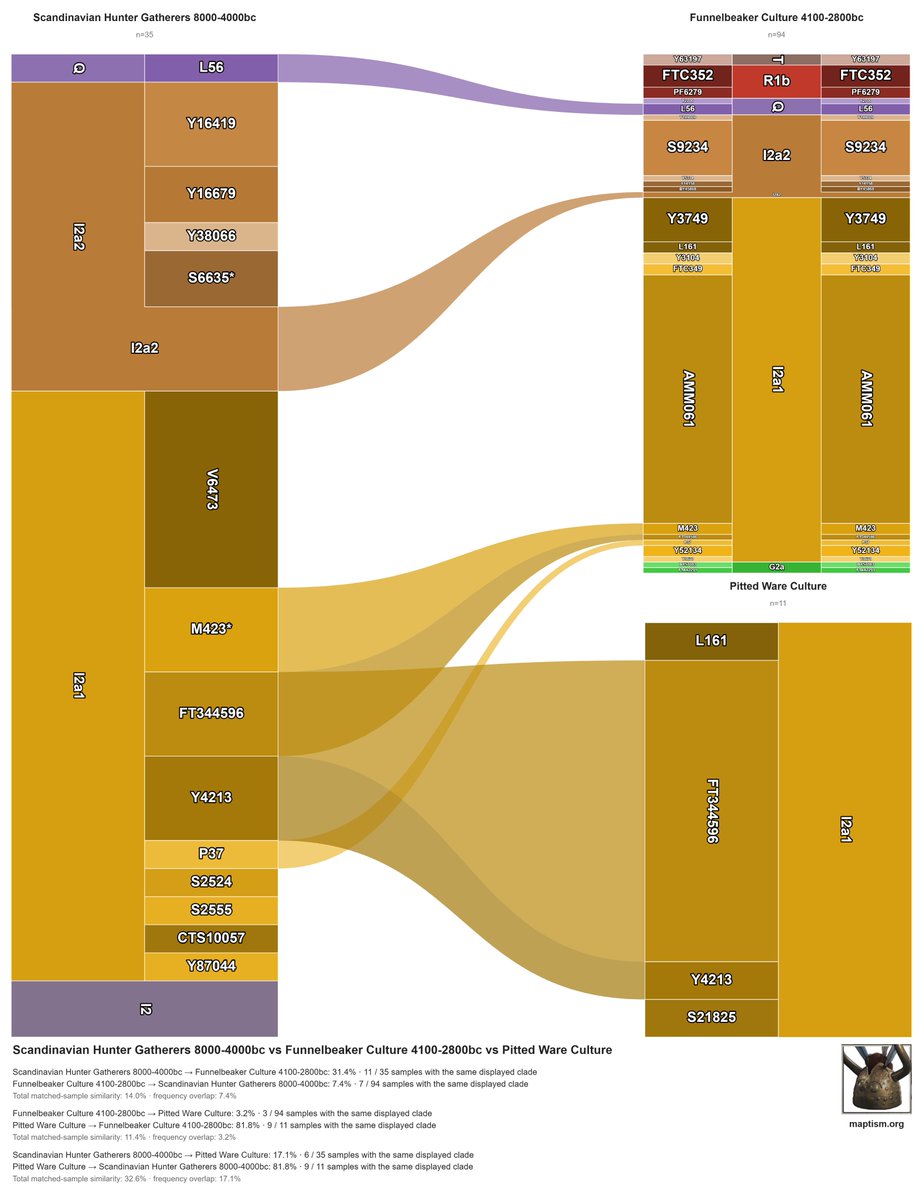
Y-DNA Comparison between Scandianvian Hunter Gatherers, Funnelbeakers, and Pitted Ware individuals.
That these issues, nor the Warburg or Ostorf I1 samples, were not mentioned or raised in the McColl paper regarding the origin of Palaeo-Germanic is unprofessional and betrays a lack of scrutiny when coming to conclusions regarding the Origin of Germanics. A shame, as the rest of the Paper is actually very good and shines an important light on the later Iron Age history and development of the Germanic Peoples.
To recap:
The Origin of Germanic: Counterproposal
As i have shown, the evidence points to Northern Germany, specifically Northwest Germany, NOT any further north. I1 developed in the early Single Grave Culture in the Northsea Coast, which formed in 2900bc when the Indo-European Corded Warers took over the Northsea Coast region. I1 then mimics a Founder Effect due to a sudden increase in Sampling in 2500bc caused by change in Burial Rite, not a change in population or a discontinuity in Lineage.
This then develops, out of the Single Grave Culture, into the Dagger Period, which expands across the rest of Scandinavia, until eventually becoming the Nordic Bronze Age with influence from the bronze-working, highly stratified Unetice civilization, and admixture from the Baltics as a result of Political and Economic Exogamy.
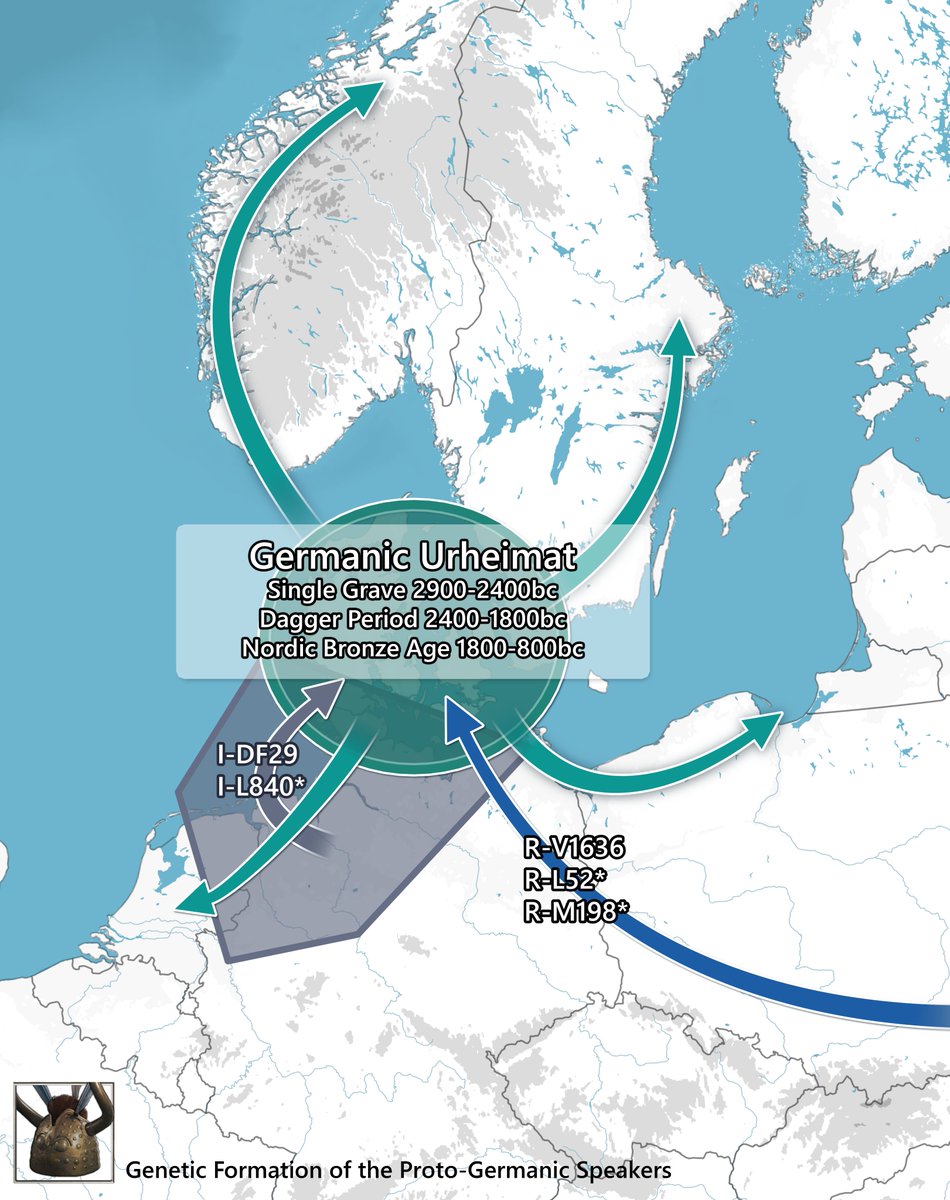
Map illustrating the Genetic Formation of Palaeo- to Proto-Germanic Speakers
Later, the Nordic Bronze Age would split apart into multiple early iron age cultures, until the Northsea-East Baltic coast area was re-unified by the Proto-Germanic Jastorf Culture in 600bc, developing in Northern Germany, which would go on to Spread the Proto-Germanic Language and the Germanic Tribes we know from history across Europe.
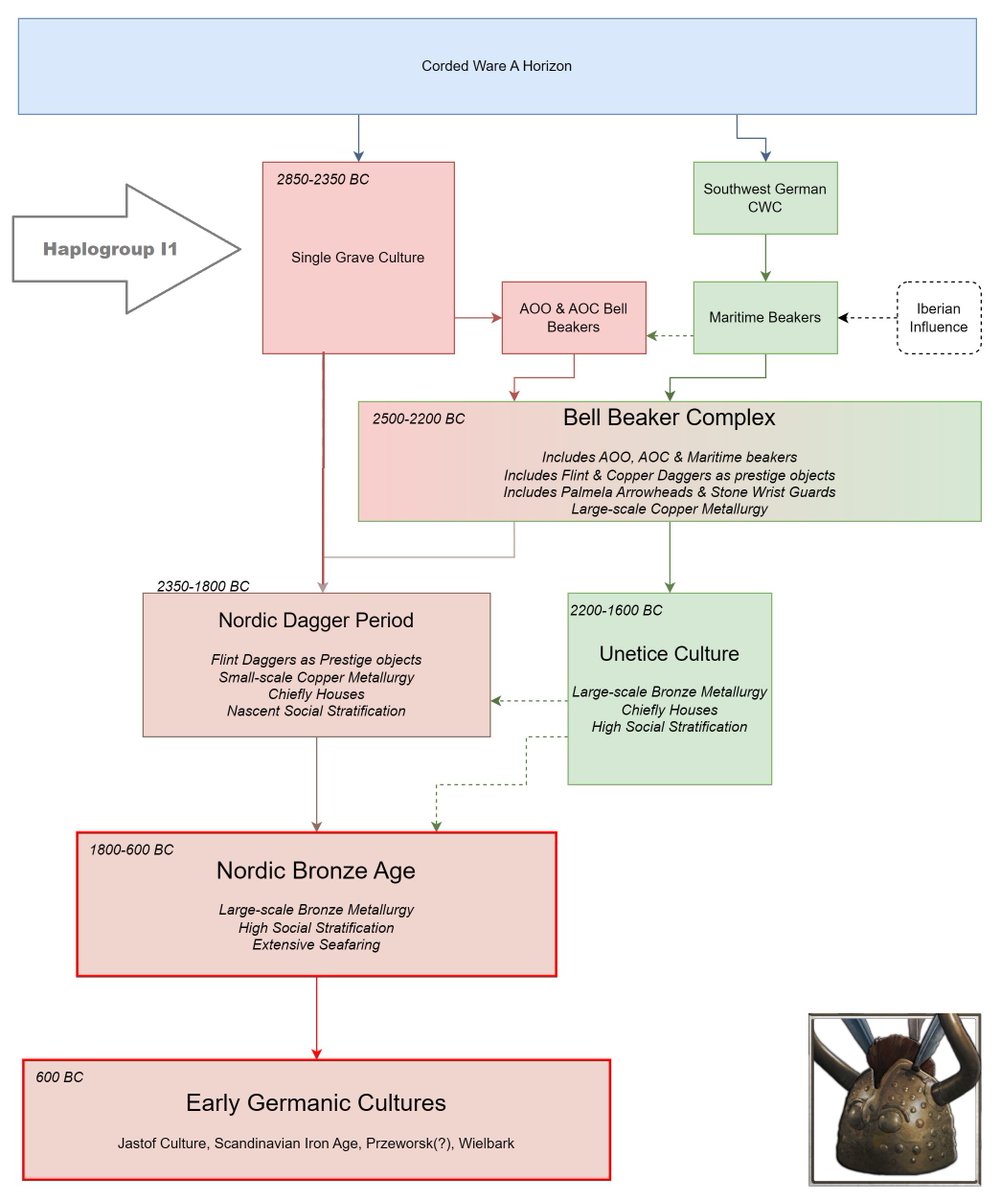
Graph illustrating the evolution from Proto-Indo-European to Proto-Germanic
That concludes this thread and my Critique of McColl and his teams paper "Tracing the spread of Germanic languages using ancient genomics". Thank you for reading, and if you have any critiques of my interpretations, or think i missed something, please leave a comment.
If you want to learn more about the Ancient Germanic People, their Culture and their History, i have made multiple high-quality maps and threads which you can read eithe here on X, or on my website, Maptism.
In Chronological order:
-
Jastorf Culture: https://x.com/Maptysk/status/1974884694303870983
-
Goths in Poland: https://x.com/Maptysk/status/2030386901861961968
-
Ancient Germania: https://x.com/Maptysk/status/2027476111148343343
-
Goths in Ukraine: https://x.com/Maptysk/status/1854248289337803117