Refounding Ro to $3B+ Run Rate

文章目录
部分视频或图片暂未收录,已在正文保留提示;需要时可查看原文。查看原文 ↗
30k feet in the air, I had a pit in my stomach. It’s December 2021 and I’m flying home to visit my parents. I’m looking at our 2021 results. It was ugly.
Ro was growing at ~9% YoY. We were at a $270M run rate. We were burning. We had raised ~$800m in total over the previous 5 years and still had the majority in the bank.
In 2021, we were a zombie company. Not enough growth to matter, too much cash to die, and a pref stack that would squash an elephant. I’m not even sure Bending Spoons would have taken a look.
In 2022, we refounded the company.
In 2026, we’re at $3B+ run-rate, growing revenue more than 100% CAGR for the last three years.
Today, Ro isn’t a zombie. It’s a rocket.
Here is the story of how we
-
Refounded the company
-
Re-accelerated growth as we scaled larger and larger
-
Built the foundation for a new patient centric healthcare system
THE PUDDING
Since we refounded Ro, we’ve nearly 10’x the business.
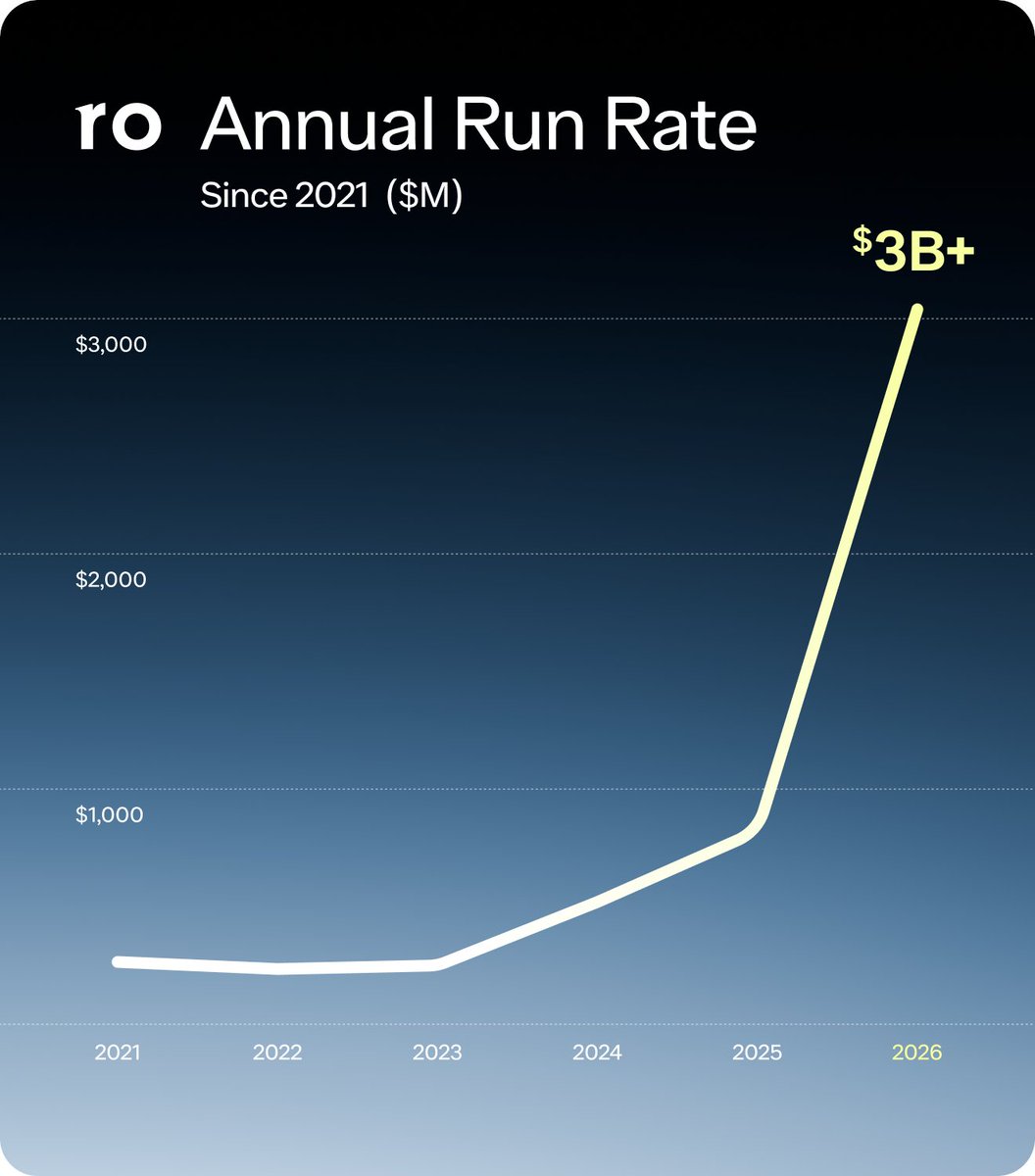
ARR calculated as 12 times November revenue each year.
We did it with fewer people than we had in 2021:
-
December 2021: 463 people
-
May 2022 (pre-refounding peak): 596 people
-
October 2026: 406 people
Now overlay that on the revenue chart. ARR per employee is up more than 10-fold in four years, while People & Opex as a percentage of net revenue fell to less than 15%.
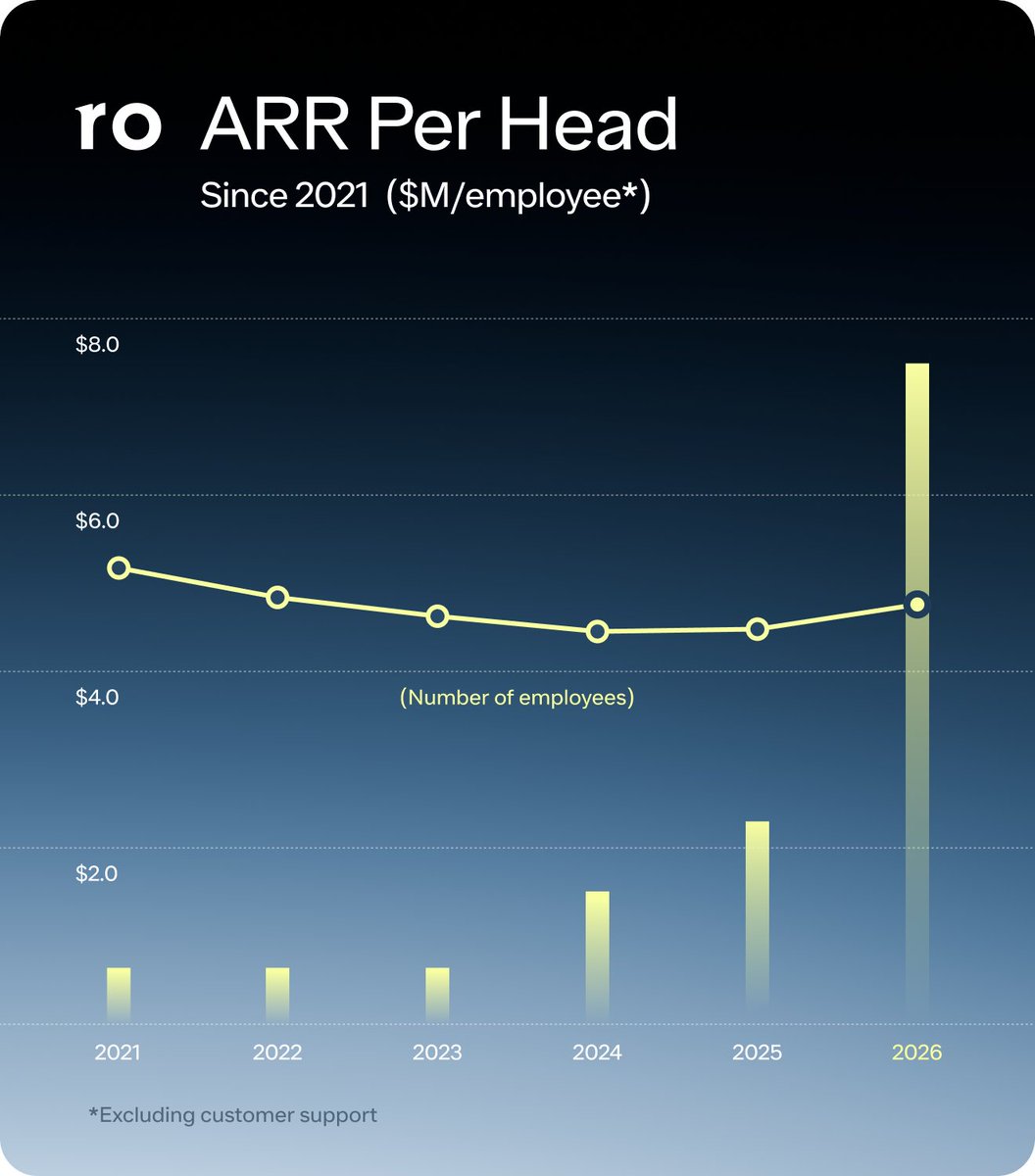
Headcount is as of Nov 1st each year.
That graph is the refounding in one picture: 10x the business, fewer total people, every year more leverage than the last.
To put this in perspective: There are roughly 1,800-2000 public healthcare and technology companies listed in the US. The number with more than $2B in revenue, growing more than 50% this year, forecasting 50%+ next year is ~5-10. None of them are healthcare companies.
The private companies that clear that bar are probably single digits: Anthropic, OpenAI, Databricks, Kalshi, Anduril etc…
And Ro.
One of my favorite people in the world, Barry McCarthy, once told me that “cash is your ticket to the island of invention.” One of the best CFOs of all time saw the financials as a means to an end. Money is a tool to push the world forward.
At Ro, we fight for patients. That’s why we wake up every day and skip to work. Over those same 4 years:
-
We've helped millions of patients, one in virtually every single county in America (The lone holdout: Kalawao County, Hawaii. Eighty-two residents, no road in, freight arrives once a year by barge).
-
Helped more than 1% of the US population
-
Became the leading provider of GLP-1s in the country
People will say, “You’re just a GLP-1 company.” I disagree, but I’d be proud if we were. GLP-1s are upstream of the leading causes of death in the U.S. And the scale is already staggering: they generate more revenue than the AI labs, and twice as many consumers pay for a GLP-1 as pay for AI. Think about that for a second.
People will say, “You just rode a wave.” The wave was real. It was available to everyone, but there’s only one leader. We had the platform, we built for the moment, and we delivered for more patients than anyone else. And we’ll keep fighting for them.
Most importantly, we’re just getting started.
OCEANS FULL OF PLASTIC
I remember the moment I knew we needed a reset.
December 2021 was a weird time. The previous 20 months with the pandemic had been trying for every one to say the least. People had lost friends and family members. I lost my grandpa during Covid. People were arguing equally strongly about very important and very unimportant topics. But it was the holidays. Whether you’re a catholic or a capitalist, it’s a joyful time of year. A lot of people at Ro, myself included, were headed home to see family.
The Ro People Team, as a small thank you, sent out a box of macaroons to everyone at Ro from a local women owned business in NYC. A little treat.
Welp. The next thing I know, I open up Slack to be greeted by a message right in the #General channel:
"The next time we send holiday gifts, can we not send them in oceans full of plastic?!"
It was out of a Silicon Valley TV show. Honestly, my head almost exploded. If I was a cartoon character, steam would have been spewing out of my ears. The team worked hard to send every person in the company a gift to end the year, a small thank you for all of the hard work and this person’s first instinct was to shit on the packaging. My first instinct was to… @here, you’re fired.
Fortunately, system 2 thinking took over and knew that wasn’t the right answer. But my second instinct brought a realization that was worse than my first.
Nobody complains about gift wrapping at a company that’s winning.
This message was a symptom of a disease. And it was 100% our fault. Not in a self-flagellating way. In an "own your shit" way. This wasn't always us. We weren’t always “complain about macaron packaging” soft. We were, literally and metaphorically, macaroon soft.
We had done the exact thing people point to when they talk about 2020: we raised $500M, we hired too many people too fast, and tried to do everything at once. After four years as a rocket ship, growth had slowed to 10%.
Something had to change.
🧂GRAIN OF SALT 🧂
Quick aside. You should take everything in this post with a grain of salt.
Every founder is imprinted by his or her own experience. The lessons feel visceral, but the sample size is one. Listen to enough founders and you'll hear advice in direct opposition, and both worked... for them. F. Scott Fitzgerald said the test of a first-rate intelligence is the ability to hold two opposed ideas in the mind at the same time and still function. That's startup advice in a nutshell.
There are commonalities in how great companies get built. There's also tremendous survivorship bias, and constant exceptions that prove every rule. Follow it all and you'll end up in a blender.
So I'll share freely, hoping some of it is useful. But you're going to have to be the filter. I'm not saying “This is the way”. I’m saying, “This is the Ro Way,” we're still iterating on it, and maybe some of it travels.
So how did we do it?
STRONG ATTRACT, STRONG REPEL
As I’ve shared this story with founders over the last year, some have asked, “if you had to stack rank the things you did, what would be at the top?” You can see why founders are such great dinner guests.
Of course, it wasn’t just one thing, and I’ll talk about the big and small things we did to “refound Ro.”
But the sine qua non, without which there is none, was this:
We embraced a “strong attract, strong repel” culture.
I believe the best products, the best pieces of art, music, media and fashion are strong attract, strong repel. The reason some people love them will be the exact same reasons some people dislike them. I think it’s the same for company cultures.
What does “Strong Attract, Strong Repel” mean?
The best company cultures are highly opinionated about what they are building and the way they are building it (i.e., the WHAT and the HOW). As a result, some people love it and some people do not. They are filled with people from heterogeneous backgrounds but they have a homogenous way of working. I want diversity of experience, knowledge, and backgrounds. I don’t want diversity in how we build.
One of the best analogies someone shared with me is that a strong attract, strong repel culture is very similar to a great restaurant. It has a menu and some people are going to love it and some people are not. Don't go to a steakhouse if you're a vegan and don't go to a vegetarian restaurant if you're a carnivore. You're not a better or worse person if you're either, but you're definitely not going to be happy as a vegan at a steakhouse.
Why? Because the steakhouse is trying to be the best steakhouse in the world. This is the key. This is very similar to building software products. A product cannot be everything for everyone. It must try to be the best for a specific customer. It must be highly opinionated on who it is trying to serve so that it can build features that really fit the use case and, in doing so, will actually build features that make it worse for another use case. A minivan is better for carpooling than an F1 race. Similarly, an F1 car would be the worst car for a family roadtrip ever. “Hang on Timmy!”
Companies and cultures are the exact same. Strong attract, strong repel.
***Optional Reading* — Feedback in two buckets: features & bugs
**Of course, this does not mean that Ro's company culture is perfect or above feedback. But we put feedback into two buckets: ✨ features or 🐛 bugs. Imagine giving feedback to the steakhouse. "This steak should be a mushroom." That's bad feedback. It's a feature. "This steak is overcooked, I asked for medium rare and it's burnt." That's good feedback. That's a bug.
At Ro, if someone says they don't have enough context to do their job, that's a bug. We want to eliminate every single bug. If someone says they don't like when leadership is in the details, or takes issue with the fact we don't have a 9-5 culture, or they don't take the same pride in efficiency (waste is eventually passed on to patients in some way), they aren't going to be happy here. These are features.
We double down on features. We fix bugs.
A key part of this, similar to a restaurant, is to articulate the menu so that people can opt in or opt out ahead of time. Imagine a restaurant that said “come here when you’re hungry, we serve food.” You don’t know what kind of food or how it's made. No one would eat there. I’m going to ignore the avant garde Michelin restaurant that considers “a foam surprise” food…but I digress.
That was one of the places where we messed up. We didn’t articulate the Ro menu. In the early days, it was all osmosis. Only 5 out of the first 100 people that joined Ro even applied on the website. All of our initial hiring was all through people we, or our team, had worked with in the past. But when covid hit, and we raised $500M, that changed. We didn’t create the opportunity for people to opt-in or opt out. We just said, “we’re changing healthcare, come join”. That’s on us.
We didn’t tell them that Ro is grounded in a rare duality: unapologetically performance driven, coupled with a Big Heart. It's not about "balancing them"... it's about turning both to 11. If you have a lot of one but not enough of the other, you're not going to love it here. We didn’t tell them that we don't "clock in". We're metrics driven. We fight for our patients as if they are our family members. We don't believe nice people finish last.
We weren’t explicit about the menu.
Where talented people work is a gift. It’s where people spend the majority of their waking hours. It’s on the company to earn that time and we take that responsibility extremely seriously. As a result, it’s on the company to be very explicit about its culture (i.e., menu) both on the way in and on an ongoing basis.
So we doubled down on a strong attract, strong repel culture. Then we refounded the company from the ground up.
THE REFOUNDING
It was painful. Again, it wasn’t just one thing and, to this day, we’re still iterating. The Refounding consisted of several inputs:
-
Team Reset
-
Top Talent Investment
-
One Brand
-
Narrow the Focus
-
Reaffirm Ways of Working
-
Killed long term roadmaps
TEAM RESET
From January to May 2022, we parted with ~7 VPs. In June, we moved on from ~20% of the company. In July 2022, one of my co-founders took a step back. In August, we refounded Ro. We asked people to opt-in or opt-out. Over the next 90 days, ~6-8% of the company opted out.
*Optional Reading* — No Glory in Firing To be clear, there is no glorification in moving on from people.
People in silicon valley will often praise companies that do layoffs #efficiency. Making the necessary hard decisions to fight another day is definitely worth acknowledging (it’s better than the alternative). But overall, I think the conversation around layoffs specifically is pretty stupid:
First. It would have been a whole lot more efficient to never hire that many people in the first place.
Second. Taking someone’s job away is the worst part of running a company. The second that changes, I’m going to have to take a closer look in the mirror because I won’t like that person very much.
Third. The more I learn, the more I do believe more in “right place for each person” and less absolute “this person is or isn’t talented”. We parted ways with a lot of talented people in the process that weren’t fits for Ro. It’s been awesome to see them thrive at other companies from afar.
On that last point, a personal note: I had a consulting internship at Booz my junior year of college. There were ~12 interns. 11 of them got job offers. I got fired 4 weeks into the internship and put "on the beach." This was a first for them. I'm not an idiot. But I'm definitely not meant to be a consultant. Right place for each person.
TOP TALENT INVESTMENT
Right after we did our layoffs, Saman (my-cofounder) and I met with the top talent of the organization. Breakfast, lunch, and dinner straight for the next 30 days. We did a few things during these meetings:
-
Resold them on the vision of Ro. We needed to “rehire” every single person.
-
Asked them what they loved and hated most about Ro. Committed to doubling down on what they loved and eliminating what they disliked.
-
Gave them more equity and asked them to continue to give it their all for 90 days. If after 90 days, they didn’t feel a difference, we’d personally help them find their next job. If after 90 days, they felt the momentum, then just give us another 90 days and see what happens.
Over the next four years, we’ve continued to double down on our investments in talent. We created coaching programs. We constantly evaluate compensation and equity. We meet with every single top talent team member on a recurring basis. We ask them how we can make their job better? What would make them quit?
Last but not least, we look to promote from within. Insert all the caveats. Of course this isn’t the case 100% of the time. But I’ve generally found that hiring high horsepower people that are “strong attract, strong repel” with your culture and pushing them to take on more and more is much better than hiring based on a resume.
ONE BRAND
At Ro, we help people achieve their health goals because, if we do, we help unlock the full potential of humanity. We want to build a patient centric healthcare system and we think this is the highest leverage way we can help push the world forward.
I’m sure a therapist would have a lot to say about this but, in many ways, I’m trying to recreate my dad with software and give him to everyone. I have a congenital heart condition and he’s been my doctor since as long as I can remember. When your dad is your doctor, they don’t just care about your health. They care about your health goals in service of you achieving your life goals.
We always knew where we wanted to go but we also knew we needed to start narrow. We started as “Roman”. A digital men's health brand. We started with ED.
Then we launched Rory for women’s health. Then we acquired Modern Fertility. Then we launched Ro Mind for mental health. Ro Derm for dermatology. We had Workpath for in-home care. Kit for at-home labs and diagnostics. It was a mess. There was no consistency. Externally or internally.
We can save the house of brands vs. branded house debate for another time. They each have their place. What I will say is that Ro needed one brand. We believe in offering a single trusted place for patients and that brand shouldn’t be limited by biological sex or health category. The human body doesn’t have walls and neither should we.
In addition, employees needed to know where they worked. Of course, there are countless examples of great companies (e.g., Meta) where the name on the website or app doesn’t match the parent (again, take everything with a grain of salt), but Ro needed one name. We needed the name on the wall when you walked into the office to match the website to match the email address to match the app store to match linkedin to match the name in the ad their mom sees during the Super Bowl.
For patients, for partners, for employees, we needed one brand and one mission. We needed Ro. The name has created more than alignment and consistency. Internally, it’s created more love for what Ro means for today and what it could mean in the future. Externally, it’s created exponential awareness that keeps compounding. It’s worked for us.
NARROW THE FOCUS
Entropy. The second law of thermodynamics. Without external forces, a company will naturally drift its focus. Not because of any bad actors but because of curiosity and exuberance. So as a leader, you have to work tirelessly to make sure the energy is not diffuse but concentrated towards a clearly defined strategy. Think of it like light… the more concentrated, the farther it will reach.
We embraced “Sequential vs Parallel” — Slootman Style
I still remember reading “Amp It Up!” on Linkedin in 2018. I was amped by the end of it. Slootman (“Slooty” as he’s known in my group chats) is an absolute gamer. There is so much to love about that article and about his full-contact style. But the thing that sticks with me the most to this day is the impact of narrowing the focus. It is what unlocks both speed and higher quality. If you don’t like the wrapper the message is in, you can check out Jony Ive’s 90 seconds on “focus”. Different styles, different accents, same message.
One of the reasons this is so hard, particularly for type A people, is that in the short term, it feels like you're accomplishing less of your vision. And you are. Over any 90-day window, you'll push one thing meaningfully forward while four things you genuinely care about sit at zero. Zero is the most painful number for any competitive person. Every instinct screams to do just a little bit.
Over 90 days, focus loses. Over the years, I've only ever seen it win. I think the reason is that humans are inherently bad at thinking exponentially, and focus is a compounding asset. It compounds twice. First in depth: ridiculous, painful levels of focus are what push a thing past "good" into "the best". This is where the asymmetric upside comes from. Then in sequence: every finished thing becomes the foundation for the next, so each step is faster and bigger than the last. The wheel starts turning and you have so much momentum you can’t be stopped.
Do one thing at a time, each for far longer than seems reasonable. It will feel slower every quarter and prove faster every decade. Ten or twenty years out, you'll have built 100x more than if you'd kept all five moving at once from the start.
What did this actually “look like” in practice for us?
We Shut, We Cut, We said “No” to 10x More
During this re-founding, we shut down 10+ products. We cut ~$50M+ of DTC revenue that was “vanity revenue” (upside-down unit economics). We cut all B2B efforts. We cut all external API integrations. At the time, we were powering Amazon Care with our routing technology, Siemens clinical trials, and Prudential’s at-home lab tests. Over 10k in-home visits per month. We shut it down.
I personally said no to almost every conference, every podcast, every panel.
I told all of our investors directly that we were heads down and that if they asked for our team’s time they’d be directly reducing shareholder value. Requests fell precipitously. We needed to put our oxygen mask on first. (Note: I still have to send some reminders every once and a while.)
*Optional Reading* — Tomorrow Wall
**This level of focus is genuinely painful for ambitious, exuberant builders. Their heads are full of ideas, and a focused company seems to give every idea just two options: build it now, or lose it forever. Building it now breaks the focus. Losing it forever is worse. People don't stop having big ideas, that energy gets channeled somewhere.
One of the things that I’ve found works for us, and it’s not a particularly novel concept, is the “Tomorrow Wall”. It’s like Dumbledore's Pensieve, pointed at the future instead of the past. When an idea leaves someone's head and goes onto the wall, two things happen at once. The idea is saved, permanently, with fidelity, waiting for the day we pull it off the wall and jam on it. And the person is relieved. The idea is no longer something that dies if they don't fight for it today.
We're not perfect at this at Ro. My team will be the first to tell you. But the wall is how we still get to dream together while doing one thing at a time. We're not asking anyone to dream less. But we’re also not building all the dreams at once.
REAFFIRM WAYS OF WORKING
In service of our “Strong Attract, Strong Repel” mindset, we reaffirmed our ways of working. Here are some of the big ones.
NEW PRINCIPLES
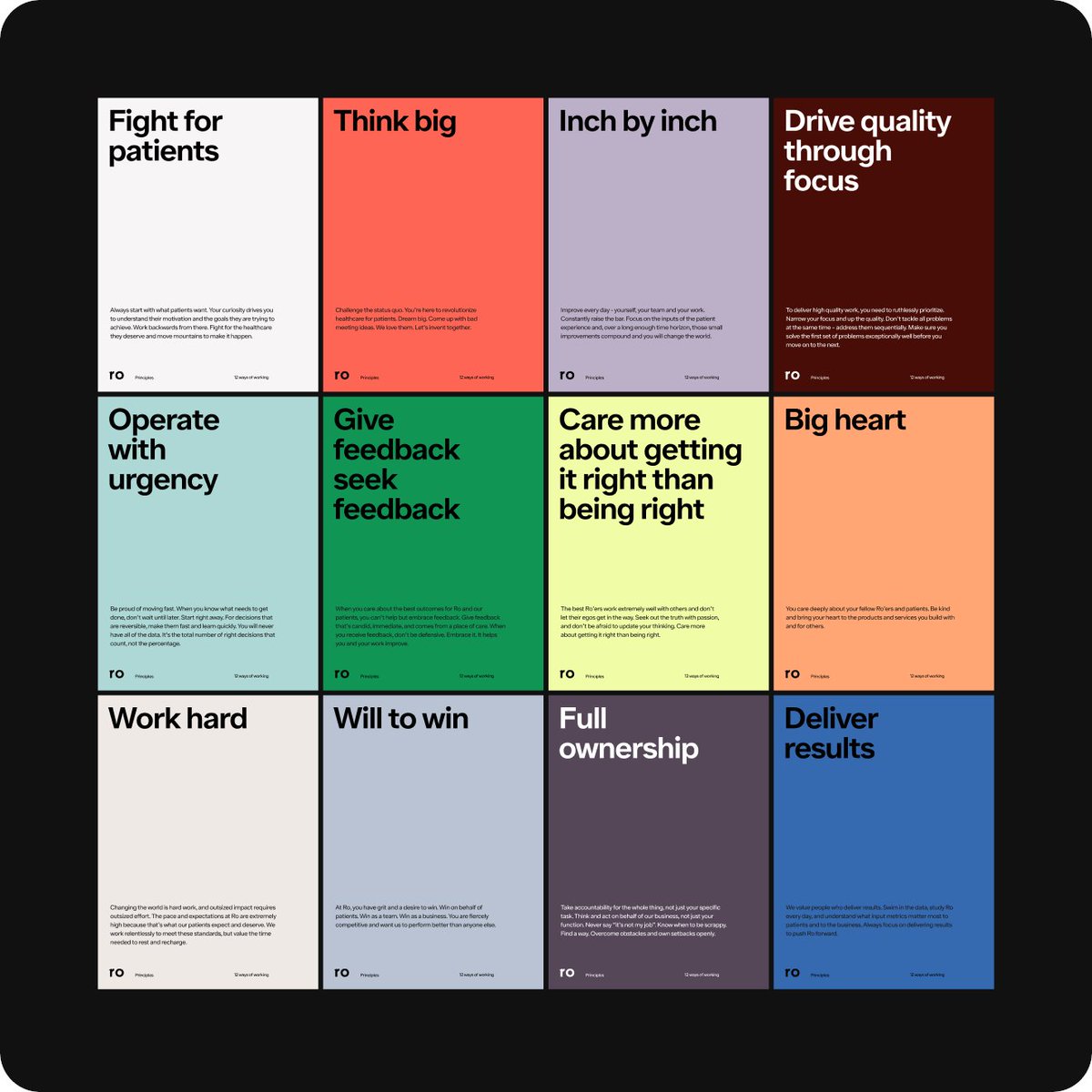
When we asked everyone to opt in or opt out of the next phase of Ro, we rolled out new company principles: to make our menu clear, and to earn the gift of their time. They were designed to embody the philosophy of the most talented Ro'ers and to explicitly filter out people who we knew would not be happy here.
One principle is "Work Hard."
I remember when we were sharing a draft of the principles with a few people, and one person said, "Don't you mean something more like 'care deeply'?"
I said, "No, I don't. That is a different principle. We call it Big Heart. I literally mean “Work Hard."”
People who work hard aren't scared of that principle. They also know exactly what it means. Don't miss your kid's recital, date night, or exercise… but yeah… we don't work fixed hours, you're going to work some nights and weekends, and we want people who want to do that, for the love of what they're doing, because they want to be great and be part of something great.
At one all hands meeting, it had become very clear why we needed this principle:
Someone asked, "Would Ro ever consider a four-day work week?" This was when that was all the rage.
I said, "No. And we'd sooner consider a 7-day work week. We're not going to consider a 7-day work week. But, to be clear, we'd consider it before a 4-day work week."
Again, someone is not a better or worse person because they want a 4-day work week. I just don't want them to work at Ro. And it's on me to make that very clear and live with whatever filter it creates.
For each principle, we described it explicitly. What it means. What it does not mean. We explained that we would double down on the features and give everything we had to eliminate all the bugs. We articulated our menu. This clarity is what enables people to opt in or opt out with confidence.
MADE IT ALL ABOUT THE WORK
My dad was a physician and ran an emergency room early in his career. He raised Jewish kids and saved the lives of patients with swastika tattoos on their chests. He fought to save every life equally, because he believed they all deserved saving. That is the house I grew up in. And that is the healthcare I want Ro to deliver.
It's hard enough to solve one big problem over the course of a lifetime. It's rare to have the resources, timing, and team to try. I'm grateful that I have that opportunity at Ro.
There are many problems in the world that Ro can't and won't solve. We made it clear to the organization that we weren't going to comment on them as a company or expend any energy whatsoever on anything that wasn't in direct service of our mission. That's what we're here to do. That's what we obsess over. That's what we put resources towards.
As a Jew, I was personally tested on October 7th. People asked me privately whether I would say anything to the organization or publicly. I did not. And I told them why, individually if they asked. I didn't make a statement about not making a statement.
Healthcare is our way of caring for the world. We're here to fight for patients. To start a patient revolution. To build a patient-centric healthcare system. That's hard. That's it.
MASSIVE INVESTMENT IN CONTEXT
We’ve always been a transparent organization. We’ve always invested in internal alignment and comms. But, on the other side of the refounding, I personally tried to level up here. Investing in context requires transparency, which creates trust, and it creates strategic alignment, which unlocks speed and innovation.
Beyond the typical high-performing classics (e.g., company priorities, goals, initiatives, WBRs, MBRs, QBRs etc.), there are two types of documents that have been lifesavers: Coffee Musings & Steer Docs.
-
☕ Coffee Musings: A Coffee Musing is a note I write to the whole company, usually after I've caught myself having the same one-on-one conversation over and over. It's cultural rather than tactical: I'm trying to improve the shared instinct we have as an organization. "Strong Attract, Strong Repel" started as one. The goal: correct drift, restore clarity, and say plainly what might otherwise go unsaid.
-
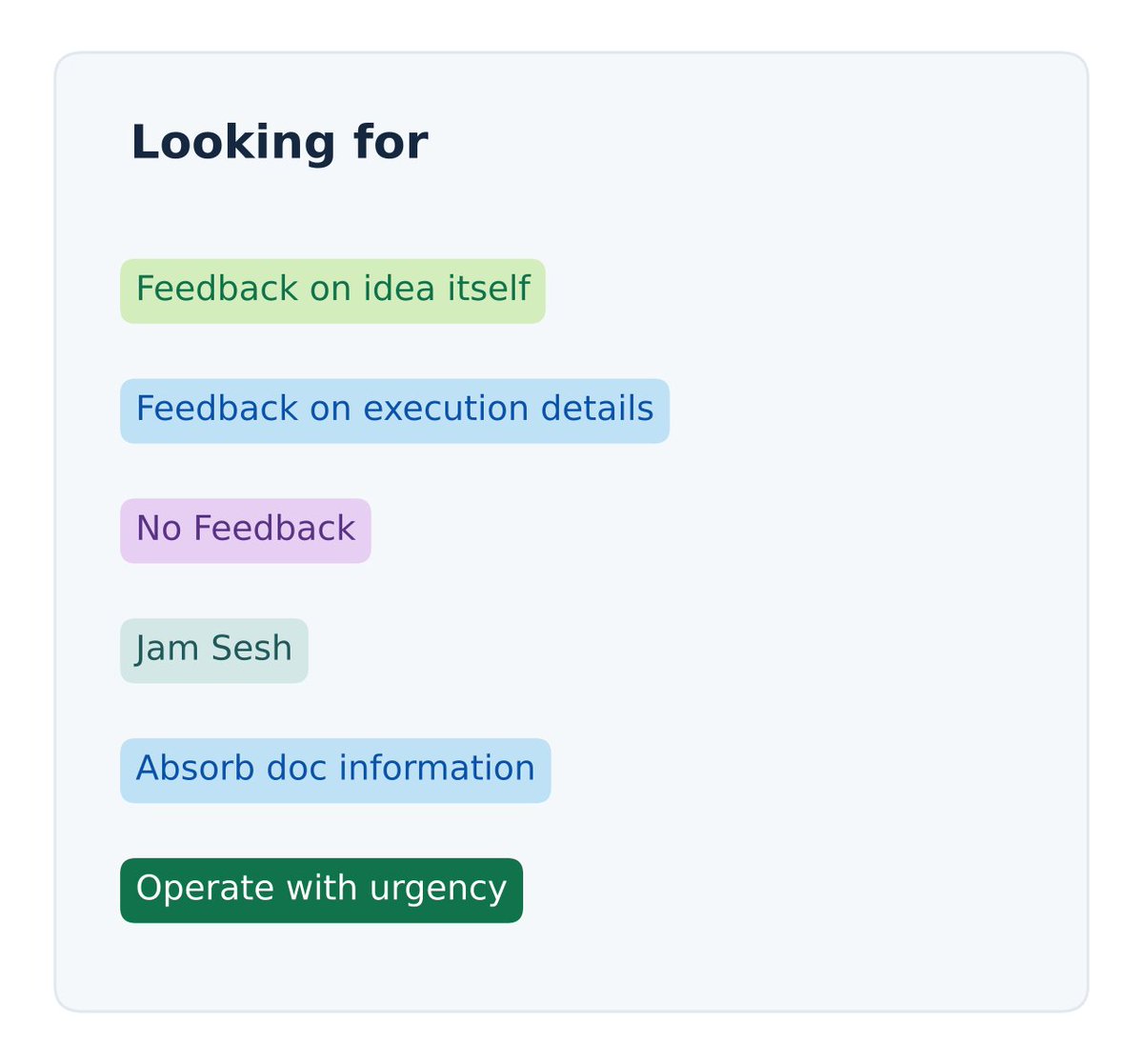
🧭 Steer Docs: A Steer Doc cuts through organizational noise. A Steer Doc is our Google Maps "route update": a smaller, faster steer between formal planning cycles (annual priorities, 90–120 day plans). Every Steer Doc has the same structure: background, route guidance, next steps, high-level takeaways, and an FAQ. Last but not least, they say the quiet thing out loud. What action am I looking for after you read this (from feedback to action)? They eliminate the game of telephone, root out misalignment, and catalyze action in unison.
🛠️Tactical Leadership Monthlies
Every month, our leadership team meets for the entire day. We start by going around the room and updating one another on key items at work and in our personal lives. We then spend two hours walking through the financial performance of the previous month and how we're tracking across key metrics to hit our forecast. In the afternoon, we have working sessions on near-term tactical initiatives (the next 30-60-90 days), often led by the Ro'ers driving those initiatives across the org. We sometimes carve out time for longer-term strategic decisions, but this day is not an offsite. It's an expensive day every month, spent aligning, unblocking, and accelerating the organization in the near term.
We already had weekly LT meetings, WBRs, MBRs, financial updates, and post-board breakdowns. But taking this time as a leadership team to get into the details together, no question off limits, no fear of "stupid questions", created a much deeper understanding of the drivers of our business and how everyone's work laddered up. It also genuinely created a greater team-first mindset. Six months into these, you'd see a leader take an open headcount they had advocated for and say it was better utilized on someone else's team to push the business forward.
I will say, these meetings are only as productive as the trust in the room. I learned how much we had in a moment I'm not particularly proud of.
After the re-founding, we were at a genuine offsite. In a long-term brainstorming session, I expressed frustration in a radically unproductive way. I was worried about where we were as an organization, but I had kept those worries bottled up, and they boiled over.
How the team responded was a moment I'll never forget. Instead of fighting back, they showed me tremendous grace. They recognized the root cause and basically Robin Williams’d me from Good Will Hunting. They said, “hit us with it all, we can take it.” Even better, they said something I knew intellectually but had never fully internalized. They were in it with me. They could have left at any moment. They felt equally motivated to fix it, because they believed in the potential of what we were building, too.
When building, you're going to think about how much to share with different concentric circles at the company. Personally, I've found that sharing to the level of significant discomfort has been worth it. I used to hide my fears. Now I don't. What happened? I learned that not only could my team handle it, but they had the same ones. And vocalizing them made it even easier to attack them head-on, together.
*Optional Reading* — Reciprocity
**I have never asked anyone at Ro to do anything that I haven't done or am not willing to do. From packing boxes to cleaning the office to writing code to reading what someone else writes. I have committed to the organization that I will read any document that anyone at Ro shares with me directly. I have yet to break that promise. It may take me until the weekend but I will read it and engage with it. It could be an idea they had, a project they are working on, a financial model, a legal memo, a Figma design, a data dashboard… whatever it may be, I'll read until the very last pixel.
You have to find your own authentic way to lead but I ask a lot of people. I ask them to engage with the materials that I write and create. I will always do the same for them.
PUSHED THE PACE
You and your leadership team set the pace of the organization. It's on you to speed it up. Speed has so many compounding benefits. I remember Sam Altman saying "slowness anywhere justifies slowness everywhere." But most importantly, business is about the number of right answers you stack up, not the percentage you get right. The faster you ship, the more right answers you find.
All of the above helped speed up Ro: narrowing the focus, making it all about the work, investing in clarity and alignment from a strategic and philosophical perspective. But there are also very tactical things you can do to speed up teams. We experiment with a lot but here are some of my favorites:
-
Daily Steers: After we first launched our Ro Body business (high quality care centered around GLP-1s), my co-founder Saman and I didn't think we were moving fast enough. So we pulled the team in to meet every day at 8:50am for two straight years. These were tactical meetings and covered the entire business — from ad copy to conversion funnels to pricing to operations to supply chain to the patient experience. We made decisions in the meeting or assigned people to run at problems. The daily cadence was important. It's very difficult to show up the next day and not accomplish what you said you would, even harder the day after. We've used these Daily Steers since. They don't all last two years (some last two weeks). But they massively amp up the pace. I've stacked them too (7:30–8:00 on one project for two months, 8:00–8:30 on another for two months, etc.). And that first one? It steered Ro Body from launch to the largest provider of GLP-1s in the country.
-
Call when someone asks to schedule: If someone Slacks me to schedule time, or I see an email going back and forth about scheduling something important, I'll pick up and call them right then. If it's Wednesday, and someone says Monday… that's four days. Literally 1% of the year.
-
Ambitious Timelines: Insert every caveat and ignore the stupid strawmen. The point is people are capable of far more, far faster, than they or you realize. It's on you to clear the way for them. Eliminate the bureaucracy, create the clarity so they move with velocity (speed × direction) and give them something to strive for.
CHANGED THE HIRING PROCESS
I won't go over our entire hiring process here; every company always has room to improve theirs. But here are a few things we did to solve the root cause of our initial over-hiring. After the layoffs, we eliminated all open roles. We then created a structured form for people to create a business case to request headcount. That business case would be reviewed by the functional lead and then needed to be approved by the CFO and founders. We stopped all automatic back-filling. We tracked Net Revenue per employee at the company and function level, over time. We did a bunch of other things too. But earlier I said it would have been a whole lot more efficient to never hire that many people in the first place. This is the system that works to prevent that from happening again.
KILLED LONG TERM ROADMAPS
The refounding also changed our relationship with time. We all know the Bezos line, “Stubborn on the vision, flexible on the details.” We fully embraced it. Stubborn on the vision (ours hasn't changed in nine years). Explicit priorities once a year. Real precision only on 90-day horizons. And we killed anything longer entirely.
People crave certainty. 3-year roadmaps give people comfort in the short term but creates whiplash in the medium and long term. They're inaccurate. Again, you will find founders who see this differently but I’m a believer that a long-term roadmap is printed MapQuest directions in a Google Maps world. Every turn perfectly named in advance feels good at the beginning of your trip. Until a road closes. You need to recalculate and you’ve spent all this time and energy on steps 5 through 13. A detailed long-term roadmap is a stack of predictions, and prediction errors compound.
We plan the way we build software: hold the vision constant, ship quickly, take in the data, and commit the next stretch as our headlights reach it. Of course, there are exceptions to this rule (e.g., a massive facility that requires longer term commitments but even these run on short 90-day roadmaps, they just carry longer resource commitments). We'd rather be world-class at living with uncertainty than really good at drawing fake lines.
***Optional Reading* — Living with uncertainty is not an excuse for lack of rigor
**The predictable pushback: "no long-term roadmaps" is not a license to wing it. Not all uncertainty deserves the same attention, and the skill is telling the difference.
We don't spend time on questions that are unknowable in the present, that depend on data the work hasn't generated yet (the detailed plan for a product that hasn't shipped its v1), or whose answer wouldn't change anything we do today. We do spend time on the inverse: questions that are answerable now and would change what we build this quarter, and how to build today so we don't foreclose where we might want to go tomorrow.
The rigor didn't disappear. It shifted. Instead of debating long-term details, we ask: What are we tracking right now that would make us double down, or change course? What's the right order of investments (anything after #3 is irrelevant)? What information do we need to collect now to make better decisions as the future unfolds? We chase the unknowns that change what we do today or teach us what to build next. Everything else can stay blurry. We'll make those decisions in the future, with more data than we have today. We won't waste calories mapping every IFTTT scenario. We'll spend them on what matters most right now.
ONE FOOT IN FRONT OF THE OTHER
We announced the refounding in August 2022. By September, I was exhausted. The hard decisions were behind us; the hard years were all still ahead. A dark tunnel, and I couldn't see light at the end of it.
My friend Johnny Harris was 60 days into a step streak he'd kept alive while filming in Switzerland. I call Johnny a wild stallion because he is the human equivalent. If the man sees a rushing body of water, no matter how cold, he will get naked and run into it. He's the friend who pushes you outside your comfort zone, and you're always glad he did. That September, he saw me struggling and didn't give me advice. He took me on a hike. Then another the next day. And the next. Three straight days, over a weekend visiting my in-laws. When I got home, I was on day 4 of a 10,000-step streak.
As I write this, I'm on day 1,517. Just over four years.
On day 1,000, I walked my 10k with a group of friends and then cooked them dinner to celebrate. My wife opened the toast: "Walking 10,000 steps isn't that hard.”
“But,” she followed up, “consistency is.”
She's right, and that's the whole trick: putting one foot in front of the other, consistently. A streak has no finish line. If Johnny had pitched it as "walk every day for the next four years," I never would have started. The horizon would have been too daunting to look at, and every single day would have felt like nothing against it.
A streak never asks you to look at the horizon. It only ever asks one question: did you do it today?
If you're a founder in a tough spot, that's the best advice I have, and it's embarrassingly simple. In September 2022, I was staring at slowing growth, real burn, and that pref stack — after five years of 70–80 hour weeks. If I had honestly digested the odds that it was all for naught, I don't know that I could have kept going. So I stopped looking at the horizon.
Soon after we started “Daily Steers” for Ro Body. I ran them every day for 24 months. We still use these steers at Ro today for many projects.
Make the product a little better than yesterday. Push the vision a little further than yesterday. Measure progress against the day before, not the destination. Until someone invents teleportation, there's no skipping steps. You can only take them one at a time.
Here's the part I didn't expect: the streak outlasted the tunnel. In 2022, I didn't know if there was light at the end of it. But you don’t find the light, you make it. Whatever rough patch comes next, I know it's survivable, because the last one was.
I got into YC as an impressionable 22-year-old, and Paul Graham said something I've never forgotten: startups only die for two reasons — they run out of money, or the founders quit. Everything since has taught me that the second one is just a streak you decide to break.
LOOKING BACK
Thanks for making it this far. I’m sharing this because a few founders have said that our conversations have been helpful and I’m hoping it’s been the same for you.
When I reflect on the above, the only reason the tactics were successful is because we already had the most important thing — the team. With the right team, you can build anything. You can overcome anything. I get to sit here and write this blog post because Ro is filled with big hearted, brilliant, and performance driven people. Ro would be nothing without them. Nothing.
Ro isn’t perfect by any far stretch of the imagination. I’m sure our team will be the first to read this and have a ton of suggestions. I love that. People only do that when they care enough about the thing in the first place. We might not get it right every time but we are committed to being the best version of ourselves. I do think our team knows that, above everything else, Saman and I care about our patients and trying to create an environment for the team to do the best work of their lives. If your team knows that, they will both help you get there and lift you up when you inevitably make mistakes along the way.
LOOKING AHEAD
When we first started Ro, we told people we were going to start a patient revolution. We were going to upend the healthcare system by empowering patients. We were going to help patients achieve their health goals because, if we did, we would unlock the full potential of humanity.
People laughed us out of the room. “You’re just an ED company.” First, hell yes we help people have better sex. We do that better than anyone else in the world and we’re damn proud of it.
Then “we’re just weight loss.” Second, hell yes we help people lose weight. We’re the largest GLP-1 provider in the country. And GLP-1s now treat diabetes, obesity, heart disease, kidney disease, liver disease, sleep apnea and countless other conditions. Basically the chronic diseases that are upstream of how humans die.
Just just just.
We’ve “just” helped millions of patients. We’re now “just” crossing a $3B+ run-rate.
Well guess what? We’re JUST getting started.
We’ve done this by being unapologetically patient centric. We’ve done this by ignoring the “just” modifier that is often applied to our focus. We’ve done this by consistently making contrarian bets…not “just” to be different but because we’ve run after what patients want regardless of what other people say or do.
We’re just going to keep fighting for patients the Ro way.
I'm biased, but I believe Ro is working on one of the most meaningful problems in the world. When you help millions of people achieve their health goals, you help unlock the full potential of humanity.
This is lofty language. Writing it down can feel almost too grandiose. I remember writing down similar words when we were 3 people in a small office that smelled like popcorn on 19th and Broadway above an AMC movie theater. But I feel it’s never been more true than it is today.
And if you want to be one of the people who changes the world, you first have to believe it.
It’s so much easier to choose the respectable safety of pragmatism. In many ways, it’s become cool to be a cynic. You’re going to be right more often. But, now more than ever, I think we as a society need to fight the fear of believing in and working toward ridiculously rare outcomes.
In 1985, a small team of British scientists in Antarctica detected a hole in the ozone layer. The projections were terrifying. Two years later, the world signed the Montreal Protocol. Today, the hole is healing, and hundreds of millions of skin cancers will never happen because of it. They had this phrase as they were working that “the current future is not the future future.” The world we’re headed toward today does not need to be the world we’re headed toward tomorrow. The world is always changed by people who believe that.
In the future, I'm going to write more about what Ro's building. How we're at the forefront of the patient revolution. How we fight for patients. How we're using AI. How we're saving patients money. How we're helping patients achieve their health goals so they can chase their life goals. How we are building a patient-centric healthcare system from the ground up.
This is a once-in-a-generation time to build in health. What used to feel like science fiction now just feels like science.
In an age of true AI abundance, where Jevons paradox has taken over, the one thing we will always continue to invest in is our health. It is the single facet of life that has no diminishing marginal returns. Without energy, we don't have AI. Without our health, we cannot… … you know your answer. That’s what makes health so meaningful.
JOIN US
We’re hiring very talented people and not too many of them. If the above sounds like your type of restaurant, big heart and performance driven both dialed to 11, come build with us.
This is just the beginning.