So, how does one sell data to AI labs?

文章目录
Someone recently mentioned to me that he’s interested in licensing their company data. I didn't know much about the space and was curious myself. So I took the question to X:
I got way more replies than expected. That turned into a week of calls with people buying data, brokering deals, and turning data into training environments. I was drinking from a fire hose. Wanted to jot down some learnings here for anyone else looking to learn about the space.
Who buys the data?
It's helpful to understand the different buyers in the space:
Frontier AI Model labs (e.g. Anthropic, OpenAI)
These are the apex buyers on the AI data supply chain.
The person every single data vendor wants to reach is the AI researcher. They dictate the research direction and what training data is needed.
At a big lab like OpenAI or Anthropic, there will likely be procurement leads that serve as the interface between researcher’s training data needs and the vendors supplying them.
At a smaller model lab, you might be eaiser to reach the researcher more directly.
Data labs (e.g. Mercor, Handshake)
Data labs like Scale, Mercor, Handshake, and Micro1 source company data, work with domain experts, and build tasks and environments to sell to frontier AI model labs.
The role for people that you want to talk to in terms of selling data is called “data partnership”.
RL environment startups
There are also smaller startups that specialize in building those environments. They are also buyers for raw data.
And a lot of times these startups also have direct Frontier AI lab relationships. So they buy the raw data, turn them into RL environments, and sell them to frontier AI labs.
They can typically sell the RL environments for 5-10x of the cost they pay for the raw data.
Because they are smaller compared to the bigger data labs, oftentimes you can talk to the founder or their head of data partnership. And they can move quicker.
Data brokers
Data brokers focus on data acquisition and reselling the data to bigger buyers. They tend to not build data products like RL environments.
Some of them have direct Frontier AI lab relationships. But a lot of the times they also sell data to data labs like Mercor, Handshake, and Micro1.
Data brokers usually buy your data, hold them in inventory, and do de-identification themselves, before selling to another buyer.
Data broker affiliates
It's worth clarifying the difference between data brokers and data broker affiliates. A lot of the times when people talk about data brokers on X, they're actually talking about data broker affiliates.
Affiliates don't actually spend money to buy your data from you. Instead they connect you with a buyer, and the buyer would do the vetting and ultimately pay for your data.
They make money by earning a referral fee from the buyers if the deals go through. It's the lowest barrier-to-entry way to get into the data space. Hence you see a lot of data broker affiliates out there on X.
Some affiliates are a bit more hands-on and provide value-added services. They help the seller put together an inventory, find buyers, negotiate terms, and coordinate delivery for a fee, often a % of the overall transaction (15%-40% from what I’ve heard so far).
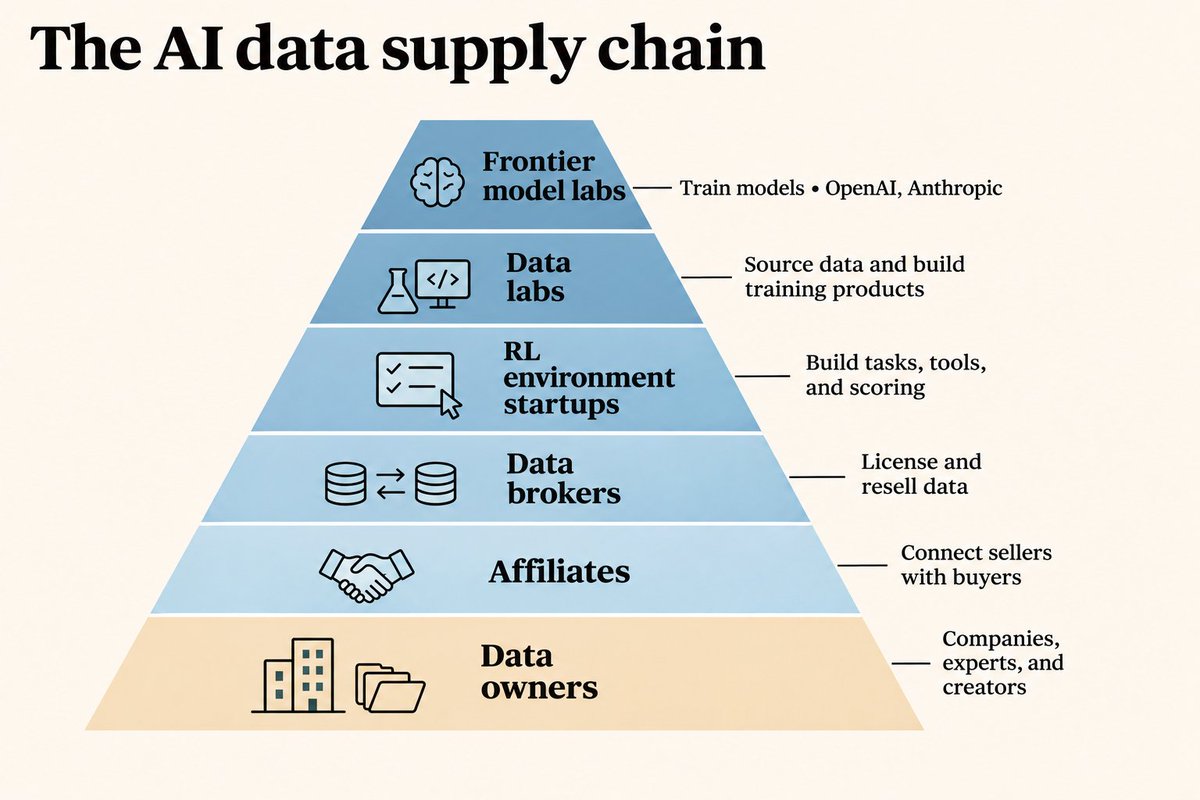
The different players in AI data supply chain
How to find buyers for your data?
I will start by posting on Twitter or searching on X/Twitter and see who's talking about buying data and just engage in some conversations or DM them about what data you have.
Trust me - they want to talk to you. I'm mostly talking about data labs, data brokers, and RL environments startups here.
But getting in touch with researchers or data procurement leads at Frontier model labs is a whole different challenge. It requires a lot of hustle, connections, and having something very unique to offer. That's a different topic for another day.
I also found these lists aggregating companies buying/selling data.
Example data partnership pages
Almost every data lab and data broker will have a data partnership intake page. Sharing a few here to give you guys a sense of what they look like:
Quick note on pre-training vs. post-training
One distinction that helped me understand this market is where the data gets used in training.
Pre-training builds a model’s general knowledge and capabilities. Buyers want large collections of text, code, images, and specialized records.
Post-training improves specific skills and behaviors. Buyers want expert demonstrations, feedback on model responses, and tasks or RL environments with a way to score success.
The same codebase could serve both. Its files become pre-training material. Add a bug report and tests that verify the fix, and you have a post-training task.
What data are they buying?
The reality is there's probably demand for all sorts of data but I'll just highlight a few categories that I've heard the most about during my brief exploration.
Company operational data
This is perhaps the most common and popular category. Operational data can be a mix of email, calendars, Slack, CRM, and ERP. What makes it interesting is how those pieces fit together. An email might explain why a shipment was changed. The ERP record shows what someone actually did about it.
What makes a company’s data interesting?
For operational data, buyers often look for companies with 30+ employees and several years of operating history.
Headcount can signal more complex workflows, while time in business means more records of how work gets done.
English-language data from U.S. companies is often preferred, though requirements vary by buyer. Data spanning several systems, like email, Slack, CRM, and ERP, can be especially useful because it captures a fuller workflow. Size helps, but the quality and uniqueness of the data still matter.
CAD data
CAD data came up a lot during my convos. These can be CAD for mechanical engineering, manufacturing, architecture, or construction, etc.
Domain-specific data
Data that are specific to certain domains, like finance, law, healthcare, bio, pharma also seem to be in demand.
Physical AI / robotics data
There also seems to be a big demand for physical AI data. Ego-centric data is perhaps the most common type of data here.
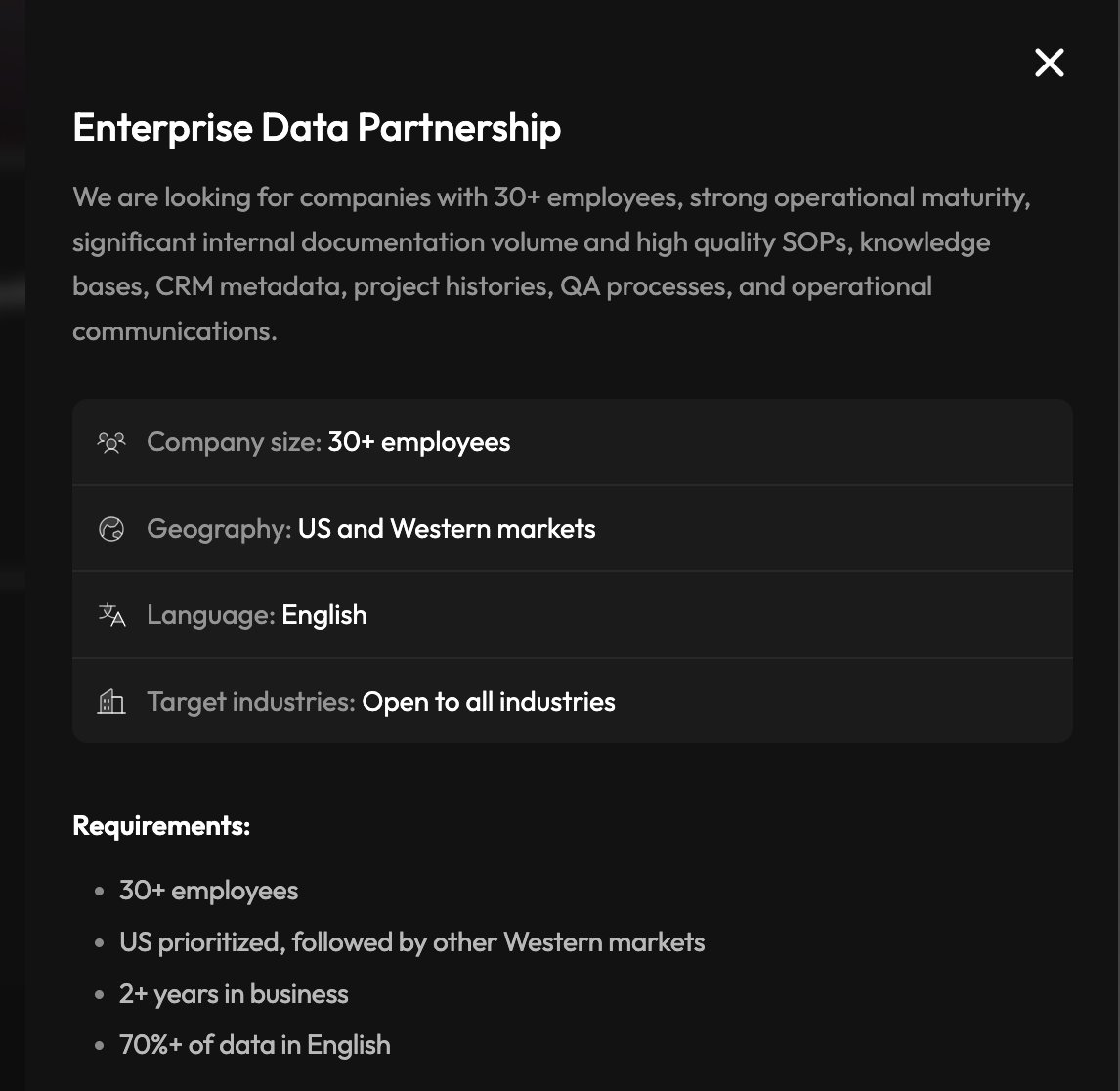
Example requirements from Micro1's data partnership page
What does the buying/selling process look like
If the buyer is interested in your data, the first thing they usually want is a sample of your data.
If there’s a fit, you negotiate what’s included, the price, and whether the license is exclusive. An exclusive deal can pay more upfront. A non-exclusive license leaves you free to sell to other buyers.
If the buyer wants your data, they will make you an offer and it's up to you to accept the offer.
Seems like the general best practice is to get offers from several different buyers so you can compare. But you also don't want to aggressively pit them against each other that they lose interest. There's a fine balance here.
Then the dataset has to be transferred and checked.
The part I hadn’t appreciated was how long it can take for the money to hit the bank. In some deals I heard about, the buyer might take about a month to review the data after delivery, and another 30–60 days to pay after accepting it. There’s a lot of lag between accepting an offer and getting paid.
Funding structure for a data business
This data space is moving very fast. There's definitely money to be made right now. But it's also hard to know what the space will look like a year (or even six months) from now.
A lot of the budget ultimately comes from a handful of model labs, and their research priorities can move quickly.
Because there are so much uncertainty in terms of the terminal value for these data companies, some people propose funding and running these companies as cash flow/dividend businesses rather than venture equity businesses.
Gokul Rajaram has a good post here:
Evolution of data companies
On the flip side of selling data to AI labs is helping enterprises deploy AI. If you already understand an enterprise’s data well enough to turn one of its workflows into tasks for a lab, you can use some of that same work to evaluate and deploy AI inside the enterprise itself.
Mercor, Handshake, Scale, and some data/RL startups are already doing this.
Yoni Rechtman has wrote a good piece on how more data companies will evolve into deployment companies:
Thank you
Thanks to all the people that reached out and helped me understand the data space.
Wanted to share my learnings here in case it's helpful for anyone else looking to learn more about the data space.
I'm still very new to this, so take everything I say with a grain of salt. Also welcome any feedback from other more experienced folks here.
Hope this is helpful.