Ramayan: Devas vs Asuras Are Not Oppressor vs Oppressed
文章目录
Why the new Ramayan film is not a Marxist projection
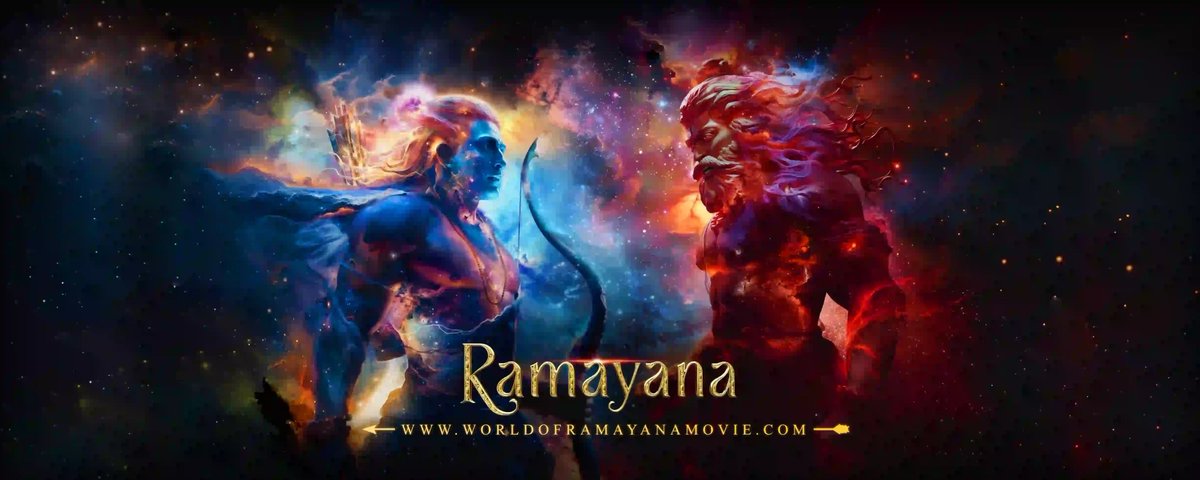
I want to respond to critics of the Ramayan film who accuse it of being a left-wing, Marxist projection. If that were so, Ravan and his people would be the oppressed, and Ram and the devas the oppressors. That reading is mistaken. The Hindu tradition speaks of a struggle between devas and asuras. That struggle is very old and central to our cosmology, but it is not a Marxist class struggle. Let me explain.
In Marxism, oppressor and oppressed are defined in strictly materialistic terms: one class owns the means of production and exploits the other class, who have nothing but their labor. The conflict is over control of wealth and power. This cannot be mapped to the deva–asura conflict.
Ravan is no deprived man. He is the king of Lanka, a city of gold, and he is shown as a very rich and powerful man. So, the asuras are actually very rich and very powerful. The difference is that the devas are more spiritually oriented, and the asuras are more materialistic.
Same teaching, opposite outcomes
In the Chāndogya Upaniṣad, Indra, king of the devas, and Virocana, king of the asuras, both go to Prajāpati to learn about the Self. They receive the same first instruction. Virocana is convinced that the physical body is the Self, goes home and teaches the asuras to adorn and serve the body. Indra, by contrast, returns repeatedly for further instruction and digs deeper again and again, until he reaches the real teaching about the Self. Same teacher, same opportunity, but the outcomes are opposite: the dominant quality of the asuras is materialism, and of the devas is spirituality.
In the Bhagavad Gītā, Krishna says that the marks of the asura nature are ostentation, arrogance, self-conceit and anger. Such a person thinks: I am the lord, I am the enjoyer, I am rich and nobody can match me. The film shows this about Ravan.
Ravan: learned, devout and arrogant
The critics need to hear this point: The differentiation between spiritual and materialistic has nothing to do with being intelligent, hardworking or charismatic. Ravan is learned in the Vedas. He has done great tapasya and is remembered as a great devotee. It is through his austerities that he won his boons, which shows our tradition’s emphasis on meritocracy. (Even Hanuman reflects that were it not for his adharma, Ravan could have been the protector even of the world of the devas.)
But his overriding quality is that his power is not for the upliftment of others and for dharma; it is for his personal arrogance. His abduction of Sita is an example of this.
Even Ravan’s famous boon from Brahmā asks for protection from all sorts of powerful beings but not from humans, because he holds them in contempt. This contempt is itself a form of asuric arrogance—not a class-based oppression of a lower group. His ego is the cause of his death.
So, a film that shows Ravan as learned, disciplined, formidable and even admirable is not whitewashing him. It is being faithful to Valmiki. A cardboard villain teaches nothing. The tradition's lesson is far more serious: knowledge, austerity and ritual devotion, without humility and without dharma, produce an asura who destroys others and finally destroys himself.
A war for dharma, not for property
Unlike in a Marxist class struggle, this war is not a fight over property. Ram does not annex Lanka or take its gold; he crowns Vibhīṣan, Ravan's own brother, and goes home. He insists that Ravan must receive proper funeral rites, saying that enmity ends with death.
Even the devas are humbled when they become proud. And Prahlāda, an asura, is honored as one of the greatest devotees. Vibhīṣan chooses dharma against his own brother. Neither is defined by birth into an asura lineage. These are cosmic dichotomies of consciousness and conduct, and they run through every individual. No Marxist class conflict works like this. A personal grievance is not the same thing as a class being oppressed. To show that Ravan has a history and a motive is not Marxism. It is the Ramayan.
The real distortion is dogmatism
To those who are upset, I say: the complex dualities and dichotomies of the tradition are being brought out in this film, not buried, so we can discuss and argue like our ancestors did. People who think that any depth given to Ravan must be Marxism do not understand the tradition. They want a flat story of good versus evil in the Abrahamic sense. That is closer to the oppressor–oppressed template they are attacking than anything in the film. Our tradition has no Devil, no eternal adversary of God, and nobody is condemned by birth. One’s karma decides and this applies equally to everyone.
Many of the critics are being reductionist and flattening the tradition, and that is a distortion of the tradition of many Ramayans, of Valmiki, Kamban and Tulsidas, each telling the story in its own way. It is a tradition in which Ravan and Kumbhakarṇa are remembered in the Bhāgavata as Vishnu's own gatekeepers, fallen through a curse and destined to return. Our heroes do not depend on the villains being entirely disgusting or trivial.
The deva and the asura are not the oppressor and the oppressed. They are two choices within the same family, and within each of us. That is what the Ramayan has always taught.