Own your means of production
文章目录
One of the best ways to invest in AI right now is to buy a burglar alarm company.
On October 29, Thrive Holdings agreed to buy ADT in a deal valued at $15.3 billion. ADT was founded in 1874.
Thrive has raised over $3 billion and owns stakes in more than 75 businesses, including accounting firms and IT shops. (One is called Nerds Support!) General Catalyst is making similar bets in corporate travel, asset management, and a hospital system in Akron, Ohio.
Why are they doing this? Because they believe service businesses will make the most money from LLMs. These firms already have customers. The bet is to rebuild their software so they can do the work with fewer people and replace tools they used to buy. They'll own the systems doing the work and keep more of what customers pay.
This will make the K-shaped economy worse: more of the income will go to owners, and a smaller share to workers.
We can already see the divide between owning assets and earning wages. The S&P 500 hit a record high in October. Workers' share of business output hit a record low in the third quarter. The economy can grow while workers get a smaller share of it.
Outsourcing showed us an earlier version of this. Companies moved work to cheaper labor abroad, weakening workers' bargaining power at home. Owners kept part of the savings as profit. This helped hollow out the middle class even as the economy grew.
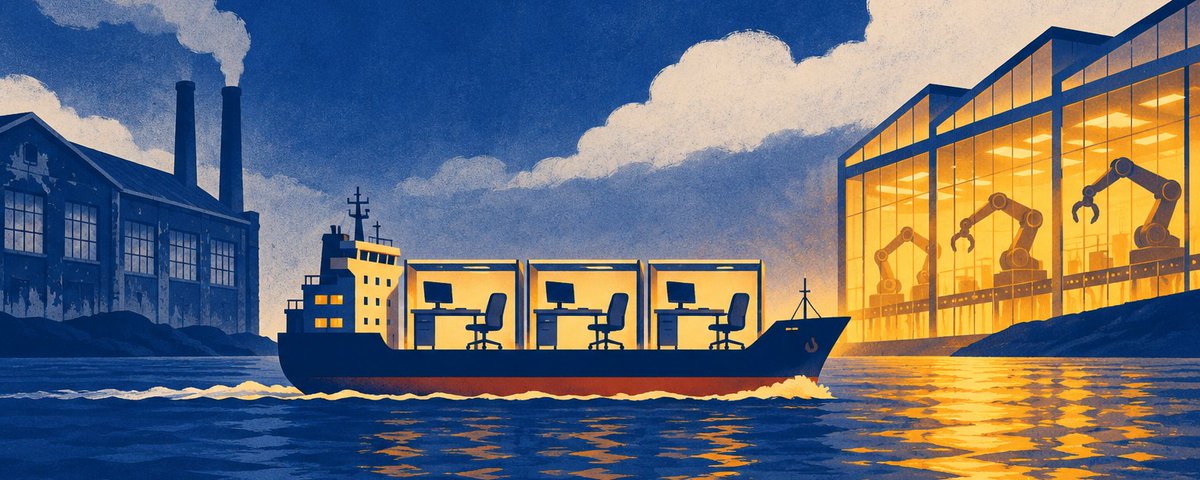
A factory's machines are its means of production: the equipment it uses to make things. Workers earn wages for operating them. The owners keep the profits.
Service businesses have mostly rented their means of production. An accounting firm pays salaries for people's time and expertise, and subscriptions for software.
LLMs change both. They make custom software cheaper to build and let that software do work that once required an accountant. Firms will build their accountants' methods into systems they own and improve. They will own both the tools and the expertise they've built into them. That's what owning the means of production looks like in a service business. This may take a few years to play out, but it's inevitable. (If your neighborhood IT firm doesn't own its means of production yet, it'll either get outcompeted by Nerds Support or get bought out by them.)
The next wave of outsourcing is coming for knowledge work. This time, firms will own the systems doing the work.
A possible path out is for workers to become owners themselves. They need to own their own means of production. They need to turn their expertise into capital: software they can sell, license, or use to start companies. AI is making that cheaper too. The same technology that lets a firm replace an accountant lets an accountant build a firm. But will it work? Can they outcompete capital and the current incumbents? We’ll find out.
Work is becoming capital
An accounting firm owns its name, its client list, its processes, and its office furniture. The accountants supply the judgment. When a partner leaves, twenty years of experience leave with her. Growing the firm usually means hiring more people.
Earlier accounting software handled arithmetic, forms, and recordkeeping. LLMs can now do some of the work that required an accountant's judgment. A firm can build those methods into software and use them across thousands of returns.
Consider Shield, Thrive's IT business. Shield owns stakes in twenty IT firms serving more than 3,750 businesses. Shield says its custom in-house software, resolves half of all actionable helpdesk tickets. Of those resolutions, 92 percent require neither human approval nor logged technician time. The median resolution time is sixteen minutes.
Shield could have sold their in-house software to IT firms and charged a fraction of what it saved them. Instead, it bought the firms and keeps the savings after paying to build and run the software. It already has the customers. They call the same number, and their email starts working again.
Similarly, Thrive says its tax software has cut preparation time by about a third and increased throughput by about 50 percent.
With these savings, vertically integrated firms will outcompete (i.e. deliver higher quality work for a lower price) non-software, non-AI accounting firms.
This is vertical integration: the same company owns the software and the businesses that use it. AI will push more service businesses toward this model.
Owning the software
An alarm company has a useful advantage: customers already pay it to provide a service. When software lowers the cost of that service, the savings increase its profit. Some will go to the software vendor, and competition will force some to go to the customer. The business keeps the rest.
Renting the software makes it harder to keep those savings. The vendor will charge based on what a human used to cost. Your competitors can buy the same software and lower their prices too. You can end up with a smaller payroll, a bigger software bill, and the same margins.
Building your own software gives you more control over costs and improvements. Your best people can put their methods into it. You can refine those methods as you learn from customers. Competitors can buy the same LLMs, but they can't buy your expertise around them. [1]
You can own the software that runs your business and still buy models and tools. The model is an input, like electricity for a factory. OpenAI owns a stake in Thrive, yet Anthropic led Thrive's tax benchmark; OpenAI led its helpdesk benchmark. Thrive can choose the best model for each job while keeping its customers and its own software. The model suppliers have to compete for its business.
That explains why Thrive buys accounting firms. It gets existing customers and profits, then builds software to do more of the work. Thrive says its tax software has cut preparation time by about a third and increased throughput by about 50 percent.
With these savings, Thrive's accounting firms will outcompete (i.e. deliver higher quality work for a lower price) non-software, non-AI accounting firms.
The cost of vertical integration
The software compounds and extends these new businesses leverage over its labor. Thrive uses its accountants' corrections to improve the system. Part of the work it used to rent from people is now done by software it owns. The firm keeps that capability and uses it again next tax season. This makes Thrive less reliant on labor and will eventually increase Thrive's leverage over its workers. (Whether that means lower wages, higher expectations, or something else is hard to say. But it certainly won't be good for labor.)
Many service businesses will struggle to build and maintain this software. The ones that succeed can use it in other firms they buy. If an acquisition is more profitable with your software, you can afford to pay more than a buyer who plans to run it the old way. I expect the best builders to end up buying many of their competitors. My bet is that the most valuable company built on AI this decade will be a service business with a software company inside it. There will be substantial consolidation coming for all service businesses. You'll either need to adapt, get bought, or get destroyed.
Buying competitors means fewer firms competing for customers and fewer independent employers competing for workers. An accountant can change jobs and still work for the same owner. Lower costs make the acquisitions attractive; fewer rivals make it easier to keep the savings.
Labor's share of income was falling before AI. Offshoring helped drive that decline. In global supply chains, capital and highly skilled labor gained a larger share of income at the expense of less-skilled labor. AI extends that pressure to the professionals whose expertise once protected them.
Workers' pay and benefits accounted for 53 percent of US nonfarm-business output in the third quarter of this year, the lowest share on record. Middle-class households have also been receiving a smaller share of total household income. Corporate profits averaged 13.9 percent of national income in the 2010s. By late 2024, they accounted for 16.2 percent.
If an LLM can do part of your job more cheaply, your employer will want the software. It gets to own a system that does the work instead of paying you to keep doing it. After paying to build and run the system, the company no longer needs to pay you a recurring salary (i.e. “rent”). Even if the company keeps you, the cheaper alternative gives the company more leverage over your pay.
Existing owners have money to invest and customers to serve. They are already buying the businesses and building the systems. Workers who keep selling only their time will get a smaller share of the gains.
A company has to pay to build a system before it can save money on wages. Capital has gotten more expensive, and it will likely continue to do so. From January to early November, ten-year Treasury yields rose from 4.2 to 4.9 percent, and investment-grade corporate yields from 4.9 to 5.7 percent. (Note this is not unique to the US government or to AI companies. Capital is simply becoming more expensive since everybody wants it.) As more businesses build their own systems, they will compete for the capital to finance them. That favors owners who can fund the work themselves.
Workers need to use their expertise to build assets of their own. An accountant knows which parts of the work are difficult, which mistakes matter, and what clients will pay for. She can build that knowledge into software and sell or license it to other firms, or use it to start her own. She has turned her expertise into an asset. That is how workers get a share of the returns to capital. [2]
A factory in every business
At the University of Texas Medical Branch, pathologist Peter McCaffrey and two engineers built AutoTox in five weeks. It drafts interpretations of toxicology tests for pathologists to check. The lab's four pathologists went from reviewing about fifty cases a week to five hundred.
The hospital now owns a system that does part of its doctors' work. A small team turned its expertise into an asset that the hospital can keep using and improving.
I run Retool, which sells the tools companies use to build and run their own software. This is a tailwind for us: the more software our customers build, the more they need to connect it to their data, secure it, and keep it running reliably. I guess you could say that we’re selling the means of production.
AI will make the K-shaped economy worse as businesses turn their employees' expertise into capital. The companies that build the best systems will use them to win customers and buy competitors.
Own the software that does your work. If you know how the work gets done, turn that knowledge into software you can sell, license, or use to start a company. You won't have the opportunity to do so in a few years! If you wait for your employer to build it, your expertise will become their capital.
The Marxists were right that it matters who owns the machines. They were wrong that you'd have to seize them. Now you can build them yourself.
Notes
[1] Competition tends to pass savings to customers through lower prices. William Nordhaus estimated that innovators kept about 2 percent of the total social value their innovations created. A business can be an excellent investment while passing most of the benefit to its customers. Owning good software gives it a head start; it still has to keep improving.
[2] An accountant who starts her own firm may earn part of her income as profit. Her income could rise even while the measured labor share falls. More people could share in the profits even as wages account for less of the total.
沿着这个主题继续读
从一篇文章,找到相关的教程、经验和阅读路径。