It's So Over

文章目录
There's this common inflection point I've noticed across niche corners of Twitter (think Sneaker Twitter, Crypto Twitter, Money Twitter, etc.): when the focus shifts from the opportunity that brought everyone together to climbing the social ladder and monetizing your audience, it's over - this is where Crypto Twitter is today, unfortunately.
For some background, my pipeline has been: Sneaker Twitter → Money Twitter → Betting Twitter → Crypto Twitter. I was more of a lurker in Money Twitter and Betting Twitter, but have been an active participant in both Sneaker Twitter and Crypto Twitter for multiple years.
These spaces have a lot more in common than people like to admit. Crypto is by far the most ambitious of the bunch, which is why I've decided to stick around as a community member, but that's beside the point. The dynamics are so similar that watching what's happened to CT over the past year or so has felt like déjà vu.
I'll do my best to articulate what's going on in my brain after years of observing how these communities spawn and eventually die.
The Opportunity
A small group of anons find this cool new thing and decide to share their ideas on Twitter. Genuine curiosity fuels early growth, and there's this natural trickle of new participants who were lucky enough to stumble upon it, usually through their algo pushing it to them or hearing about it from a friend of a friend. The core value proposition is a space for people who are early to this new thing to share ideas and exploit inefficiencies. There's no focus on marketing or onboarding the next idiot. It's actually quite the opposite at times; there's usually a degree of gatekeeping to preserve this new thing they've found. Less competition means more money for the chosen ones who've been lucky enough to stumble upon the new gold mine.
As time passes, the game evolves and slowly becomes more solved. Businesses are created to solve problems for participants; the trickle of new participants speeds up, the market becomes more efficient, and thus there's less gold to be found. In a way, it becomes this race to the bottom. People start acting more out of greed and will do things that accelerate this race to the bottom, like breaking the unspoken rules of combat (buying more than 3% of a coin, leaking early alpha, etc.). The edge shifts from being smart to being fast. Everyone has the same ideas and knows what to do, but who can do it the fastest?
Towards the end of Sneaker Twitter, we used to pay these sketchy individuals to pre-scan shipping labels so we could presell sneakers before the releases even happened.
Online releases usually happened on Saturdays, and orders wouldn't arrive until the end of the following week. By the time you actually had your shoes in hand, prices had usually dropped significantly from their release-day highs. This created a race to sell before everyone else.
People would do a couple of things. Some would accept the highest bids on marketplaces like StockX and then go out and secure the specific sizes they'd just sold. Others would sell their pairs immediately after buying them online, without actually having them in hand or knowing exactly when they'd arrive.
The problem was that StockX required sellers to drop off their orders within 2–3 business days, making this pretty difficult. The solution? Pay someone with access to a UPS scanner to scan your prepaid shipping label and mark the package as dropped off. This kept your sale from getting canceled, and you could just ship the shoes days later when you actually received them.
Buy-side demand had gotten so limited on some of these releases that, to make money, you basically had to do some variation of preselling just to squeeze out a profit.
(The whole prescanning thing was pretty sketchy legally, but people didn't care when they were in a race to sell. I believe some people got caught up and may have faced legal consequences over the whole thing, but I forget the details.)
Coins are basically at this stage.
It's a constant race to be the earliest seller. Sniping coins, trading prebonded pairs, multi-walleting, etc. Its all just an ongoing race to the bottom. Behavior becomes more aggressive and never really improves, unless there's something drastically different or new. The opportunities in the market haven't necessarily disappeared, but the game becomes a whole lot less attractive.
The Shift to Social
As participants cannibalize themselves and continue the race to the bottom, others pivot to an entirely different game: the social one. The opportunities that originally brought people into the space aren't as attractive anymore, so it becomes more profitable to sell the dream to someone else. Social, which was once a byproduct of finding good opportunities, becomes the opportunity itself. Instead of building an audience by making money, people start making money by building an audience. With callout rewards and other incentives encouraging participants to lead sheep to slaughter, that's exactly what they're doing.
I think the course sellers of Money Twitter are a good comparison here. Money Twitter was a bit different from Sneaker Twitter in that there were actually people building real businesses and providing some sort of value to the world (not a ton of examples here, but there's some). Sneaker Twitter, on the other hand, was mostly just a game of buying low and selling high. In that sense, Money Twitter has a lot more in common with Crypto Twitter than Sneaker Twitter does. There are some genuinely cool things happening in crypto, like ICE, the parent company of the NYSE, partnering with Trade[XYZ] to bring Hyperliquid-based perpetual futures to the U.S.
But as the opportunities become less attractive, the people actually building things increasingly share the spotlight with grifters who ruin the fun for everyone else and give the broader space a bad reputation. Money Twitter had its fair share of these people: social ladder climbers focused on growing their personal brands so they could sell low-value info products, courses, or blast their audiences with ads.
As competition in the world of online business increased and the easy opportunities dried up, some people realized it was a lot easier, and often more profitable, to sell the dream of building a successful business than to actually build one themselves.
I think people unfairly assume that anyone selling a course or putting information behind a paywall is automatically grifting. I disagree. There's plenty of genuinely valuable information out there that's worth the price of admission. My point is less about monetizing information itself and more about how the social dynamics change once selling the opportunity becomes more lucrative than participating in it.
Earlier, I talked about how Sneaker Twitter eventually devolved into a race to be the earliest seller. I think Crypto Twitter is now dealing with both that same race to the bottom and its own version of Money Twitter's course seller dilemma. Memecoin dream pushers are the new course sellers.
Memecoin death is fairly overstated these days. There's been enough takes on this subject that I won't go into it much, but I think it's fair to say the memecoin millionaire dream is mostly done. It's no longer a game where new participants can come in and make a name for themselves. It's very much a K-shaped, socially driven game where those at the top continue to compound their advantages.
Sneaker reselling never fully died, either. People still make money doing it today, but that doesn't mean it's nearly as attractive an opportunity as it once was. I think memecoins are headed down a similar path. The existence of a market doesn't necessarily mean it's a good game to be playing.
Sure, we'll see nine-figure, maybe even billion-dollar coins at some point, but the path to catching one will be incredibly difficult. It's just not a good game to focus on anymore. Akin to mining for gold in a minefield. The reward is potentially great, but the odds of getting there are disproportionately bad.
Anyway, it's gotten to the point where you have a lot of people who are unable to move on and admit that the best days of asymmetry are behind us. Instead, they continue shoving this dying dream down people's throats in an attempt to generate new exit liquidity for themselves.
The whole Kimchi situation does a pretty good job of illustrating this. Kimchi rose to prominence off the widely circulated story that he made $40M trading TRUMP, a story that was made up by his friends as a joke, which sort of spiralled out of control.
He's since partnered with Pump, which has quite literally been marketing the idea that you can become the next Kimchi by trading memecoins. Larp til you make it, basically. The dream being sold is that you can become the next Kimchi, while the very story used to sell that dream remains untrue.
The incentives only continue to encourage this behavior. The new gen is largely correct in prioritizing becoming influencers over becoming traders, if you can even call what they do trading. Platforms want volume, influencers want to monetize their audiences, and neither necessarily needs their followers to make money.
What's particularly interesting is how much more tolerant the community has become of this behavior. In the early days, bad actors were generally ostracized because people wanted to preserve the opportunity they'd stumbled upon. Now, some of those same types of people are being rewarded with massive deals and even bigger platforms.
I think fighting back against this is fruitless. You can't really expect people to stop doing what's profitable just because it's making the community worse. It's probably better to let them play their game and unplug from wherever they congregate.
The Collective Log-Off
And that's largely what's been happening. A lot of the people who originally made CT valuable have been quietly opting out of the public timeline. Some have pivoted to stocks, some have logged off after winning, and others are still trading crypto but have gone private because they have no interest in interacting with what's left of CT.
I think these people are directionally correct, and I find myself going back and forth on doing this myself. Admittedly, I've accepted that I'm a crypto community member because I believe BTC and blockchains are inevitable. But at the same time, CT seems to be headed in the complete opposite direction, so I see little reason to continue participating or trying to provide value there.
The original value proposition of CT was being able to exchange ideas and find opportunities with other people who were early to something. These days, most of the valuable conversations and information have moved to Telegram, private groups, and elsewhere. You can largely ignore the public timeline and still do just fine, assuming you have access to the right people. There's increasingly little alpha left to be found on CT itself.
The only contribution I find myself wanting to make these days is sharing useless commentary on markets and other things. However, there are people better than me who still provide value to the timeline without looking to grift or sell you some scam. I think these people are truly underappreciated.
I made a list of 100 people who I think fit this description. Might update it over time, might not. Not sure yet. There are definitely some other great accounts, but I threw this together on the fly.
On a more positive note, as I'm writing this, we've actually seen some capitulation from some of the tourists, which is cool. Won't name names, but a certain someone who streams himself buying new pairs in an attempt to onboard his followers to CT (which no one asked for btw) has announced he'll be distancing himself from CT because people always ruin the next great thing that comes their way, seemingly referring to himself as said great thing.
The Great Decoupling
In true CT fashion, I'm calling for a decoupling, but this time it's crypto decoupling from CT. Obviously, I'm not trying to top-tick CT here. I think CT had already topped by 10/10, and the decoupling has been happening for a while now. You can see it in how the average CT participant has spent the past year complaining about launchpads, while the sharper crowd has been making seven to eight-figure perps or identifying promising onchain opportunities early, like VVV and CARDS.
Weirdly, I think 10/10 permanently cooked the psyche of CT participants. It's created this overhanging fear that everything can go wrong and be taken from you in the blink of an eye. This fear (mostly subconscious, I think) has only furthered the rape-and-loot mentality of participants.
It also doesn't help that the sitting US President and his family view crypto with that same mindset.
People seem much more accepting of this behavior now and no longer ostracize those engaging in it the way they would have years ago.
The point of this isn't to bullrope you on crypto. I think crypto is inevitable, but not in the way CT thinks. In my opinion, CT is sort of disconnecting itself from where crypto is headed on a HTF. It's becoming a pretty boring fix for our ancient financial systems. Sure, there's some fun to be had speculating on which projects will best tackle this, but as a whole, it's a much less exciting game than making millions of dollars on vaporware.
We'll still have those moments as BTC goes up and creates risk-on conditions where people lose all sense of reason and go back to degenerately gambling with huge amounts of money. But these moments are fragile, and the exit doors will only get smaller.
CT sentiment is incredibly reflexive to BTC price action, but more than anything, bullish price action only temporarily masks the underlying problems. It doesn't fix them. So yeah, sure, BTC entering an up-only trend would make everyone forget about these issues for a while, but the behaviors and mindsets don't really change. The ceilings for coins get higher, but so does the amount of rugs, scams, and grifting, potentially even disproportionately. There might actually be more bad than good.
The recent month-long on-chain bull run from late August through September is a pretty good example of this. Some coins went absolutely crazy, but the amount of extraction and grifting that went on during that same period was equally insane.
Closing Thoughts
I'm not calling a top on CT here; I think CT topped 12–18 months ago. This is more of a collection of observations that, to me, solidify the idea that the top is already in and offer some thoughts on where CT heads from here. Bleak for some, maybe not for others.
Generally, I don't think it matters much. The idea that the antics of launchpads and onchainers somehow change the long-term BTC thesis is laughable.
CT is uniquely addictive, so I don't think this place becomes a ghost town anytime soon. If anything, I think people just become more clique-y, go private, and become increasingly selective about who they interact with. Muting words and accounts, and carefully curating who you follow, have already become common practices and will only become more so.
Circling back to Money Twitter and Sneaker Twitter, I think two charts do a good job at showing my I'm talking about.
The Nike chart actually does a great job at showing the general lifecycle of Sneaker Twitter, in a way.
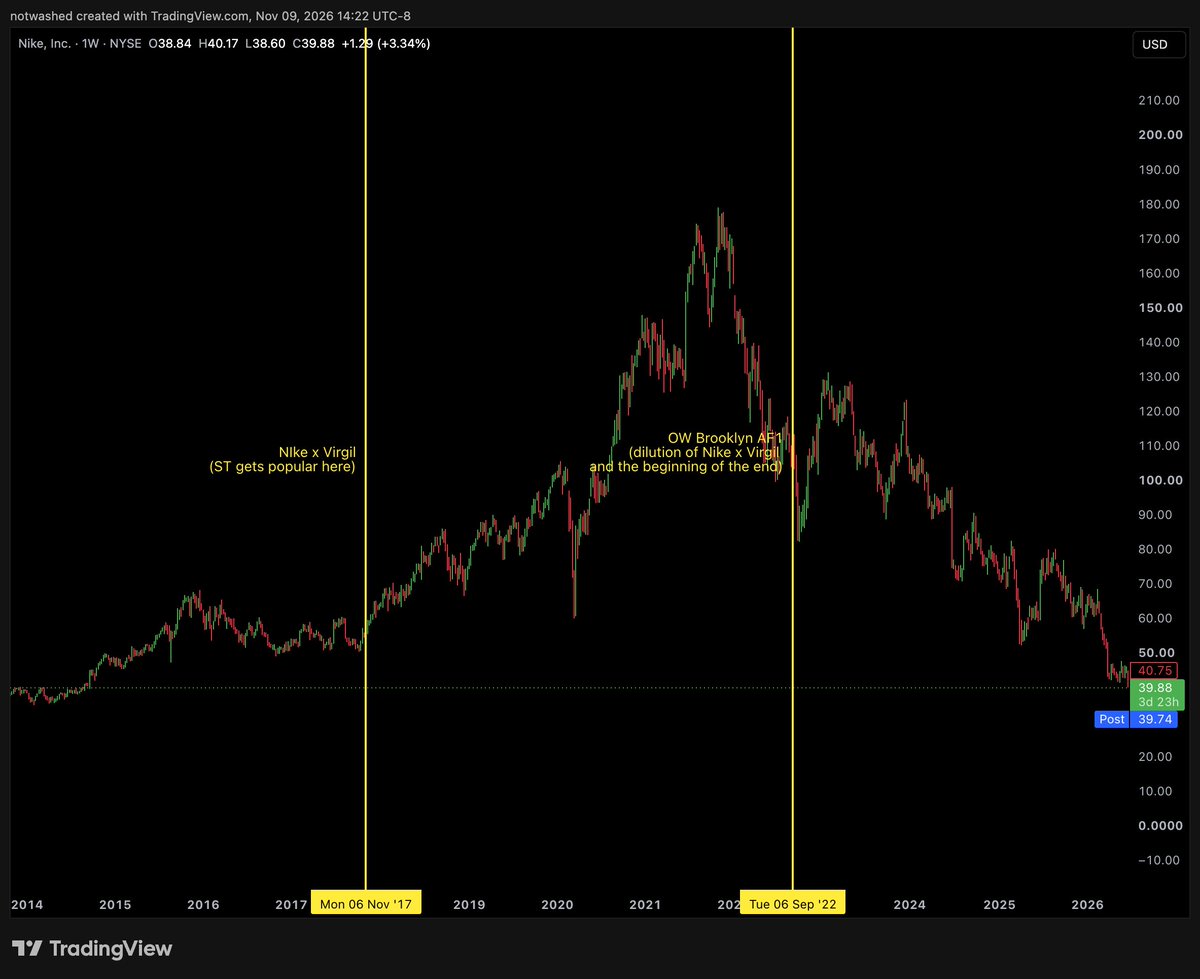
The start and end of Sneaker Twitter.
By 2023, people were mostly gone and doing things like TCG reselling, ticket reselling, creating companies, etc.
This chart definitely isn't as accurate as the Nike example, but this is sort of how I see the correlation between CT and crypto.
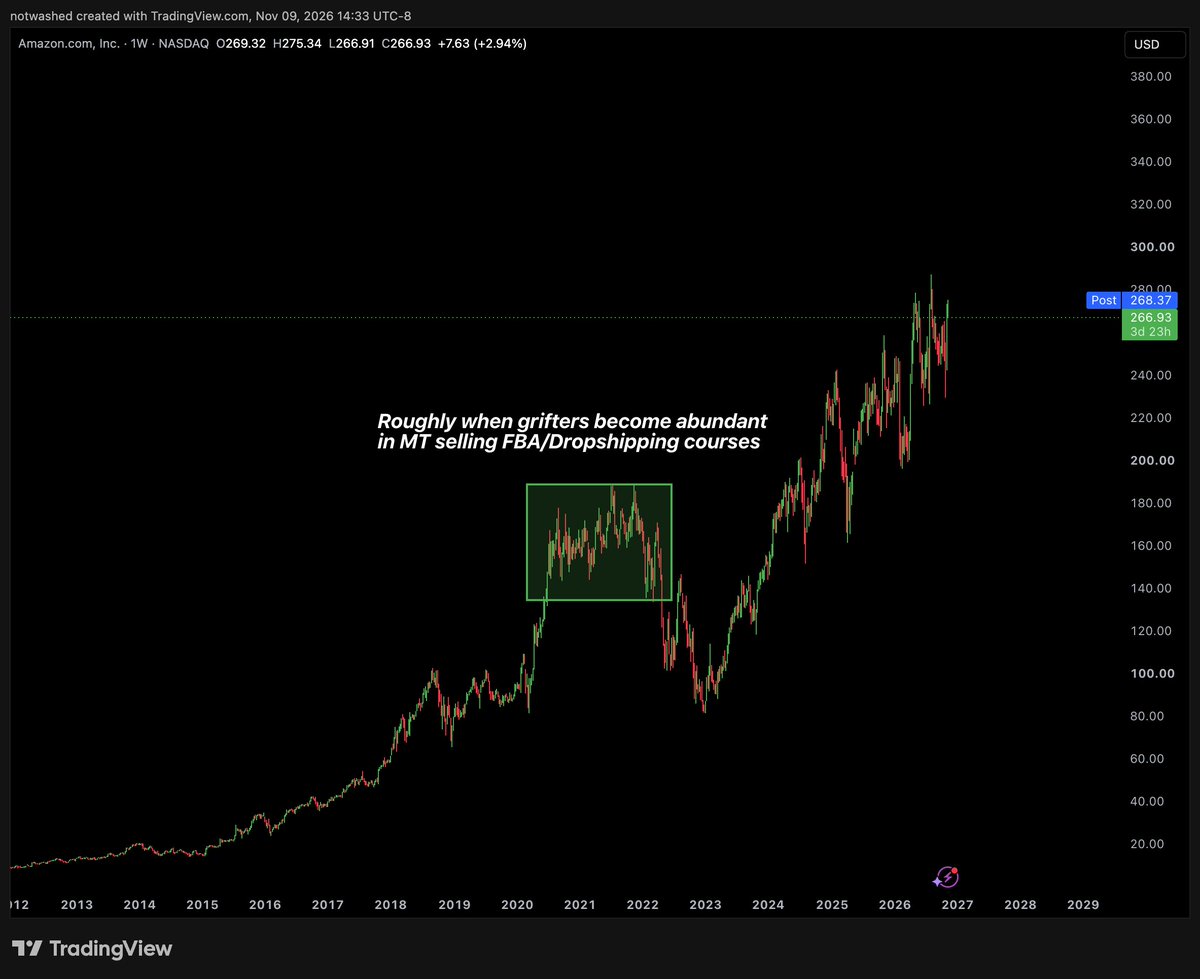
Very rough idea, don't obsess over this.
E-commerce has largely been an up-only trend, but the niche community, discourse, and opportunities surrounding it arguably topped back in 2021–2022.
Now obviously, Amazon is much more than e-commerce and is a behemoth of a company, but the point is that the success of an industry doesn't necessarily translate to continued opportunity for those who were early to identify and capitalize on its emerging opportunities.
I'll also note that MT was pretty broad, encompassing just about anything in the online business world. When I was a lurker, the dominant themes were brand creation (partly dropshipping), info products, agencies, and affiliate marketing.
Sneaker Twitter explains how participants cannibalize themselves through increasingly aggressive competition, eventually destroying the very opportunity that brought them together.
Money Twitter explains how, as the original opportunities become less attractive, participants shift from making money through businesses or trading to making money by monetizing their social influence.
In that sense, Crypto Twitter today is closer to Money Twitter than Sneaker Twitter. Crypto isn't topped in the way sneaker culture is, and CT isn't going to become a ghost town.
CT can become increasingly irrelevant to crypto's future without crypto itself becoming any less relevant. The alpha that used to live on CT is increasingly found through onchain activity or within private communities on Discord and Telegram. Not all social aspects are inherently bad. There are still accounts trying to make this place better while growing an audience of their own, and it makes sense to focus on those accounts while tuning out the noise.
CT, as a niche corner of Twitter where you can discover opportunities, share ideas, and connect with sharp people, is mostly over, and that's alright.