7 Occult Practices to Wake Up From the Modern Trance

文章目录
most people have a fundamentally broken perception of what the occult teachings are and what practices they actually imply.
hearing the word occult, what instantly comes to mind are pentagrams, black candles or some devilish rituals straight from epstein island, while the true definition of this word has nothing to do with all that.
the word occult comes from the latin occultus, which simply means: hidden.
hidden from the crowd. hidden from the masses. hidden from the ordinary perception.
all these pentagrams and devilish associations simply come from the fear of the unknown, deeply rooted in human nature. when we cannot fully grasp and conceptualize something, we fear it & we give it a shape that corresponds with our level of perception.
the same applies to anything else that our ancestors couldn’t explain. the thunder, which the greeks heard as the wrath of zeus. the eclipse, which the ancient chinese saw as a dragon devouring the sun. and the same applied to occult esoteric teachings, which were practiced for centuries.
the subjects they touched on often stood in opposition to everything the church and the crown wanted people to believe.
every teaching that stood in opposition had to be hidden from the inquisition & demonized. every esoteric school of thought had to be passed from master to student in coded manuscripts and closed lodges.
throughout centuries, these teachings survived in the shadows, and some of the greatest minds in history quietly studied them.
george washington took his oath of office on a masonic bible.
carl jung spent decades deciphering old alchemical manuscripts.
newton is said to have written more on the occult than on physics.
why?
the truth of the matter is, there’s no higher knowledge than the hidden, metaphysical knowledge.
when one understands the nature of the universe, and his own place in relation to it on the deeper level, there are truly no limits to what he can accomplish.
reality is mental at its root. only the man who masters his mind can master his reality. that’s why every practice below starts in the same place.
not in the temples. not in the church. but in the mind.
I spent the last years of my life studying the occult deeply. dozens of books read, 100+ articles written on the subject.
today, I’ll lay out the essence of all of it for you. without any of the candle rituals and demonic stuff.
just plain, no bs daily practices you can implement in your day-to-day life to truly start living on another level.
let’s get into it.
1. GURDJIEFF’S SELF-REMEMBERING
“remember yourself always and everywhere.” (g.i. gurdjieff)
an average man lives pretty much like in a trance.
he appears to be working, but his mind is somewhere else.
he appears to be listening, but he’s only waiting for his turn to speak.
he thinks he’s conscious, but he’s sleepwalking like a lunatic most of the time.
studies show that an average person spends around 47% of their waking hours with their mind somewhere else, running on autopilot, simply executing the tasks their subconscious has learned by habit, without almost any sense of conscious awareness.
that’s why you can be driving for 30 minutes and not remember a single turn of the road. that’s why you can be ‘reading’ a book for 10 minutes and catch yourself not registering a word from the last 3 pages you’ve ‘read’. that’s why the weeks blur into each other and ‘time goes fast’. yeah, no shit. you’ve maybe registered half of it.
the modern world got us sleepwalking like lunatics all the time. in 2004, the average attention on a screen lasted 2.5 minutes. today it’s 47 seconds.
the pinnacle and the foundation of all occult teachings is awakening from this long sleep and adding that thread of awareness to your life as often as possible.
one of the greatest spiritual teachers of the 20th century, george ivanovich gurdjieff, called it self-remembering. the act of being aware of yourself in the middle of everyday life.
his student, p.d. ouspensky, presented it in the form of an arrow analogy.
normally, your attention is a single arrow. it points outward, at whatever is in front of you. you read, and you ARE the reading. you argue, and you ARE the anger. nobody’s home.
self-remembering turns it into a double-headed arrow. one end points at the world. the other points back at you.
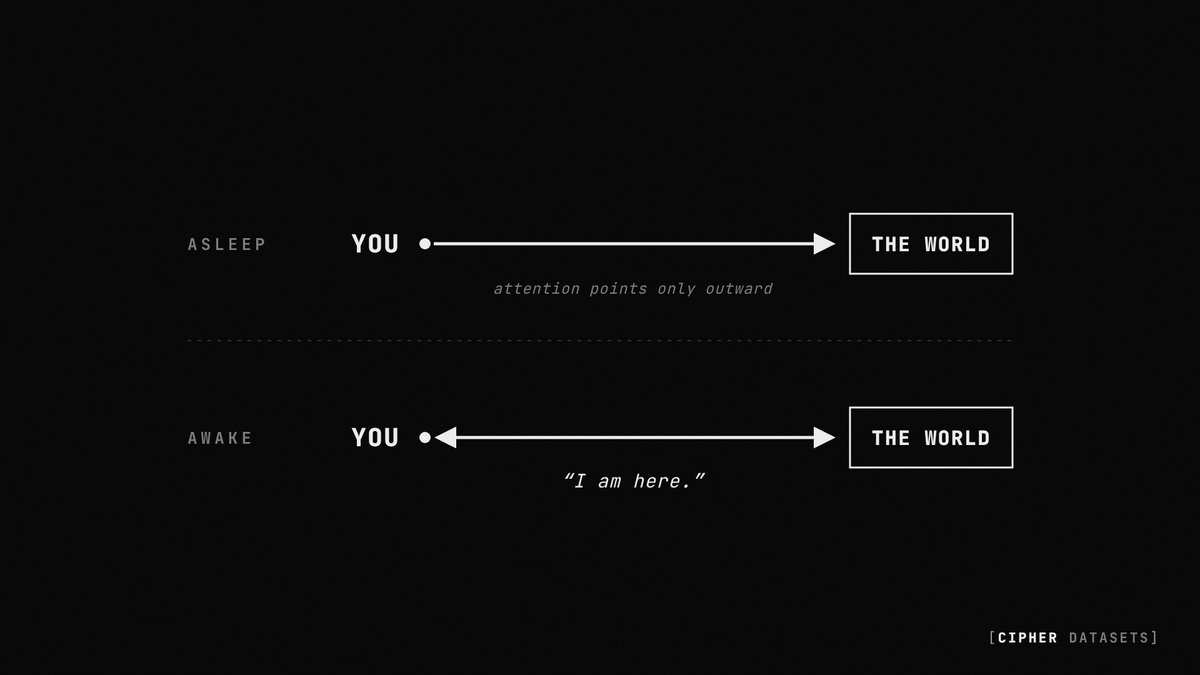
you don’t just see the street. you see the street, and you know: “I am here.”
so what’s the practice?
just like a lucid dreamer does constant reality checks to see whether he’s dreaming or not, the goal is to set fixed checkpoints throughout the day, during which you break the autopilot and bring back your conscious awareness.
in the shower, in the line at the store, in the middle of the set in the gym, just remind yourself: “I am here.”
do it as often as possible and you will slowly start catching yourself awake without any checkpoint at all.
the goal is to reach a state in which awareness, not autopilot, is your default.
what gurdjieff called the third state of consciousness. the one in which you’re awake all the time.
this is the real escape from the matrix.
onto the next one.
2. STEINER’S NEEDLE
“dhāraṇā is the binding of the mind to one place.” — patanjali, yoga sutras III.1
perhaps the biggest curse of the modern world is this constant noise and the need for dopamine stimulation.
mfs go through their days switching between scrolling tiktok, watching tv and checking the group chat, then expect to sit down and do something meaningful with their lives.
WRONG.
the first and one of the most fundamental disciplines of the occult is curating your attention span, so that you can reach the state of ultimate focus in everything you do.
an average person can’t even sit alone with their thoughts without the phone for 15 minutes. in a 2014 study, 67% of men chose to give themselves electric shocks rather than sit in an empty room with nothing but their own mind.
and that’s EXACTLY what you need to be doing voluntarily.
in 1910, rudolf steiner published occult science. one of the foundational techniques in it was “the needle”. sounds like another demonic initiation ritual, but it’s the most trivial exercise ever:
take a plain, boring object, a needle or a pencil, and keep your attention on it for 5 minutes straight. nothing else.
as steiner put it: “if we… turn our thoughts for at least five minutes each day to a mundane object (such as a pin or pencil)… we have already achieved a good deal.”
and what does it mean for you in practice?
set a fixed time, preferably before an activity that demands your attention span.
before every workblock, spend the first 5 minutes of it focusing on a single object. nothing but that object.
it’s the easiest thing a human being can do, and yet, the roi is off the charts.
the needle is actually the first step of my learning protocol. you can find the whole dataset **HERE. **
alright, that was the mind. now we’re moving to the body.
3. YOGIC PRANAYAMA
“when the breath wanders, the mind also is unsteady. but when the breath is calmed, the mind too will be still.” (hatha yoga pradipika II.2)
breath was always considered sacred, and the subject of interest of many occult societies.
esoterically, breath was seen as the very thread that regulates the connection between the divine (spirit) & the earthly (body).
ever felt yourself so nervous, your breath stuck in your throat, unable to utter a single word? in the old traditions, the lack of breath meant the spirit leaving the body. symbolizing the metaphorical death, hence the saying: ‘he breathed his last’.
many traditions focused on developing breath control, the most advanced of them in ancient india.
the yogis believed the human body to be divided into 72,000 channels (nadis), all of them constantly charged through the invisible life force: prana.
over time, these channels get clogged, and the only way to clear them was through specific breath techniques. one of them, nadi shodhana, literally means ‘channel purification’.
throughout millennia of observation & practice, they developed the occult science of pranayama: the art of mastering the life force of the body through deliberate breath control, connected directly with the energy of the mind.
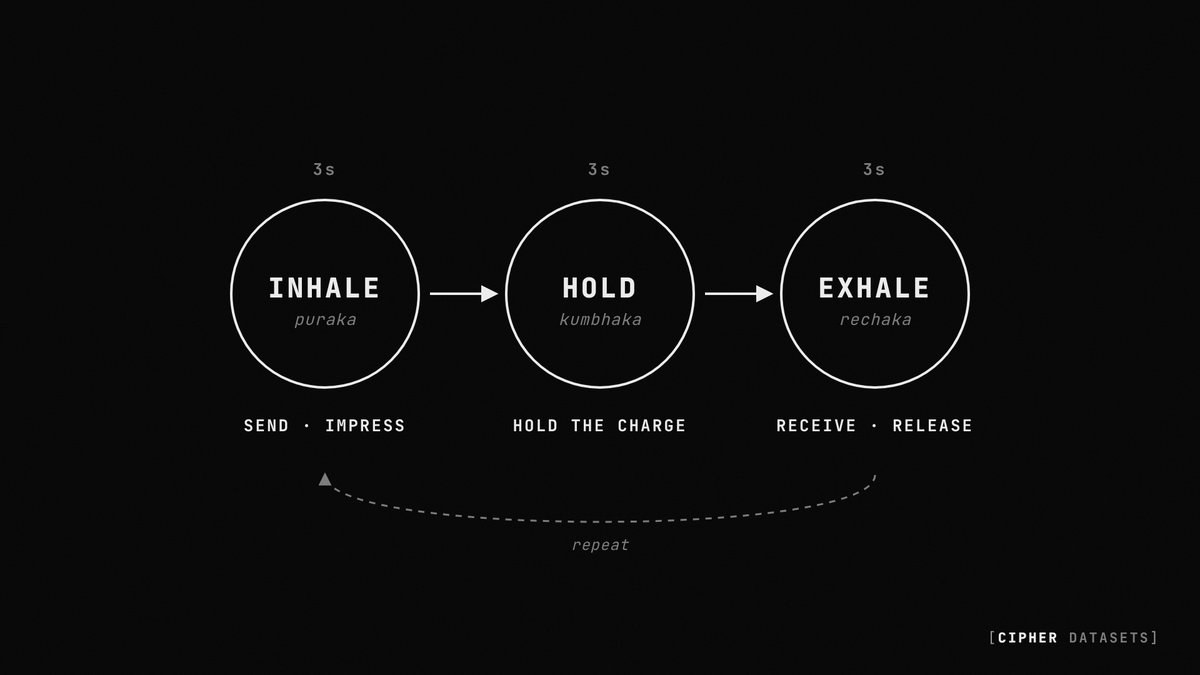
the entire practice ran on 3 parts: inhale (puraka), hold (kumbhaka) and exhale (rechaka).
when inhaling, the goal was to focus the mental energy on the life force flowing through the body. then the yogi held that energy, only to release it and purify the body of all tension.
the inhale was meant to impress, charging the body with intention, while the exhale was meant to release, letting go and opening up to receive.
and all in a specific rhythm, for example 3-3-3 (inhale, hold, exhale).
good, how to apply all of it to your life?
whenever some big fear or pressure hits, you have this natural tendency to tense up & breathe even faster, but that’s only dragging you deeper into panic.
the essence of ancient breath practices is to master yourself and remain still under pressure. instead of reacting, slow the breath down, bring back the rhythm and reach the state of inner calm before even attempting to do anything physically.
the whole art goes far deeper than this and has many other practical applications. for a more advanced explanation and specific pranayama techniques, read my full protocol HERE.
4. ALCHEMICAL TRANSMUTATION
"solve et coagula."(dissolve and coagulate. the motto of the alchemists)
somewhere between the 12th and the 17th century, the entire medieval world became consumed with the quest for gold.
the collective dream was achieving the legendary philosopher's stone: a divine substance able to turn any base metal into pure gold.
kings all over the world paid fortunes to court alchemists. the greatest minds of the age devoted their entire lives to the great work. (newton was particularly obsessed with alchemy.)
now... in literal understanding, the chemical transformation of lead into gold was never successfully achieved. but in the occult teachings, the art of transmutation was never about the literal gold. it was a metaphorical map of the transformation of the psyche and the raw energy it contains.
the entire art consisted of 3 stages: nigredo (blackening), albedo (whitening) and rubedo (reddening).
the alchemist first took the base metal, sealed it in the vessel and heated it until it turned black and decomposed.
then he washed it until it turned white, and kept refining it until it turned red. pure gold.
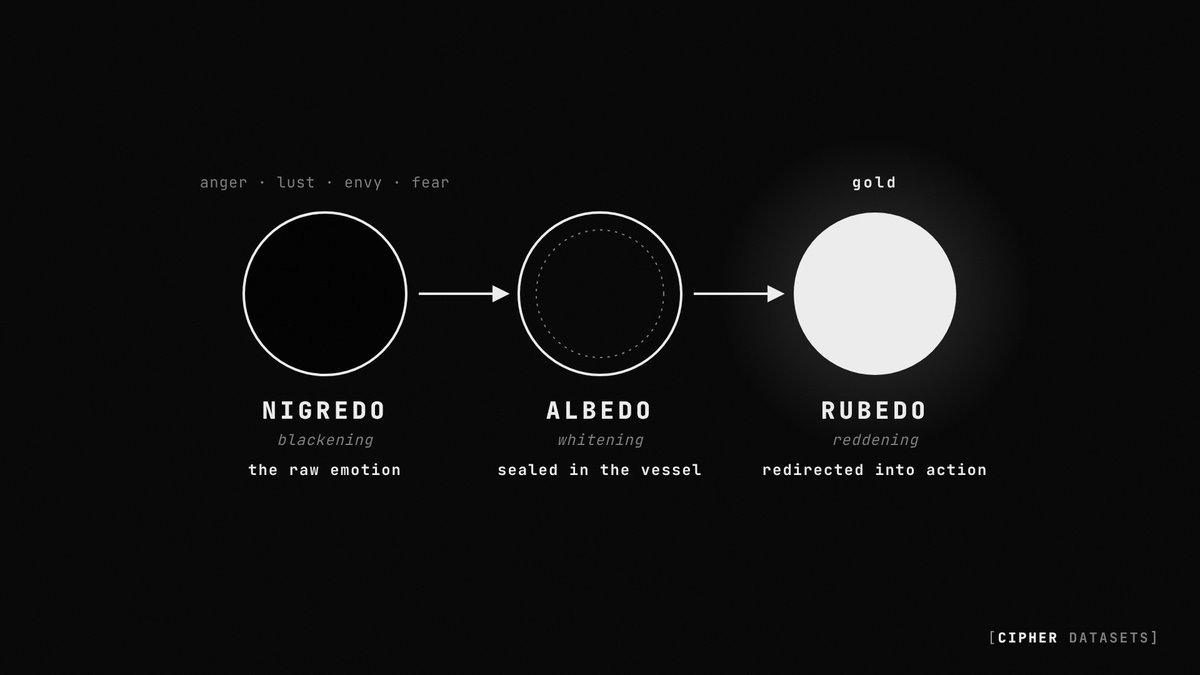
now, the base metals symbolized the base human emotions such as anger, lust, envy and fear. each of them carries a charge and consists of raw energy.
the art of transmutation is not about suppressing them, but sealing the vessel when one hits so none of it leaks, and when the heat peaks, redirecting that energy into a chosen purpose and transforming it into gold.
the core of the hermetic principle of polarity is that all human emotions are one in nature and moldable in degrees. as the kybalion puts it: "opposites are identical in nature, but different in degree."
by ridding yourself of a specific emotion through giving it a release, you are ridding yourself of energy you could have used.
in the simplest, plainest terms, the art of transmutation is about taking control of your emotions when they hit and never giving them an instant release. keep that charge in yourself and redirect it into action.
the full emotional alchemy process, stage by stage, is here →
5. THE ART OF MEMORY
"memory, the treasury of all things."(cicero, de oratore I.18)
most people see memory as an everyday, normal faculty, but few know that at its core, it is an occult art.
memory has long been the subject of study of the initiates, tracing all the way back to ancient mystery societies who practiced and excelled at it at a level not seen these days.
roman senators speaking for hours in the senate and the courts without a single piece of notes.
seneca the elder repeating 2,000 names in the exact order he heard them, then reciting 200 lines of poetry back to his students in reverse.
renaissance memory masters said to possess memories so powerful, that peter of ravenna claimed to carry 100,000 memory places in his mind, reciting the entire canon law by heart.
all while modern students cram for hours and still cannot memorize a single chapter. why?
memory, at its core, doesn't run on repetition as is commonly believed. it runs on places and images.
in one of the oldest surviving memory manuals, the rhetorica ad herennium, written around 85 bc, the entire art of memory is divided into 2 elements: images (imagines) and places (loci).
the esoteric schools of thought that built on it taught that the mind remembers best when the things subject to memorization are connected to well-familiar places, so that the initiate can walk through them in imagination the same way as he walks through his house.
this is how the most famous memory technique was born: the memory palace.
taking the things you need to remember and putting them inside that location in the form of grotesque images that stick with the brain.
because, as the old manual says, we forget the ordinary and remember the extraordinary.
this is the simplest way to memorize anything FAST. say you need to learn a speech. instead of repeating it 100 times and highlighting it in 27 different colours, build a memory palace.
let's memorize the practices we went through so far in this very article. walk through your home:
at the front door, a man sleepwalks straight into it. you shout: *"I am here."*in the hallway, a giant needle is stuck in the wall. in the kitchen, a yogi blows out every flame on the stove with one long exhale. in the bathtub, lead melts and turns into gold. on the couch, a roman senator recites his speech to you for hours.
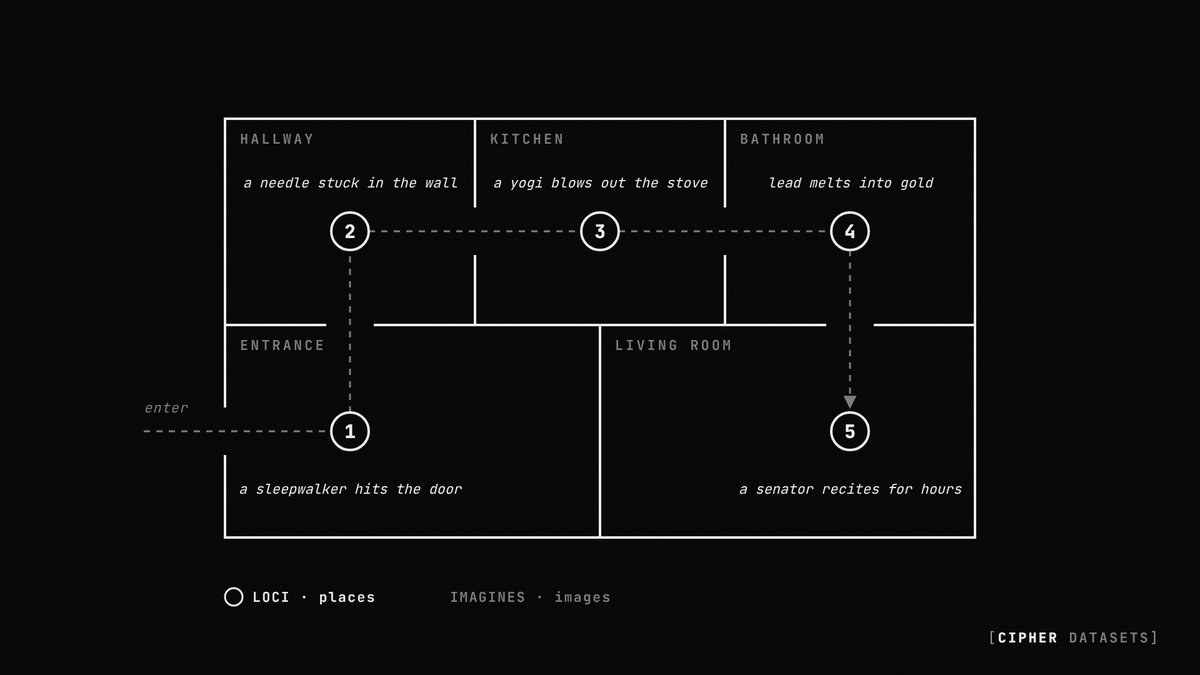
walk the route a couple of times, and you've already memorized the first 5 practices of this article. without a single repetition.
this was the first and the most basic use of the art of memory. throughout the centuries, different esoteric schools evolved it into an entire system of palaces built for ordering a mind on a cosmic level, storing entire libraries of knowledge and creating new ideas through combination.
read the full art of memory protocol →
6. THE PYTHAGOREAN EVENING REVIEW
"what bad habit have you cured today? what fault have you resisted? in what respect are you better?"(seneca, on anger III.36)
an average man's evening routine is: an hour of netflix, then scrolling in bed even more until his eyes close, marinating his subconscious mind in this dopamine slop for the next several hours.
the last 5 minutes of your day are the most important 5 minutes, as your subconscious soaks in whatever you've learned, felt or mindlessly consumed.
in the ancient secretive school at croton, founded by pythagoras himself, the disciples followed one rule, written in the golden verses:
"never let sleep close your eyes before you have gone over the deeds of the day three times: where did I go wrong? what did I do? what did I leave undone?"
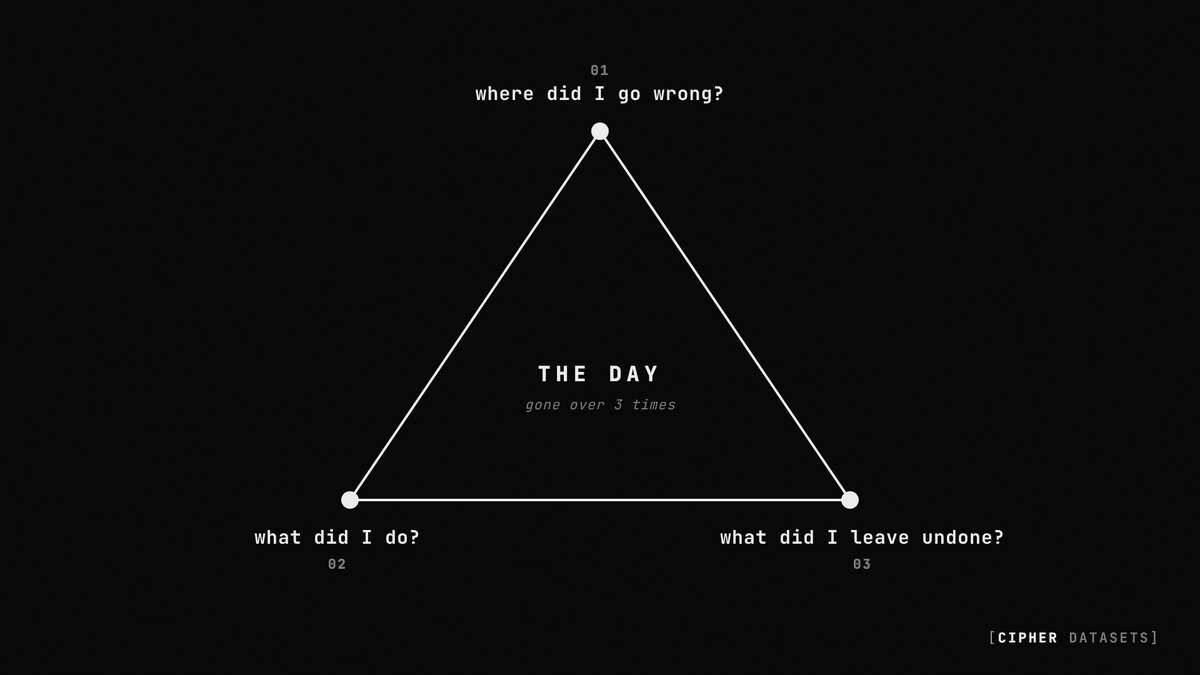
these 3 questions, answered honestly, hold the key to solving most of your problems & stopping your mistakes before they repeat.
make it an every-night practice to go through them, for each day separately. for as I like to put it: 'a day that is not reviewed repeats itself.' and god, how right it is.
only when you look back at the day and truly let its lessons sink into your head can you wake up a better man than the one who went to sleep.
7. THE DREAM JOURNAL
"a dream which is not interpreted is like a letter which is not read."(talmud, berakhot 55a)
throughout history, dreams had always been treated as sacred by all esoteric traditions.
starting with the ancient egyptians, who slept in temple chambers to receive messages from the gods, and wrote the oldest dream book known to man.
all the way to carl jung, who saw dreams as letters from the unconscious & a compass guiding a man toward his true self.
the exact nature of dreams and their purpose are still not fully explained by science, but what remains as fact: they often carry a meaning higher than our conscious mind can reach.
history is full of examples of great minds receiving guidance, answers or premonitions in their sleep. alexander dreamed the fall of tyre before he took it. kekulé saw a snake biting its own tail, and woke up with the structure of benzene. lincoln is said to have dreamed of his own body lying in the white house, just days before his assassination.
the problem with dreams is that they tend to fade or vanish completely within minutes after waking up.
it would be a shame to receive a dream like that and forget it a couple of minutes later, right?
the practice, however trivial it is, is to always keep a dream journal next to your bed, and whenever you wake up from a dream, write it down as soon as you can.
then, adding reflection and conscious intellect, you will often find patterns and interpretations you would never see otherwise.
the art of dreaming goes much deeper, into lucid dreaming and dream programming. I wrote an entire protocol on this: dream-hacking →
alright, now you know the 7 practices. the 7 real doors out of the trance. you woke up in the first chapter. the only question is whether you stay awake.
let me be honest with you. these practices are real, they’ve been tested for centuries by the initiates who passed them down, but they’re just the surface level. every single one of them goes much deeper.
this publication runs on 2 layers:
the free one, which you just read, is just the first layer. we go through the essence of esoteric teachings, but it’s mostly theory. the why.
the paid one is the practical one. it goes much deeper into these mechanics and gives you an actual in-depth breakdown and step-by-step map to implement them into your life. the how.
inside the paid archive, you’ll find dozens of protocols on the deepest esoteric material I’ve ever written. almost every practice from this article + much more, broken down into a step-by-step playbook.
the inner circle is steadily growing, and dozens of paid members are already inside and reporting real shifts in their reality.
so, if you’re done sleepwalking and want to truly start living on another level, everything waits for you on the other side.
→ enter the paid archive if you are ready
-Cipher.