Claude Money Roadmap: 8 Ways People Are Getting Paid With Opus 5.5 Right Now
文章目录
A year ago, Tony Dinh paid over $1,000 for a launch video.
This fall he made one just like it with Opus 5.5. In under 30 minutes.
Studios still charge $1,000+ for that kind of video. Agency quotes for a small business website can still hit $14,500. With Claude, both now take under an hour.
That gap between what clients pay and what the work costs you now is the whole opportunity.
Most people never see it. They ask Claude for "side hustle ideas", get 20 generic ones, and close the tab.
The people getting paid do the opposite. They don't ask Claude what to sell. They use it to do work someone already pays for.
I went through the "make money with Claude" articles that blew up on X over the last few months. Most were recycled noise. 8 playbooks weren't.
This is the map: 8 playbooks from 11 builders. For every playbook you get:
-
what it is, in plain English
-
who it's for and what you need
-
your first move today
-
the builder who wrote the full guide, so you know exactly where to go next
They're sorted from easiest to hardest. Find your level and start there.
One rule before we start: every number below is what the author reports. Treat it as proof that it's possible, not as a promise.
Bookmark this now. You'll want it open the day you pick your playbook.
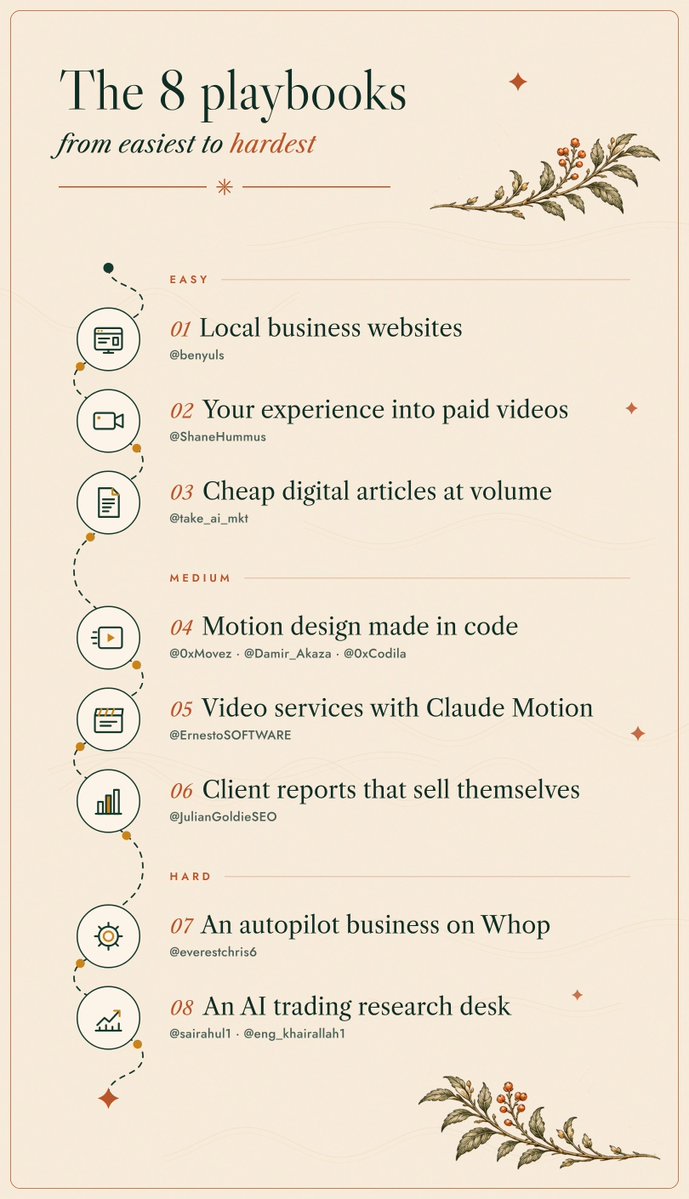
The 8 playbooks at a glance
-
Local business websites (easy)
-
Your experience into paid videos (easy)
-
Cheap digital articles at volume (easy)
-
Motion design made in code (medium)
-
Video services with Claude Motion (medium)
-
Client reports that sell themselves (medium)
-
An autopilot business on Whop (hard)
-
An AI trading research desk (hard)
1. Local business websites with Google Maps + Claude
· Difficulty: easy · You need: Claude · Builder: @benyuls
The idea. @benyuls shared the story of a 17-year-old who bills $7,800 a week building websites for local businesses. Six months ago she made $9 an hour at McDonald's. Her method: find a place on Google Maps with 4.7 stars and a website from 2013 (her example was tacos in Philadelphia), drop its details into a site builder, and send the owner the finished site with their name already on it.
The math. An agency would quote about $14,500 and six weeks for the same site. She spends around 20 minutes per client.
Why it works. The 4.7 stars prove the business has customers and money. The 2013 website proves nobody has fixed it yet. That combo is your perfect client.
First move. Search one niche in your city. Save 10 places with 4.5+ stars and an old or missing site. Have Claude build a new homepage for the best one, then show it to the owner before you ask for anything.
Full story: @benyuls
02. Turn 20 years of experience into paid videos
· Difficulty: easy · You need: Claude and your phone · Builder: @ShaneHummus
The idea. If you've done one thing for 20 or 30 years, don't buy a course and start from zero. Your experience is the product. Shane starts with a "time machine test": how much time, money and pain could you save your younger self? If the answer is "a lot", you have something to teach.
How it works. No studio needed: your phone or webcam is enough. Claude interviews you about what you know and turns your answers into a script in your own words in about 15 minutes. In his example, each video took 90 minutes, which worked out to $200 an hour. And that's the floor, because the video keeps earning after the hour is over.
No camera? No problem. Deedy Das says Opus 5.5 is incredible at instructional videos. He made a launch video for an AI startup in about a minute, for roughly $2.
Why it works. Everyone online is teaching AI. Almost nobody with 25 years in nursing, cars or the trades is teaching what they know. Less competition, more trust.
First move. Tell Claude: "Interview me about my job, one question at a time, until you find the 5 mistakes beginners make most."
Full playbook: @ShaneHummus
03. Sell cheap digital articles at volume
· Difficulty: easy to medium · You need: Claude Code · Builder: @take_ai_mkt
The idea. A Japanese creator built a system in Claude Code that writes and ships paid articles priced at 100 yen (under $1) on note, Japan's answer to paid Substack posts. His math: revenue = number of articles × purchases per reader. You can't force readers to buy more. You can publish more, and that part is just work, so he hands it to AI.
The clever part. One CLAUDE.md file in the folder works like a company handbook, so Claude never needs the brief twice. His biggest lesson: article #1 and article #20 were equally good, because sales data never went back into the system. Feed your best and worst sellers back into CLAUDE.md and every new piece gets smarter.
Why it works. A low price makes it an impulse buy. More articles means more doors for readers to walk through. The feedback loop teaches the system what sells.
First move. Pick a platform where people already buy small things, like Gumroad. Publish 5 short paid guides on one narrow topic and watch which one sells.
Full guide: @take_ai_mkt's article (Japanese) · English translation
04. Motion design made in code: build it, then sell it
· Difficulty: medium · You need: Claude Code on Opus 5.5 (included in Pro) · Builders: @0xMovez, @Damir_Akaza and @0xCodila
The idea. Since Opus 5.5 dropped, the feed is full of slick animations made 100% with code. The secret: Opus 5.5 doesn't output a video. It writes a program that draws every frame, and a renderer turns those frames into an MP4. That's why you need Claude Code, not the chat: it can render the video, look at its own frames and fix them.
Where to learn it. @0xMovez turned the whole process into a full course, and it has 29M+ views.
The money. Damir notes that studios charge $1,000+ for this kind of video. Tony Dinh's launch video from the top of this article is the proof: a $1,000 job, redone in under 30 minutes. And @0xCodila points to companies already offering around $500 for a 15-second video made this way.
How to sell it. Damir's best rule: never sell "an animation". Sell a package: what's included, how many formats, how many revisions, and the deadline.
Why it works. Startups keep shipping features and want a video for every launch. Most can't afford a studio. You can be the studio.
First move. Damir's advice: make 3 examples for real products you like and send them straight to the founders.
Learn to build it: @0xMovez · Learn to sell it: @Damir_Akaza · Find paying clients: @0xCodila
Halfway there. If this is already useful, repost it so one friend who keeps saying "I should do something with AI" finally sees it.
05. Video services with Claude Motion
· Difficulty: medium · You need: a Claude Team or Enterprise plan · Builder: @ErnestoSOFTWARE
The idea. Anthropic launched Claude Motion on October 8. It turns your content into short animations where every word, number and timing stays editable. Ernesto, whose UGC program pulled 150M+ views in a year, mapped out 5 ways to get paid with it:
-
Ad creatives as a service, built from the longest-running ads in the Meta Ad Library
-
Daily reels and YouTube, where one raw clip becomes three cuts
-
Launch videos for startups, a job that used to take a week and $2,000+
-
Clipping campaigns, where brands on Whop and Content Rewards pay $1-5 per 1,000 views
-
UGC pipelines, where creators send raw drafts and Claude edits them
Reality check. Motion animates your own content with code. It doesn't generate footage or people. And right now it's in beta only on Team and Enterprise plans, not on Pro or Max. Team starts at 2 seats, so budget for it before you promise anyone a video.
First move. Start with clipping. It's the one where brands already publish open campaigns with a set rate, so you don't have to pitch anyone.
Full breakdown: @ErnestoSOFTWARE's article
06. Client reports that sell themselves
· Difficulty: medium · You need: Pro for Dashboards, Team for Motion · Builder: @JulianGoldieSEO
The idea. Anthropic launched Claude Dashboards the same day. Julian rebuilt agency SEO reporting around it: client data goes in, Claude builds live charts, and Motion turns the main finding into a 30-second video. The client gets a short video update instead of a spreadsheet nobody opens.
Why it works. Reporting eats a huge chunk of agency time, and clients barely read it. A 30-second video gets watched, gets forwarded to the boss, and makes your monthly fee feel worth it.
His warning. Check your plan before you promise a client a video, because Motion is Team and Enterprise only.
First move. Export one client's monthly numbers as a CSV. Drop it into Claude and ask for a dashboard plus the 3 numbers that changed the most.
Full workflow: @JulianGoldieSEO
Quick one before the hard playbooks: follow me. I'm already working on the next map.
07. An autopilot business on Whop
· Difficulty: hard · You need: Fable 5.1 via API, a Telegram bot, a Whop account · Builder: @everestchris6
The idea. Chris runs Fable 5.1 inside Hermes, an open-source agent from Nous Research, and gives it orders through Telegram. Then he connects it to Whop. Two ways to earn:
-
Fast: deploy one of Whop's ready-made business blueprints, sell it to the people already complaining about that problem, and kill it fast if it flops. Each test takes a few days, so you can run several niches at once.
-
Slow but bigger: build your own blueprint. When another business deploys it, you earn 10% of Whop's gross profit on that site's sales.
Need more ideas? @cyrilXBT mapped out 60 workflows that run while you sleep: sales follow-ups, support replies, invoices, research. Each one has a trigger, an agent and a check step before anything goes out.
The smart detail. His agent prepares everything, but it has to stop and wait for him before it contacts a real person, publishes anything, launches ads or moves money.
Reality check. Fable 5.1 is Anthropic's most powerful public model and priced like it: $10 per million input tokens, $50 per million output. Watch your usage.
First move. Browse Whop's blueprint gallery and pick one niche you actually understand before you write any code.
Full guide: @everestchris6
08. An AI trading research desk
· Difficulty: hard · You need: Opus 5.5, market data, patience · Builders: @sairahul1 and @eng_khairallah1
These two builders disagree on something important, so read both.
Rahul's experiment. He connected Opus 5.5 to live financial data with one goal: find a strategy worth deploying and prove it works before claiming it does. The loop: research → hypothesis → code → backtest → fail → improve → stress-test → validate. Claude proposes, but it can't declare itself the winner. The backtest decides. He even told it to assume the best strategy was overfit and test it again. His reported result: an energy-sector strategy with 53% returns in backtests, ahead of the S&P 500.
He also shared the exact research prompt, and that post did 1.2M views. Use it as a research tool, not a money button.
Khairallah's 24/7 system. Opus 5.5 reads the news and writes a trade thesis. Sonnet 5.5 summarizes filings overnight at cheaper batch prices. Before any money moves, every idea has to state the action, the stop, what would prove it wrong, and its sources. His big warning: the model may already know what happened after the news you feed it, so a backtest of its judgment can look brilliant and mean nothing. His rule: weeks of paper trading first, and judge the system by its journal.
The takeaway. Use Rahul's loop to generate and kill ideas fast. Use Khairallah's rules before a single real dollar moves. And notice that in both systems Claude never gets the final say. The backtest or the journal does.
Not financial advice. Paper trade first.
Full articles: @sairahul1 · @eng_khairallah1
What all 8 playbooks have in common
After reading all of them, the same 4 rules keep showing up:
-
Sell an outcome, not "AI". Nobody buys an animation. They buy a launch video in 3 formats with 2 revisions by Friday.
-
Give Claude a rules file. CLAUDE.md shows up in the motion studios and the article machine. Write your rules once and every session starts smart.
-
Make Claude prove its work. Rahul's backtests, Khairallah's journal, the motion builders who make Claude watch its own frames. The winners never trust the first output.
-
Start small, then scale. 3 samples. 1 niche. Paper money. Kill fast. Nobody here started with a big launch.
Which one should you start with?
-
No skills and no code: #01 or #02
-
10+ years in one job: #02
-
You like writing: #03
-
You can open a terminal: #04
-
You run an agency or want one: #05 or #06
-
You love agents and automation: #07
-
You already trade: #08, paper money first
The real gap
Remember the $1,000 video that now takes 30 minutes? That gap won't stay open forever. Every month more people learn to do this, and prices drop.
Most of these playbooks start on a $20 Claude plan. The builders above aren't smarter than you. They picked one playbook and ran it longer than a weekend.
Pick one. Give it 30 days.
Before you go
If this map helped, do these 4 things. Takes 10 seconds:
-
Bookmark it. You'll want it open the day you start.
-
Repost it. Someone you know is stuck and doesn't know where to begin.
-
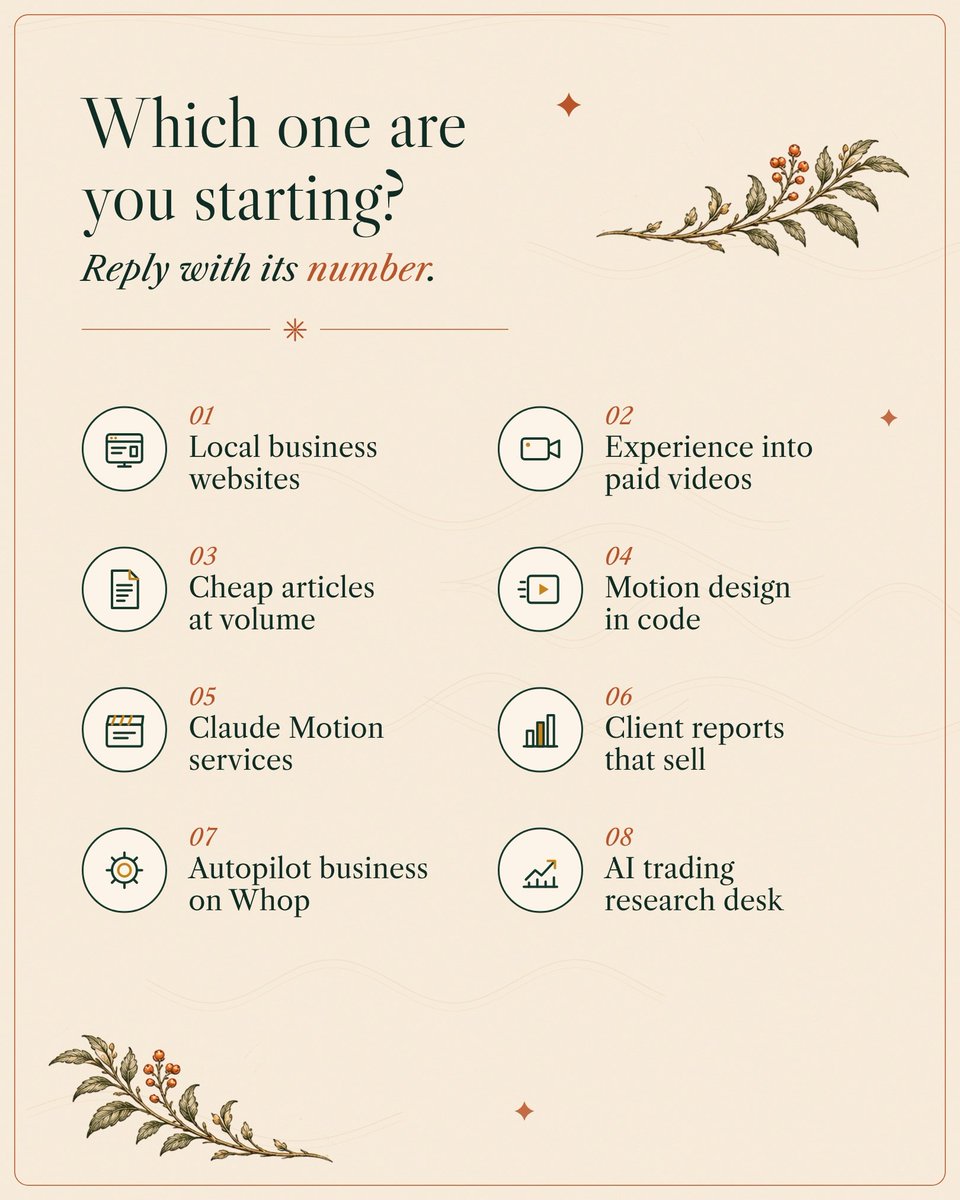
Reply with your number (01 to 08). I'll reply with a starter prompt for that playbook.
-
Follow me. I'm already working on the next map.
And go follow the builders above. Their timelines are where the real alpha drops first.
沿着这个主题继续读
从一篇文章,找到相关的教程、经验和阅读路径。