Fundraising is an engineering problem. Treat it like one.

文章目录
How to engineer your fundraise, Part 1: building the pipeline before you ever pitch.
A lot of technical founders run their first fundraise the same way. They email a handful of investors they've heard of, take meetings as they trickle in, and let the whole thing drag out over three or four months. A meeting here, a follow-up there, a "let's stay in touch" that goes nowhere.
That's a terrible way to raise money.
If you're one of the lucky founders who can hit up five top-tier investors and have them throw money at you, that's fucking great. You can skip this. But if you are like the rest of us, you’re not one of them. Most founders, even at really good companies, should expect to reach out to at least 100 investors (or more+), and might end up taking close to that many meetings. You're not trying to convince everyone. You're trying to find the few who say yes, and get to a quick no from everyone else instead of a long, drawn-out maybe.
The good news is that this is a process, and you can engineer it like anything else you’ve built. You’d never source a critical component by emailing one supplier, waiting three weeks for a quote, then trying the next one. You’d build a vendor list, qualify them, figure out who can actually hit your specs and volumes, and get quotes from a bunch of them in parallel. Run your raise the same way.
This is the first of a two part series. This one covers everything you should do before you talk to a single investor and the next one covers how to actually run the process. Honestly, this first part is where most founders cut corners, and it shows.
**1. Build your investor CRM
Start with a spreadsheet. I still use Google Sheets for this stuff. If you want something fancier, go for it, but the tool doesn't really matter. What goes into it does.
You want at least 200 investors on that list. Not 200 names pulled from a "top deep tech VCs" listicle. 200 investors you think can actually write checks at your stage and in your sector.
Where to find them:
-
Ask people - Talk to as many founders and investors as you can. Give them the two-sentence version of what you're building and ask who they think the right investors are. This is the highest-signal source you have.
-
Funding announcements - Look at companies you admire, or companies adjacent to yours, and figure out who funded them. Who led, who followed, and who keeps showing up.
-
Databases - PitchBook, Crunchbase, and whatever else you can get access to.
Ideally, for every investor on the list, you can point to a company in their portfolio that tells you they'd play in your space. Adjacent, not directly competitive. If they already own your competitor, they're not going to fund you.
And yes, use AI. A lot of this is just grunt work, and there are probably much better ways to do it now than when I was raising. But don't completely sign off on it. Review what comes back. The research is how you build a mental map of who funds what and most importantly, why. If you outsource the whole thing, you lose those mental notes, and you're going to want them when you're actually sitting across from these people.
It doesn’t need to be complicated. These are the columns I’d start with:
-
Firm and Partner - List the fund, but also the specific person you want to talk to. Investors don’t make decisions as a firm, partners do, and the partner who knows your sector is the one who’s going to champion you internally. Getting in front of the wrong partner at the right firm can be almost as bad as not getting in at all.
-
Size - The stages and check sizes they actually invest in, not what their website says. A fund that mostly writes $10M Series A checks isn’t going to lead your $3M pre-seed, no matter how much they like you, so this is the fastest way to filter people out.
-
Why - A sentence on why this investor would care about your company. Usually it’s an adjacent company in their portfolio or a thesis they’ve written or talked about publicly. This column does a lot of work: it forces you to justify every name on the list, and it’s the first thing you’ll want to reference when you reach out. If you can’t fill it in, they probably shouldn’t be on the list.
-
Introducer - The person who can introduce you. A warm intro dramatically changes your odds of getting a meeting, so you want this mapped out for every investor you care about before you launch. More on this below.
-
Last/Next - The last time you were in touch and what the next step is. Once you’re running dozens of conversations at once, this is how you keep anyone from falling through the cracks.
-
LinkedIn and email - So you’re not scrambling to find contact info when it’s time to move.
-
Wave - When you’re going to reach out to them. Not every investor should hear from you on day one, and this column is how you plan the order. More on this below too.
-
Status - Where things stand: need intro, intro available, meeting set, passed. At a glance, you should be able to see how much of your pipeline is actually ready to go.
-
Notes - Everything else that matters. Things like “partner can invest personally,” “likes very early, check might be too small,” or “high value target.” This is where the mental notes from your research end up, so you’re not relying on memory three weeks later.
Keep a separate tab for firms you’ve heard about but haven’t vetted yet. That way the main list stays clean, and you’re only spending time on investors who have earned a spot on it.
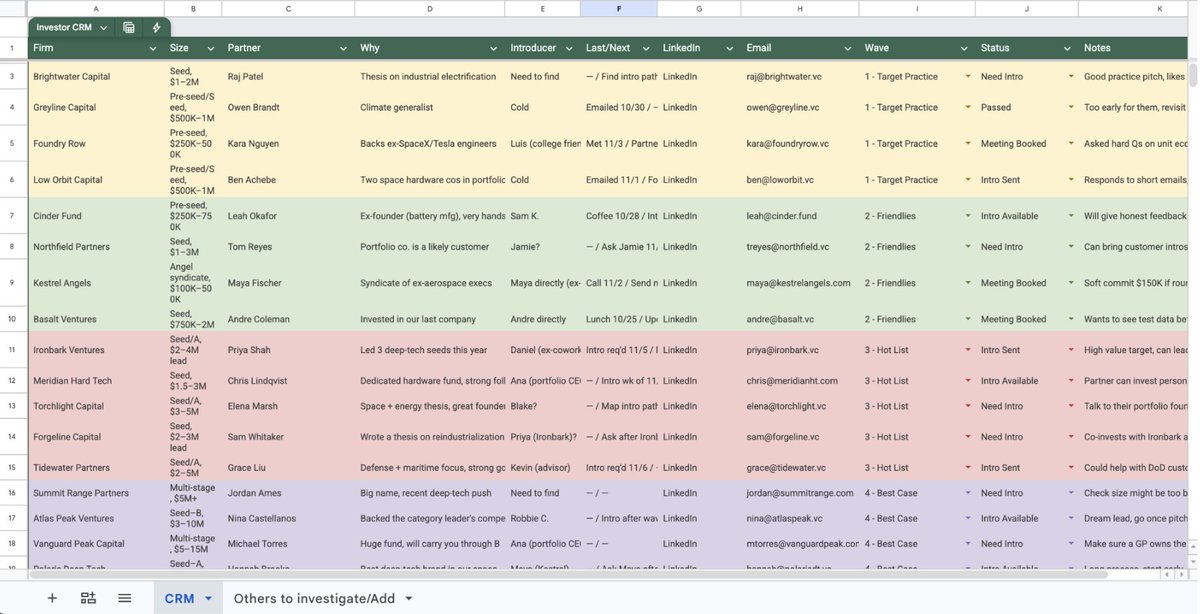
*All fake, obviously. Please don’t email Nina at Atlas Peak. She doesn’t exist, and she’s not going to lead your round.
2. Rank your investors
Once you have the list, rank it. Not every investor on there is equally likely to invest, or equally valuable if they do, and you want to know which ones matter most before you start reaching out. I’d look at three things:
-
Reputation - Is this a well-known investor or fund, and do founders actually speak well of them? A strong name can help with your next round and with hiring, but only if the people behind it are good to work with. Talk to founders they’ve backed, especially ones whose companies hit a rough patch. That’s when you find out what an investor is really like.
-
Proof points - Do they have a history of backing companies adjacent to what you’re building? There are great consumer funds out there, and no matter how good their reputation is, they aren’t going to lead your fusion round. This also changes over time. Some firms that barely touched deep tech a few years ago are doing a ton of it now. Either way, you want evidence in their portfolio, not just a line on their website.
-
Stage and check size - Beyond whether they invest at your stage at all, look at how your round fits into their fund. Are they writing a check that matters to them, and do they reserve money to keep investing in later rounds? Which leads to one of the most common traps I see.
The biggest name isn't always the best investor. I sometimes caution founders against taking a pre-seed check from one of the giant multi-stage firms. When you're managing a fund that's billions of dollars, a $1M check is a rounding error. They're sprinkling those around anything that sounds interesting.
It looks and sounds great at first. Then you go to raise your seed round and the first question is, "Why isn't [big firm] doubling down?" Unless you're one of their chosen companies, that logo can actually work against you, and they're probably not going to help you much either. How do you know if you'd be one of the chosen? The sad reality is it probably comes down to whether you already have a warm relationship with a GP there. If you don't, there's a decent chance a junior person gives you a million bucks and that's that.
Compare that to a fund that specializes in your stage. It's their whole business model. They need you to win. I want, badly, for every single company in my portfolio to succeed and raise follow-on capital. To be fair, there are real benefits to the big multi-stage firms. If you're genuinely one of their priority companies, they'll support you the whole way and everybody there cares. If you can get that, get it. It's just not always the right answer.
Once you've ranked everyone, break the list into tiers. I actually think of them as waves, because the ranking is really about the order you go out in:
-
Target practice - Real investors who could plausibly write you a check, but who you wouldn’t be heartbroken to lose. Your first pitches are going to have problems you can’t see yet: questions you can’t answer cleanly, slides that confuse people, a story that takes too long to get to the point. You want to find those problems here, not in front of the firm you’ve been dreaming about.
-
Friendlies - Investors who already know you, like the space, or have a reason to root for you. They’re more likely to give you honest feedback on what’s working and what isn’t, and early interest from them can build momentum you’ll carry into the next wave.
-
Hot list - The investors you actually want on your cap table. Strong fit, strong reputation, and a real reason to believe they’d lead or join your round. By the time you get to them, your pitch should be sharp and you should already have some conversations moving.
-
Best case - The dream firms. They’re the hardest to get in front of and the most likely to pass, but if everything goes right, they can change the trajectory of your company. Go after them, just don’t build your whole plan around them saying yes.
The smartest approach is usually to start with your lower-tier investors to get reps under your belt. It probably takes at least 10 meetings before your pitch stops having obvious kinks, and the sad truth is it might take 50. But don’t wait too long on the good ones either. Investors talk, momentum fades, and if you spend two months practicing, the round starts to feel stale before your best targets ever hear about it. More on how to sequence this in Part 2.
3. Find your warm intro paths
Cold outreach can work. It's rare. (I wrote about how to make a pitch email worth reading here.) An introduction from someone an investor knows and trusts is much more likely to get your email opened. It won't save a weak pitch, but it gets you in the room.
This is mostly just doing the work. Look at your mutual connections on LinkedIn, ask friends, ask founders who've raised from the people on your list. For each investor, pick the three or so connections you actually know, not the person you met once at a conference, and ask something like:
"Hey, do you know [investor]? We want to talk to them. Would it be okay if I send you something to forward at some point?"
Note the "at some point." You're not asking them to make the intro today. You're lining up the path so that when you launch, you can pull the trigger on all of them at once.
This is what the Introducer and Status columns are for. Every investor in your top waves should have a clear next step, ideally a specific person who can introduce you. It's fine if half of that column is question marks at first ("Dave?", "maybe Sarah"). The point is to see where the gaps are. If a priority investor still has no path when you're ready to launch, go find one, or make a conscious decision to go cold.
Build the pipeline before you need it
None of this is fast. I'd honestly rather founders didn't have to do any of this. You should be building your company, not building spreadsheets of investors. But if you want a successful fundraise, you need to be prepared for it, and that prep has to be part of how you pick your launch date. If you're planning to raise in January, the work starts now.
Once the pipeline is built, you're ready to actually run the process: compressing your outreach so your first meetings all land within a week or two, what actually sells an investor once you're in the room, and how to write a blurb that makes them think, "Oh shit, I need to take this meeting." That's Part 2.