Complete guide to GTM engineering (2026)
文章目录
GTM engineering job postings grew +200% in one year.
Still, most people don't know how this role works.
I'm breaking it down in one single article, plus the best tech stack and where to get job offers for it.
Bookmark it, because it's long.
What the Fu** is a GTM engineer?
GTM stands for go-to-market. It's everything a company does to find, win and keep customers.
A GTM engineer builds the systems that do that work.
Think of a sales team that used to grow by hiring more reps. A GTM engineer grows it by building machines instead.
The machines find the right accounts, research them, reach out at the right moment and keep the CRM clean.
Clay popularized the title in 2023. The words are a bit older: Scale AI posted a "GTM Engineer" role on Hacker News in 2021, for a client-facing engineering job.
How it differs from the roles around it
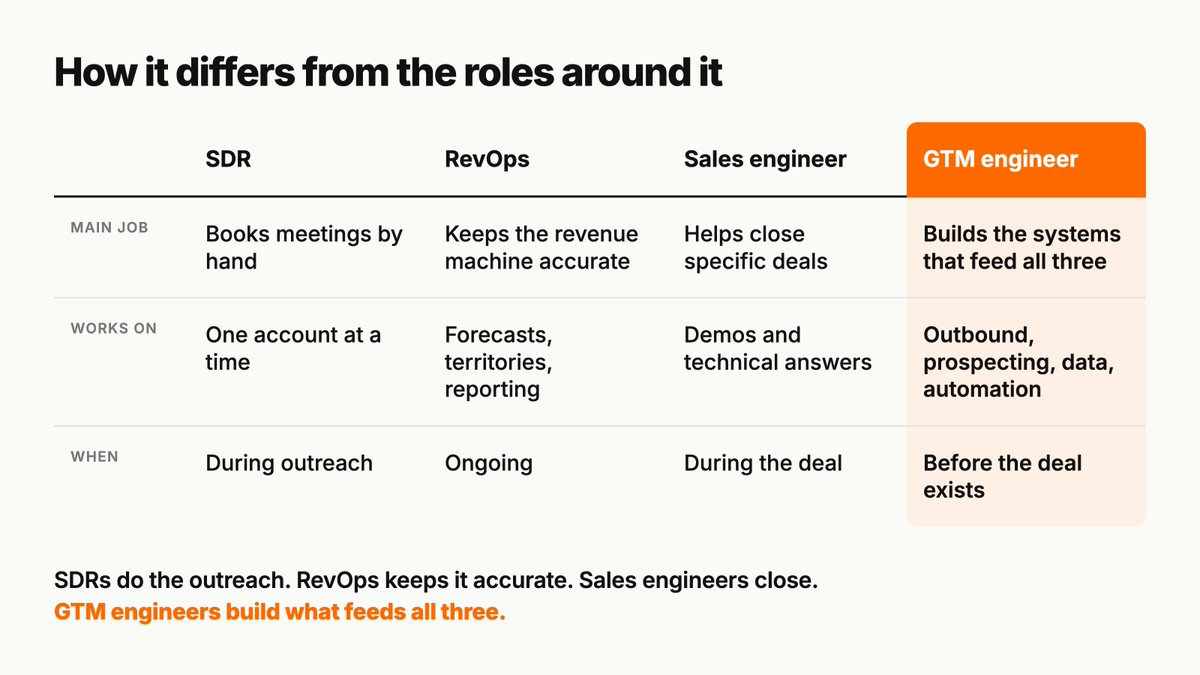
The overlap with RevOps is real, the difference is direction. RevOps keeps the machine accurate. A GTM engineer keeps building new parts for it, mostly around outbound and prospecting.
What a GTM engineer's day looks like
You might think that they are all playing around in Claude, and it's kinda true, but it goes a bit beyond that.
It consists of connecting APIs, creating workflows and automating everything they can.
Most of the job falls into four buckets.
-
Building workflows. They take something a rep does by hand, like researching an account, and turn it into a system that runs on its own.
-
Connecting the stack. CRM, data providers, email tools and AI agents all need to talk to each other. The GTM engineer is the person who wires them up.
-
Owning the data. Bad data breaks every workflow downstream. So they keep company and contact records complete and current.
-
Running experiments. A new signal, a new message, a new segment. They test it small, measure it and scale what works.
The output is always the same: reps spend their time talking to the right people, and the busywork runs in the background.
The full stack for GTM engineering
You could break down the stack of every GTM engineer into layers.
1. Data
This layer tells you who to talk to and what's going on at their company.
-
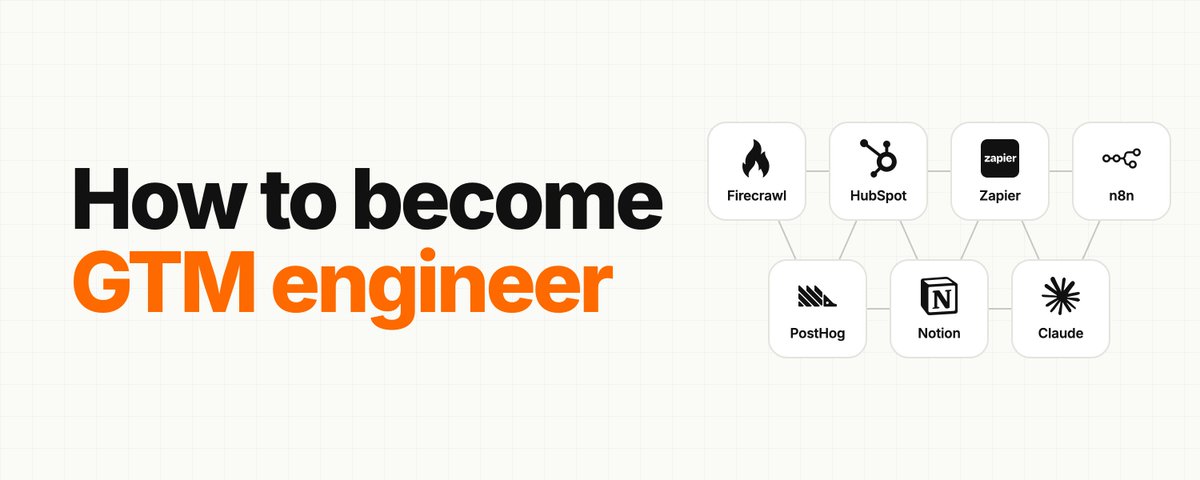
Apollo.io: a big database of contacts and companies, with work emails.
-
Firecrawl: web context. Turns websites like pricing pages, careers pages and changelogs into clean data.
-
Clay: enrichment. Pulls data from many providers into one place and fills the gaps.
2. Product signals
This layer tells you what people are actually doing inside your product.
- PostHog: product signals. Who signed up, what they used and when they're ready to talk to sales.
3. Orchestration
This layer moves data between tools and runs the logic.
-
Zapier: the easiest way to connect apps without code.
-
n8n: workflow automation for more technical teams, with more control.
4. System of record
This is where every account, contact and deal lives. Every workflow reads from it and writes back to it.
-
HubSpot: CRM. The most requested one in GTM engineer job posts, per Bloomberry.
-
Salesforce: the common pick at larger companies with complex sales teams.
5. Outreach and calls
This layer turns everything above into conversations.
-
Customer.io: emails. Sends messages triggered by what someone did in your product.
-
Gong: records and analyzes calls, so you learn what actually works.
6. Content and visibility
This layer gets you found before you ever reach out.
-
Ahrefs: SEO. Shows what people search for and where you rank.
-
Profound: GEO. Shows how AI answers like ChatGPT talk about you and your competitors.
7. Comms and playbooks
This layer keeps the team in sync.
-
Slack: comms and alerts. Where your workflows ping reps when a signal fires.
-
Notion: playbooks. Where you write down what each play does and why.
8. AI agents
This is the newest layer and the one changing fastest.
-
GrokBot: AI for research, writing and building workflows by just describing them.
-
Claude: AI Models to power workflows.
Main workflows GTM Engineers do
These are the plays I see most often. Each one is simple to explain and hard to do well.
1. The champion who changed jobs
Someone who loves your product leaves a customer and joins a company that doesn't use you yet.
A workflow catches the move, checks whether the new company is a fit and drafts a note for the rep.
The new company gets a warm intro from someone who already trusts you.
2. The job post signal
A company posts a job that shows it has the problem you solve. A new RevOps hire, a first SDR, a Head of Growth.
The workflow finds those posts, checks the company's website to confirm it's a fit and finds the people who'd buy.
The job post also tells you which tools the team already uses. That's your opening line.
3. Research before every call
Researching one account by hand means jumping between the CRM, funding databases and the company's own site.
A GTM engineer turns that into a chain of agents. One reads your own history with the account. One finds recent news and hiring. One maps who's involved in the decision. One drafts the email.
The rep types a company name and gets a brief back in minutes.
4. Inbound in minutes
Someone fills out a demo form, and the clock starts.
The workflow figures out who they are, scores the company, routes it to the right rep and drafts a reply.
The lead hears back while they're still thinking about the problem.
5. A CRM that cleans itself
Most CRMs are full of duplicates and old records.
A cleanup workflow merges duplicates, refreshes fields and flags contacts who left their company.
Nobody gets excited about this one. Every other workflow depends on it.
How AI agents are changing the role
Until recently, being a GTM engineer mostly meant building big spreadsheets of data and automations.
Now more of the job is directing AI agents.
You describe the play. The agent builds it, runs it and suggests changes based on what happened. You review and approve.
The best setups learn over time. Every email a rep edits and every reply that comes back teaches the system what good looks like.
The human part doesn't go away. Someone still has to decide what good looks like, which signals matter and when a play should stop.
Genspark's job post puts it well. It asks for "a fleet of narrow agents that each own one motion and one number."
I think that's where the role is heading.
How to become one
Bloomberry looked at GTM engineers' backgrounds. The most common path is SDR or BDR, then RevOps, startup generalists and marketing. Software engineers are the rarest.
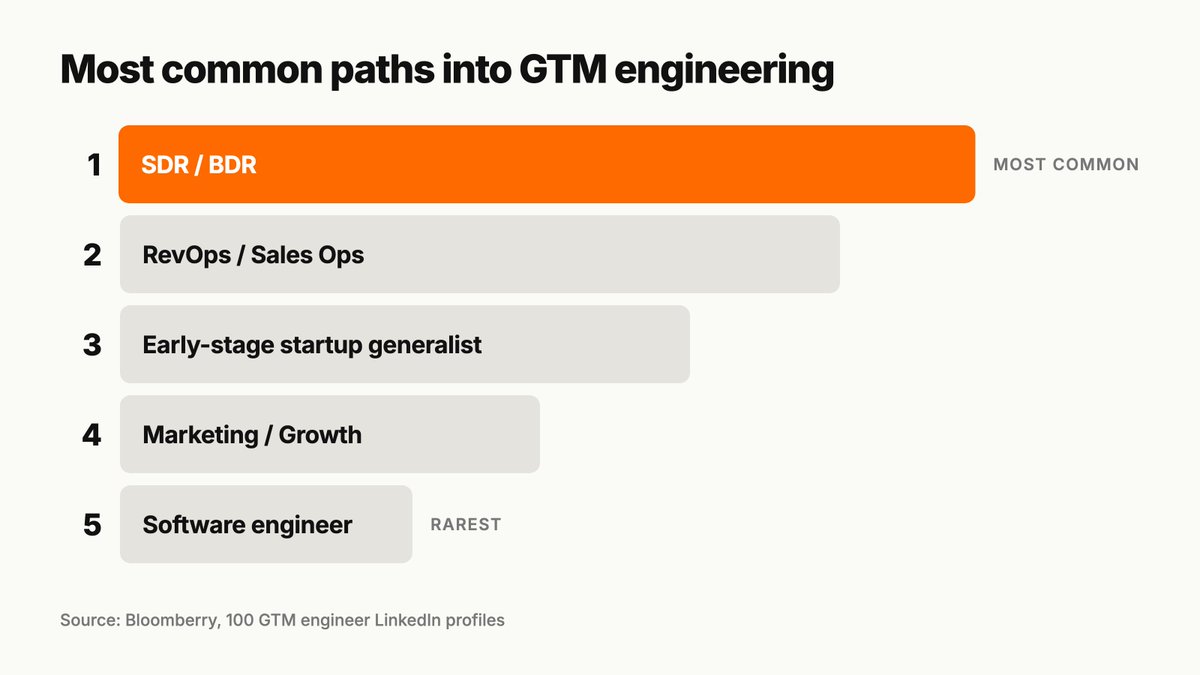
So you don't need to be an engineer. You need to be the person who gets annoyed doing something twice and automates it.
Learn one CRM well, one automation tool and enough SQL to ask your data questions. SQL and Python each show up in 38% of job posts.
What you waiting for?
You don't need the full stack to start.
Pick one workflow from this article. The inbound one is the easiest. Build it with the tools you already have, run it for a week and see what breaks.
That's what this jobs is about. Building, breaking, fixing, repeating.
I post about GTM engineering and AI agents every week. Follow me if you want more of this.
沿着这个主题继续读
从一篇文章,找到相关的教程、经验和阅读路径。