The Crypto End-game (Belief assets & Cashflow assets)
文章目录
Crypto’s token-launch game has been solved. The pumpfun pump-and-dump factories are automated. Every launch is bundled and fomo KOLs have perfected the art of dumping on side wallets. The average hold time is seconds.
The industry has become very efficient at creating tokens, but creating something durable and worth holding for more than a year is much more difficult.
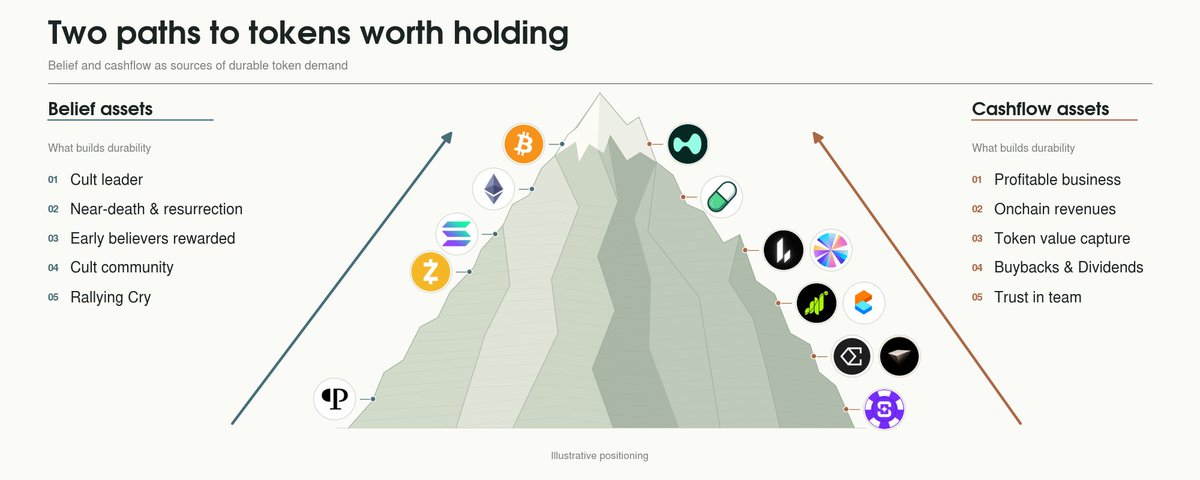
I find it useful to think about durable token demand along two dimensions: the strength of the belief supporting the asset and the credibility of the economic value accruing to its holders.
(need a better prompt to make visuals look less like AI slop)
Belief assets
These are assets with no cashflows which derive value from a common belief that they are worth something. They have value insofar as other people believe they have value. As a non-believer in Bitcoin, I will only buy BTC if I think enough people believe in it.
But what differentiates fleeting memes like WIF or BONK from a meme with permanence like BTC?
There are recurring features of durable belief assets¹:
-
A figurehead. A cult leader. BTC had Satoshi. ETH had Vitalik. SOL had Anatoly arguing with ETH maxis on twitter every day. HYPE has Jeff. Leaders of “belief assets” become larger than life. When the token is mentioned, this person’s name needs to pop up in your mind instantly.
-
A near-death moment and resurrection. BTC had Mt Gox. ETH had The DAO. SOL was intertwined with FTX, yet all of them came back from the dead. HYPE had the JellyJelly attack which dumped it to single digits as people questioned if it would cease to exist. Emerging from a near-death encounter sifts out all but the most devoted believers. This forms the base of your most hardcore believers.
-
Make your early believers rich. VERY rich. Number go up is the best BD and the people you make rich become your most ardent believers. BTC gave its early adopters a 200x in 2013-18. ETH did a 40x in 2020-22. SOL pulled a 100x too. HYPE did 30x with size and gave a fat airdrop to early believers.
-
A cult community with memes and a unique identifier. Even with monetary incentives, you still need memes to spread quickly. You need inside jokes so people feel like they belong to an exclusive club. You need people supporting the “greater cause” blindly because they feel like they belong. BTC had laser eyes, ETH had “.eth”, SOL had the “◎” / “.sol”. HYPE had the annoying “.hl” guys.
-
A one-liner rallying cry. You need a simple one-liner to spread your religion. BTC was “digital gold”. ETH was the “world computer”. SOL was the “ETH killer” or “decentralized NASDAQ”. HYPE is the “house of all finance”.
In recent times, ZEC comes close with (2) from the shielded pool vulnerability, (3) as it ran from $40 to $1200 in a year, and (5) as “Private bitcoin” or “quantum-proof bitcoin (soon)”.
These characteristics cannot be manufactured. You can’t just call your community a religion (super cringe). Within this category, I like PRL aka “AI bitcoin” as an early bet that it can develop the characteristics above.
There is a more straightforward way to climb up this mountain of durable tokens…
Cashflow assets
Cashflow assets are rare because (i) it’s much easier to market your token/narrative for exit liquidity than build a business with positive FCF, and (ii) if you actually have a cash-cow business that prints money and don’t need to raise money for growth, you save a lot of trouble by NOT launching a token and just pocketing the profits.
Teams that are printing money, like DexScreener, Axiom, Trojan, are happy directing 100% of profits to themselves. It was this way until Hyperliquid came along and showed that you can create a business with strong cashflows, where accruing value to the token could give you a better outcome than pocketing short-term profits.
The key questions here are:
- Economics: Is there durable economic surplus (profits)? HYPE and PUMP are the best examples here as they make $1-2m/day throughout the year.
Perp DEX revenues tend to be more sustainable and less cyclical especially after the introduction of equity perps. The durability of launchpad revenues tends to be questioned. The market has been right about PONS, STONK, and GP (BonkFun) revenues not being durable, but PUMP has been proving it wrong.
-
Transparency: Can that surplus be verified onchain? The most pristine revenues are fully on-chain, like HYPE and PUMP, as they require minimal trust. On the other hand, you have projects like GRASS where revenues are fully off-chain (private contracts with frontier labs), where the market questions if the revenues exist, though I’m sure they do.
-
Token vs Equity: How does that surplus benefit the token? Is there an equity entity siphoning value? This has been a subject of debate recently as Venice raised money on its equity while giving out free tokens. GRASS also had to clarify that all value goes to tokenholders.
The best counter-example is SHFL which is a great business that makes good revenues, but value accrues to the equity entity in Curacao, which received $18m in dividends, while tokenholders get an entry into a lottery².
-
Value capture: Does value accrue directly to the token through buybacks or dividends? Self-explanatory, but automatic buybacks and dividends (HYPE, LIT, SKY) are much better than discretionary buybacks (PUMP).
-
Trust: If distributions are deferred due to investing in growth, can the team be trusted? This is most similar to investing in startups. Tokens like GRASS, ENA, CHIP and CARDS sit here. They are explicit that value accrues to their token only, but they are investing in growth. It involves a lot of trust in the team as there aren’t legal protections for tokenholders and often not even a board or financial statements. Hence, something like the Blockworks’ TTF is helpful.
Demanding an early-stage project distribute all its surplus can undermine its ability to grow. But tokenholders have good reasons to prefer it. If they cannot establish how retained earnings will eventually benefit them, “investing in growth” is asking them to underwrite both the business and the team’s future willingness to share its success. Buybacks resolve part of that uncertainty today, and I commend CHIP’s recent improvement in clarity around token value accrual.
The golden examples here are HYPE, LIT, PUMP, and SKY. All four satisfy (1) through (5).
It is rare to find new tokens that tick all five boxes. PAPER was one of the best examples in recent history, as it could plausibly generate substantial revenue³. Unfortunately they scrapped the token because it created an incentive to exploit the exchange.
I think this category is ripe for innovation. HYPE pioneered the idea of a highly value-accretive token. PAPER gave folks a taste of what it could have been. Imagine launching a high-revenue business like Polymarket (makes ~$20m a month) and accruing all the value to a token⁴.
In fact, the Shuffle team have been talking about launching a fully on-chain casino. If such a casino existed and 90% of net gaming revenues go back to buying the token every day, that’d put SHFL all the way at the top of the list. Buying tokens near the bottom of the list is just a bet that the team will move upwards.
Looking ahead, I am eyeing the launch of Perp DEX tokens like VAR (Variational) and XTEN (Extended). Other projects worth noting include exchanges like ARCUS, ENTROPY, and POLYMARKET (if they ever TGE). If you are keen to build here, hit my DMs.
Conclusion
There are only two ways to become a durable, multi-cycle asset. BTC, ZEC, and HYPE achieved that by climbing on the “belief side”, while HYPE, LIT, and PUMP are climbing via the right side.
Across all assets, HYPE is the most comfortable hold, as it both is really strong as a cashflow asset with the potential of becoming a durable belief asset.
Many other tokens try and climb the mountain but fail, including new L1 tokens (game is overplayed now) and boomer DeFi tokens with little revenue and little to no value accrual. Narrative trades like AI try again and again to climb up the left side of the mountain, but gravity prevails.
Marked safe from AI slop:
(AI used for the visual)
1 I first wrote about this in “Religion as a Framework for Blockchains” back in Jan 2024, 10 months before HYPE’s TGE. But have since found that HYPE fits all of the criteria for a “belief asset”, even though it is also a cashflow asset.
2 30% of net gaming revenue earned via SHFL is burnt (only IF bettors are betting with SHFL, which represents a small % of revenues). $18M in dividends was declared as per the linked financials, and confirmed by someone close to the team.
3 Rollbit Perps is still making ~$18M/yr on their 1000x perps product. I expected Papertrade to be able to grow to >5x the size of Rollbit, hence ~$100m a year of revenues.
4 Hyperliquid. HIP-4. kek