How I Turned 0.5 SOL Into $100,000 in Under 30 Days

文章目录
Why keeping a small bankroll—and being a top-500 League of Legends player—changed the way I approached memecoin trading
I turned 0.5 SOL into roughly $100,000 in 30 days.
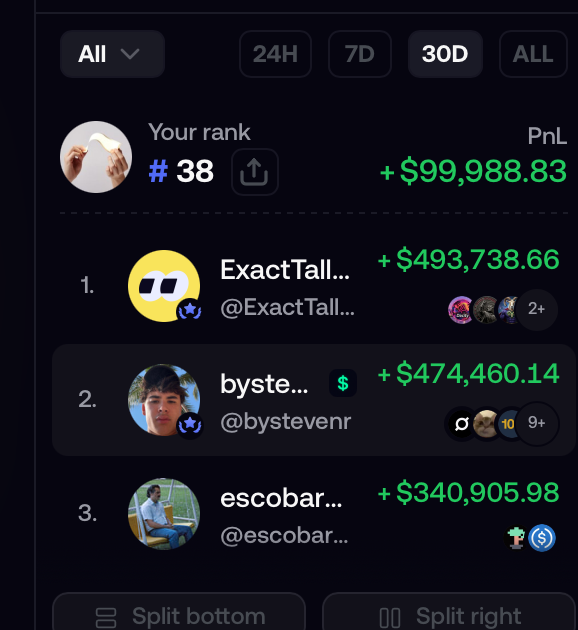
I finished the run ranked #38 on Fomo with +$99,988.83 in 30-day PnL.
I also did it on a completely fresh account. I started with zero followers, no established influence and no existing audience to push my positions. There was no community waiting to copy my trades and no personal brand creating attention for the coins I entered.
Everything had to begin with the decisions I made using that 0.5 SOL.
But the part I want to talk about is not only the money. It is the mindset behind it.
Throughout the run, I intentionally avoided leaving a large amount of money in my trading account. Even as I made more, I kept withdrawing and returning to a smaller active bankroll.
My goal was not to become a trader who needed $50,000 sitting in an account to make $1,000. I wanted to become genuinely good at creating opportunities with limited capital.
And a surprising amount of that mentality came from something completely unrelated to crypto: becoming a top-500 League of Legends player.
The short version
There was no single magic indicator or secret group responsible for the run.
The framework was straightforward:
-
Keep the active bankroll intentionally limited.
-
Start without depending on followers, influence or an existing audience.
-
Follow attention before it becomes obvious on the chart.
-
Take trades where the potential reward justified the risk.
-
Do not confuse a lucky outcome with a good decision.
-
Withdraw profits instead of automatically risking everything again.
-
Journal the wins, losses and thought process publicly.
-
Preserve enough capital and mental energy for the next opportunity.
The result was extreme. The process underneath it was much less glamorous: observe, wait, act, protect the win and reset.
Why I Kept My Trading Account Small
Another thing I did was intentionally avoid keeping large amounts of money in my trading account.
Even when I started making serious profits, I would move money out because I wanted to challenge myself to turn small amounts into large amounts.
I did not want to become dependent on having a massive bankroll to make money.
It is similar to League. A genuinely skilled player does not need to be massively ahead in gold to create an advantage. They understand how to make the most of the resources they have.
I wanted to develop that same ability in trading.
For me, it was about sharpening my decision-making rather than relying on bigger position sizes. Obviously, growing small amounts quickly comes with significant risk, but that was the mentality behind my approach.
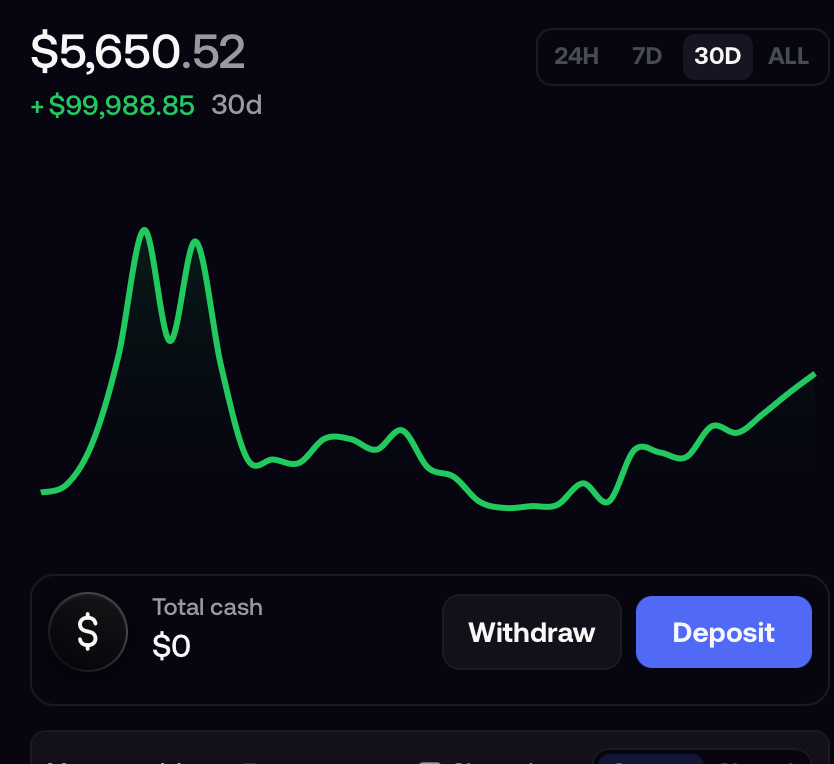
Thirty-day PnL: +$99,988.85. Total cash left on Fomo: $0. I was not trying to grow a screenshot—I was withdrawing profits and repeatedly testing whether I could rebuild from a smaller bankroll.
What League of Legends taught me
People underestimate how much high-level competitive gaming can change the way you process information.
In League, I was constantly watching the map, tracking cooldowns, managing resources, anticipating rotations and deciding whether a fight was worth taking. I could not focus only on what was directly in front of my character. I had to understand the entire state of the game.
Eventually, that style of decision-making became automatic.
When I began trading memecoins, I realized that a surprising amount of it transferred.
The chart was only one lane. I also needed to watch attention, liquidity, narratives, wallet behavior and broader market conditions. A token could look strong in isolation while everything around it said the opportunity was already finished.
League did not give me a magical ability to predict markets. It trained me to make decisions in a competitive environment where information is incomplete, resources are limited and conditions change quickly.
League players versus Fortnite players
This will probably upset somebody, but I think the games emphasize different kinds of thinking.
Fortnite heavily rewards mechanics, reaction time, positioning and fast execution. Competitive Fortnite obviously has real strategic depth, but the action frequently demands that you solve the immediate fight with your hands.
League rewards mechanics too, but at a high level the game revolves around macro: understanding the map, recognizing temporary advantages, predicting movements and deciding whether a fight should happen at all.
Fortnite can train you to win the fight in front of you. League trained me to think about the map surrounding the fight.
That difference mattered in memecoins.
Anyone can click Buy. The harder skill is knowing when you should—and when doing absolutely nothing is the better decision.
Stop taking every fight
One of the easiest ways to recognize a lower-elo League player is by watching how often they take unnecessary fights.
An enemy appears on the screen and they immediately go in. They do not check whether teammates are nearby. They do not track cooldowns or the enemy jungler. They react first and think later.
Memecoin traders do the same thing.
They see a green candle, a ticker appearing repeatedly on the timeline or somebody posting a massive gain. The fear of missing out takes over and they buy without asking whether the opportunity still exists.
But a trade being available does not make it a good trade.
I did not need to take every fight. I needed to take the ones where I believed the odds justified the risk.
Missing a coin costs nothing. Forcing a bad trade does.
Learning to read the map
At high elo, the minimap is almost as important as what is happening directly in front of you. It shows where pressure is building, where players are rotating and where the next opportunity may appear.
Memecoin trading has its own minimap.
Instead of watching the enemy jungle, I watched liquidity. Instead of tracking objectives, I tracked narratives. Instead of anticipating a rotation toward Baron, I paid attention to where traders and attention were moving next.
Before entering, I wanted context:
-
Is the idea understandable in one sentence?
-
Is attention accelerating or already exhausted?
-
Are buyers continuing to participate?
-
Is the volume sustainable?
-
Are larger wallets accumulating or distributing?
-
Does the broader market support risk-taking?
-
What specifically invalidates the trade?
A chart without context can tell a convincing lie.
Tempo is everything
League players understand tempo. Certain opportunities only exist for a short period.
Maybe the enemy jungler appears on the opposite side of the map. Maybe an important cooldown has been used. Maybe your team has a temporary numbers advantage. The window opens, you evaluate it and then it closes.
Memecoins work the same way.
There are moments when narrative, attention and liquidity align. If I recognize that alignment early, the trade may offer real asymmetry. If I arrive after the coin has already moved several hundred percent and everybody is celebrating, the same ticker can represent a completely different trade.
Sometimes I was early. Sometimes I was late. Sometimes the highest-quality decision was to watch without participating.
Speed mattered, but preparation created the speed. Watching recurring narratives, communities and market behavior meant I was not beginning my research from zero when an opportunity appeared.
A profitable mistake is still a mistake
In League, you can make an objectively terrible play and still be rewarded.
Maybe you take a horrible fight and somehow get a triple kill. The outcome was positive, but the decision was still bad. Repeating it will eventually punish you.
Trading is no different.
Somebody can ape into a random token, make 20x and immediately believe they discovered a repeatable system. But one lucky result says very little about the quality of their thinking.
I tried not to judge a trade solely by whether it made money. I wanted to know whether the original reasoning was sound, whether the entry made sense with the information available and whether I respected the amount I was willing to lose.
A profitable mistake is still a mistake. A well-reasoned trade can still lose. The process becomes visible only across a large sample of decisions.
Tilt destroys bankrolls
Anyone who has seriously climbed ranked understands tilt.
You lose a game you should have won. A teammate makes an unbelievable mistake. You become desperate to recover the LP immediately, so you queue again while emotional and begin making decisions you normally would not make.
Trading has the same trap.
You lose one trade, enter another to make the money back and then increase your size because you want to recover faster. The previous trade begins controlling the next one.
I had to learn that emotional control was as important as finding opportunities. A loss could not become permission to abandon the process.
You cannot let your last trade determine your next trade.
Know when to reset
Reset timing is fundamental in League.
You do not remain on the map indefinitely simply because you are winning. You take the advantage, buy your items and prepare for the next play. Staying too long can turn a winning position into a donation.
That is how I approached profits.
I did not need to sell the exact top or squeeze every dollar from every move. Taking money out of the active bankroll was part of completing the trade.
There is a major difference between making money on a screen and actually keeping it.
Withdrawing also protected me from the confidence that follows a large win. Instead of allowing one successful trade to justify reckless size on the next, I could reset and ask the same question again:
Can I create another advantage without depending on the money I already made?
Understand the win condition
Every League game has a win condition.
Sometimes the team needs to play around a scaling carry. Sometimes it needs to dominate early. Sometimes the correct plan is to avoid fights until a specific power spike. If you do not understand the win condition, you are playing without a plan.
I wanted the same clarity before entering a trade.
Was it a short-term momentum opportunity? Was I expecting a narrative to gain traction? What would prove me wrong? Where would I begin taking profit? How much could I lose without affecting my ability to take the next opportunity?
If I could not explain what I was trying to accomplish, I had no reason to enter.
What the result does—and does not—mean
Starting with 0.5 SOL matters because I did not want to become dependent on constantly adding more capital.
But nobody should look at this result and assume that depositing 0.5 SOL normally leads to six figures. It does not.
Turning a small bankroll into roughly $100,000 within 30 days is an extraordinary outcome produced in an extremely volatile market. Most memecoins lose value, and losses can be total. Screenshots rarely show every drawdown, missed opportunity or emotional decision behind a successful run.
The useful part of the story is not the expectation that somebody else can reproduce the number. It is the idea that capital size and decision quality are not the same thing.
I did not want to become the person who could make money only because they already had a lot of money.
I wanted to become the person who understood how to work with limited resources—how to identify advantages, choose the right fights, control emotion, take profit and reset.
Final thoughts
Most people enter memecoins looking for the next 100x. They spend all their time asking what to buy and almost none asking why they are buying, what they are risking, when they are wrong or when they should leave.
Being top 500 in League taught me that the smartest play is not always the most aggressive one.
Sometimes the correct move is to fight.
Sometimes it is to reset.
Sometimes it is to walk away.
I did not want to become good at trading because I had a large bankroll. I wanted to become good enough at trading that I did not need one.
That is the mindset behind my journey from 0.5 SOL to roughly $100,000 in 30 days.
Follow the public journal: @OLedsed on X
View my profile: OLedsed on Fomo
This is my personal experience, not financial advice. Memecoin trading is highly speculative and losses can be total. The approximately $100,000 figure is the rounded version of the displayed 30-day PnL of $99,988.83.