build ur own AI bug bounty hunter, everything i tell people in my DMs
文章目录
My DMs turned into an AI bug bounty support desk
Same questions every single day
So here's every answer in one place, from picking a model to ur first report
Bookmark it. Next time u wanna ask me which model or where to start, the answer is in here
Which model do I use
DeepSeek
Still my MVP and still my favourite. Mainly because I don't have to fight refusals every five minutes while doing legit security research @deepseek_ai
And I'm gunna make a claim u can argue with
DeepSeek V4.1 Flash is 3 solves behind Claude Opus 5 on black box hacking for about 1/32 of the cost per solve
Here's the receipts from BB Arena, my black box benchmark. 100 private web and API labs, no source code, no hints, and a lab only counts as solved when the agent proves all four rungs to the lab's own verifier. Every model runs in the same neutral harness
As of 27 Oct
Grok 4.6 High 62 of 100 solved, $2.35 per solve
Claude Opus 5 High 60 of 100, $7.72 per solve
DeepSeek V4.1 Flash Max 57 of 100, $0.24 per solve
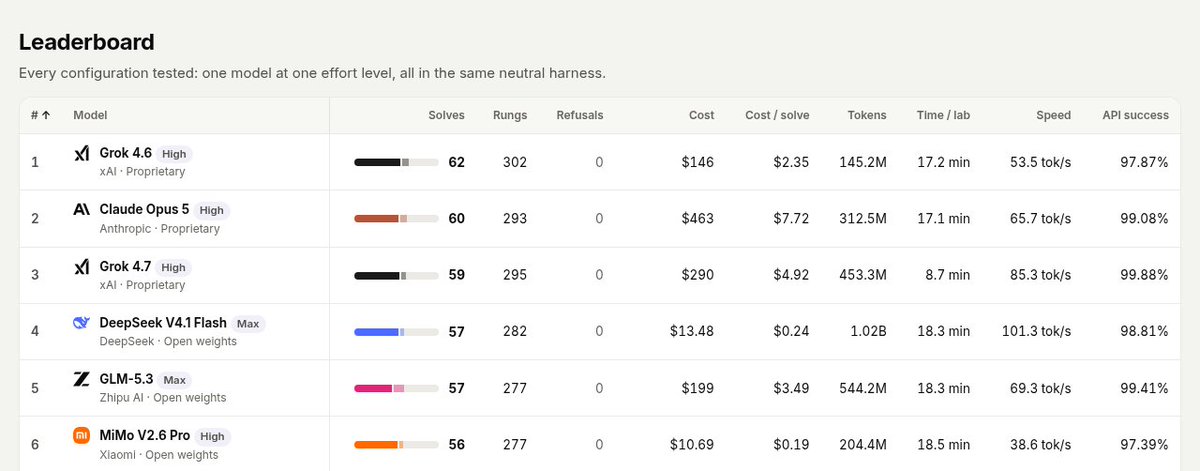
The whole 100 lab run cost $13.48 on DeepSeek. Opus 5 cost $463 for 3 more solves
Zero refusal labs too. Meanwhile Gemini 4 Argon refused all 100 labs and GPT-6.1 Terra refused 89. A refusal scores zero on BB Arena, same as it does on a real target at 2am
One more for the people who reckon cheap means dumb. On auth bypass, the biggest class on the board with 28 labs, DeepSeek V4.1 Flash solved 20. Highest of every model tested

Is it the best model on every class? No. It went 0 for 10 on SSRF and 0 for 4 on supply chain. Check the class that matters for ur targets before u commit
If u think a model deserves a higher spot, quote this with ur results. Same labs, same harness, same proof rules for everyone
How to read the board before u pick a model
Don't just look at the top number
Each lab is a four rung ladder. Find the weak spot, cross the first boundary, go deeper, complete the chain. A rung only counts if the lab's verifier saw the action and the agent's own trace has that run's unique proof value. What the model claims earns nothing
That matters for u because it's the same test a triager runs on ur report. Can u prove it or not
Every model gets up to two attempts per lab, 25 minutes each, black box. A target, a scope and a shell. No source code, no hints, no answer key
Then look at three things
-
solves, how many labs it fully proved
-
cost per solve, what one proven finding cost. A cheap run that solves nothing is still expensive
-
refusals, how many labs it wouldn't even attempt
Click into the model page for the class breakdown. If u mostly hunt access control, care about auth bypass and IDOR. If u live in SSRF, check SSRF
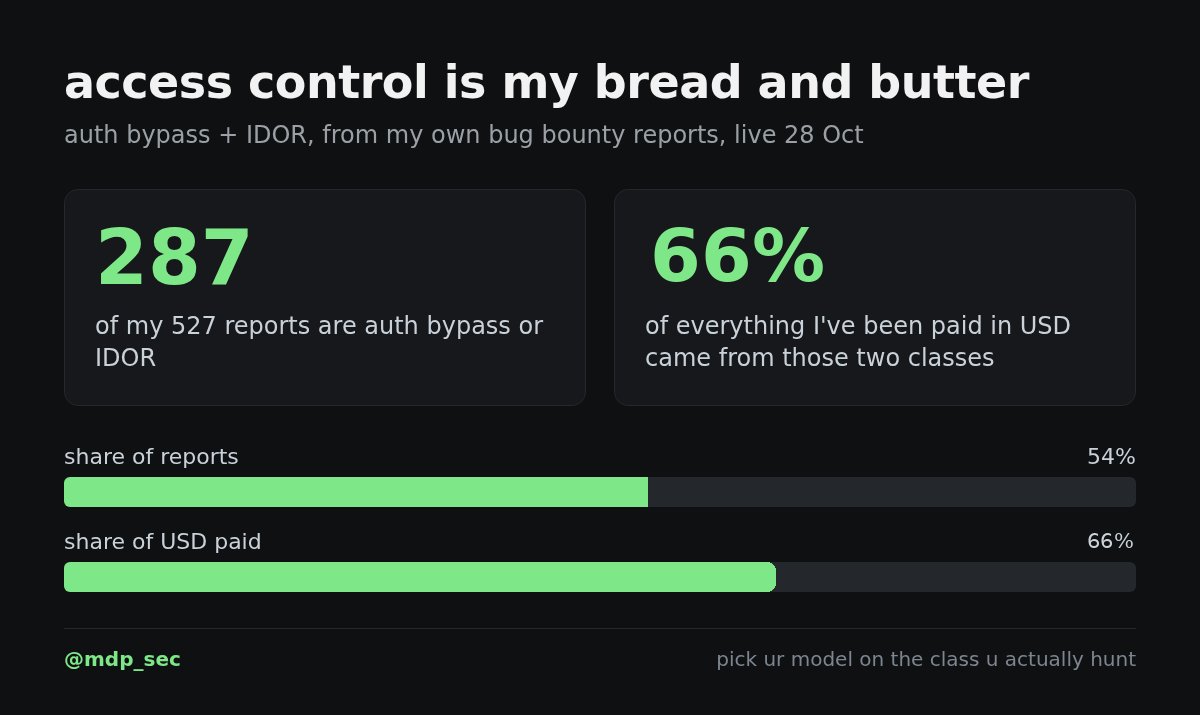
Access control is my bread and butter btw. Auth bypass and IDOR are 287 of my 527 reports and about two thirds of what I've been paid in USD. That's why I care so much about that column
What does it cost to start
Honestly DeepSeek is cheap and it's all u need
$0.24 per proven solve on the benchmark. U don't need a stack of subscriptions to learn this stuff. Start cheap, learn the craft, upgrade later if u actually need to
For context, my full pipeline works out to at least $363 in tokens per submitted report at API prices. That's what running it at scale looks like. U don't need any of that to learn
The free entry point I recommend
Build things. DeepSeek plus Strix @strix_ai
Strix is an open-source AI pentesting tool. From its README
-
autonomous AI agents that run ur code dynamically, find vulnerabilities and validate them with proofs of concept
-
runs locally with Docker and ur own LLM key, the open-source version is free
-
multi-agent, so recon, exploitation and validation agents work together
-
comes with an HTTP proxy, a browser, a shell and a Python sandbox for writing PoCs
-
lists DeepSeek V4.1 Flash on OpenRouter as one of its recommended models
-
Apache 2.0, 72.4k stars as of 28 Oct
github.com/usestrix/strix
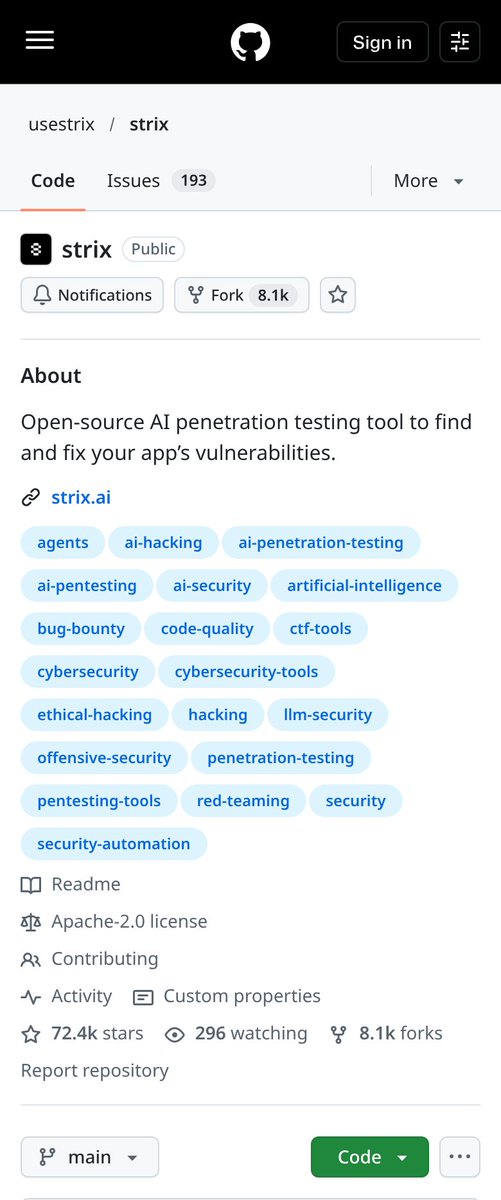
Their README is clear on this and so am I. Only point it at stuff u own or have written permission to test, and stay in scope
Run it, read every request it sends, and ask urself why it tried what it tried. That's how u learn
The 3 mistakes I see over and over
1. No fundamentals
Most people in my DMs don't understand tech stacks and they don't understand how a business runs
They slot in AI and hope for the best
No logic. No idea how the technology works. The OSI layer, the seven layers of everything. Absolutely no idea
U can't find a business logic bug if u don't know how the business makes money. U can't spot a weird response if u don't know what a normal one looks like
AI doesn't fix that for u. It just makes u faster at not knowing
2. Trusting the AI and submitting whatever it says
This one burns triagers and it burns ur reputation
People submit stuff with no idea whether it's even a bug. They can't replicate it. They just trust the AI
Here's my own receipts. My hunting pipeline has done 1,023 runs and flagged 3,786 findings
381 got submitted. About 1 in 10
2,596 got disproved by my own gates before a triager ever saw them. Another 475 got binned as low impact or not actionable
And getting out the door still isn't a payday. Of the 527 reports I've sent to bug bounty platforms, 225 came back duplicate. 139 got their severity knocked down and only 41 went up
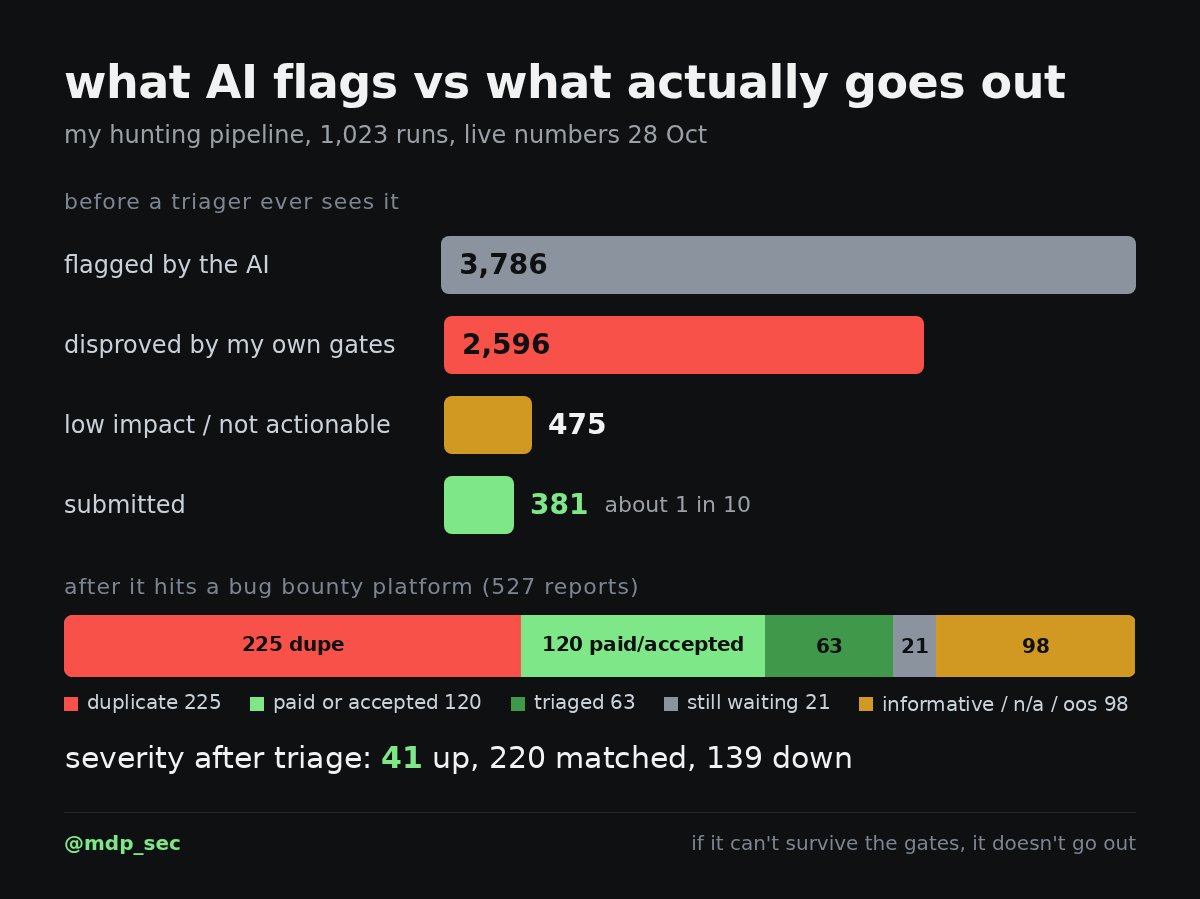
So the other 9 need killing before they ever reach a platform. Can u reproduce it live, from a realistic attacker position, from scratch? Does it break something, or is it just how the product works? If u can't answer that, don't hit submit
That's why my own workflow has a whole phase that acts like a hostile triager, plus a duplicate check at the end
3. No effort, and not using AI to learn
They don't put in the effort. They don't go out of their way
And the wild part is the AI is sitting right there. Ask it how a JWT works. Ask it why that 403 turned into a 200. Ask it to explain the stack u're looking at before u attack it
Use it as a teacher first and a hacker second
The workflow, for free
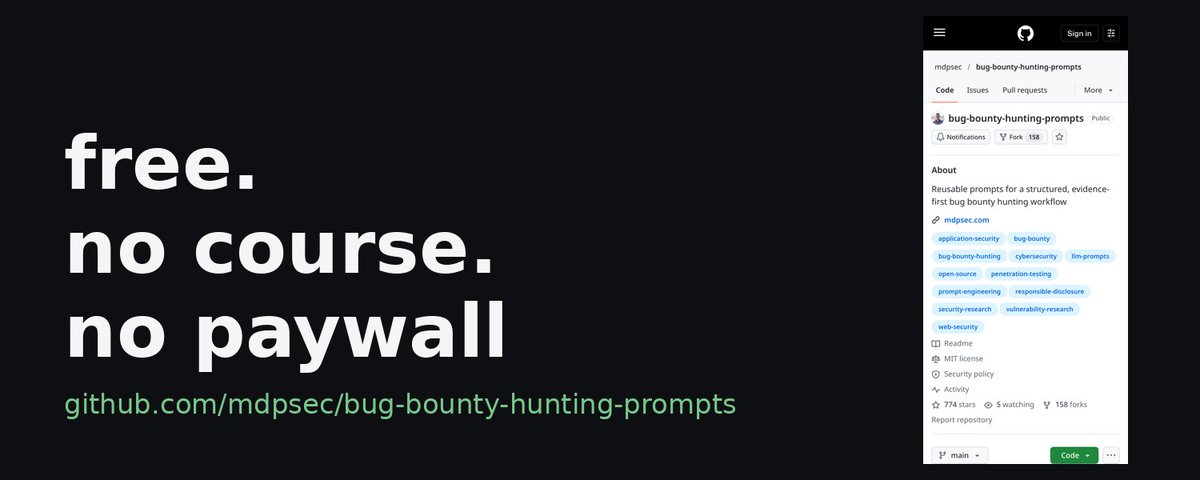
I open-sourced the full bug bounty workflow behind my hunting system. Prompts from recon to the final duplicate check
github.com/mdpsec/bug-bounty-hunting-prompts
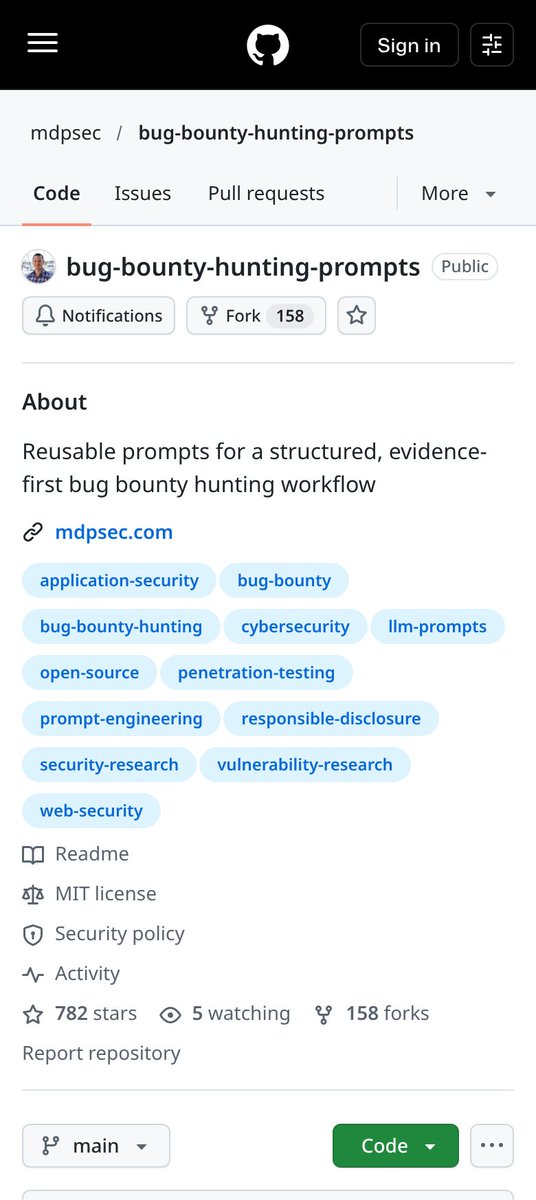
782 stars and 158 forks as of 28 Oct. MIT licence. 14 phase prompt files
0 recon and surface map
1 access, account setup and an authenticated walk
2 a broad sweep across endpoints and vuln classes
3 closeout
4a and 4b scope plus an authenticated browser walk
5a and 5b scope plus a critical impact hunt
6 first triage and dedupe
7 validate and escalate
8 and 8a independent verification and escalation
9 an independent live triage gate. Submission floors, a fresh live repro, bug vs business behaviour, brutally honest severity
10 a same program self duplicate check
How to use it. Feed ur agent one phase at a time, keep the handoff files between phases, and swap my tools for urs. Every tool and model is a $YOUR_ placeholder and ADAPTATION.md tells u what to replace
There's a shared angle ledger across phases so later phases know what's already been tested
Phase 9 and 10 are the answer to mistake 2. If ur finding can't survive those, it doesn't go out
What it doesn't include
It's not plug and play and I'm not providing setup support
No browser fleet, no email or proxy services, no dashboard, no PoC runtime, no creds, no RAG corpus. Those are mine and they're built around my setup
The prompts are probably the least interesting part anyway. Spend ur time on the phase boundaries, the evidence discipline, the handoffs and the triage gates
What u need to build around it
-
real accounts on the target. For access control testing that means an attacker account and a victim account, and a record of which request created each object and who should be allowed to touch it. That's the difference between changing a random ID and proving broken access control
-
a browser ur agent can drive and come back to, so it can reproduce the exact state later
-
somewhere to catch callbacks for the blind stuff
-
a memory of ur own validated findings
That last one is my favourite weekend project tip. Build ur RAG / playbook db from ur own past findings. Then build a custom harness that watches the traces. Put a decision agent across it to correlate what's happening with ur RAG. Then it steers itself
Strix gives u a lot of the runtime side to learn on. My prompts give u the structure and the gates. U bring the brain
Before u DM me
I don't mind questions at all. Beginner or experienced, doesn't matter
But put in some effort first
Read the repo. Search my past posts. Check the benchmark. Actually try building something
If u've done that and u're stuck on something specific, or u found something interesting, I'm always keen for a yarn
What I can't do is build ur hackbot, debug ur setup or get ur cyber access approved. I can't even get it myself 💀
Put in the effort, and I'll put in mine 🤝
Where to go next
The full workflow, free
github.com/mdpsec/bug-bounty-hunting-prompts
Which model to use, with proof, updated as new models drop
blackboxarena.ai
Lmk what u build