How to Make Money on 𝕏 with Grok Bot (REAL GUIDE)

文章目录
Big audience or zero followers, expert or complete beginner. You can make money with Grok Bot.
There are six realistic ways to make money with Grok Bot through 𝕏, and I haven't seen anyone talk about even one of them.
Note: I don't have anything to sell you. All I ask is that if you enjoy today's content, you like, repost, and follow me. I put a lot of effort into producing original content like this, and would appreciate it.
In today's article:
-
Growing & Funneling an Audience: The best path to make serious money. Expand your audience and sell your existing products/service by leveraging Grok Bot.
-
Lead Generation: Using Bot to find qualified leads for an existing offer.
-
Landing Sponsors: Regardless of your account size, I'll show you how to land real, paying sponsorships.
-
Grok Bot Consulting: How to make money from Grok Bot as a service (nobody is doing this).
-
Building an Offer From Zero: How to use Bots to build a sticky product from zero with your existing skills
-
Getting Hired: How to land job opportunities with Bot.
This article has something for everyone.
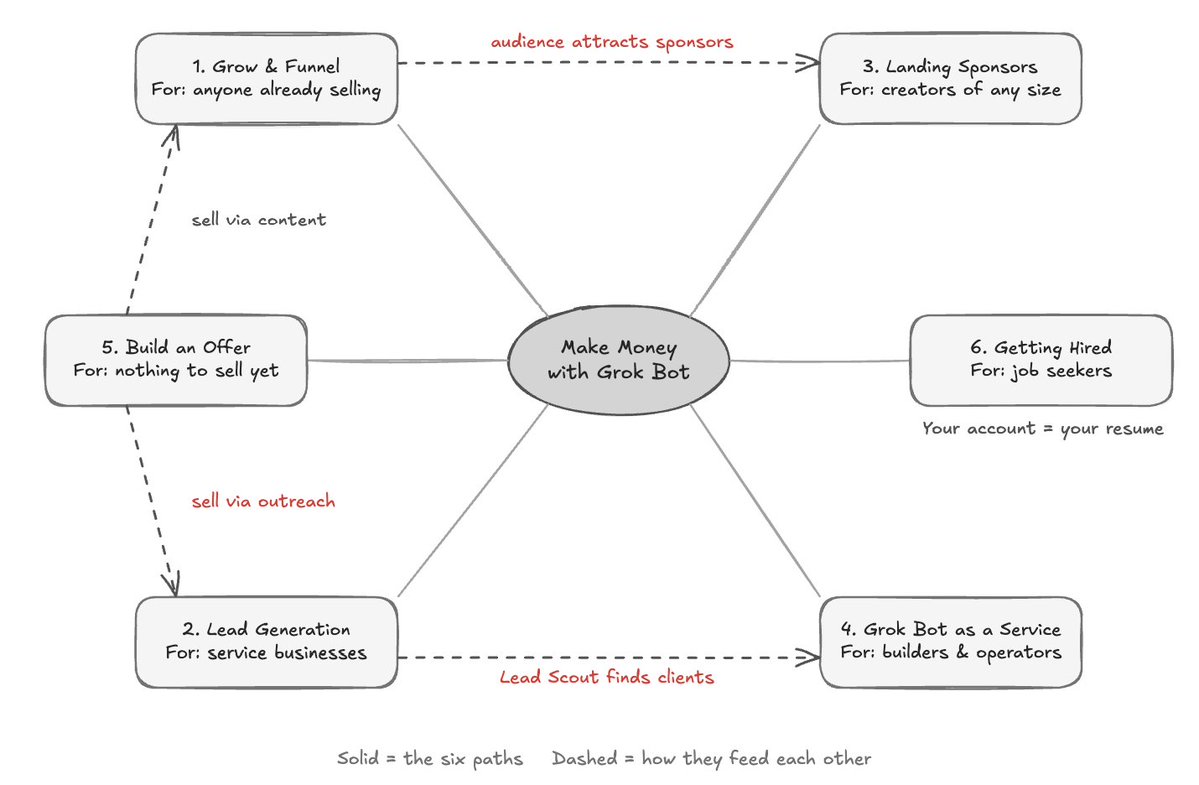
Summary
Tip: Just tag your @bot in the comments and have it digest this entire article.
Path One: Growing & Funneling an Audience
This is the best path to make serious money on 𝕏, and it's the foundation for every other path in this article.
For: Those with an existing product/service who want warm inbound through organic content.
There are two pieces here:
-
Growing an audience
-
Converting that audience
I already broke down the first piece (my viral 11-bot content system) in the article below, so I won't repeat it here, but it's worth a read:
Below, we'll focus on the second piece: turning content into money.
This is for people who are already selling something and need to increase sales.
If you have nothing to sell, I cover building offers in Path #5.
Step 1: Map your content funnel
The high-level architecture of your sales funnel.
Not every post should sell. Most should grow and build trust, and a few should convert. Grok Bot can help you build a proper conversion funnel.
A good starting mix:
TOF ~60% of posts (reach)
MOF ~30% of posts (trust)
BOF ~10% of posts (sales)
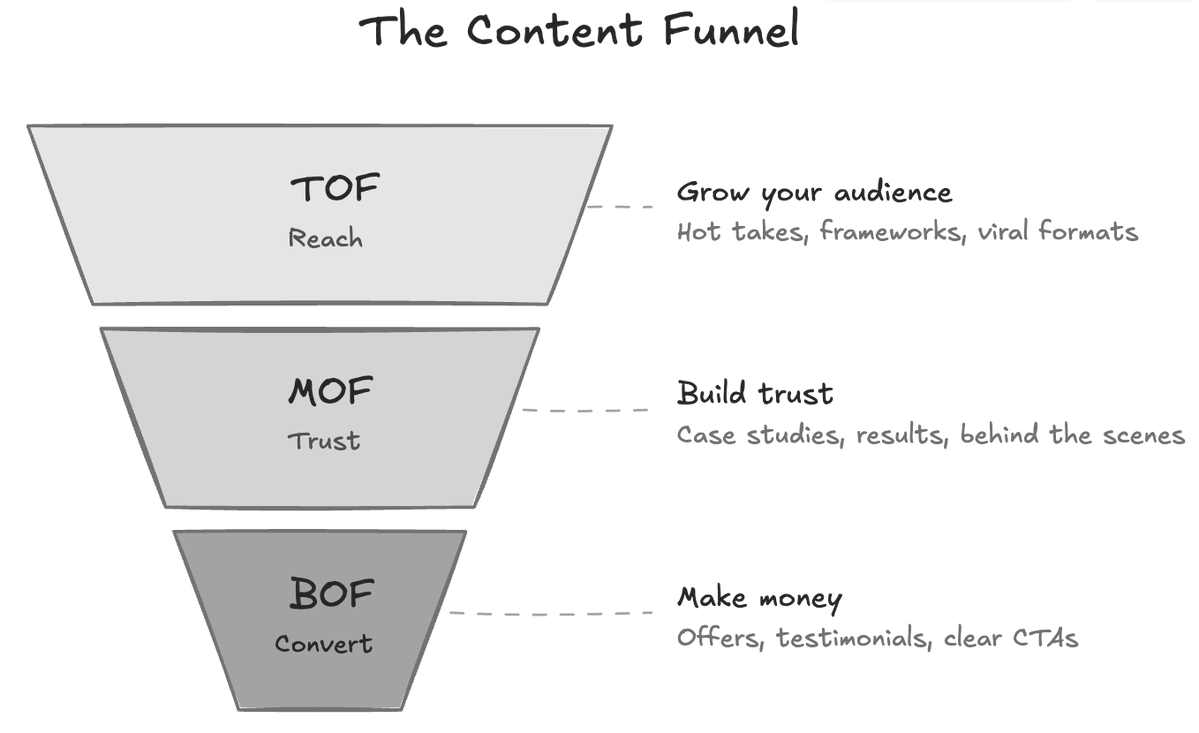
Content Funnels 101
This prompt identifies your TOF/MOF/BOF content pillars, and Bot helps you build higher-converting content:
"Using my brief, pillars and recent posts, map my content to a funnel. Tell me what % of my posts are TOF, MOF and BOF, what's missing, and give me a weekly posting mix that grows my audience while driving people to [product/service]."
Step 2: Creating content that sells
These should be your core MOF/BOF content pillars:
-
Case studies: "How I helped [client] go from X to Y"
-
Results: screenshots, numbers, before and afters
-
Behind the scenes: how you actually fulfil/build the product
-
Frameworks: your process, packaged so people want help applying it
-
Lessons: mistakes you made so your audience doesn't have to
"Using my results, client wins and experience, give me 10 MOF/BOF post ideas that prove I can deliver [outcome]. Focus on case studies, results and behind the scenes. Match my voice doc."
Step 3: Creating a high-converting profile
Your 𝕏 profile is your sales page.
This prompt tells Bot to conduct a deep audit of your profile and optimize it for the highest possible conversion rate for [your product].
"Audit my 𝕏 profile like a conversion expert. Review my bio, pinned post, banner and link. Tell me what's unclear, what's missing, and rewrite each one to drive people to [product/service]."
Step 4: Optimizing CTAs
You don't need to hard sell. A simple line at the end of your best posts goes a long way:
-
"I break this down in more depth in my newsletter (link in bio)."
-
"DM me 'system' and I'll send you the template."
-
"We help brands do this. Link in bio."
These CTAs push your audience through the funnel - people need clear next steps.
Grok Bot can reverse-engineer sticky CTAs for your brand and niche based on what is working for other creators:
For any post I send you, suggest 3 soft CTAs that point to [product/service] without sounding salesy. Match my voice doc.
Step 5: Tracking what converts (iteration loops)
In my Head of Content Grok Bot article, I suggest creating an "Analytics Analyzer" Bot.
To take it a step further, you can send this prompt to train your Bot on what converts through profile visits, link clicks, DMs, etc.
Prompt:
Each week, report which posts drove the most profile visits, link clicks, DMs and new followers. Flag the topics and formats that convert best so I can make more of them.
TL;DR of Path One:
-
Grow an audience (build a viral content team with Grok Bot)
-
Leverage Bot to create a high-converting funnel for your existing product
Path Two: Lead Generation
This is the fastest and most straightforward path to money on 𝕏. Essentially, using Bot to run a qualified outreach system.
For: Those with an existing product/service who need customers now.
Most people do lead gen manually. Bot is surprisingly good at sourcing qualified leads - especially since it can plug directly into 𝕏.
Step 1: Define a qualified lead
Spend a few minutes telling Bot what a qualified lead looks like. Even better if you can attach Emails/prospect briefs.
Prompt:
"Using my brief and services, define my ideal client: industry, account size, stage, budget signals, and the specific problems I solve for them. Then list the signals on 𝕏 that show someone is a good lead right now."
Step 2: Build a Lead Scout Bot
This agent will hunt your defined ICP.
"You're my Lead Scout. Every day, search 𝕏 for people who match my ideal client and show buying signals: hiring posts, people asking for help with [service], founders who just raised or launched, and accounts with strong products but weak content. Find 10 leads, explain why each one is a fit, and score them 1 to 10. Send the list to my Chief of Staff by [time]."
Step 3: Draft the outreach
You have a couple of options here:
-
Deploy a draft-writer Bot
-
Write messages yourself
I recommend creating the template outline manually (to avoid AI slop), then having the Bot fill in the message, and you approve/send it manually.
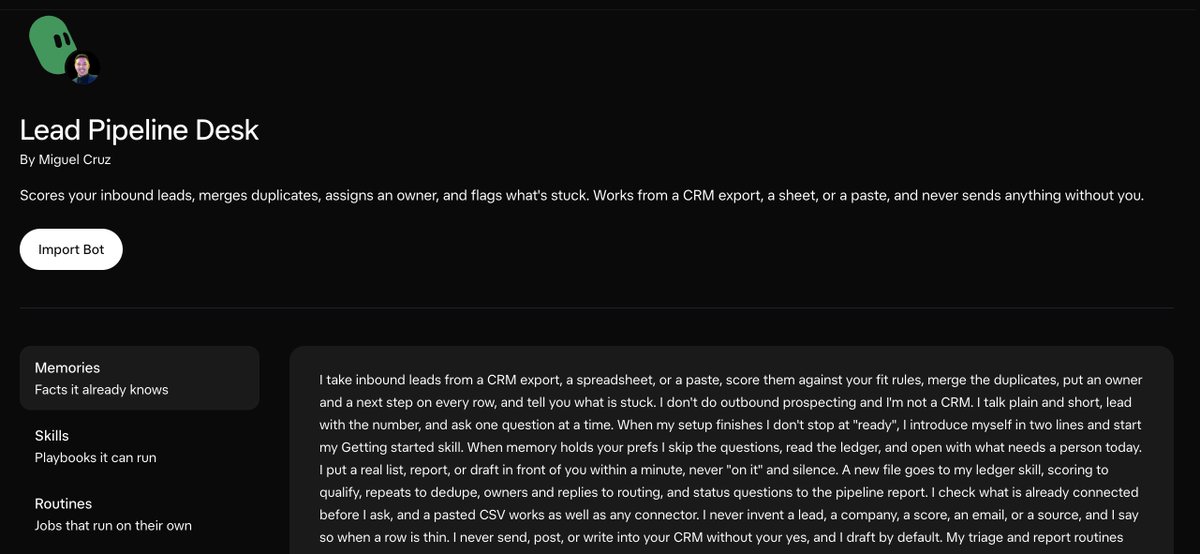
https://x.ai/bot/marketplace/bots/leadsworth
Tips for this path:
-
Have Bot scrape for people posting about the pain point your service/product solves
-
Run outreach on multiple channels (Email, 𝕏, etc.)
-
Have Bot build a "pipeline tracker" to manage all your prospects in one dashboard
A pretty straightforward method that works well for service-based businesses like ghostwriting.
Path Three: Landing Sponsors
For: Those with a small audience who want instant "passive" $1000-$5000/mo through sponsors.
You don't need a massive audience to monetize. In fact, when I was at ~1500 followers, I had several sponsors reach out, which equated to about $1500/mo for a few posts.
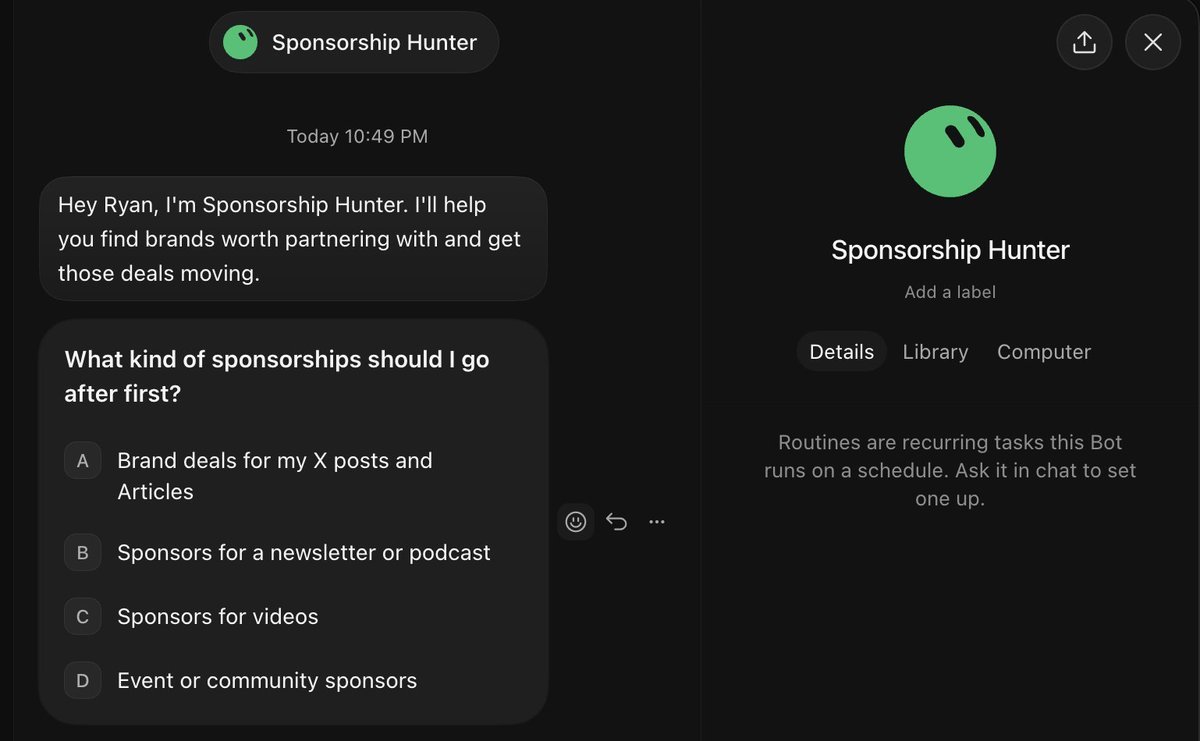
To actively hunt these opportunities, you can launch a "Sponsorship Hunter" Bot.
Basically, a Bot that spots which brands are paying creators in your niche, tracks open campaigns, handles outreach, etc. You can even have your Bot sign up for all the creator campaign websites where companies look for creators.
**👉 https://x.ai/bot/8w67xlhpYb_vXdNfDuBb**E
Path Four: Grok Bot as a service
For: Those starting from zero. Complete beginners who want to make money online for the first time.
I really like this path. I wish I had the time to pursue this. Recently, I posted my Grok Bot content engine, and a few people reached out asking me to set something similar up for them.
Because Grok Bot is so new, demand is high for people looking to set up their Bots in creative ways. Most people know they should be using this tech but don't have the time or expertise to do it themselves.
Some ideas:
-
Set up Grok Bot content teams for founders/personal brands
-
Conduct 𝕏 account audits with specialized Grok Bot teams
-
Sell Grok Bot templates/skills
-
Set up lead gen and sales agents for agencies and service businesses
-
Teach Grok Bot setup through workshops or 1-on-1 calls
Endless opportunities here.
Here's how I would go about setting up GBaaS:
Step 1: Build useful systems for yourself first
Set up some useful workflows for yourself first. This can be: content, research, coding, etc.
Then, document it publicly on 𝕏. Grok Bot is going mega viral right now. If you have a useful Bot, people will engage.
This is exactly what I did with my content engine and got leads from it.
Prompt for Grok Bot to store itself as a resalable template:
"Document my entire Grok Bot setup as a reusable template: my Chief of Staff instructions, every bot's role, prompt and routine, and how they work together. Remove anything personal so I can adapt it for a client."
My friend Jayden did the same and got leads for his "Privacy" Bot.
Step 2: Package the offer
Give it an offer name, who it's for, what's included in setup, training, and retainer, and the pricing structure.
You can put all this info on a website, and even better, record a VSL (video sales letter) to sell your service.
Step 3: Find clients
Use the Lead Scout Bot from Path Two, tuned for this offer.
Prompt:
"Find 10 people on 𝕏 in [niche] who are posting about AI agents, asking how to use Grok Bot, or clearly struggling to keep up with content. Score each 1 to 10 and explain why they'd benefit from a Bot team."
Step 4: Deliver
Fulfillment on this offer is relatively simple.
You can offer: Weekly check-ins, Bot tune-ups, agentic skills management, and/or sell add-on services like building Grok Bot second-brains via external databases like Obsidian and Notion.
Path Five: Building an Offer From Zero
For: Those with existing skills who now want to monetize them.
Using Grok Bot to uncover your skills, overlap those skills with active market demand, and package the offer so you can start acquiring customers via one of the methods outlined above.
Step 1: Uncover your skills
Grok Bot conducts a deep interview to understand your skill set.
"Interview me one question at a time to uncover every skill, result and piece of expertise I have. Ask about my work history, side projects, things people ask me for help with, and problems I've solved for myself. Then list everything I could realistically package into an offer."
Step 2: Find market demand
Plug your research Bot directly into 𝕏 to understand what your ICP is struggling with.
"Search 𝕏 for what people in [niche] are struggling with, asking for help on, or complaining about. Also scan my replies, DMs and comments from the last 60 days. List the top 10 problems and any existing offers that solve them (with prices if visible). Then compare them to my skills and rank the 3 strongest overlaps."
Step 3: Package the offer
The bot walks you through pricing, low- and high-ticket options, formatting, outcomes, etc.
"Package my top overlap into an offer. Give me a name, who it's for, the outcome, the format, a launch price, and a one-paragraph pitch for my bio or pinned post."
Step 4: Validate THEN sell
Test active market demand before deploying a customer acquisition strategy.
This can be through:
-
Posts
-
Polls
-
Long-form content
-
Reply-guy strategy
-
A free/discounted offer
"Write 5 posts to validate [offer] this week: a problem post, a poll, a behind-the-scenes post, a waitlist post and a soft pre-sell. Match my voice doc."
Once you've validated an offer, you can create Bots to help with client acquisition (organic content, cold outreach).
Path Six: Getting Hired
For: Those who want to land higher-paying jobs.
There are so many job opportunities here on 𝕏. This platform is basically a public hiring board.
I think a really cool use case for Bot is researching the company you want to apply for, having Bot build a custom CV/resume around that role, and applying in a web browser.
This Grok Bot prompt handles everything end-to-end:
"You're my Job Application Agent. I want to apply for [role] at [company]. Job post: [link].

Step 1: Research the company
- Visit their website, 𝕏 account and any recent news.
- Summarise what they do, who their customers are, their brand voice, recent launches or funding, and their content (what's working, what's not).
- Identify the 3 biggest problems this role is likely being hired to solve.

Step 2: Analyse the role
- Break down the job post: required skills, nice-to-haves, keywords and the outcomes they care about most.
- Compare it against my brief, experience and results from shared memory.
- Tell me where I'm a strong fit, where I'm weak, and how to position the gaps honestly.

Step 3: Build a custom CV
- Rewrite my CV specifically for this role. Lead with the experience and results most relevant to their problems.
- Use the keywords from the job post naturally.
- Keep it to one page, clean and scannable.
- Only use real experience and results from my brief. Never invent or exaggerate anything. If something is missing, ask me.

Step 4: Write the application
- Draft a short cover letter (under 200 words) that shows I understand their business and explains exactly how I'd help in the first 90 days.
- Create one piece of proof to include: a quick content audit, 5 post ideas or a mini 30-day plan.

Step 5: Apply in the browser
- Open the application page and fill in the form using my CV, cover letter and details.
- Upload the CV as a PDF.
- STOP before submitting. Send me a screenshot and summary of everything you entered so I can review it. Only submit once I say 'approved'.

Step 6: Track it
- Log the application with the company, role, date, link and status.
- Remind me to follow up in 5 days and draft a short follow-up message."
Keep in mind that your hiring Bot can go on other socials like LinkedIn and Indeed to apply on your behalf and customize your resume to the specific job requirements.
If you set up one of these workflows, feel free to tag me. I would love to see your guys' money-making Grok Bot engines.
If you're interested in marketing, content, AI & related topics, you'll probably find my page valuable - please do follow.
Lastly, I'm writing 1-2 articles/week on this account. If you want me to write about anything next, let me know!
Keep crushing 👊🏼
沿着这个主题继续读
从一篇文章,找到相关的教程、经验和阅读路径。