How to go viral in any niche on YouTube (full guide)
文章目录
This article is my entire beginner YouTube course, condensed into one read, and it's probably the most important article I've ever written for beginner YouTubers.
If you want the extended 1 hour and 33 minutes of this in video form, with every example shown on screen, I published the full course for free on YouTube: https://www.youtube.com/watch?v=gixEtxrZ9PQ
I'm Leroy. I'm an award-winning YouTube strategist, and I've helped drive over 2.5 billion views. After that, I stopped counting. I've been on YouTube in some capacity since 2008.
Since then, I've worked with some of the platform's biggest creators and grown small creators into niche dominators. All verifiable. Dog rescue. Real estate. Finance. Gaming. Entertainment; the list goes on.
And none of them grew by accident.
Here's the exact playbook I give every beginner I talk to.
1. YouTube doesn't work the way most think
Forget everything you think you know about "the algorithm."
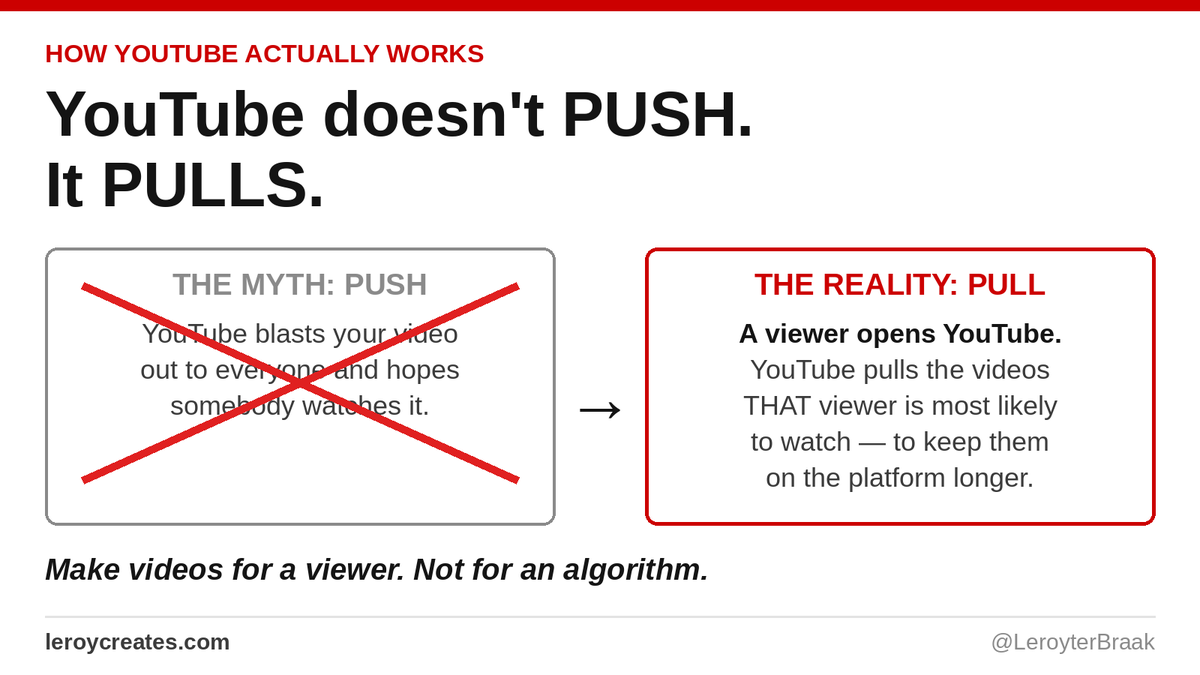
YouTube is not a video platform first. It's a discovery platform.
Every time a viewer opens YouTube, the algorithm asks one question: which videos is THIS person most likely to watch right now so they stay on the platform longer?
YouTube wants that viewer to stay because staying means ads, and ads mean money. That's the whole business.
That means YouTube doesn't care about you. Good or bad.
It doesn't care if you have 10 subscribers or 10 million. It's not shadowbanning you. It's not against you. If you make videos certain people want to watch, it will show them to more people like them. Simple as that.
This is also why I call YouTube a game of odds.
You will never get a 100% guarantee that a video breaks out. Nobody can give you that - not me, not anyone. But every lesson below stacks the odds further in your favor. And it is what helped me become a top 1% player in the space.
2. Before you upload anything, answer one question: why the hell are you doing this?
Too many creators launch a channel without defining who they are. And this kills channels before they even take off. I've seen it time and time again.
In one sentence: what defines you, or your brand? Then ask yourself: What do you love? What do you hate? What do you actually want this channel to do for your LIFE in 3 years? Write down your answers. Dare to go into detail.
This isn't some BS. If you already have a channel and you've never sat with these questions, do it now. It's your channel DNA. It filters your ideas, your audience, and how you'll make money later.
Seth Godin said it best: when you try to speak to everyone, you speak to no one. This is the same on YouTube for a lot of creators.
The top 0.1% of YouTubers have ''it.'' The thing that makes them widely appealing. For most of us, that is not the case, so therefore you should clarify what your channel is, and know who you are on that channel.
Another part of this is understanding your unfair advantage. Everyone has one, but most people never use it or can't identify it.
I once spoke to a beginner who said he'd wasted his life so far. Thirty years old and dropped out of college. Dead-end job. Plays video games all day.
I asked which games. He answered: "Mostly World of Warcraft. About 10,000 hours. I'm like top 10% in the world."
I looked at him, confused.
Brother, that IS your channel. He'd happily make those videos for months without getting paid, because it's what he's already obsessed with.
Understand that before you make money on YouTube and get to the point where you could call it your job, you need to go through YouTube's war of attrition. Most amazing creators give up before they're ready to get the views they think they deserve from upload one.
And the worst part is, this timeline is wildly different for everyone. It depends on your skill level in certain areas and how fast you pick up the new skills needed to run a successful YouTube channel.
So whatever you do, make sure you create videos on something you are wildly passionate about, or know you can make every single week for a year without seeing a penny back for it.
You also need to be brutally honest about your goal. Don't say "I want to inspire people" if what you actually want is a $25,000-a-month business that mostly runs itself. The clearer the destination, the easier it is to reverse-engineer the right channel and strategy:
-
Want $30K/month fast? Build a high-RPM channel or one tied to a product or service you deliver. Optimize for value per view, not views for ego.
-
Want to be the next MrBeast? Chase reach and brand first. Accept that money comes later, and prepare for it.
-
Want 4-hour days working in some trendy nomad bar in Bali? Build a faceless channel you try to systemize heavily from the get-go.
Finally, once you have done all of the above, turn that into an answer your biggest fan will give to this question a friend will ask them when they name-drop your YouTube channel.
''Oh, what's that channel about?''
Now I've spoken to many creators, large and small, about this specific question. Most tend to gravitate to a marketing-first answer, almost like a knee-jerk reaction.
''XYZ makes videos about pressing issues in the financial markets and tells me in a clear way how to navigate said problems.''
Your fans don't talk this way. They are not your spokesperson. I need you to understand this when crafting that answer.
''Oh,* he/she makes videos about the stock market but not like one of those super dry nerds.''*
That is a lot closer to how real people speak, so make sure you figure out from* their *perspective, not your marketing answer.
Then keep the above answer as your channel's North Star. Being predictable for the most part on your channel is what converts viewers into a fanbase.
3. Great ideas are stolen, not invented
This might be the most important lesson in this entire article.
Ideation is not sitting in a cave waiting for genius to strike. It's a system. You need to know this: almost nothing successful on YouTube is truly original. The biggest creators borrow, remix, and repackage what they've seen on YouTube or in other media. Trying to be a genius is exactly what slows beginners down.
Your secret weapon, especially as a beginner, is the outlier: a video that overperformed for a channel. Here's my rule of thumb:
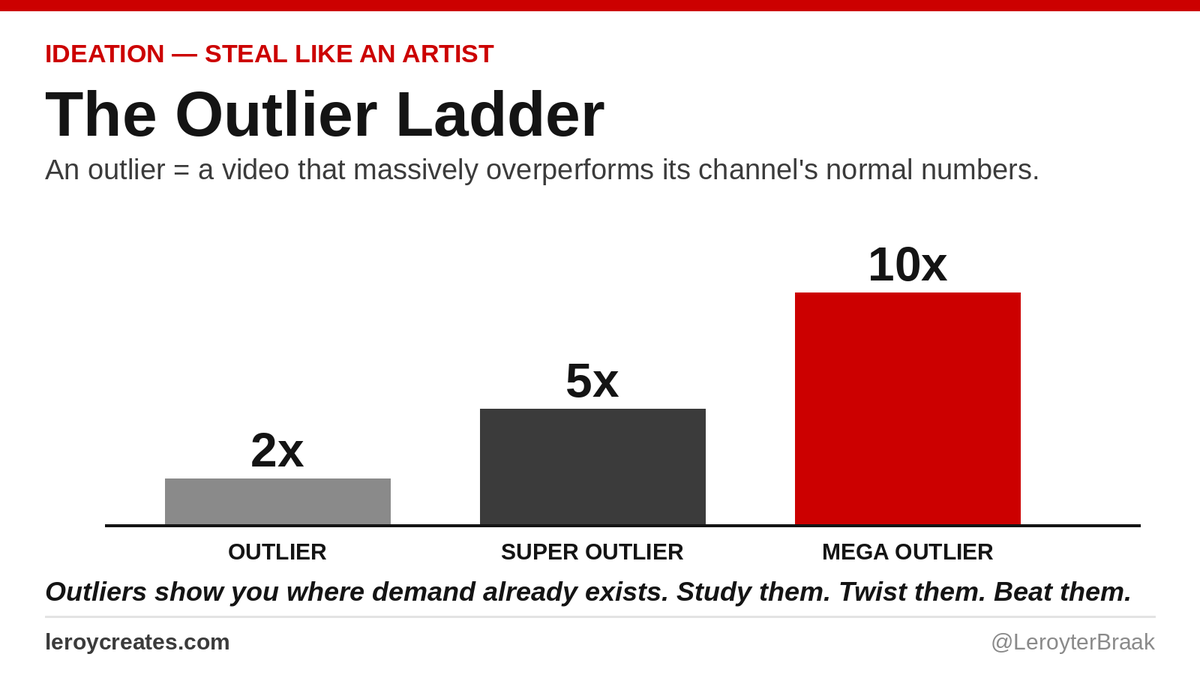
So when you find an outlier on YouTube you need to study it like a scientist:
-
The packaging. Title structure. Thumbnail style. Colors, words, patterns.
-
The hook. Transcribe the first 30 seconds. How does it build intrigue?
-
The story. What structure carries it? How do they open and close loops, what is the big overarching plot building towards the end?
-
The edit. Do they use fast cuts? Loads of Memes? Or simple visuals combined with strong storytelling?
Now understand, once you've done all this, that you don't copy it. Analyze it, improve it, differentiate it. What can you do to make this outlier your own? How are you going to make a similar viewer of your version go like, ''huh, this was even better than that other video I saw sometime back on this topic''?
My weekly system for finding outliers worth investigating goes like this:
-
The 60-minute workout. Once a week, no exceptions. In 1of10, filter for 3x outliers, at least 100K+ views, last 3 months. No keywords. Just scroll, save everything that grabs you. It's training a muscle - the more you do it, the more winning titles and thumbnails live in your head rent-free.
-
Sniper research. Your niche's keywords, 2x filter, last 6 months. What's popping right now that you can spin?
-
Mine old outliers. A super outlier from 6–12 months ago that nobody remixed succesfully since then? Ask yourself if you can repackage it, improve it, update it. R.I.U. for short.
-
Keep 30–40 ideas banked. Fresh, every single week. The more options you have, the bigger the chance a winner is in there. Remember: YouTube is a game of odds.
Most importantly: you don't need to reinvent the wheel. Quite the opposite. Find what works. Do it better, or different.
4. People don't click titles. They click unanswered questions.
You can make the most valuable video in your niche. If the packaging sucks, it gets ten views.
Keep in mind that YouTube does not reward effort. It rewards clicks and the number of viewers who stay after clicking.
Your video's packaging is its idea, title, thumbnail, and hook, and it does one job: create tension that only watching can resolve.
Every click on YouTube is driven by one of five triggers:
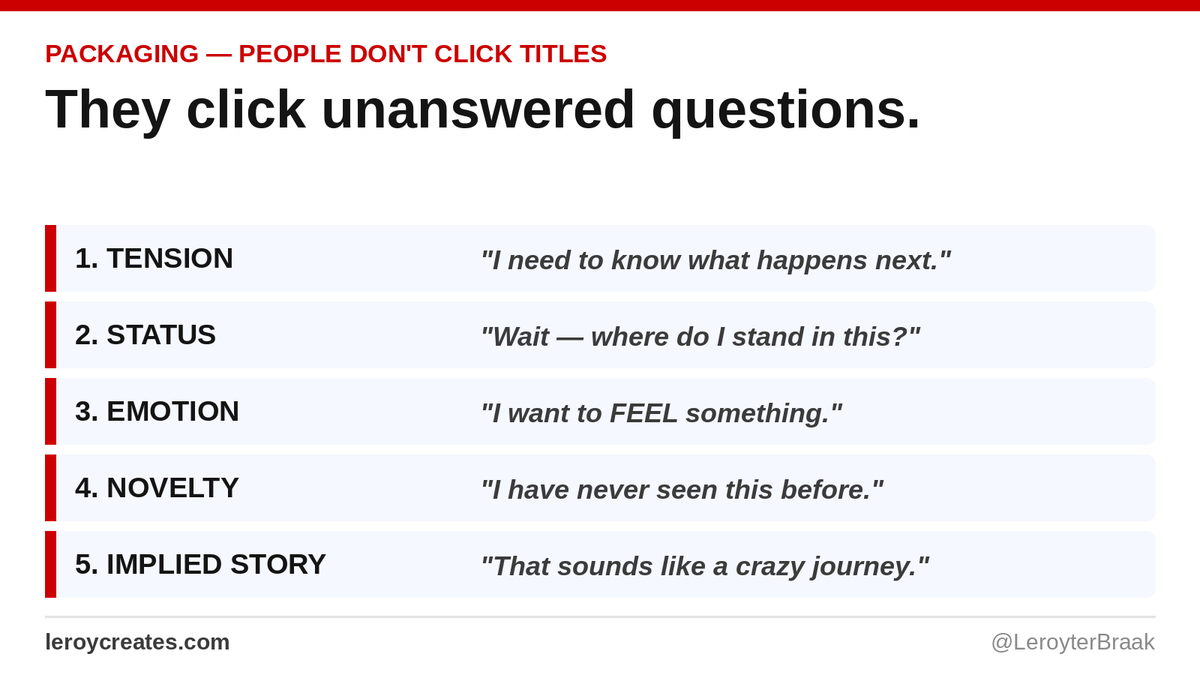
And understand the division of labor: the thumbnail gets attention. The title earns the click.
Your thumbnail should be a visual trailer. It's not just some decoration. It needs visual tension (something feels unfinished), clarity (a stranger gets it instantly; confusion kills curiosity), and emotion.
You don't need to be a designer. Those can be hired. You need to be an amateur psychologist. The more you find outliers like the ones above, the better your gut will get at spotting compositions that will earn the click.
Now, when it comes to titles, stay away from what I call the *"good-for-you *category." Let me explain:
Bad title: "I Learned playing the Piano."
That's the *good-for-you *category. The viewer thinks, "Good for you," and keeps scrolling.
Better: "I Tried Learning the Piano in 7 Days. Here's What Happened."
Now there's a journey, a semblance of stakes, and a question unresolved for the viewer: did he pull it off?
Write at least five title options for every video. Sometimes we rewrite ours 10+ times before we land on our list. Then run every title + thumbnail pair through this checklist before you record:
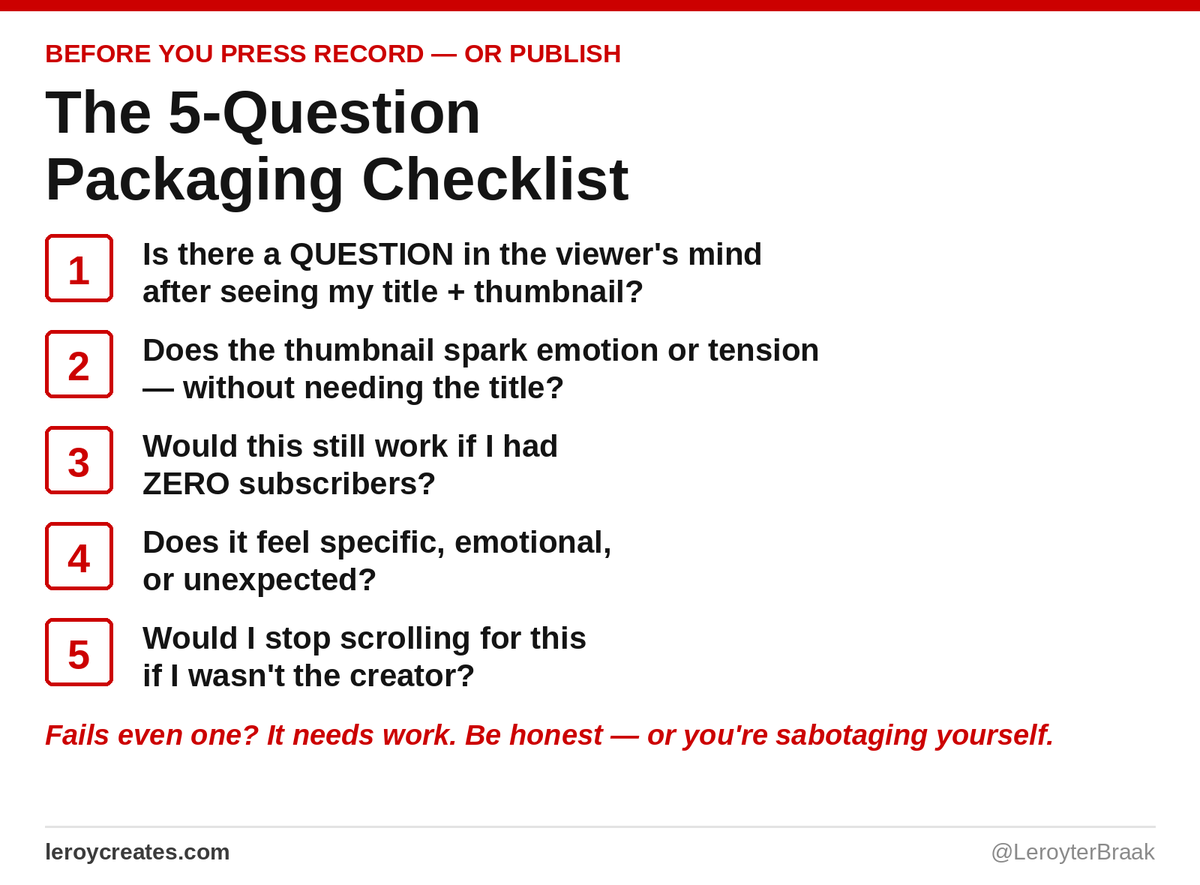
5. If your first 30 seconds don't work, don't proceed
I don't care how good the rest of your video is. If the hook fails, nobody will see it.
Your hook's only job is to earn the next few minutes. Every sentence must raise interest or tension. If a sentence doesn't, you should cut it.
Let me give you two basic examples:
Bad:
"Hey guys, welcome back to the channel. I just got to Tokyo, and I'm super excited to share everything with you. Let's get into it."
A new viewer doesn't know your name, your story, or why they should care about your excitement. You gave them nothing.
Better:
"I landed in Tokyo with $14, no phone, and one mission: survive 48 hours by befriending the locals who Americans think hate strangers."
Stakes, curiosity, and urgency are baked in compared with the first example.
Three concepts that make hooks work well:
-
Open with questions. E.g., "What do a 12-year-old, a billionaire, and a chess prodigy have in common?" — or close the hook with one: "But how did one tweet destroy a brand that took 10 years to build?" A question turns a passive viewer into an active one.
-
Tease, don't spoil. "She faked her Harvard degree, scammed half of Instagram, and somehow she managed to make it even worse." Give the breadcrumbs to build intrigue for the rest of the story.
-
The rule of three. If you read closely, you'll see I just used it in the above two as well. I love using the rule of three when I can, because it just works so damn well. Always put the juiciest element last; that's your hook's climax, and it is the one that will stick in their brain the most.
6. Understand storytelling is just controlled curiosity
Keep this in mind: a new viewer owes you nothing. The moment they click your video, they're looking for an excuse to leave. So every part of your story has to earn the next part.
I like to structure videos as events:
-
Minor events are clues. Small reveals, open questions, a message that might change everything later. They're the dopamine hits that keep your viewer patient.
-
Major events are payoffs. The big moments the minors pointed to.
Here's what most beginners get wrong: retention is not about cutting every pause and editing like a maniac. It's about spacing your major events well, so the viewer always has something to wait for. A scene can breathe as long as your storytelling structure makes sense.
And after major event, rehook. The moment you resolve something, open the next thing. Don't do the old-school *"If you thought that was crazy, wait until you see what happens next." *Ask yourself, what is the unanswered question still left in the viewers' brain, and how can I remind them of it in a way where they won't see this dip of energy in the story as an exit point.
Two more rules I like to go by. Keep your language below a sixth-grade level as much as possible. Complicated language limits how many people can enjoy your video. And if you're educational: build credibility fast (a result, a comment from someone you helped, proof) and wrap every problem you solve inside a story. Drumming up a problem and reading out the solution isn't cutting it anymore.
7. The most important skill on YouTube is doing it again
Nope. Not talent. Not gear. Reps. Just like any other skill, you need reps.
If you apply everything in this article once, you'll improve. I promise you.
Do it a 100 times, and you'll become undeniable.
You'll get faster at spotting formats, sharper at rewriting weak titles, and better at pacing. Judgment is YouTube's meta-skill - and judgment only comes from reps. It's not that I'm smarter than you. I've just done this longer than most of you.
Again, YouTube is a game of odds. Everything above exists to stack them.
If this helped you, share it with one beginner who needs it. I put everything I know into these - and into the free course video linked at the top - because the person who saves this playbook today can become the creator building something real a year from now.
Leroy
沿着这个主题继续读
从一篇文章,找到相关的教程、经验和阅读路径。