The Art of Mind-Binding: How to Plant Your Will in the Minds of Others
文章目录
imagine this: your country just lost the war. the empire dismantled overnight. army disbanded. borders cut.
not so long ago, you were a major power. everyone trembled at the thought of your armies.
now you are a third-league nation, forced to sign its own humiliation and pay for it heavily.
you’re broke, jobless and hungry. labouring every day, and still a full day’s wage can’t buy you a newspaper.
you somehow get used to that gloomy reality, but deep down you’re frustrated, ashamed, angry.
and in the midst of all that, a man appears who looks just like you.
another defeated soldier from the trenches. your brother in arms.
he somehow names your pain better than you could do it yourself. he calls out to your sense of pride, of honor.
he hands you someone to blame: you didn’t lose the war. you were lied to. tricked. stabbed in the back by the traitors at home.
once the hatred is boiling in you, he begins to paint the picture of something completely irrational, yet very seductive.
your nation rising from the ashes. the birth of a thousand-year empire.
he repeats it so many times, with such conviction, that you begin to believe it yourself.
and once you’ve already seen yourself there, in the laurels of glory, marching under the banners of your nation reborn… you will follow him to the ends of the world. by whatever means necessary.
sounds familiar?
understanding crowd psychology comes down to understanding one thing in particular: the crowd’s mind is not a rational mind.
when you have 1000 people in the room, you don’t get 1000 independent thinkers. you get 1 organism, moved by the same primal drives stirring from within: fear, anger, longing.
once you touch those primal drives through images that steer their imagination, you hold the reins.
this is what all of history’s most powerful leaders understood, including the infamous austrian painter who set europe on fire.
but it’s not just a thing of the past or ‘evil’ people.
in fact, we all play this game, either as the manipulator, or the manipulated.
look at the modern world: politicians, influencers, advertisers.
each of those is a form of persuasion. or more precisely, the art of getting inside the subject’s imagination, planting an image there, and steering it so that they bend to our will.
ignoring it doesn’t make it go away. understanding the machinery however, not only arms you with knowledge to use it on others, but also to defend yourself and see these practices for what they are.
these last few days my lab was buried in the material. books, treatises, real-life testimonies.
and no, not the usual stuff you would expect, like machiavelli’s prince or robert greene’s books on manipulation.
the real stuff, the kind that dissects the mechanism from the inside out: the forbidden treatises of renaissance magic, le bon’s study of crowd psychology, the rise and fall of the biggest cult followings in history & the speeches of the austrian painter yelling as if his life depended on it.
this whole process has nothing to do with logic. in fact, the less logic, the better.
let’s get into it.
WARNING
this might be the most eye-opening piece you will ever read. once you see the mechanism, you can’t unsee it. you’ll spot it in every conversation, every headline, every ad, and many thoughts that cross your own mind. read at your own risk.
THE HIDDEN ANATOMY OF A BOND
before we move any further, we have to go through the fundamental machinery through which an image enters and moves men.
according to the old masters of renaissance magic, and the greeks before them, there are 3 levels on which man perceives and receives information.
from lowest to the highest:
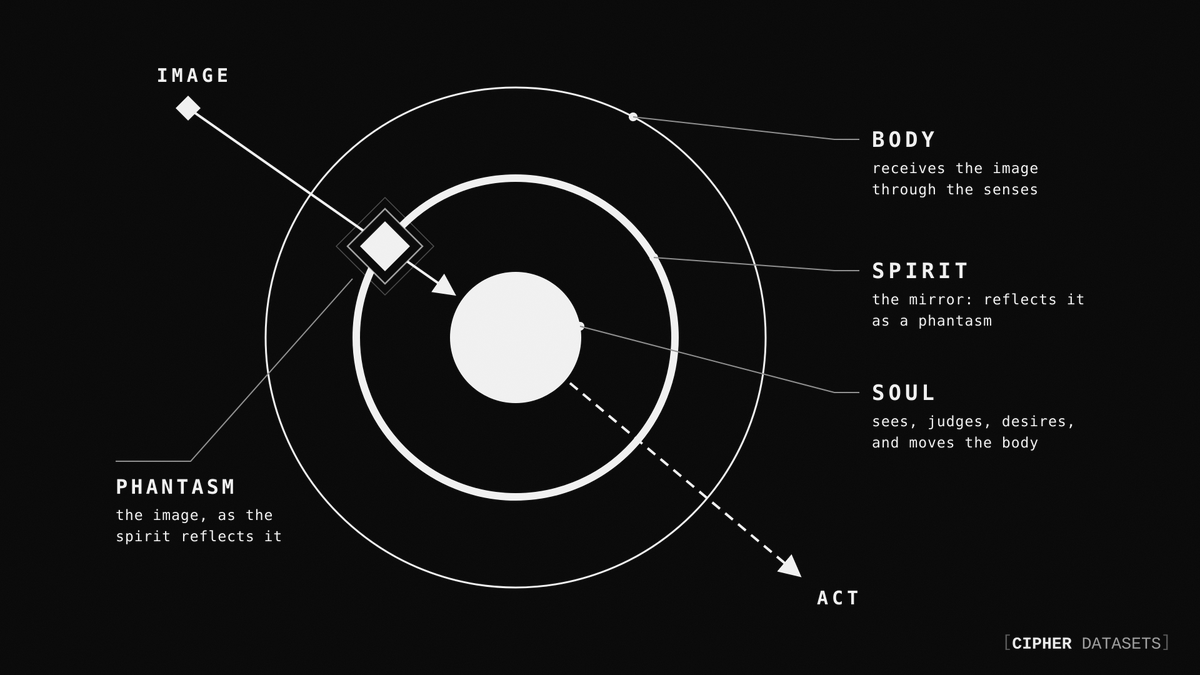
1) the body: the lowest level of reality. receives incoming stimuli from the 5 senses, above all the eyes, “the noblest of the senses.” over 11 million bits of information coming every second. only a tiny part of it actually reaches the next level.
2) spirit: the middleman between your body and soul. a subtle vapour, made by the heat of the heart from the purest blood. almost body, almost soul. it carries the images inward and reflects them like a mirror. that reflection is called the phantasm. it acts as a filter to reality.
3) soul: the highest level of man. the part that actually perceives. yet it never touches the world itself, only its reflection in the spirit. it looks at the phantasm, judges it, and through the spirit, moves the body.
the image becomes the act.
the information travels from the bottom up. meaning that only the highest level, the soul, is what actually becomes aware of it. and by then, it’s no longer the world. it’s a picture of it.
WHEN THE IMAGE STRIKES: EROS
the key part in this process relies on spirit.
spirit is not a blank mirror. as a vault, it holds a database of information about your nature, recorded long before you could remember.
it holds your deepest longings, your deepest fears and insecurities.
it looks through the incoming images from the body, and filters them against its own records.
when an image strikes and somehow corresponds with something that is already deep within the spirit, something happens which the ancients called: eros.
and eros doesn’t stop at love. giordano bruno reduced every bond to it. fear is love of what you fear. hatred is love of the opposite. vinculum vinculorum amor est. the chain of chains is love.
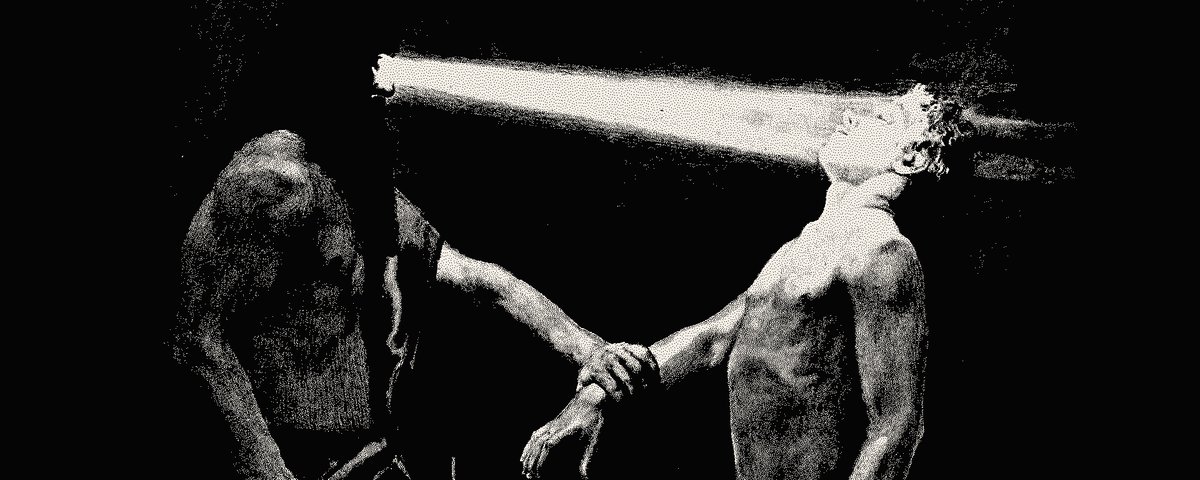
that’s why for the ancients the term “love arrows” was literal. the eyes shoot out rays of spirit, which pass through the pupils of another and strike straight into the heart. you can literally fall in love (either romantically or with a leader, an idea, a cause) if the physical image corresponds with the spiritual image well enough.
if it strikes deep enough, something rare yet terrifying happens.
POSSESSION: WHEN THE IMAGE TAKES OVER
the physical image matches the spiritual image so closely that the soul cannot distinguish between the two.
the real person, or the real thing, becomes just a pretext, because the subject sees his own unconscious reflection in it.
“we are enamored of an unconscious image.”
the image takes over the entire mirror. it feeds on every other thought, until nothing else is left. as ficino wrote: “the lover carves into his soul the model of the beloved.”
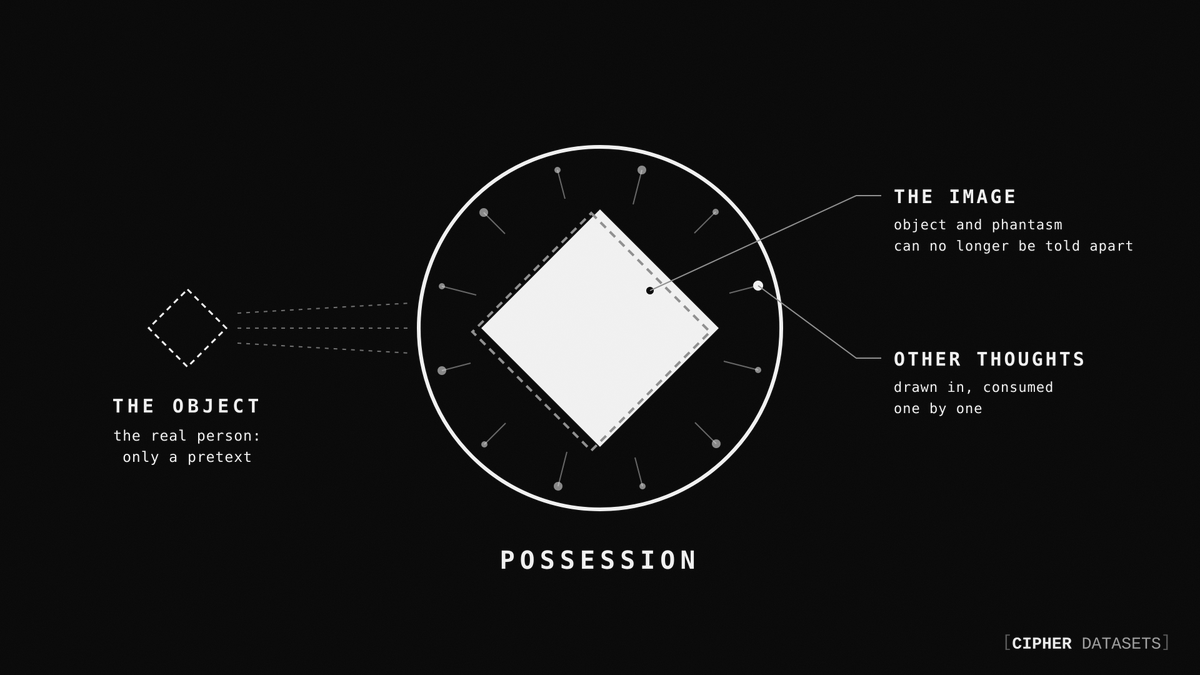
the soul begins building an entire world around it, and will go to the ends of the world for it.
CROWD PSYCHOLOGY: WHEN 1000 SPIRITS BECOME ONE
now imagine planting the image not in one mind, but in thousands.
at first glance, it seems far harder: 1000 spirits, each with its own wounds, its own longings, its own images waiting inside.
in fact, it’s all the easier. giordano bruno knew it already: “it is easier to bind several persons than one only.”
3 centuries later, gustave le bon, the father of crowd psychology, explained why.
in order to bind an individual, you have to find his SPECIFIC hook: his own wound, his own longing, the exact image his spirit is waiting for.
in crowds however, the individual loses his sense of self and becomes a member of a collective mind. le bon called it “the psychological law of the mental unity of crowds.” the man in a crowd, he observed, falls into a state much like a hypnotised subject in the hands of the hypnotiser.
now, the collective mind is not a rational mind like the individual’s. it does not reason in straight lines, it does not weigh, it does not doubt. it is capable of thinking ONLY in images, more specifically: emotionally charged images.
“crowds being only capable of thinking in images are only to be impressed by images.”
what moves the crowd are primal drives: fear, anger, pride. longings that are part of all human nature, and that every man in the room already carries.
so you don’t need to find 1000 hooks. you need one image that strikes the hook they all share.
that’s why the road to what we call “possession” is far shorter in a crowd than in a single man.
“in a crowd every sentiment and act is contagious.”
one man’s anger can become the anger of thousands in minutes, if the image is shaped sharply and intensely enough.
now, as you know the mechanism in its core, it’s time to look at how it all actually takes place.
we’ll go through:
-
the specific tools of the binder and the whole chain of binding in practice.
-
case studies of men who bound entire nations to their will.
-
the 5 steps behind every successful bond, the playbook used by ad men, politicians and god-kings alike.
the continuation of this article is available only on Substack.
keep reading → https://cipheron.substack.com/p/the-art-of-mind-binding-how-to-plant?r=4frypi&utm_campaign=post-expanded-share&utm_medium=web