C.S. Lewis Predicted Malfoid: Why You Feel the Way You Do.
"WHY Malfoid is a thing," is a savory, compelling question. Happily, I know the answer for why Malfoid has prompted men to have all spontaneously begun yearning for a woman they can never know, for a rewrite that will never happen, indeed, for a chance to participate in the struggle to earn a ladylove.

That's a story older than most countries, built into our bones, and perpetuated by the continuous, foolhardy renewal of our vows to the impossible.
Even if Heaven did not exist, it would still be an idea worthy of our Romance.
In recent memory, I can only liken Malfoid to the Amelia-craze in terms of its vast capture and epiphany of the male yearning: They were an apocalypse in the literal sense – an uncovering. Like Amelia, Malfoid represents an impossible ideal. Unlike Amelia, though, who represented the nation as a woman who stoked the fires of hearth and home, Malfoid steers us toward the inferno of our own mendacious Hell. She encourages us to reject the lies of our caged imagination whose imprisonment has convinced us that we ought only desire the morally cheap woman, that the Onlyfans Frankenstein's monster of cosmetic surgery is an appropriate object for our honorable affection. Malfoid shows us that we were made for more, for better.
I DO mean that, yes.

Yes, Malfoid undeniably fixes problems in Harry Potter books. So would Dumbledore not leaving the Invisibility Cloak with Harry. But only one of those has caused men to recall that they are noble creatures who yet must be tested to be made worthy of their beloved. The others are well-catalogued and understood; Criticizing Rowling is not my goal, here. Yes, Malfoid is a potent antidote for many of the problems found in the Potterverse's structural foibles, and ought to be acknowledged as such, but her utility to the underlying story hardly explains the ever-mounting Movement she represents.
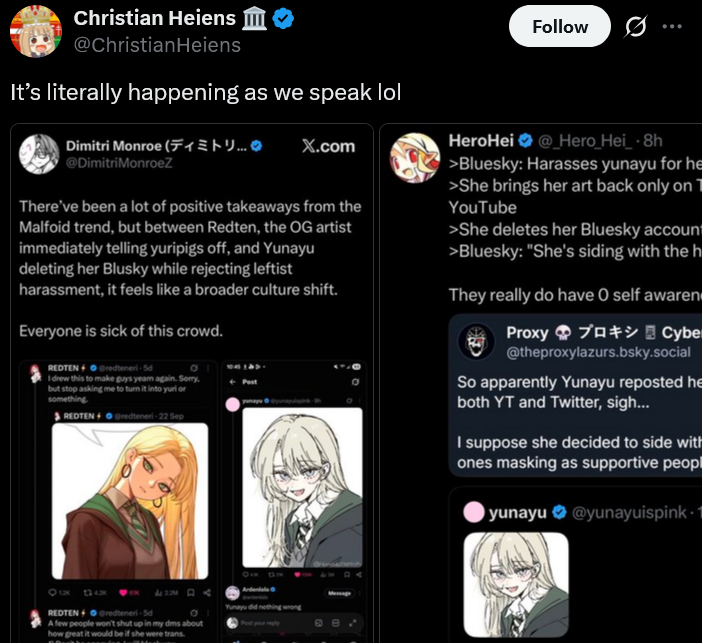
But Movements die when the image fails to become tradition. Malfoid can spread slogans. We, the participants, need more if our ladylove is to survive in our imaginations and move us to greater things. We need text and principle and vow. I would be delighted to offer all three to you, though, as you will find, C.S. Lewis already beat me to it.
Love is Unnatural: Forego Simping; Embrace Alliances Forged in the Bedroom.
Before we begin in earnest, I should underscore that I come by the Malfoid somewhat dishonestly, gentile that I am: I was too old for Harry Potter when it arrived, so my subject-matter knowledge is limited to a smattering of books that I read to teach my students and a few movies that I raced through for art references. I would argue my ignorance has allowed me a certain critical distance that helps analysis, but that would be self-serving.
Many, many others have contributed their encyclopedic knowledge to the fanfiction side of this phenomenon. I have none. Trust me, instead, with the dissection thereof.
Our modern conception of love (like that stirring in your heart when you think about Malfoid) is somewhat unusual as an idea since, before Lewis published his seminal work, the Allegory of Love, it was an untraceable idea, a shadow that randomly appeared in troubadour fiction with seemingly no precursor. We might think that "Love" as we experience it in literature and media naturally occurs, like sunburns from sunlight, like rain from clouds. The opposite is true.
For many centuries, Love was a joke. Rarely would a writer appeal to it, and to do so would reveal the author to be very foolish. Ovid's Art of Love was a work of satire. It would be like if you and I collaborated on a serious, scholarly work on the Art of Taking a Shit, and then we shopped it around, hoping to get it peer-reviewed: it's self-evidently stupid, and the gravity and seriousness IS the joke.
Take note that this man is suffering from being Empty Headed
For proof, consider the following passage from Ovid's Art of Love, which purports to tell young men about how great Love is:
Magna superstitio tibi sit natalis amicae
Quaque aliquid dandum est, illa sit atra dies.
Loosely translated, it says,
Let your girlfriend's birthday be a Great Dread for you.
And the day in which you must give something, that is a Dark Day.
Modern scholars typically render that as, "Beware your girlfriend's birthday. It will be very expensive."
And marriage all through the Medieval period was mostly utilitarian: You took a wife because she got you more stuff, like allies that you could throw at problems. If the allies dried up, you ditched that ho and found one with better friends. You would no more stay with her for Love than you would keep a rancid blanket: It had fulfilled its purpose. Move on.
The Allegory of Love: Four Aspects
And yet, a literary entity close to our modern understanding of Love randomly appears in the late 13th century-ish. In those tales, Love Conquers All, but unironically; Ladies are cruel, but only because they wish to make men better; Men worship Love but are not simps.
Lewis proposes that the Love that you and I know from Romantic literature arises out of a genealogy of Courtly Love, itself broken into four distinct aspects present across the genre:
-
Humility – The Lover yields and does not Conquer
-
Courtesy – The Lover must obey the conventions of society. By Courtesy, we don't mean "being polite." We mean, thou shalt kneel before the countenance of your lady fair.
-
Adultery – This one's fun. The beloved was always married, because of course she was, and the Lover struggled mightily against the husband and often lost. Maybe the real Romantic Love was the cuckholds we avoided becoming.
-
Religion of Love – Purposely a parody of the Christian Church, where the God of Love had tenets and laws and commandments and whose will could not be broken.
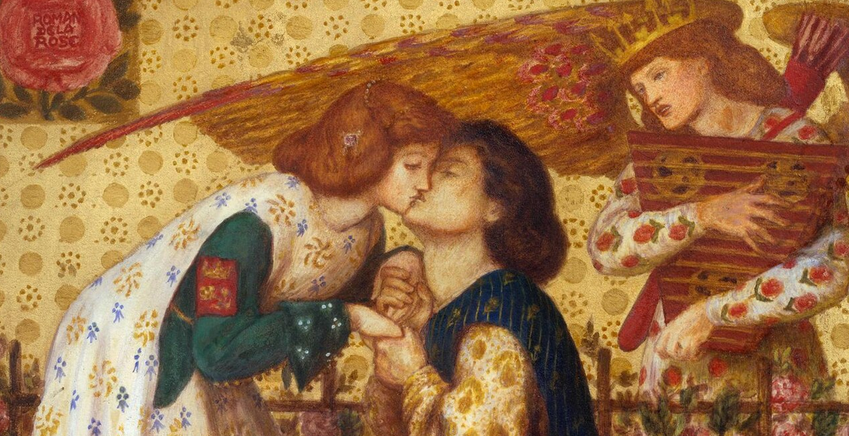
You get all four of those, you have yourself a Courtly Love tale of Romance and Love close to how we would understand "Love" in, say, Enchanted or Casablanca or Romeo and Juliet. Later, the tradition of Courtly Love admits of a change to the third dimension, adultery. Spenser, being a God-fearing, Catholic-hating protestant, adopted the Courtly Love structure, swapping Adultery for Marriage via Faerie Queen. Thus:
- Marriage – Romantic love must point to the pairing of Lover to Beloved and does not work against marriage.
Lewis Predicted the Malfoid
Now, take but a casual look at Malfoid, and you will see that Lewis's Courtly Love framework maps cleanly onto her, despite the fact that she has no official writings or canon existence.
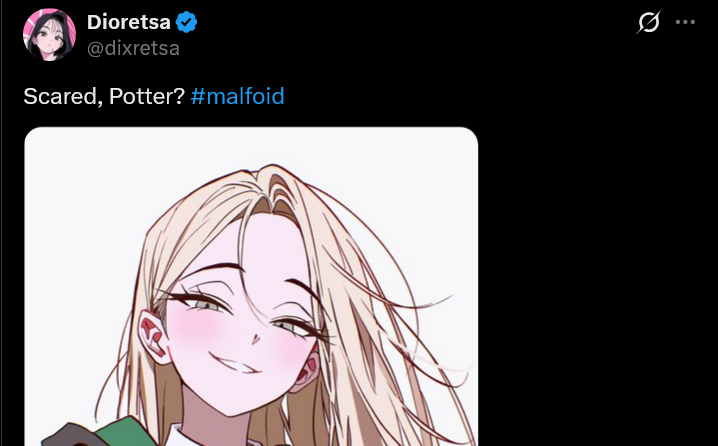
- Humility: Malfoid is proud and of a different social class than Harry. The yearning chronicled in our experience points to submission to the ideals that she represents. Attempts to make Malfoid yield to Harry have been used mostly in jest or are more in keeping with an anime-based tradition of the Tsundere; others that veer towards the risque have their fans, yes, but are mostly repulsed by the zeitgeist. Actually, our own attachment to Malfoid is informative, here: The very fact she does not exist in canon and yet has staunch defenders is the pinnacle of the unattainable Beloved.
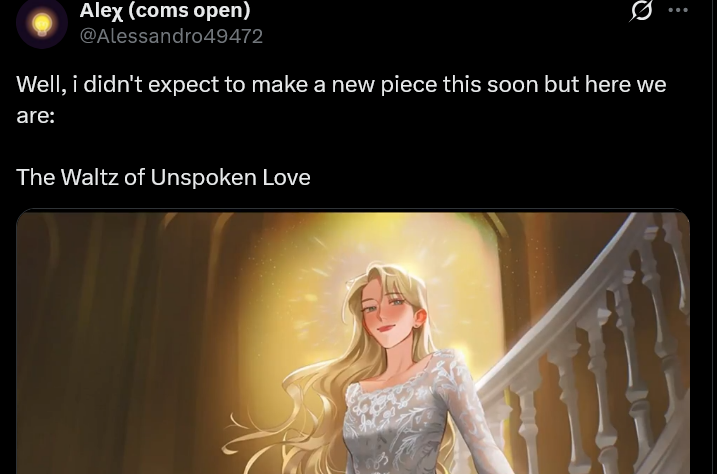
- Courtesy: Rivalry, but under manners. There is no open pursuit of Malfoid: There is teasing, resistance, and delayed gratification, stretching across 7 books. Notably, Malfoid is of a different house, and the structure of the story imposes societal rules of engagement, here. Malfoid is not always accessible, since she lives in another dorm, and Harry and Malfoid can only meet during class or between classes or during school social functions. They must both observe the rules in order to continue to tease and resist each other.
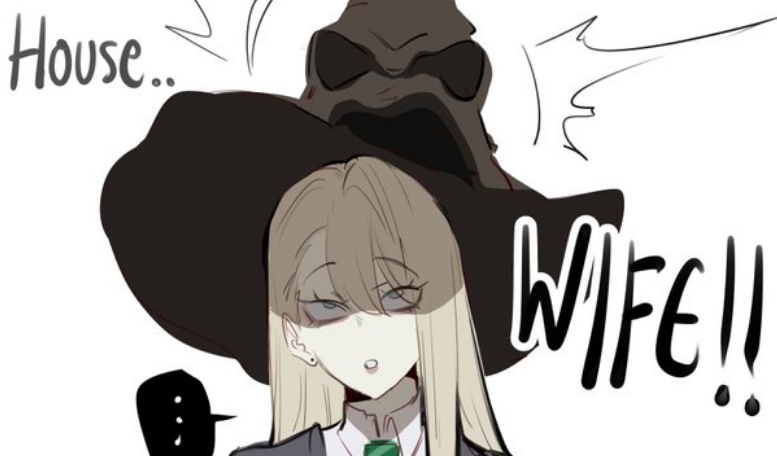
- Marriage: My favorite meme of this is Malfoid getting sorted into House: Wife by the hat. That's funny. It's also revealing. Harry and Malfoid give in to each other in the fiction that many are composing. The enemy obstacle is not a preexisting spouse, but the Malfoy's house, societal convention, and class distinction. They are aimed at each other, and overcome their obstacles so as to have a flowering relationship and marriage afterwards.
Said differently, the Malfoid mythos is not satisfied with Harry and his ladylove having a one-night tryst. No story that I've seen thus far begins and ends with, "And then they boned. The end."

- Religion of Love: Their attachment outranks and dispels the feud between them. They're supposed to be enemies, but love is the stronger loyalty.
It's startling, actually, how easily Malfoid fits into the genealogy of Courtly Love literature. Malfoid is in all places at once, and everywhere, the archetypal princess of every pop-culture media presentation of that trope: She is Isolde, she is Guinevere, she is in *Knights Tale *(2001), *Casablanca, *she is Buttercup in The Princess Bride, she is in Cyrano de Bergerac, Beauty and the Beast, Romeo and Juliet, she is Beatrix motivating Dante, Criseyde from Chaucer, etc. etc. etc.
Every one of them: A man Humbled, a Courtesy complied, a Marriage sought, and a Faith that transcends all.

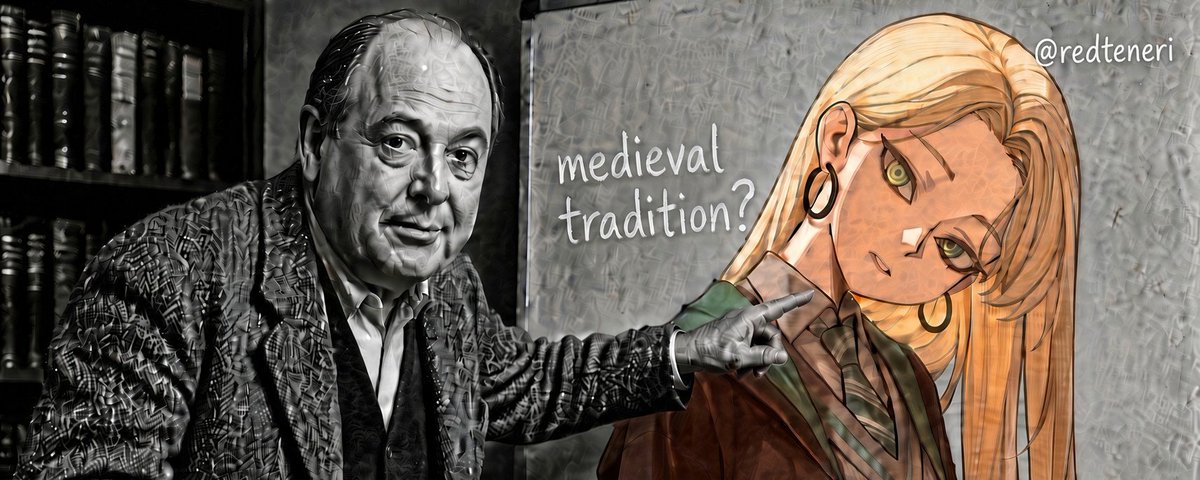
You get it now, don't you? That tug in your heart? It's because you have experienced the medieval tradition of Courtly Love all your life. It's in your school curriculum. It's in the movies you watch; the books you read. And if you haven't read Courtly Love romances, then I can guarantee that the makers of your media DID. You have inherited a legacy of self-abasement in front of the object of your affection; You have been habitually enculturated to acknowledge that certain women can make you improve and make you want to do it.
I say, "you." I mean "we."
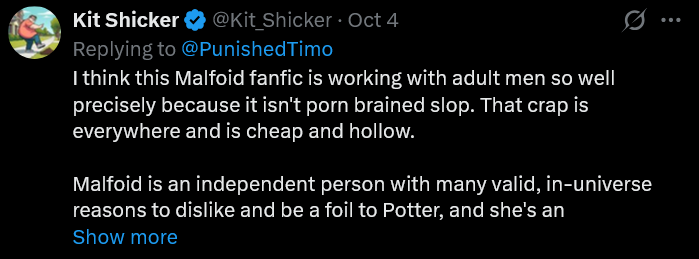
We have travailed the long road towards marriage, and we have held such virtue in our eyes as to point our efforts higher. There's a clarifying truth there, yes?
So WHY are we fascinated by the Malfoid? Why is it that fanfiction writers are emerging in places not normally productive of their ilk? Why do we feel the need to defend her virtue, to cast out the immodest cosplayers?
We are steeped in a tradition of Courtly Love, and Malfoid only reminded us of our inheritance.
Don't bother "colonizing" Romantasy. It was already done centuries ago. You just need to Remember.
If you would like to see the next article in this series, it is readable here: "Malfoy Does Not Horny Post." https://x.com/GodsBeggar/status/2108538023788847164?s=20
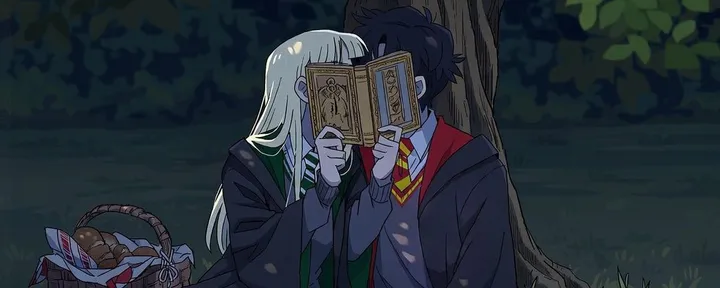
The Banner image is AI (SI?). The writing is Mine.
Thank you to @ChristianHeiens, @FareastSN, @Kit_Shicker, and @AtavismDr for showing me that I wasn't alone in my thoughts.
The video discussion that inspired this Article is forthcoming and will be added here upon its upload.