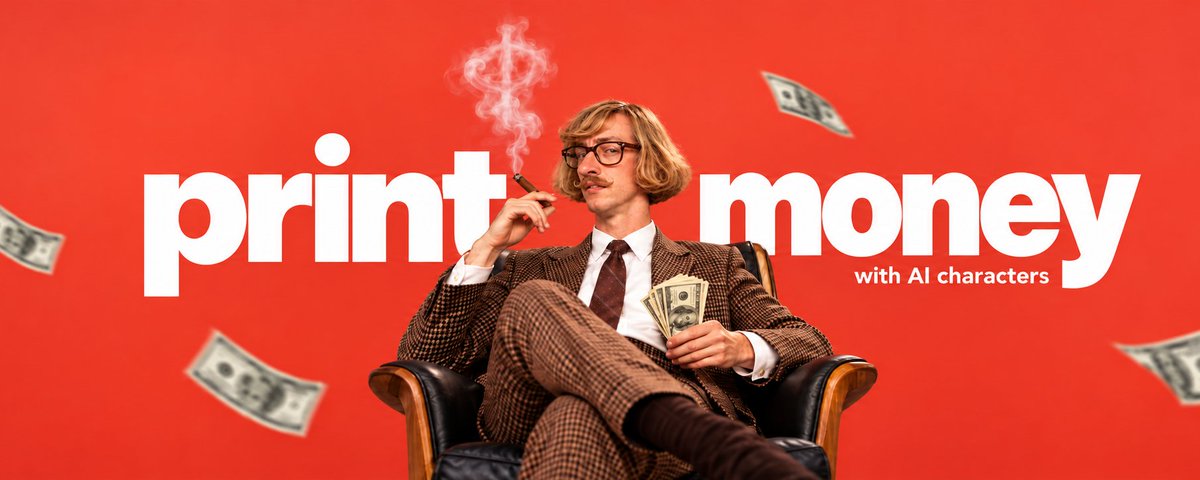
HOW TO MAKE F*CK YOU MONEY WITH AI CHARACTERS. (full course)
文章目录
部分视频或图片暂未收录,已在正文保留提示;需要时可查看原文。查看原文 ↗
AI characters have taken over the internet.
Instagram, TikTok, X, Reddit. you name it.
I LITERALLY have friends who can’t even tell the difference between some AI videos and reality anymore. at the same time, these goofy AI characters are pulling millions of views while the tools required to make them keep getting cheaper, higher quality and more efficient.
this is also some of the easiest internet money you can ever make. AI characters are still in that weird phase where millions of people are watching them, but 99% of people have absolutely no idea how they’re made or how to turn that attention into $$$.
you can make one recognizable character, keep their identity consistent, take videos that have already gone viral, swap your character into them, and produce content that would’ve required way more time, skill and money not long ago.
people love looking back at old internet gold rushes and saying they would’ve started early. dropshipping, ecom, bitcoin. all absolute goldmines that printed generational wealth for the people who got in at the right time.
and THIS time, you are NOT going to get left behind.
the barrier to entry is stupidly low. you don’t need capital, resources or any specific location. f*ck, you can sit in a village in Pakistan with an iPhone, a laptop and an internet connection and make bank.
in this article I’m putting the entire process on a silver platter:
-
how to make a character that actually grabs attention
-
how to set up a US TikTok audience from outside America
-
how to turn your FYP into a nonstop feed of proven content
-
how to recreate viral formats around your own character
-
5+ ways to monetize the attention
-
how to automate most of the operation once you know what works
I am NOT gatekeeping anything, so buckle up. this is gonna be a long read.
let’s get started.
1. MAKING THE CHARACTER
everything runs around the character.
right now, the content itself can be completely random. one video could be someone dancing, the next could be a street clip, the next could be something completely different. the character is the thing people keep seeing over and over again.
look at characters like Jean Phil or Abu Shalab. you could put them into ten unrelated videos and you’d still recognize them immediately. the hair, face, clothes, body and overall look are specific enough that the identity survives whatever content you put around it.
that is what you’re trying to build.
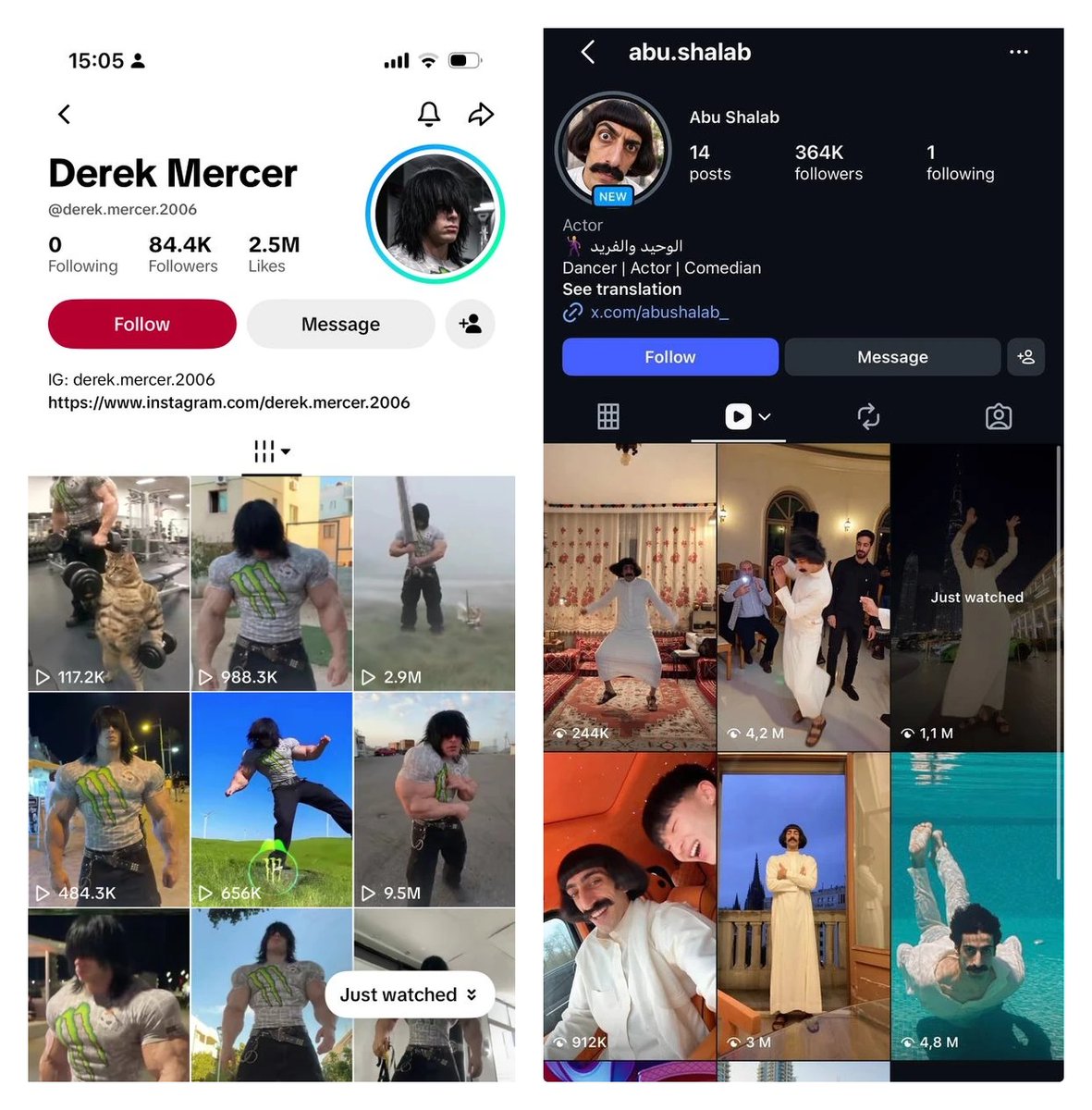
you want 2–4 features that hit immediately and remain obvious from different angles, in different environments and while the character is moving. one exaggerated hairstyle, one facial feature you notice instantly, a very specific outfit, maybe a recognizable body shape, expression or accessory.
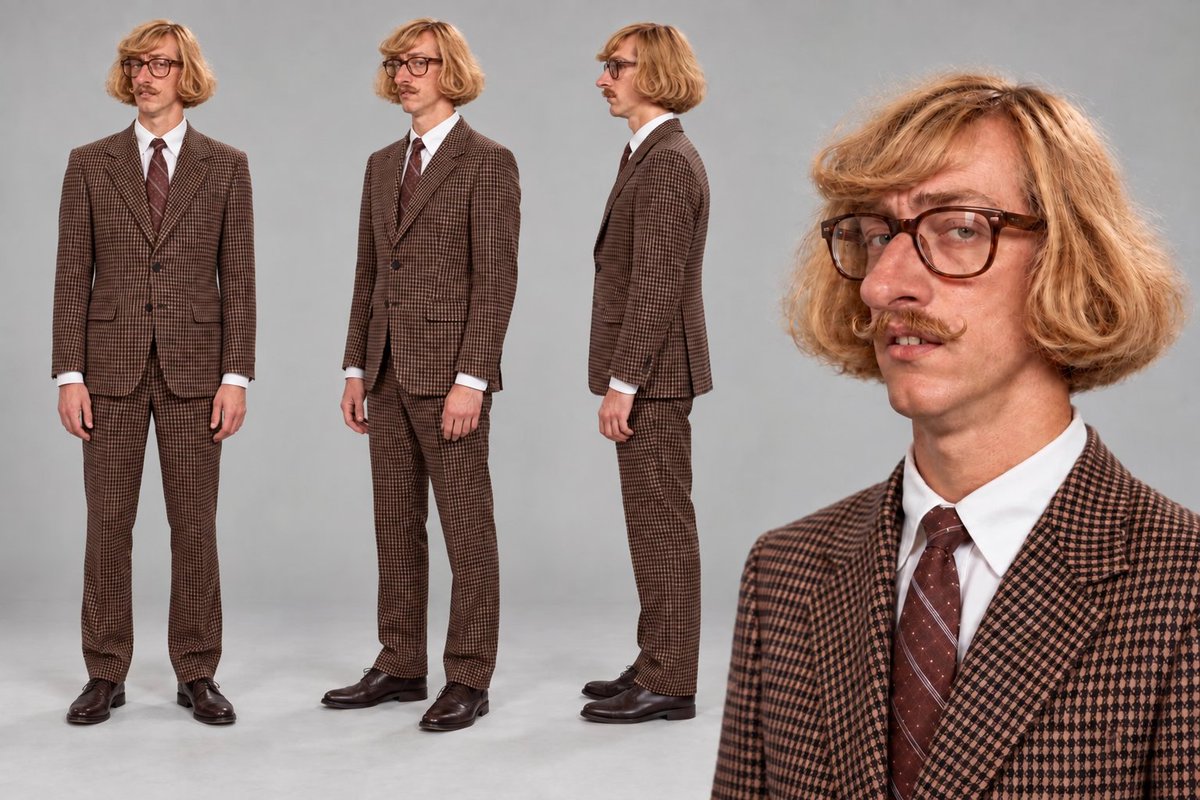
a skinny guy with brown hair, glasses and a suit is nothing.
a ridiculously skinny guy with a perfectly round ginger bowl cut, thick glasses that magnify his eyes, a tiny moustache and a suit that looks like he bought it in 1974 is a character.
you can picture the second one immediately.
PROMPT 1: DESIGN THE CHARACTER
this first prompt is only for ideation. you’re deciding who the character actually is before touching an image model.
You are my character designer for a series of viral, photorealistic AI characters for TikTok, Instagram and short-form video.

The entire goal is ATTENTION.

I want original human characters whose appearance is specific enough that someone notices them immediately while scrolling and can recognize them again in completely different videos.

The character should still look like a believable real person.

DESIGN PRINCIPLES:

Each concept should be built around 2-4 LARGE, readable traits.

Possible traits include:
- an exaggerated signature hairstyle or head shape
- a standout facial feature: glasses, facial hair, nose, eyebrows, freckles, etc.
- a distinctive body shape or posture
- a very specific repeatable outfit
- a recognizable expression
- one signature accessory or prop

Do not add random weird features simply for the sake of being weird.

The features should feel like they belong to the same person and should remain obvious:
- at thumbnail size
- from different camera angles
- in different environments
- while the person is moving

Do not create fantasy characters.
Do not make them cartoonish.
Do not copy celebrities or existing creators.
Do not default to generic influencer designs.

WHEN I START:

Ask me:
1. male/female + rough age
2. whether I have any visual direction already
3. anything I definitely want included or avoided

If I say “surprise me”, immediately give me 3 VERY different concepts.

FOR EACH CONCEPT GIVE ME:

NAME:

ONE-LINE VIBE:
One specific sentence that instantly makes the person easy to picture.

HAIR:
Exact cut, shape, length, colour, texture and styling.

FACE:
Exact face shape, nose, eyes, eyebrows, facial hair, glasses, skin details and default expression.

BODY:
Height/build/proportions/posture if they contribute to the design.

OUTFIT:
Exact garments, colours, fabrics, fit, shoes and accessories.

SIGNATURE FEATURES:
The 2-4 things somebody would remember after seeing the person for one second.

PERSONALITY:
How the character carries themselves and behaves.

WHY THE DESIGN WORKS:
Explain what somebody notices first and why the character should remain recognizable across completely different videos.

Be extremely specific.

Never say:
“quirky haircut”
“unique glasses”
“vintage outfit”

Say:
“perfect helmet-shaped black bowl cut ending directly above both ears”
“thick coke-bottle glasses that visibly magnify his eyes”
“brown houndstooth three-piece suit with high-waisted wide trousers”

I should be able to clearly picture the character before generating them.
let it give you ideas and keep editing until one actually feels worth building around. this person could end up appearing in hundreds of videos, so don’t rush the part that everything else depends on.
PROMPT 2: GENERATE THE ACTUAL CHARACTER
once you know exactly who the character is, turn that concept into a production prompt.
at this point I want to leave as little room as possible for the image model to randomly reinterpret the person.
Use the approved character concept above as the CHARACTER BIBLE.

GOAL:
Write one production-ready image-generation prompt for a hyper-realistic full-body studio photograph of this exact character.

Do not redesign the character.
Do not add new features.
Do not remove identifying features.
Do not beautify, simplify or reinterpret the character.

CHARACTER IDENTITY:

Describe in exact detail:
- age
- height
- build
- body proportions
- posture
- skin tone and natural skin characteristics
- face shape
- jaw
- nose
- eyes
- eyebrows
- lips
- facial hair
- glasses
- hairstyle
- hairline
- hair colour
- hair texture
- signature features

OUTFIT:

Describe every visible item individually:
- jacket/top
- shirt
- tie if present
- trousers
- socks if visible
- shoes
- jewelry
- accessories
- props

Include exact colours, materials, fit and proportions.

POSE:

Simple relaxed standing pose.
Full body visible head-to-toe.
Character facing camera unless the concept requires otherwise.
Natural arms and hands.
No dramatic fashion pose.

ENVIRONMENT:

Plain seamless light-grey studio backdrop.
Clean floor.
Soft natural contact shadow beneath the character.
Nothing else in the scene.

PHOTOGRAPHY:

Full-frame camera.
85mm lens.
f/8.
Eye-level.
Full body in frame with a small amount of breathing room around the subject.
Soft diffused key light from front-left using a large softbox.
Gentle fill.
Subtle rim light.

PHOTOREALISM:

The result must look like a real human photographed in a studio.

Prioritize:
- natural skin pores
- tiny skin imperfections
- realistic facial asymmetry
- individual hair strands
- realistic eyes with natural reflections
- realistic cloth texture
- natural wrinkles and folds
- realistic shoe/jewelry reflections
- physically accurate shadows
- true-to-life colour
- realistic human anatomy

Do not make the character unnaturally polished, glossy, cinematic or AI-perfect.

NEGATIVE PROMPT:

Create a character-specific negative prompt preventing:
- CGI
- 3D render
- cartoon
- illustration
- plastic skin
- waxy skin
- airbrushed skin
- beautification
- face drift
- different hairstyle
- different facial hair
- different glasses
- changed outfit
- additional jewelry
- duplicate accessories
- distorted hands
- extra fingers
- distorted anatomy
- asymmetrical or broken eyes
- cropped feet
- cropped head
- text
- watermark
- logo

FINAL PRIORITY:
Preserve the character's recognizability above everything else.
generate the image and actually inspect it. if the hairstyle suddenly looks more normal, the face changes, the outfit loses whatever made it recognizable or the model adds random details, fix it now.
PROMPT 3: MAKE THE CHARACTER SHEET
once you have the character, make a proper reference sheet before you start generating videos.
use the final character image as the ONLY identity reference.
Use @image1 as the ONLY character identity reference.

GOAL:
Create one professional, ultra-photorealistic character reference sheet showing the exact same person from @image1 across multiple angles.

The character must remain the exact same human in every panel.

CHARACTER IDENTITY — LOCK THIS:

Study @image1 carefully and preserve exactly:
- facial identity
- face shape
- skin tone
- skin details
- eyes
- nose
- lips
- eyebrows
- hairstyle
- hairline
- hair colour
- facial hair
- glasses
- body proportions
- outfit
- shoes
- jewelry
- accessories

Do not redesign, beautify, simplify, exaggerate or reinterpret the character.

LAYOUT:

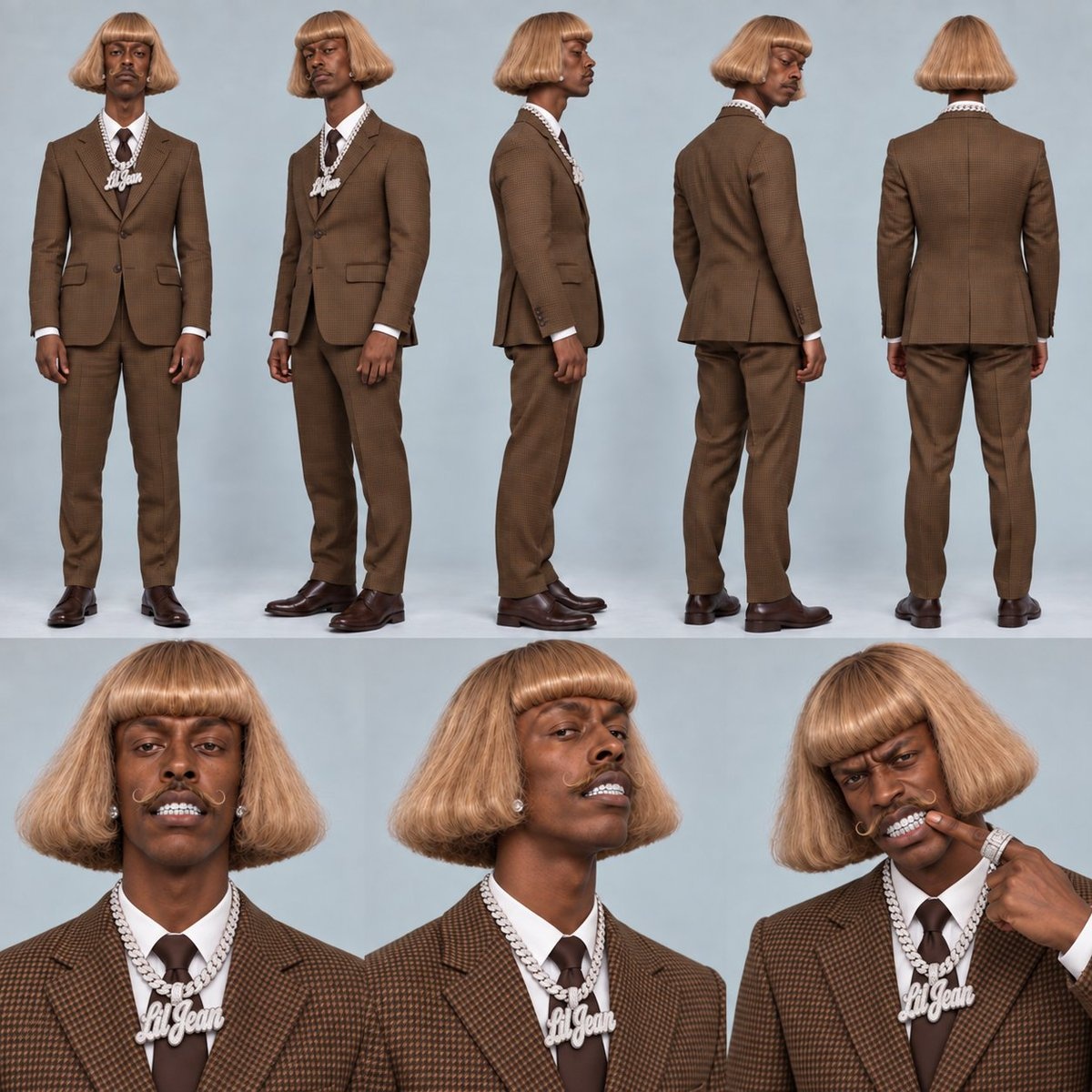
One wide image with two rows.

TOP ROW — FIVE FULL-BODY VIEWS:
1. front
2. three-quarter front
3. side profile
4. three-quarter back
5. back

Keep:
- same scale
- same outfit
- same relaxed standing pose
- full body visible from head to toe

BOTTOM ROW — THREE CLOSE-UPS:
6. neutral front headshot
7. three-quarter headshot
8. signature expression

PHOTOGRAPHY:

Use the same:
- plain seamless light-grey studio background
- soft diffused studio lighting
- lens perspective
- colour balance
- image quality

REALISM:

Maintain:
- natural skin pores
- tiny imperfections
- realistic facial asymmetry
- individual hair strands
- realistic fabric texture
- realistic jewelry/glass reflections
- natural human proportions

CONSISTENCY:

No:
- face drift
- changing jaw
- changing nose
- changing skin tone
- changing hairstyle
- changing hairline
- changing facial hair
- changing glasses
- changing body proportions
- changing outfit
- extra jewelry
- duplicate accessories

No text.
No labels.
No logos.
No watermark.

The final result should look like the same real person photographed eight times during one studio session.
keep regenerating until the entire panel fits your idea and every angel looks the same.
2. SETTING UP THE AUDIENCE
if you’re outside America and want to run the account for a US audience, this is the setup to use:
-
get a cheap used iPhone and factory reset it.
-
set the region to United States.
-
remove the SIM, skip Apple ID initially and turn off location, Bluetooth, tracking, Siri and Screen Time.
-
connect a residential US proxy through Shadowrocket BEFORE installing TikTok/Instagram.
-
create a fresh email through Safari and use it for a new Apple ID.
-
set Language & Region → United States and use a US timezone. I normally use Eastern Time.
-
download TikTok and start signup with the fresh email. before finishing, tap the phone-number option once. if it automatically shows +1, that’s the quick check I use to see whether the signup flow is reading the setup as US.
-
switch back to email and finish creating the account.
I don’t immediately start posting. I spend roughly four days using the account first, which gives me time to train the FYP for the next step.
none of these settings magically make bad videos reach Americans. the content still has to perform.
3. THE CONTENT
right now, I would not overthink niches.
look at the viral AI characters already blowing up. the videos are random as fuck. one clip can be dancing, the next can be somebody talking in a car, the next can be a completely different viral situation.
the character is what connects the account.
so I’d train the FYP around finding videos that would actually be interesting with your character swapped into them.
follow accounts that consistently post viral short-form content. watch the videos properly, like/save the good ones and keep searching until your FYP starts feeding you more of the same.
then start downloading winners. hundreds of thousands of views is good. millions is even better.
if you’re sitting inside ChatGPT asking it for “50 viral content ideas” while TikTok is literally showing you videos with 5M, 10M and 20M views for free, your research process is backwards.
I’d keep the research extremely simple:
- find viral videos
- download them
- swap your character
that’s it.
you’re building a library of videos people already proved they want to watch, then asking whether putting YOUR character inside them would make sense.
later, when this gets way more mainstream, I’m sure people will start building niche-specific characters and testing much more deliberate content strategies.
right now, you don’t need to force that.
4. MAKING THE VIDEOS
now take one of those viral videos and swap your character into it.
this is where Higgsfield Genjutsu gets ridiculous because you’re giving it both sides of the problem:
-
@image1 = who the new person is
-
@video1 = everything about the original video
the video already gives you the motion, timing, camera, performance, scene and audio. the character image gives it the identity that needs to replace the original person.
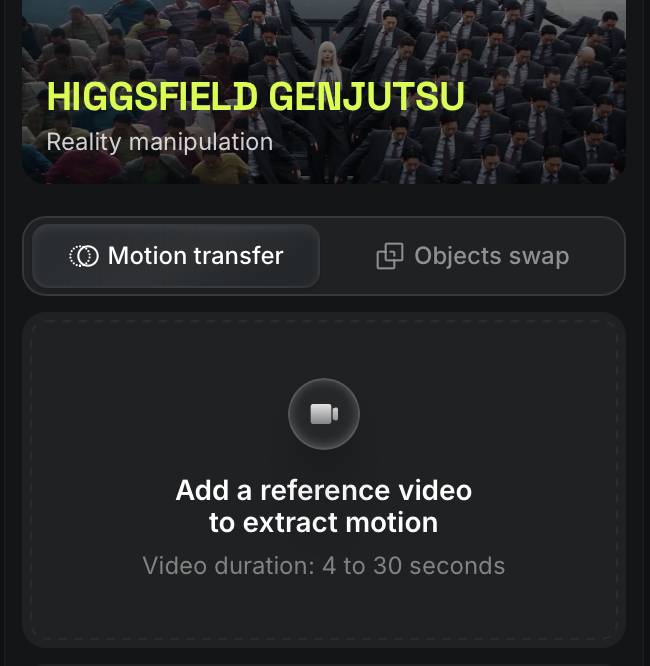
this is one of my actual prompts:
Use @image1 as the ONLY character identity reference.

Use @video1 as the complete motion, performance, camera, timing, audio, environment, and scene reference.

GOAL:
Replace the original person in @video1 with the character from @image1 while preserving the original video as closely as physically possible.

CHARACTER IDENTITY — LOCK THIS:
The replacement character must remain the exact same person from @image1 throughout the entire video.

He is:
- a tall, slim Black man
- realistic natural dark-brown skin
- distinctive straight blonde bowl/bob haircut with blunt bangs and outward-curving sides
- thin curled blonde mustache
- long narrow face and lean facial structure
- brown checked tailored suit
- white dress shirt
- dark brown tie
- polished brown dress shoes
- ONE diamond Cuban-link chain only
- diamond pendant reading “Lil Jean”
- diamond grill/iced-out teeth visible naturally whenever his mouth opens
- realistic human proportions

Do not redesign, beautify, stylize, simplify, exaggerate, or reinterpret him.

His facial identity, haircut, mustache, skin tone, body proportions, outfit, jewelry, and overall appearance must remain consistent in every frame and from every camera angle.

PERFORMANCE TRANSFER:
Copy the original performer in @video1 as precisely as possible.

Preserve:
- exact body movement
- exact choreography
- exact walking/running/dancing motion
- exact body timing
- exact head movement
- exact hand and finger movement
- exact gestures
- exact posture
- exact facial expressions
- exact eye direction
- exact blinking behavior
- exact emotional performance
- exact interaction with objects and other people
- exact positioning within the frame

The new character should appear to have genuinely performed the original scene himself.

Do not create new gestures or modify the performance.

FACE + SPEECH:
Transfer the original speaking performance with extremely accurate facial animation.

The character's mouth must synchronize precisely with the original audio:
- phoneme-level lip synchronization
- correct mouth shapes for every spoken sound
- correct jaw motion
- correct tongue/lip behavior where visible
- natural cheek movement
- natural facial muscle movement
- natural breathing
- subtle microexpressions

When his mouth opens, maintain his recognizable diamond grills naturally inside his mouth.

The grills must move correctly with his teeth and jaw and must never look pasted onto the image.

When his mouth is closed, his lips should close naturally.

Do not distort his face to achieve lip sync.

AUDIO:
Preserve the ORIGINAL AUDIO from @video1 exactly.

Do not:
- replace the voice
- regenerate dialogue
- modify pitch
- modify timing
- change cadence
- change sound effects
- change music
- change ambient sound

The generated character's visual performance should synchronize to the existing audio.

SCENE PRESERVATION:
Keep the original @video1 environment essentially unchanged.

Preserve:
- exact background
- exact location
- exact people in the background
- exact props
- exact objects
- exact furniture
- exact architecture
- exact lighting
- exact shadows
- exact time of day
- exact weather if applicable
- exact camera angle
- exact framing
- exact lens perspective
- exact camera movement
- exact zoom
- exact focus behavior
- exact depth of field
- exact shot duration
- exact cuts and transitions

Do not rebuild or reinterpret the scene.

Only replace the original main character.

PHOTOREALISM:
The final character must look like a real human filmed by the same camera as the source footage.

Prioritize:
- natural skin pores
- subtle skin texture
- realistic facial asymmetry
- tiny wrinkles and expression lines
- realistic eyes with natural moisture and reflections
- individually defined hair strands
- natural cloth movement and wrinkles
- realistic jewelry reflections
- physically accurate shadows
- correct motion blur
- correct exposure
- correct depth of field
- correct film/video noise
- correct compression characteristics
- realistic interaction between the character and surrounding light

Match the source video's image quality rather than making the character unnaturally clean, glossy, cinematic, or AI-perfect.

TEMPORAL CONSISTENCY:
Maintain perfect identity consistency frame-to-frame.

No:
- facial morphing
- changing face shape
- changing skin tone
- changing hairstyle
- disappearing hair
- hairstyle flickering
- changing mustache
- changing jewelry
- duplicate chains
- changing pendant design
- changing clothing
- changing body proportions
- extra fingers
- warped hands
- unstable teeth
- disappearing grills
- flickering grills
- clothing texture flicker
- jewelry flicker

The “Lil Jean” pendant should remain one consistent physical object attached to one chain throughout the video.

OCCLUSIONS + MOTION:
When the character turns, moves quickly, crosses objects, leaves frame, becomes partially hidden, or changes lighting, reconstruct him consistently according to @image1.

Respect realistic depth and occlusion.

Hands, clothing, hair, chain, pendant, and body must respond naturally to momentum and gravity.

The chain should exhibit subtle physically realistic secondary motion rather than remaining rigid.

FINAL PRIORITY ORDER:
1. Preserve the exact original performance and timing from @video1.
2. Preserve exact synchronization with the original audio.
3. Preserve the exact character identity from @image1.
4. Preserve the original environment and camera.
5. Maintain maximum photorealism and temporal consistency.

The result should look like the character from @image1 was physically present during the original shoot and performed the original scene himself.
obviously replace the CHARACTER IDENTITY block with your own character.
I make the prompt this detailed because there are a stupid number of things the video model can accidentally change. the face, hair, jewelry, timing, lip sync, background and even little details between frames can drift if you give it too much freedom.
still inspect every generation. if the mouth is off, the face changes at one angle, the hair flickers or the model randomly creates a second chain, fix the failure and run it again.
then make more.
you’re trying to give the character enough proven videos to find out whether people actually start caring about them.
5. MONETIZING THE CHARACTER
getting 10M views with absolutely nothing to sell on the account is one of the dumbest ways to waste attention.
there are a bunch of ways to monetize this. which one makes sense depends on what you know, and what audience the character ends up attracting.
1. SELL THE METHOD
if people are fascinated by how the character was made, this is probably the easiest place to start.
I would not hide that the character is AI.
literally put this in the bio:
AI CHARACTER learn how to make your own AI characters > xyz com
somebody watches one of the videos, realizes the guy isn’t real, gets curious about how you made him and clicks the profile.
your product answers the question already in their head.
teach the exact process: designing the character, making the reference sheet, finding viral videos, swapping them with Higgsfield, fixing generations and eventually automating the operation.
the account itself is the proof.
2. AFFILIATE / CPA OFFERS
if there’s an offer that naturally fits the audience, send traffic into that.
if the audience is mostly interested in AI, AI tools/products make sense. if the character eventually develops another obvious audience, use offers that fit them instead.
3. BUILD YOUR OWN PRODUCT
you can also use the character as distribution for something you own.
app, digital product, membership, physical product, community, whatever.
once the account has attention, you have somewhere to launch things without starting distribution from zero every time.
4. BRAND DEALS
if the account gets big enough, brands can pay to get their product into the videos.
work the product into the same style of videos people already follow the character for instead of randomly turning the account into boring sponsor content.
5. SELL THE SYSTEM TO BRANDS
this could become one of the higher-ticket options.
build one successful character yourself and now you have an actual case study.
instead of explaining to a brand what an AI-character account could look like, show them the one you already built and offer to do the same thing for them.
character design, research, production, account operation, whatever parts you want to sell.
6. CREATOR REWARDS
platforms and tools sometimes pay creators directly for qualifying content/views.
if something you already use has a rewards program, check the current terms and take advantage of it.
I just wouldn’t make the entire business depend on a program another company can change whenever they want.
6. ONCE IT WORKS, AUTOMATE THE SH*T OUT OF IT
don’t automate this before you know the character can actually pull attention. people love building insane agent systems around businesses that haven’t proven anything yet, then wonder why their beautifully automated machine is producing content nobody wants.
once you’ve manually done enough reps to understand what a good reference looks like, which videos work with the character and what normally breaks during generation, start removing the repetitive parts.
research is the obvious first target. have an AI/browser workflow keep finding viral videos, downloading the strongest candidates and saving the useful information somewhere for you to approve. once you approve one, most of the production setup is already repeatable because the character sheet, identity and generation rules stay the same.
then feed your own performance data back into the research. if videos with certain movements, settings, lengths or openings consistently outperform everything else, have the system look for more references with those characteristics.
that’s when automation becomes useful: after the account has given you actual evidence about what deserves to be automated.
to summarize
I’d get the character right first, build the reference sheet, set up the account, and start collecting viral videos immediately.
then I’d make as many of those videos as I can. once the account is consistently doing 50k+ views per post, I’d start putting whatever product I want behind the attention and monetizing it.
I’ve handed you the entire playbook on a silver platter. and no, I’m not selling you shit. this post also was NOT sponsored by Higgsfield (I wish it was).
so if this helped, I’d at least appreciate a follow :)