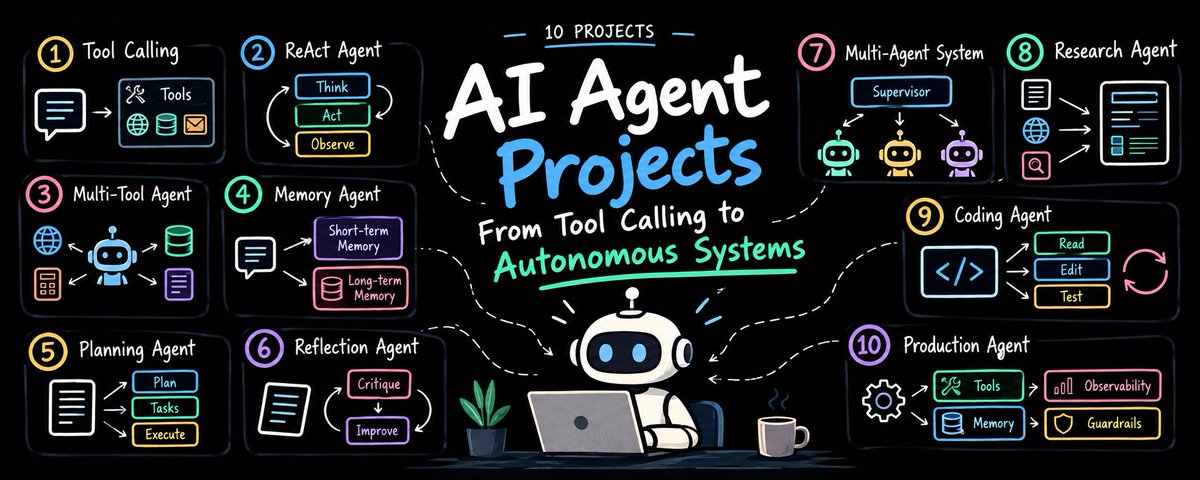
10 AI Agent Projects That Take You From Tool Calling to Autonomous Systems
文章目录
If you're learning AI agents, don't build another chatbot that calls one function. A tool call is useful for understanding the basics, but real agentic systems involve much more:
• How does the agent decide which tool to use?
• How does it remember previous interactions?
• How does it break a complex task into smaller steps?
• How does it recover when a tool fails?
• How does it verify its own work?
And how do multiple agents collaborate without turning the system into an unpredictable mess?
The best way to understand these concepts is to build them.
Here are 10 projects that take you from a simple tool-calling agent to a production-oriented agentic system.
1. Tool-Calling Agent
The problem
An LLM can generate text, but it can't directly interact with your application. You need a mechanism that allows it to call functions such as:
-
get_weather()
-
search_database()
-
send_email()
-
create_ticket()
What you'll build
Build an agent that receives a request, decides whether a tool is required, calls the appropriate function, and uses the result to generate its response.
User
 |
 v
LLM
 |
 +---- No Tool ----> Response
 |
 +---- Tool Needed
          |
          v
      Tool Call
          |
          v
       Result
          |
          v
         LLM
          |
          v
       Response
Stack
Python · OpenAI · Function Calling · Pydantic
What you'll learn
The fundamental difference between an LLM that generates text and an agent that can take actions.
2. ReAct Agent
The problem
Some tasks cannot be solved with a single tool call. The agent needs to reason about what it knows, take an action, observe the result, and decide what to do next.
What you'll build
Implement a ReAct-style loop:
Think
  ↓
Act
  ↓
Observe
  ↓
Think
  ↓
Act
  ↓
Observe
  ↓
Answer
For example:
"Find the latest price of X, compare it with last month's price, and calculate the percentage change."
The agent may need several actions before it can answer.
Stack
Python · OpenAI · LangGraph · Function Calling
What you'll learn
How agents can operate as iterative loops instead of simple request-response pipelines.
3. Multi-Tool Agent
The problem
A useful agent rarely has just one tool. It might have access to:
-
A database
-
Web search
-
Calculator
-
Internal APIs
-
File storage
-
Email
-
Calendar
The challenge becomes deciding which tool to use.
What you'll build
Give an agent multiple tools and let the model select the appropriate one based on the user's request.
                         User
                          |
                          v
                         Agent
                    /      |      \
                   /       |       \
               Search    Database  Calculator
                  |         |          |
                  +---------+----------+
                            |
                            v
                         Answer
Stack
Python · OpenAI · LangGraph · Pydantic
What you'll learn
Tool selection, tool schemas, structured inputs, and how to design tools that an LLM can reliably use.
4. Memory Agent
The problem
Most agents are effectively stateless. Start a new conversation and the agent doesn't know:
-
Who you are
-
What you discussed previously
-
Your preferences
-
What decisions were made
-
What information is worth remembering
What you'll build
Give your agent memory.
Start with conversation history, then introduce long-term memory stored outside the LLM context.
User
 |
 v
Agent
 |
 +---- Short-Term Memory
 |       |
 |       v
 |   Conversation
 |
 +---- Long-Term Memory
         |
         v
     Memory Store
         |
         v
      Retrieval
Stack
Python · OpenAI/Ollama · SQLite/PostgreSQL · Embeddings
What you'll learn
The difference between context and memory, memory retrieval, memory storage, and deciding what information should persist.
This is also a natural project to extend into semantic memory, episodic memory, and user profiles.
5. Planning Agent
The problem
Some tasks are too complex to solve in one step.
Consider:
"Research three cloud providers, compare their pricing, evaluate their features, and create a recommendation report."
A single tool call isn't enough. The agent needs a plan.
What you'll build
Create an agent that decomposes a high-level goal into smaller tasks.
                    Goal
                     |
                     v
                  Planner
                     |
          +----------+----------+
          |          |          |
          v          v          v
       Task 1     Task 2     Task 3
          |          |          |
          +----------+----------+
                     |
                     v
                  Results
                     |
                     v
                  Synthesis
Stack
Python · LangGraph · OpenAI · Pydantic
What you'll learn
Task decomposition, dependency management, sequential versus parallel execution, and plan execution.
6. Reflection Agent
The problem
An agent can produce an answer that looks convincing but is incomplete or incorrect. Instead of immediately returning the result, what if the system could critique its own work?
What you'll build
Create two stages: Generator → Critic → Revision
Task
 |
 v
Agent
 |
 v
Draft
 |
 v
Critic
 |
 +---- Good ------> Final Answer
 |
 +---- Needs Work
          |
          v
       Revision
          |
          v
        Critic
The critic might check:
-
Missing information
-
Incorrect reasoning
-
Unsupported claims
-
Formatting requirements
-
Task completion
Stack
Python · OpenAI · LangGraph
What you'll learn
Evaluation loops, iterative refinement, structured feedback, and why "generate once" isn't always enough for complex agent tasks.
7. Multi-Agent System
The problem
Some tasks naturally break into different areas of expertise. Instead of building one massive agent with dozens of tools, you can create specialized agents.
For example:
                    Supervisor
                  /     |      \
                 /      |       \
                v       v        v
           Researcher  Coder   Reviewer
                |       |        |
                +-------+--------+
                        |
                        v
                     Final
What you'll build
• Create multiple specialized agents coordinated by a supervisor
• A researcher gathers information.
• A coder implements something.
• A reviewer evaluates the result.
• The supervisor decides what happens next.
Stack
Python · LangGraph · OpenAI · Pydantic
What you'll learn
Agent coordination, delegation, state management, communication between agents, and the trade-offs of multi-agent architectures.
8. Research Agent
The problem
A normal chatbot answers from its existing knowledge. A research agent needs to gather information before answering.
It may need to:
-
Search multiple sources
-
Open documents
-
Extract relevant information
-
Compare sources
-
Resolve conflicting information
-
Produce citations
What you'll build
Build an agent that can autonomously perform multi-step research.
User Question
      |
      v
Research Agent
      |
      +---- Search
      |
      +---- Open Sources
      |
      +---- Extract Evidence
      |
      +---- Compare
      |
      +---- Verify
      |
      v
  Final Report
Stack
Python · LangGraph · OpenAI · Search API · Pydantic
What you'll learn
Agentic search, source selection, evidence gathering, citation handling, and research workflows.
9. Coding Agent
The problem
Writing code is only one part of software engineering. A useful coding agent needs to understand an existing codebase, modify files, run tests, inspect failures, and iterate.
What you'll build
Give an agent controlled access to a development environment.
              Task
                |
                v
            Coding Agent
                |
        +-------+-------+
        |       |       |
        v       v       v
      Read    Edit    Execute
      Code    Code     Tests
        |       |       |
        +-------+-------+
                |
                v
             Failure?
             /      \
           Yes       No
            |         |
            v         v
         Fix Code   Complete
            |
            v
          Tests
Stack
Python · OpenAI · Git · Docker · pytest
What you'll learn
Tool-driven software development, codebase navigation, execution loops, test-driven verification, and agent safety boundaries.
10. Production AI Agent
The problem
Everything works in a demo. Then you put the agent into production.
Now you need to answer questions like:
-
What tools did it call?
-
How long did the task take?
-
Why did it fail?
-
How many tokens did it consume?
-
Which model was used?
-
How often does it retry?
-
What happens when a tool is unavailable?
-
Can we reproduce an incident?
The production problem isn't just intelligence. It's control and observability.
What you'll build
Combine the concepts from the previous projects into a production-oriented agent.
                         User
                          |
                          v
                    Agent Gateway
                          |
                          v
                     Orchestrator
                          |
        +---------+-------+-------+---------+
        |         |               |         |
        v         v               v         v
     Memory    Tools           Retrieval  Planning
        |         |               |         |
        +---------+-------+-------+---------+
                          |
                          v
                       LLMs
                          |
                          v
                     Verification
                          |
                          v
                       Response

          +--------------------------------+
          |        Observability           |
          | Logs · Traces · Metrics · Eval |
          +--------------------------------+
Stack
Python · LangGraph · OpenAI · PostgreSQL · Redis · Docker · OpenTelemetry
What you'll learn
The difference between building an agent demo and engineering an agent system.
You'll also have to think about:
-
Timeouts
-
Retries
-
Tool permissions
-
Human approval
-
Cost limits
-
State persistence
-
Observability
-
Evaluation
-
Security
The Bigger Picture
These aren't 10 completely separate types of agents. They're building blocks. A production agent might combine almost everything you've built:
                         User
                          |
                          v
                    Agent Gateway
                          |
                          v
                      Planner
                          |
             +------------+------------+
             |            |            |
             v            v            v
          Research      Tools       Memory
             |            |            |
             +------------+------------+
                          |
                          v
                     Verification
                          |
                     +----+----+
                     |         |
                   Pass      Fail
                     |         |
                     v         v
                  Response   Re-plan
And that's the progression I'd focus on when learning agents:
Tool Calling
↓
Reasoning Loops
↓
Multiple Tools
↓
Memory
↓
Planning
↓
Reflection
↓
Multi-Agent Collaboration
↓
Autonomous Research
↓
Coding Agents
↓
Production Agent Systems
The goal isn't to build an agent that looks autonomous in a demo.
The goal is to understand when an agent should act, what it should be allowed to do, how it should remember, how it should recover, and how you can verify what it did.
That's where AI agent engineering starts getting interesting.