eXtreme Programming, revisited for the age of coding agents
文章目录
I don't remember why anymore, but in early 2000 I managed to be one of the first subscribers to the original XP mailing list. As a result, Ross Rankin and I decided to make his startup Media Ocean the first company in Atlanta, Georgia to fully embrace eXtreme Programming. We had pairing stations, wrote our tests first, played the planning game, and faithfully did standup meetings for years, eventually growing to dozens of engineers. As a result of that, on a freezing cold winter night in December 2000, Paul Gale, Chris Gardner, Andrew Fuqua, and I founded the Atlanta XP User Group. It was very successful, and in 2003 I hosted a gathering that changed my life. We took Martin Fowler out to dinner, and he encouraged me to join ThoughtWorks, where I was hired not too long afterwards.
Most of the projects in my career since then have been managed using XP of some flavor or another. Over the years, I was able to meet or work with a many XP legends such as Kent Beck and Ron Jeffries, and even got to pair with Ward Cunningham. (Yes, my number is zero.) I even hired Robert Martin himself to mentor my team at Hashrocket. In other words, I experienced the rise (and fall) of XP and Agile up close, and it shaped how I think about building software more than anything else in my career.
That history makes me quite convinced about the moment we are currently experiencing, as someone who was in the room the last time our industry completely reinvented itself.
We're the cartoon character who ran off the cliff and hasn't looked down yet. Everyone has gained these amazing magical powers of creation and is generating way too much code, everywhere, all at once. And from what I'm hearing, almost every software development team out there is currently arguing about whether to slam their foot on the gas or slam on the brakes, and some of them are doing both at once! People are scared, and plenty of them have good reason to be.
I've seen this before. As they say, history doesn't repeat, but it rhymes.
The software development landscape in Y2k
The first and favorite boogeyman for XP early adopters in the corporate world was Big Design Up Front (BDUF). Teams doing "waterfall" spent months on requirements that were already out of date by the time they were tossed "over the wall" to the programmers. Feedback cycles were measured in years. Programmers had no say in designing the systems they implemented, that was the job of analysts and architects in their castle towers.
Ironically, the second mess addressed by XP was far more common, but hardly anyone talks about it anymore. Most software in the 90s and 2000s got built with no process at all. It was the age of cowboys. I know, because before XP, I was one of them. Get stuff done, and throw it over the wall to QA. Assuming you had QA, otherwise you did it live in production and crossed your fingers.
Extreme Programming made a lot of sense by taking things that were considered "best practice" at the time and turning them up as far as they could go. For example, if testing is good, then test all the time (e.g. TDD). If code review is good, then review every line as it's written, which many people might not realize is what the purpose of full-time pair programming is. If integration is good, integrate continuously. If customer feedback is good, then get the customer (e.g. product owner or stakeholders) relocated into the same room as the programmers. And in the age of smelly fat neckbeards, that last tidbit was often met with extreme levels of resistance! But we were rebels fighting for sanity and results! Fighting the good fight, and it worked. And then Scrum ruined it all. And then ChatGPT happened, and now AGI (probably?), so we're in a singularity? And...
Hang on with that for a sec, cause guess what?
Both failures are back with a vengeance
The new BDUF is machine-generated plans that nobody reads. The other day I watched a friend scroll through page after page after page of AI slop in Confluence. He explained that nobody reads it, but inevitably someone directs Claude to turn the Confluslop into Jira epics and user stories. Which presumably is picked up by someone's Claude Code to actually do the work? Nobody knows, exactly. I got the impression everyone on his team just sits in front of the clanker and hits enter all day. They’re not particularly happy about it, but for six figures a year, I guess it's good while it lasts. They know it won't last long, cause it's nonsense.
The new wild west of no-software-process-development is nothing other than vibe coding. My books helped teach generations of programmers to value convention over configuration with Ruby on Rails. Coding agents have completely flipped that on its head, and even DHH himself is enthralled. Every developer (vibe or otherwise) now has an infinite amount of configuration knobs and switches living in who knows what amount of unstructured English prompts that they use to "create software" based on literally whatever the model decides to spit out that day. Ten developers with ten agents each, and an exponential explosion of architectural and design approaches to whatever they deliver. Sound familiar?
Those of you reading this that took the "engineer" part of your job title seriously are suffering. The rants are all over X and LinkedIn and every Slack across the world. These failures are the crisis of the moment in October 2026.
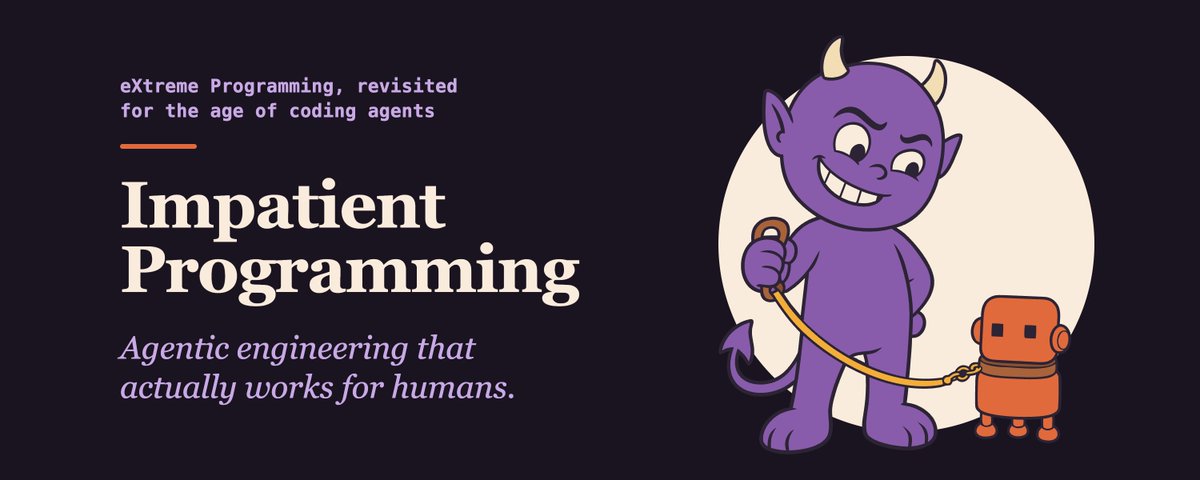
The good news is that despite the confusion everywhere, XP can inspire what comes next. Take what works, turn the dials up to 11, and give the result a catchy brand name people can rally around. I'm calling it Impatient Programming. IMP for short. Practitioners are Imps, and we keep our clankers on tight leashes. 😈
Want to learn more?
This article is only the first half of the intro. The rest is on the site: how pair programming, test-first, simple design and the planning game change once agents write most of the code, and the 29 rules that replace XP's, each set next to its 1999 original. Some smart people have already written essays telling me where I'm wrong, and we've published them. The site also has a slew of guardrail tools we have built at ZAR to keep our agents honest, plus a directory of hundreds more tools for every tech stack. It's all open now at https://impatientprogramming.org.