Arsenal Phases of play: A Framework for Understanding How Arsenal Play
文章目录
The Phase Matters More Than the Formation
One of the principles that repeatedly appears throughout elite coaching education is that the game should be understood through its different moments and phases aka Game states.
UEFA's recent technical work describes attacking organisation in terms of controlling the ball, creating dynamic patterns and attacking threat, while simultaneously maintaining rest defence.
Defensive transition demands quick reactions. Defensive organisation concerns the team's ability to establish a block, manage distances and recognise pressing or recovery triggers.
And attacking transition asks a much simpler question:
Can we exploit the moment before the opponent reorganises, or should we retain the ball?
This sounds obvious.
But it completely changes how I look at tactical analysis.
Instead of treating a team's shape as a static picture, I started treating it as a series of phase snapshots. That is what the following Arsenal analysis attempts to capture.
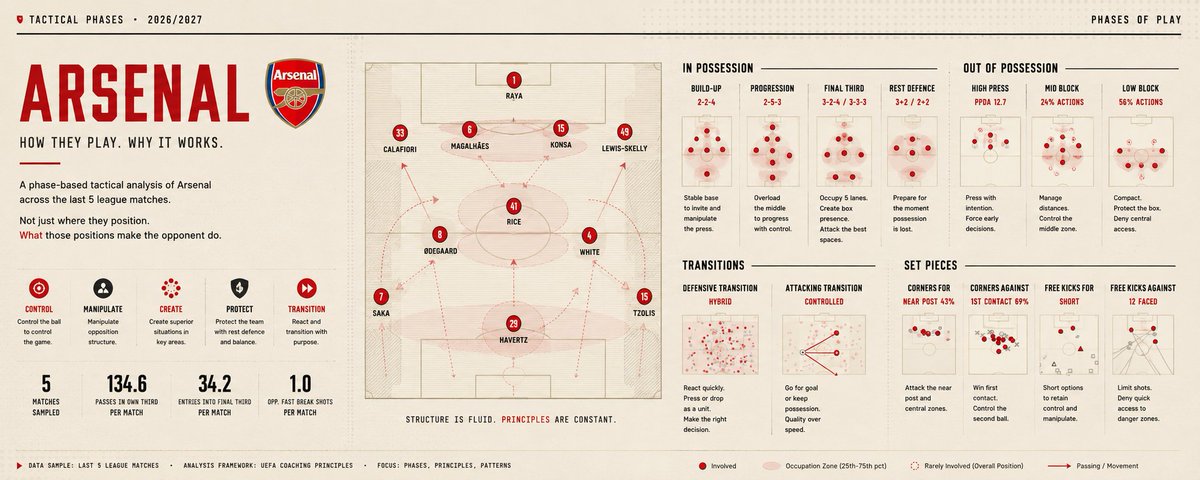
The sample is the last five league matches in the dataset, and the objective is not to claim that Arsenal permanently occupy these structures. It is to identify the recurring relationships.
- Build Up
Arsenal: 3-2-5 in theory but a 2-2-4 suggested through data...
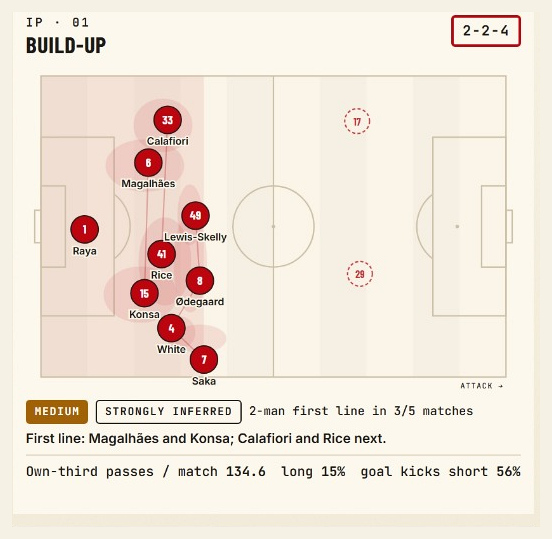
The first thing that stands out in Arsenal's build up is the creation of a relatively stable two-player first line. Across the sample, a two-man first line appeared in three of the five matches, with Gabriel Magalhães and Ezri Konsa forming the recurring base, while Calafiori and Rice provide the next layer.
But the interesting part isn't simply that Arsenal have two defenders at the base. It's what that structure allows the players ahead of them to do. The purpose of building from the back is not possession for possession's sake....it's about manipulating the opponent's defensive structure. UEFA technical analysis has repeatedly highlighted the value of building from the goalkeeper and defenders, and more recent UEFA coaching analysis describes how teams can use possession to draw opponents forward, invite pressure and then attack the space created beyond the first line.
That distinction matters, because the structure becomes a question of what the opponent gives you:
-
If the opposition presses the centre backs, Arsenal can look beyond them.
-
If the opposition protects the centre, Arsenal can circulate around it.
-
If the opposition refuses to engage, Arsenal can advance.
The numbers point to a clear intention. In this sample, Arsenal:
-
averaged 134.6 passes in their own third per match
-
played only 15% of those passes long
-
played goal kicks short 56% of the time
Arsenal are generally comfortable beginning the attack with the ball on the floor. But I think there's another layer here. The 3-5-2(2-2-4) shape can create what I'd call a potential invitation (lure) you show the opponent a pass, allow a pressing reference to move, wait for the defensive line to shift, and then attack the space created by that movement with the next pass. That is the difference between simply playing out from the back and actually using the build up to manipulate the opposition.
The data cannot, on its own, prove that every sequence is deliberately designed as a lure that requires video and sequence-level analysis. But structurally, Arsenal are creating the conditions for it, and that's where the tactical picture becomes much more interesting.
02. Progression
Arsenal: 2-5-3
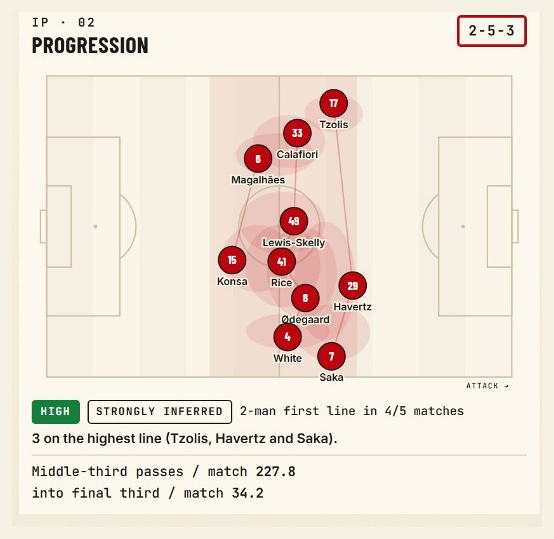
Once Arsenal escape the first line, the structure changes. The two at the base become part of a much broader five-player progression structure, and this is where the distinction between formation & occupation becomes really important. A 2-5-3 isn't interesting because it's written as "2-5-3" it's interesting because of what those five players are doing to the opponent's defensive references.
The midfield and attacking players begin occupying different vertical and horizontal relationships, with Tzolis, Havertz and Saka recording the highest involvement in this phase. Arsenal averaged 227.8 passes in the middle third and 34.2 final third entries per match – which suggests a team that isn't simply trying to bypass the midfield, but to progress through it.
This is where positional play becomes useful. The objective isn't necessarily to have every player standing in a fixed zone; it's to create passing options that force the opponent to make decisions:
-
Who jumps?
-
Who stays?
-
Who tracks the midfielder?
-
Who protects the centre?
-
Who protects the winger?
Every movement creates another question. If one defender steps towards the ball, another space can appear. If a midfielder drops, another player can occupy the space he vacates. If the winger comes inside, the full back can potentially provide width. Open play becomes a chain reaction.
This is why I don't like describing positional systems purely through formations. The shape is the starting geometry the movements are what make the geometry alive.
- Final Third
Arsenal: 3-2-4 / 3-3-3
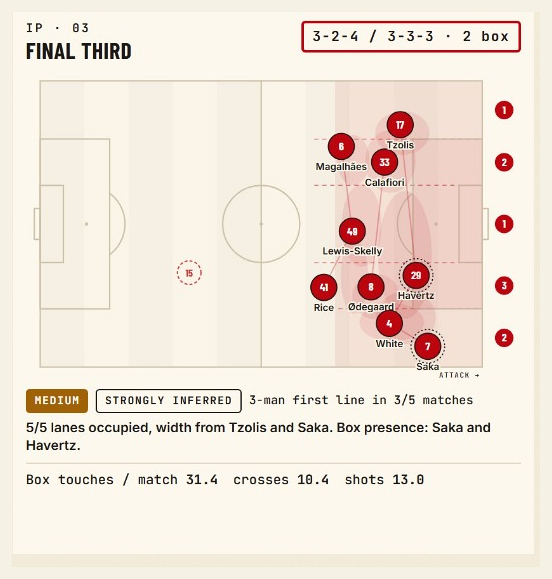
Now the structure changes again, with Arsenal moving towards a three-player first line and two players behind the attacking four. Across the sample, five attacking lanes were occupied in all five matches a detail that is perhaps more important than the formation itself.
Occupying the pitch properly creates a very simple problem for the opposition... you cannot defend every lane without giving something away. Width stretches, depth stretches, inside positions connect the two, and the box becomes the final destination. Tzolis and Saka provide box presence in the sample, and per match Arsenal averaged:
-
31.4 box touches
-
10.4 crosses
-
13.0 shots
This is where the earlier phases begin to make sense. The purpose of the build up is not merely to build, and the purpose of progression is not merely to progress. The purpose of occupying the final third is to create the conditions for penetration and penetration doesn't always mean a through ball. It can be....
-
a cross
-
a cutback
-
a third man
-
a dribble
-
a rotation
-
a switch
-
a pass around the corner
-
a run beyond
The important thing is that Arsenal are continually asking the defensive block to move, and once the block moves, another space becomes available.
- Rest Defence
Arsenal: 3+2 / 2+2
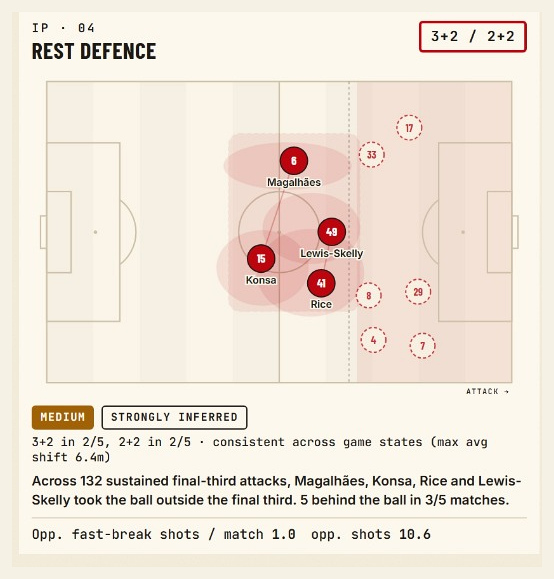
This might actually be the most important image in the entire report, because what Arsenal do without the ball while they still have the ball tells us a huge amount about their attacking philosophy.
Rest defence is often reduced to "who are the defenders left behind?" I think it's more useful to ask.... what has Arsenal prepared for the moment possession is lost? UEFA technical observers explicitly include rest defence within attacking organisation, while UEFA's work on counterpressing makes the point that good defensive structure while attacking is the baseline for controlling the opponent's counterattack.
In Arsenal's sample, the recurring structures were 3+2 and 2+2. Across 132 sustained final third attacks, Magalhaes, Konsa, Rice and MLS formed part of a last line of five in three of the five matches. That's significant, because it shows Arsenal aren't simply throwing numbers forward and hoping to recover the ball afterwards they're attempting to pre-construct the next defensive situation.
Think about it this way: the attack is happening now, but the rest defence is preparing for what happens next.
-
If the ball is lost on the right, who is close enough to the ball?
-
If the opponent plays around the press, who protects the central lane?
-
If the first pressure is beaten, who can defend the next pass?
-
If the opponent's striker receives, who is positioned to prevent him turning?
That's the hidden architecture of an attacking system. The attack and the defence aren't separate systems; they overlap.
In the sample, opponents produced just 1.0 fast break shot per match. That doesn't prove rest defence alone caused the number, but combined with the structural picture it's an important piece of evidence. Arsenal appear to be building attacks while simultaneously preparing the defensive platform required to sustain them.
- Defensive Transition
Arsenal: Hybrid
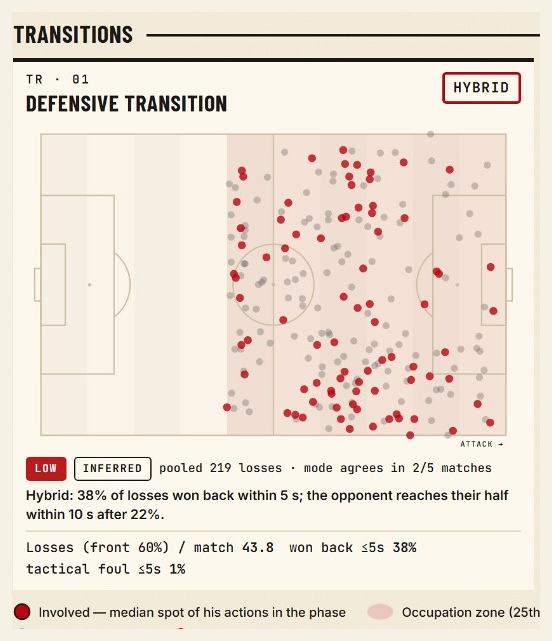
This is where the analysis gets more interesting, because Arsenal don't look completely like a pure counterpressing team in this sample. They look hybrid. Of 219 pooled possession losses:
-
38% were won back within five seconds
-
22% resulted in the opponent reaching the halfway line within ten seconds
Arsenal clearly attempt to react immediately after losing possession, but the reaction isn't necessarily "everyone press". Sometimes the correct decision is to press....sometimes it's to delay, recover, foul, or simply protect the centre. This fits closely with UEFA's description of defensive transition...'quick reactions from every player, followed by the decision to press or drop as a unit'.
That final phrase matters press or drop, not press regardless. The quality of a defensive transition isn't necessarily measured by how aggressively you press, but by whether the team makes the correct decision quickly enough.
That's why I'd describe Arsenal's defensive transition as hybrid rather than attaching a simplistic label such as "gegenpressing". The data suggests a team willing to attack the ball immediately, but equally willing to reorganise when the counterpressing conditions aren't favourable.
And that brings us to one of my favourite concepts in tactical analysis...'the trap'.
The Lure and the Trap
A lure is what happens before the opponent makes a decision. A trap is what happens after they make it.
Imagine Arsenal building with two centre backs. The opponent steps forward, the ball moves, and another Arsenal player becomes available. The opponent follows and suddenly the defensive block has shifted. The space Arsenal wanted wasn't necessarily the space occupied by the ball... it was the space created because the opponent reacted to the ball.
This is one of the reasons I find elite football so fascinating. The ball can be used as bait. A player can be used as bait. A passing lane can be offered deliberately. The opponent thinks they're closing a space, but their movement may actually be opening another. That's the essence of a tactical trap.
However, I want to be careful here. The images in this report can identify the structural conditions for a lure or trap, but they can't prove intention on every individual sequence. To prove that, I'd need to analyse the actual video...
-
What was the starting position?
-
Who moved first?
-
Which opponent was attracted?
-
Where did the space appear?
-
Where did Arsenal play next?
That's the next level of the framework. The numbers tell us what happens repeatedl... the video tells us why it happens.
- Attacking Transition
Arsenal: Controlled
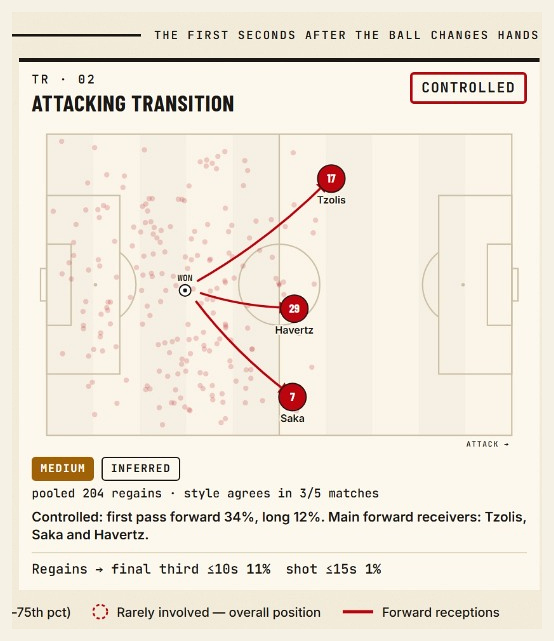
Interestingly, the same idea appears when Arsenal win the ball.... the instinct isn't always to attack immediately. Of 204 regains in the sample:
-
the first pass was forward 34% of the time and long only 12% of the time
-
11% reached the final third within ten seconds
-
just 1% produced a shot within fifteen seconds
The main forward receivers were Tzolis, Saka and Havertz. That's why I'd describe Arsenal's attacking transition as controlled.
UEFA describes attacking transition very simply 'go for goal or keep the ball'. That's actually a much deeper tactical decision than it sounds. The moment after winning the ball is often when the opponent is most vulnerable but it's also when your own team can be structurally vulnerable. Attack too quickly and you may lose the ball again..... slow the game down and the opponent gets time to recover. So the decision is contextual:
-
Where did we win it?
-
How many players are ahead of the ball?
-
Is the opposition disorganised?
-
Can we attack the space?
-
Or should we secure possession and begin another attack?
Arsenal's numbers suggest immediate transition is available to them, but it isn't their only solution. Again... control rather than chaos.
- High Press
PPDA: 12.7
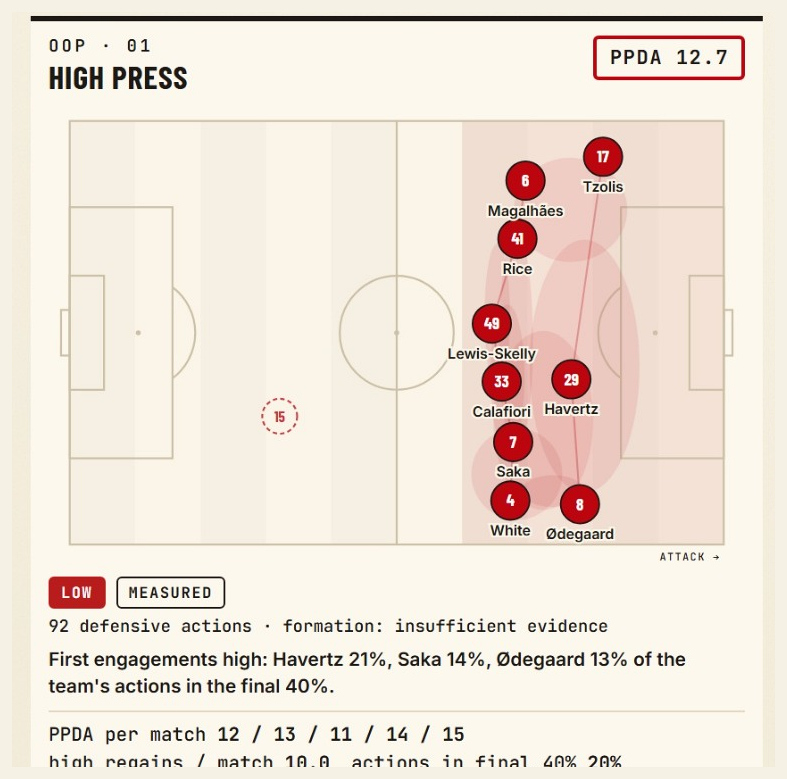
Now we flip the picture: Arsenal without the ball. The high press produced 92 defensive actions in the sample, although the data labels the formation evidence as insufficient to confidently classify the structure. That uncertainty is important I'd rather acknowledge what the data can't tell us than manufacture certainty.
What we can see is where the first engagements occur:
-
Havertz: 21%
-
Saka: 14%
-
Odegaard: 13%
Arsenal averaged 10 high regains per match, and 20% of defensive actions occurred in the final 40% of the pitch. So Arsenal clearly have a mechanism for defending high but I wouldn't describe them as a team that simply wants to stay permanently high. That would ignore the rest of the defensive data, which is where the next two phases become important.
- Mid Block
24% of defensive actions
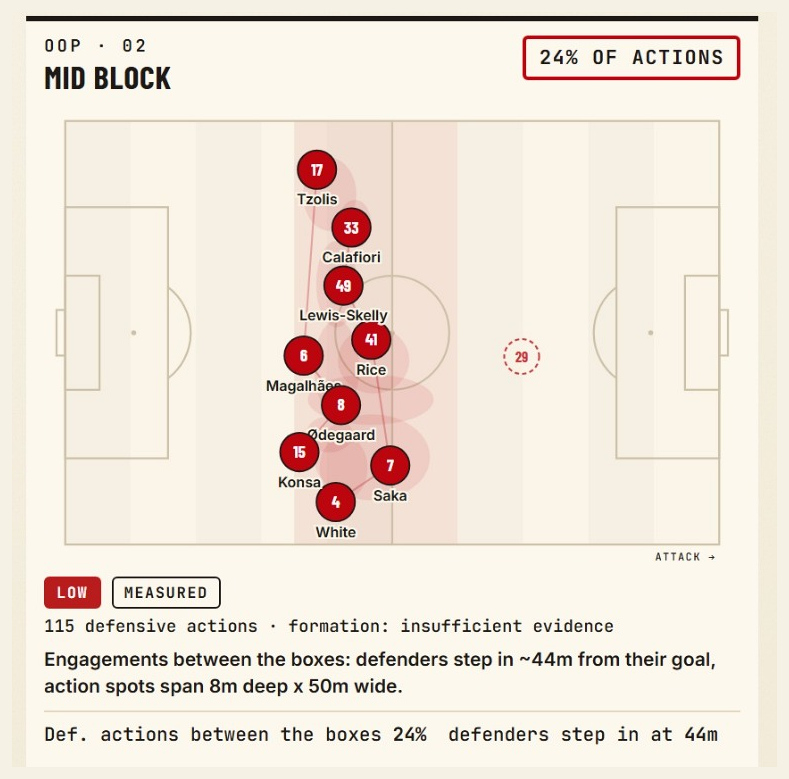
The mid block represents the space between Arsenal's high pressure and their deeper defensive organisation, and 24% of defensive actions occurred here. Defenders stepped in around 44 metres from goal, with action locations spanning roughly 8 metres vertically and 50 metres horizontally.
What interests me here is the idea of distance management. Defending isn't simply "go forward" or "drop back"; it's about maintaining relationships:
-
distance to the ball
-
distance to the opponent
-
distance between teammates
-
distance behind the defensive line
UEFA's description of defensive organisation places particular emphasis on these relationships, alongside recognising the triggers to press or recover. This is why compactness matters so much. A team can have eleven players behind the ball and still be easy to play through...equally, a team can defend relatively high and still be difficult to penetrate if the distances are right. The block is less about its absolute height and more about its connections.
- Low Block
56% of defensive actions
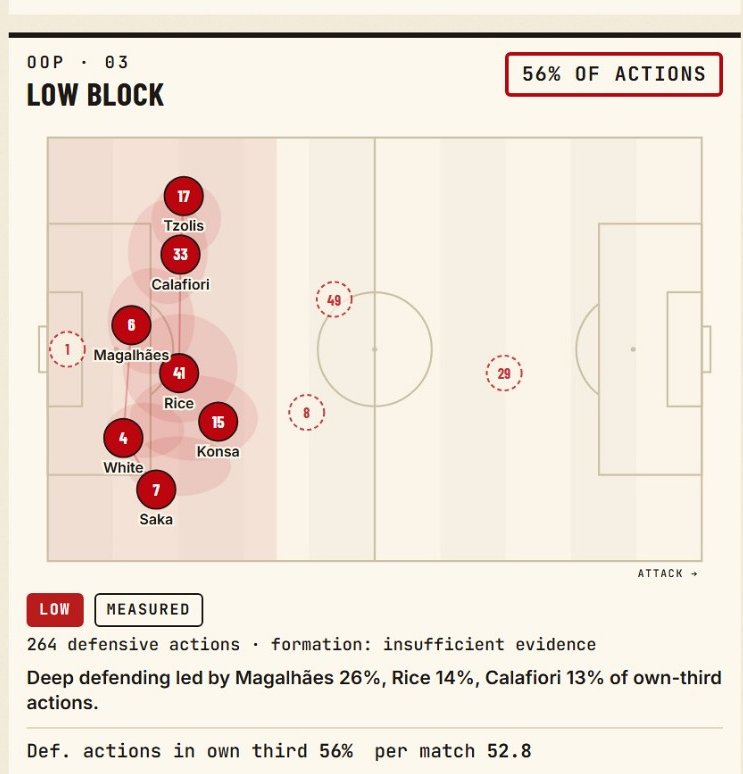
This was probably the most interesting defensive number for me... 56% of Arsenal's defensive actions occurred in their own third. That immediately challenges the simplistic idea that Arsenal are just a high-pressing team. They can press high, defend in the middle, and defend deep. Of the own-third actions:
-
Magalhaes: 26%
-
Rice: 14%
-
Calafiori: 13%
The point isn't that Arsenal suddenly become a "low block team". It's that their defensive model is elastic. Elite defensive organisation is rarely one fixed height...the questions are:
-
What is the game asking?
-
What is the score?
-
Where is the ball?
-
How much space exists behind?
-
What is the opponent's threat?
-
Can we engage, should we delay, or should we protect the box?
That's why I think the phase-based model gives a much better picture than simply saying "Arsenal press high". They do but they also recover, defend deep and manage space.
- Rest Offence
2 high outlets
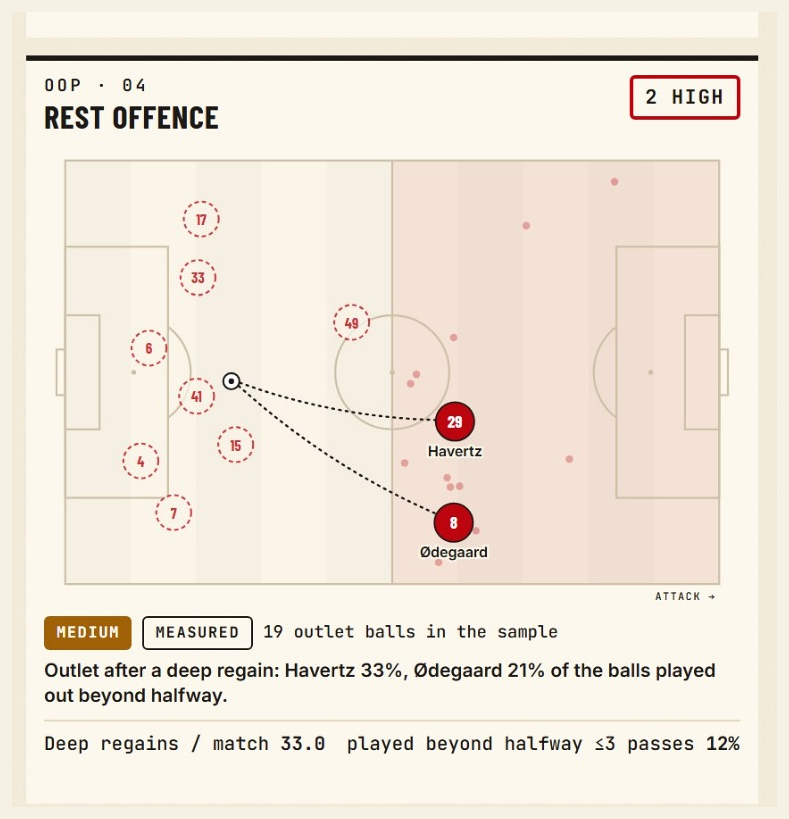
And now we arrive at the attacking equivalent of rest defence, which I call rest offence. If rest defence asks "what happens if we lose the ball?", rest offence asks "what happens if we win it?" When Arsenal recover the ball deep:
-
Who remains available to receive the first forward pass?
-
Who stretches the opposition?
-
Who gives the ball carrier an immediate outlet?
-
Who prevents the opponent from collapsing around the ball?
In the sample, Havertz accounted for 33% of outlet balls played beyond halfway after deep regains, and Odegaard 21%. Arsenal recorded 33 deep regains per match, yet only 12% were played beyond halfway within three passes.
Again, this reinforces the idea of controlled transition. The outlet exists, but it doesn't automatically mean "run" it means "now we have an option". That distinction is subtle, and it's exactly the sort of thing that disappears when tactical analysis becomes obsessed with formations.
- Set Pieces – Corners For
Near post 43% | Centre 30% | Far post 26% | Short 8%
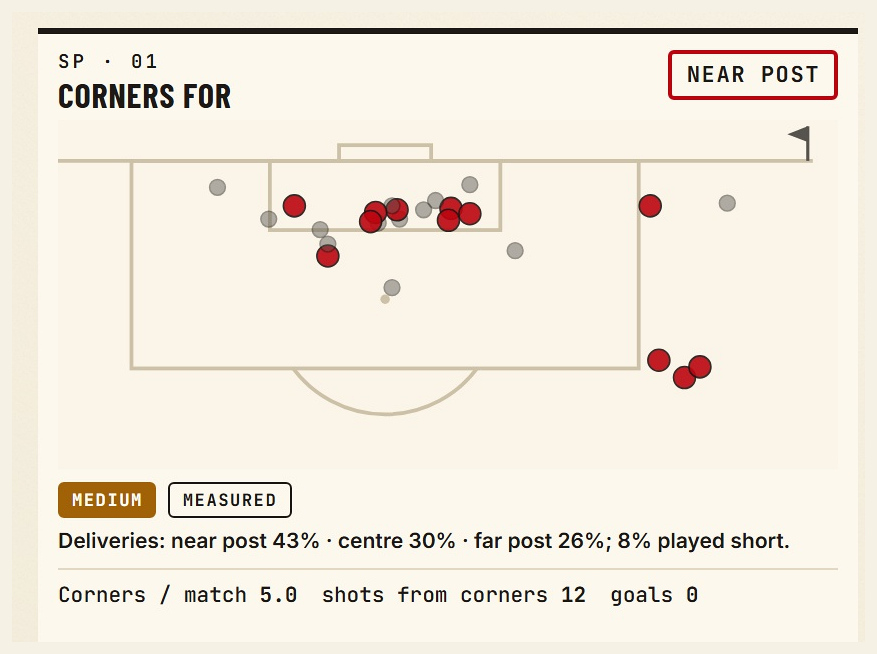
Arsenal's attacking corners show a preference for the near post (43% of deliveries), followed by the centre (30%), far post (26%) and short corners (8%). The sample produced 5.0 corners per match, with 12 shots and no goals from corners.
The important thing isn't to turn a small sample into a permanent tactical identity; it's simply another layer of the model. Set pieces are also about occupation where are the blockers, where is the first contact, who attacks the second ball, and who remains behind it? The phase changes, but the underlying questions don't.
- Corners Against
First contact: 69%
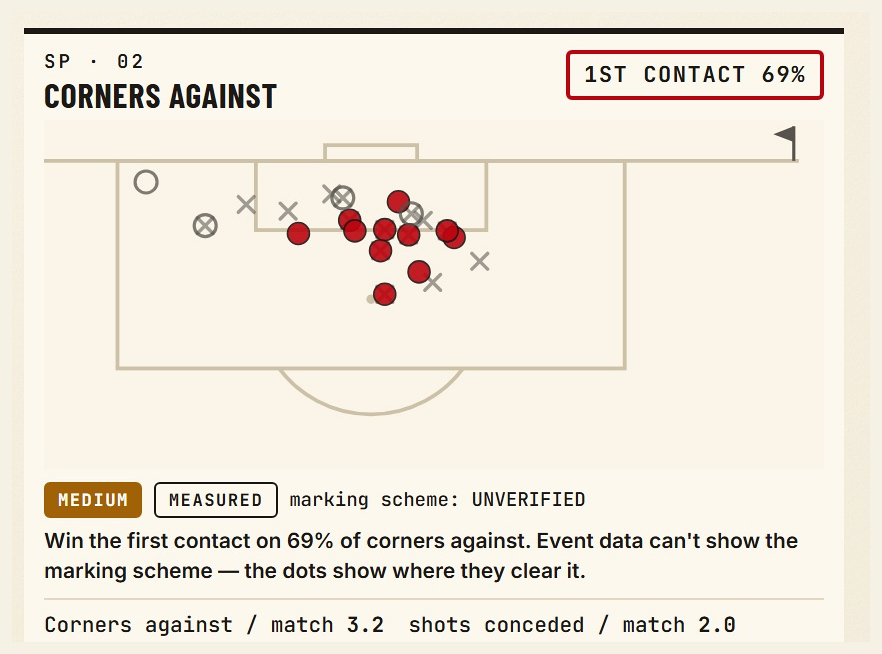
Arsenal won first contact on 69% of opposition corners in the sample. However, the marking scheme itself wasn't sufficiently verified, so I'd avoid making a stronger claim about whether the underlying structure was purely zonal, manoriented or hybrid. That distinction matters... good analysis isn't just about finding an interesting number, it's about understanding the limits of the number
- Free Kicks For
Predominantly short
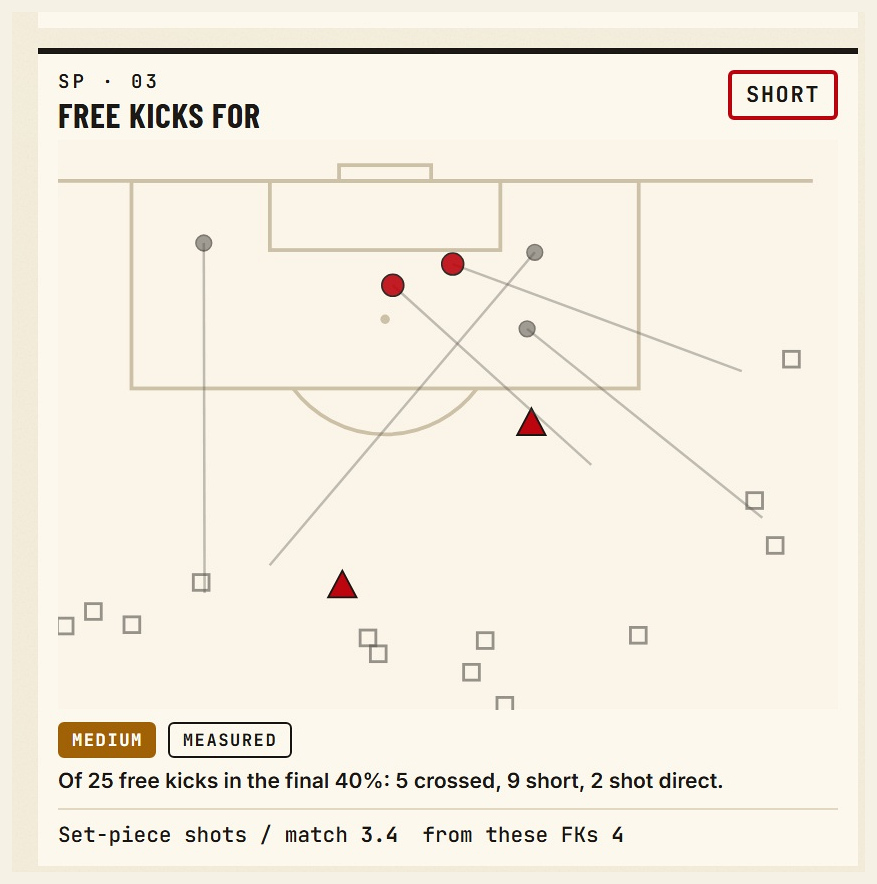
Of 25 final third free kicks in the sample, 9 were short, 5 were crossed and 2 were direct. This again points to a team that often sees the set piece as another opportunity to retain control and manipulate the opponent, rather than treating every dead ball as a delivery into the box. It's another small example of the broader philosophy: control creates possibilities.
- Free Kicks Against
12 faced | 4 produced a shot within 12 seconds
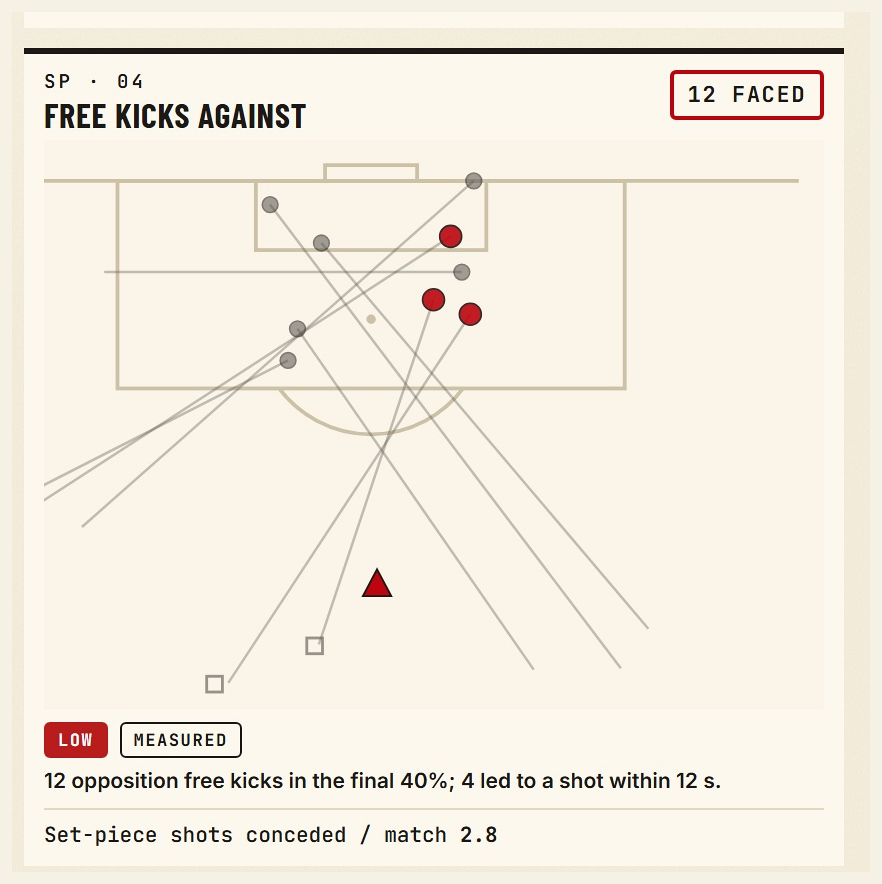
Finally, the defensive set-piece picture. Arsenal faced 12 opposition free kicks in the final 40%, and four led to a shot within twelve seconds. Again, the sample is small, but it raises another transition question what happens immediately after the first contact?
-
Can Arsenal clear?
-
Can they step out?
-
Can they win the second ball?
-
Can they prevent the opponent from sustaining the attack?
Even a set piece doesn't necessarily end when the initial delivery is dealt with. The next phase begins immediately.
So What Actually Is Arsenal's Game Model?
After looking at all of these phases together, I think the answer becomes much clearer. I don't think Arsenal's identity is best described by "4-2-3-1", "3-2-4-1", "high press" or "possession football". Those descriptions aren't necessarily wrong they're simply incomplete.
The more interesting description is this... Arsenal attempt to control the game by continually changing their structure while preserving their relationships.
-
Build up: 3-2-5
-
Progression: 2-5-3
-
Final third: 3-2-4 / 3-3-3
-
Rest defence: 3+2 / 2+2
-
Defensive transition: Hybrid
-
Attacking transition: Controlled
-
Out of possession: High block → Mid block → Low block
That isn't tactical inconsistency. It's tactical adaptation and perhaps the biggest lesson I took from this exercise.
The Shape Changes. The Principles Don't.
This is where I come back to a Leonardo da Vinci quote. Innovation isn't necessarily about inventing something completely new... sometimes it's about looking at something familiar from a different angle. Football has always had formations. What has changed is how much movement exists inside them.
A full back can finish an attack as a midfielder. A centre back can become a midfielder, a winger a striker, a striker a midfielder, and a midfield a back three. Five seconds later, possession is lost and the entire structure changes again.
So perhaps the real question isn't "what formation does Arsenal play?" but "what remains stable while the formation changes?"
For me, the answer is:
-
spacing
-
occupation
-
support
-
access to the next pass
-
rest defence
-
rest offence
-
the ability to adapt to the opponent's reaction
That's what makes the system coherent.
The Part I Find Most Interesting
There's a temptation in tactical analysis to give every team a single identity high-pressing team, possession team, transition team, low block team, direct team. But elite teams are increasingly difficult to describe that way, because the best teams aren't simply executing one behaviour. They're switching behaviours at the correct moment.
Arsenal can build patiently or accelerate. They can occupy all five lanes and attack the box. They can establish rest defence, counterpress, recover into a mid block or defend their own box. They can win the ball and attack immediately, or win it and start again. The intelligence is in knowing which one the situation requires.
That's also why I've deliberately included confidence levels throughout this analysis. Some observations are measured, some are inferred, and some are strongly inferred. A tactical analyst shouldn't pretend every conclusion carries the same level of certainty. Sometimes the most honest conclusion is.... "The data suggests this, but I need the video to prove why." I actually think that makes the analysis more interesting, because it gives us somewhere to go next.
A Final Thought
The more I study football, the more convinced I become that tactical analysis is less about finding the answer and more about asking better questions. Why did the centre back move there? Why did the midfielder drop? Why did the winger stay wide, or the full back move inside? Why did the opponent follow and why did Arsenal attack the space behind him? Why did they counterpress here but retreat there? Why was the rest defence positioned like that?
Those questions are where the game becomes fascinating. Somewhere between the formation on the team sheet and the movement on the pitch lies the actual football and that's the part I want to keep exploring.
The shape changes. The phase changes. The opponent changes. But the search for the next advantage never stops.