10 RAG Projects That Will Take You From Basic Retrieval to Production-Grade AI Systems
文章目录
If you're learning RAG, don't build another basic "chat with your PDF" application.
A basic RAG pipeline is useful for understanding the fundamentals:
Documents → Chunking → Embeddings → Vector Search → LLM
But that's only the beginning. Real-world RAG systems quickly run into harder problems:
• What if semantic search misses an exact keyword? • What if the user wants documents from a specific date or category? • What if the top retrieved chunks aren't actually the most useful ones? • What if the answer requires both structured database data and unstructured documents? • What if retrieval itself fails? • What happens when your system needs to work with tables, images, or multiple knowledge sources?
That's where things get interesting.
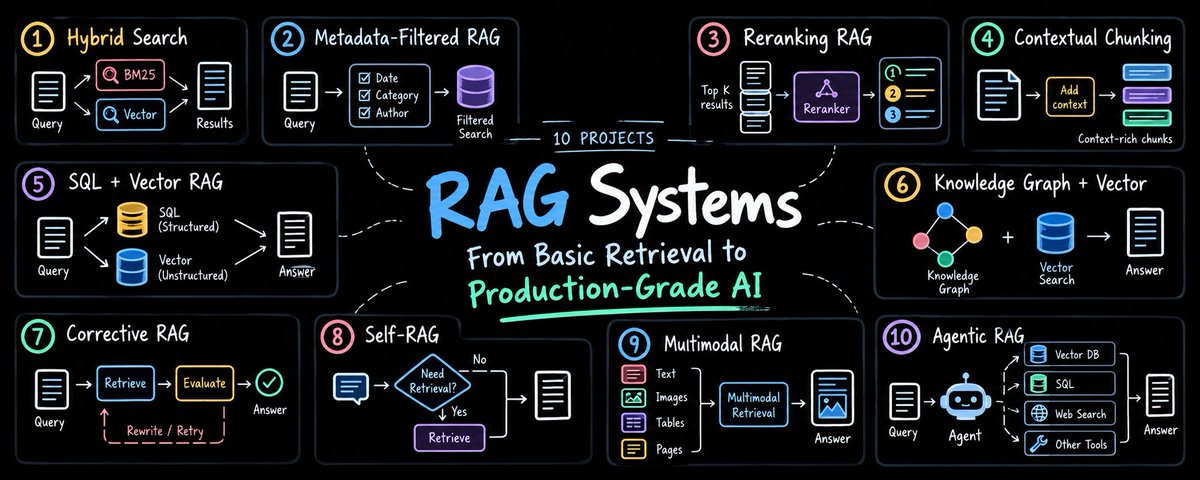
Here are 10 projects I'd recommend building if you want to move from basic RAG to production-grade AI systems.
1. Hybrid Search RAG
The problem:
Vector search is good at understanding semantic similarity. But sometimes the exact words matter. A search for a specific error code, product ID, API name, or technical term may work better with keyword search than pure semantic retrieval.
What you'll build
Combine BM25 keyword search with dense vector retrieval.
The system retrieves documents using both approaches and combines the results to produce a better candidate set.
For example:
User Query
    |
    +----> BM25 Search --------+
    |                          |
    +----> Vector Search ------+----> Combined Results
                                      |
                                      v
                                     LLM
Stack
Python · BM25 · Elasticsearch/FAISS · Sentence Transformers
What you'll learn
How lexical and semantic retrieval complement each other, and why production search systems often need more than one retrieval strategy.
2. Metadata-Filtered RAG
The problem
Semantic similarity alone isn't always enough.
Suppose a user asks:
"What changed in the authentication service in 2026?"
You don't want to search every document in your knowledge base.
You want to restrict retrieval to relevant metadata first.
What you'll build
Combine semantic search with filters such as:
-
Date
-
Category
-
Author
-
Department
-
Location
-
Document type
User Query
    |
    v
Metadata Filter
    |
    v
Vector Search
    |
    v
Relevant Context
    |
    v
LLM
Stack
Python · PostgreSQL · pgvector · Pydantic · OpenAI
What you'll learn
How structured filtering and semantic retrieval can work together.
3. Reranking RAG
The problem
Your vector database might return 20 seemingly relevant chunks. But relevance isn't binary. Some chunks are much better than others.
What you'll build
Retrieve a larger candidate set first, then use a reranker to score those candidates and send only the strongest results to the LLM.
Query
  |
  v
Retrieve 50 chunks
  |
  v
Reranker
  |
  v
Top 5 chunks
  |
  v
LLM
Stack
Python · FAISS/pgvector · CrossEncoder/Cohere Rerank · OpenAI
What you'll learn
The difference between retrieval and ranking, and why improving retrieval quality isn't always about changing your embedding model.
4. Contextual Chunking RAG
The problem
Traditional chunking can destroy context. Imagine a document contains:
Authentication Service Owner: Platform Team Region: India Version: 3.2
And you retrieve a chunk containing only:
"Version: 3.2"
The embedding has very little context to work with.
What you'll build
Add relevant document-level context to individual chunks before embedding them.
Document
    |
    v
Context Extraction
    |
    v
Context + Chunk
    |
    v
Embedding
    |
    v
Vector Database
Stack
Python · Docling · OpenAI/Claude · pgvector
What you'll learn
Why chunking is a retrieval problem, not simply a text-processing problem.
5. SQL + Vector RAG
The problem
Not every question belongs in a vector database.
Consider:
"How many customers upgraded to the Pro plan last month, and what are the most common complaints from those customers?"
The first part requires structured data.
The second part may require semantic search over support conversations.
What you'll build
Combine SQL queries with vector retrieval.
                  User Query
                       |
              +--------+--------+
              |                 |
              v                 v
           SQL Query       Vector Search
              |                 |
              +--------+--------+
                       |
                       v
                    Context
                       |
                       v
                      LLM
Stack
Python · PostgreSQL · pgvector · SQLAlchemy · LangGraph
What you'll learn
How to decide whether a question should be answered through structured querying, semantic retrieval, or both.
6. Knowledge Graph + Vector RAG
The problem
Vector search is excellent at finding similar information But similarity isn't the same as relationships.
Consider:
"Which services are affected if the payments service goes down?"
The answer may depend on explicit relationships between services.
What you'll build
Combine vector search with a knowledge graph.
          Vector Search
                  |
                  v
Question ----> Relevant Entities
                  |
                  v
             Knowledge Graph
                  |
                  v
             Relationships
                  |
                  v
                  LLM
Stack
Python · Neo4j · pgvector · OpenAI · LangGraph
What you'll learn
When semantic similarity is sufficient and when explicit relationships between entities provide additional value.
7. Corrective RAG
The problem
Most basic RAG pipelines assume retrieval worked. They retrieve some documents and immediately pass them to the LLM. But what if the retrieved context is irrelevant? A production system needs to recognize retrieval failure.
What you'll build
Evaluate the retrieved context before generating the final answer.
If the results are poor, the system can:
-
Rewrite the query
-
Retrieve again
-
Search another source
-
Refine the context
-
Or decline to answer
Query
  |
  v
Retrieve
  |
  v
Evaluate Context
  |
  +---- Good ----> Generate Answer
  |
  +---- Poor ----> Rewrite / Retry
Stack
Python · LangGraph · OpenAI · pgvector · Tavily
What you'll learn
How to build feedback loops around retrieval instead of treating retrieval as a guaranteed operation.
8. Self-RAG
The problem
Should an LLM retrieve information for every question? Probably not.
If someone asks:
"What is Python?"
there may be no reason to search your knowledge base.
But if they ask:
"What is our company's latest incident response policy?"
retrieval becomes essential.
What you'll build
A system that can decide when retrieval is necessary, evaluate the retrieved evidence, and verify whether its answer is adequately supported.
       User Query
                     |
                     v
              Need Retrieval?
               /          \
             No            Yes
             |              |
             v              v
          Generate       Retrieve
                           |
                           v
                        Evaluate Evidence
                                |
                                v
                        Generate Answer
Stack
Python · LangGraph · OpenAI · pgvector
What you'll learn
How retrieval can become a dynamic part of the reasoning process rather than a mandatory first step.
9. Multimodal RAG
The problem
Real-world documents aren't just text.
They contain:
-
Tables
-
Images
-
Charts
-
Screenshots
-
Diagrams
-
Scanned pages
Flattening everything into plain text can lose valuable information.
What you'll build
A RAG system capable of retrieving and reasoning over multiple modalities.
Documents
   |
   +---- Text
   +---- Tables
   +---- Images
   +---- Pages
          |
          v
      Retrieval
          |
          v
   Multimodal LLM
          |
          v
       Answer
Stack
Python · Docling · Multimodal LLM · Vector DB · OpenAI
What you'll learn
How document understanding changes when your retrieval pipeline has to preserve more than just text.
10. Agentic RAG
The problem
Sometimes one retrieval operation isn't enough.
A question might require information from several sources.
For example:
"Compare our current architecture with the architecture we used two years ago and identify the services that changed."
That might require searching documentation, querying structured data, and following relationships between multiple entities.
What you'll build
An agent that can decide:
-
Which source to query
-
Which tool to use
-
Whether another retrieval step is needed
-
When it has enough information
-
How to combine the results
                User Query
                      |
                      v
                    Agent
                 /    |    \
                /     |     \
           Vector    SQL    Search
             |       |        |
             +-------+--------+
                     |
                     v
                  Evidence
                     |
                     v
                   Agent
                     |
                     v
                   Answer
Stack
Python · LangGraph · OpenAI · Vector DB · Search APIs
What you'll learn
How RAG evolves from a fixed pipeline into a system capable of dynamically choosing its retrieval strategy.
The Bigger Picture
These aren't 10 completely separate architectures. That's actually the most important thing to understand.
You can combine them.
A production RAG system might eventually look something like:
                         User Query
                             |
                             v
                      Query Processing
                             |
                             v
                    Metadata Filtering
                             |
                  +----------+----------+
                  |                     |
                  v                     v
             Keyword Search       Vector Search
                  |                     |
                  +----------+----------+
                             |
                             v
                         Reranking
                             |
                             v
                     Contextual Chunks
                             |
                             v
                    Context Evaluation
                             |
                       +-----+-----+
                       |           |
                     Good         Poor
                       |           |
                       v           v
                      LLM     Query Rewrite
                                   |
                                   v
                                Retrieve
And depending on the problem, you might add SQL, knowledge graphs, multimodal retrieval, external search, or agentic orchestration.
You don't go from:
"I built a RAG chatbot."
to
"I built production RAG."
by simply swapping one vector database for another. You get there by learning how to make retrieval:
• Accurate. • Contextual. • Filtered. • Ranked. • Verifiable. • Adaptive.
If you're serious about building AI applications, these are the kinds of projects I'd put on my RAG learning roadmap.