How to Grow From Zero on Any Platform

文章目录
Welcome back to Eden! Where we talk about social media growth, unique content strategies, standing out online and not blending in with the herd, and actual useful ways to use AI that get results and don’t ruin your brain.
Today, we’re going to go over something special. It’s how to grow on social media even when you have zero followers.
Instagram, X/Twitter, Substack, TikTok, you name it.
Now, personally, I’ve grown my Instagram to 1.7 million. I’m almost at a million on Twitter. I’m the number one ranked philosophy writer on Substack. Which is pretty cool, even though I don’t talk about philosophy too much. Across all of my social accounts, my smallest account is LinkedIn with 180,000 followers.
I know quite a bit about content, and I do not agree with a lot of the content advice that is going around online. So what you read in this article may not be something that you’ve heard before because I want to focus on the things that actually matter.
I don’t want you to just drown in advice and drown in tutorial hell.
I want you to have the things that you know you need to focus on and know you need to get right so that you can ignore everything else.
What sparked the idea for this was that my girlfriend came to me a few weeks ago, she is a nutrition coach and she’s going to start posting on Instagram.
And she went to Claude and asked, “Hey, what should my first post be?”
Which is a reasonable thing to ask for anyone who is looking to start on social media. And it said, “Oh, you should just introduce yourself and what you talk about.”
And that is horrible advice.
I thought AI was supposed to be intelligent, but as we have learned at Eden, AI is only as intelligent as the person that is using it because it’s like a bag of water.
You need to be able to mold it.
It’s intelligence on tap, but you need to direct it.
You need to give it the proper context, and Claude and ChatGPT don’t have access to social media posts or data.
They can’t read social posts.
They can’t access them.
So how do they know what good looks like?
They don’t.
In preparation for this, I watched a few other “how to grow” guides. A lot of them had a ton of views, and I was surprised because I do not agree with quite a few of their points.
1) Profile setup, bio, and having a “searchable title” in your name, like “Nutrition Coach”, is usually the first thing people focus on.
I think that should be the last thing you focus on because you’ll just get stuck on it and you won’t start posting, which is the only thing that matters.
Yes, you need a profile picture that represents you and your vibe and your brand, but honestly, it doesn’t matter. You can find social media accounts everywhere with nothing as a profile picture, or an anonymous profile picture, or a casual selfie of them. It doesn’t matter.
The vibe of your brand comes across with the content that you post consistently over time.
Your bio honestly doesn’t matter either.
Yes, it can be wise to include what you do and what you can help people with in there, but people are only going to see it once or twice. They see your content, they click on your profile, they read the bio, but that’s not going to be a huge factor in whether or not they follow you or even reach out to you.
You’re not supposed to sell in your bio. You’re supposed to sell bottom of funnel.
And having “Nutrition Coach” in your name may get some people to DM you, and that’s okay but still, most of them are already going to learn that from your content.
And frankly, personally, it’s just a taste thing.
I think it looks corny when you have that in your name.
It makes me feel like you’re not a real person behind the account and that you’re trying to sell me all the time.
People can smell that.
2) Launching to your friends and family first
They’re not your audience.
They don’t care.
They may support you here and there, but it’s not going to lead to any kind of growth in the slightest.
3) Hashtags, account age, and starting fresh
Hashtags do not matter.
Neither does the age of your account or whether or not you start a fresh account.
People will create reels about this saying that it’s Meta’s policy or they’ll say something and it just ends up confusing you.
You can grow whether or not you have an old account or not.
The thing that I do agree with and that I think most people should do is not worry about their first 15 to 20 posts.
You use this as the tutorial phase of your brand so that you can practice and learn content.
And think about it, you’re worried so much about your first post, but if people visit your account and they just see one post there, do you think they’re going to follow you?
It’s an empty page. Do they even think that you post?
Of course they’re not going to follow you.
So you need to fill the page up and treat this as practice because nobody’s watching anyways.
This is where you should mess up and embarrass yourself.
And if you focus on the principles of good content once you get past that initial period of not having any posts on your account, then you’re much more likely to grow over time.
Stop overcomplicating it and think about why you follow an account, why you like posts.
You have an entire course in your head by just reverse engineering your own psychology and how you interact with profiles and posts on social media.
You see a good piece of content that you like.
You click on their profile.
You maybe scroll a bit and you follow them.
And then once you see more of their posts, you kind of become ingrained in their head or they become ingrained in your head and you start to like them more and more.
That’s just how social media works.
The Four Things That Actually Matter
1) Strategy
You need a strategy.
You need to understand what your content is going to look like over a longer timeframe (at least 90 days to a year) so that you actually have a theme.
You have something that you’re working towards. You’re not just posting one-offs and hoping that they do really well.
You also need a brand strategy document so you can feed it to AI and give it the context of what you’re actually trying to do. That way it’s actually useful.
So any ideas you feed it or content you try to write or strategy you try to create goes through that document. We created a personal brand strategist in Eden that you can use to create a strategy for free.
The gist of it is there is a personal brand strategist that will interview you and ask you questions and then spit out a document that you can reference.
And it is very thorough. It has personal branding principles based on what has worked for me and just what works in general as a brand.
2) The quality of ideas matters more than anything else
It matters more than hooks.
It matters more than the format (including the viral formats that everyone obsesses over.
You need to balance favorite ideas and validated ideas.
Validated ideas are the external ones, the ones you research, the ones that are trending, the ones that are going viral, so you know what works.
But you need to differentiate yourself.
So you also need to capture and write down ideas that you love.
But where do you find those ideas?
Where do you find the unique ideas that separate you from everyone else?
You look where nobody else is looking.
You read more books, or even read more book summaries.
You follow niche accounts that haven’t gained much traction, but put out great ideas. They haven’t studied the validated posts, so they don’t know how to grow, but they still post great stuff.
You find the niche articles that people are passing around in group chats.
You get on Substack before it turns very mainstream because that’s where a lot of unique writers are and a lot of unique ideas.
You turn Claude or ChatGPT into an idea engine to fuel the process.
A lot of the times you’ll grow the most on social media and stand out the most if you pull ideas from a different platform and bring them to the platform that you are trying to grow on.
So for me, I would cross pollinate ideas between Substack, YouTube, Twitter, and Instagram.
That’s what’s will help me stand out. If you’re only studying the platform that you’re trying to grow on, then you’re more likely to just blend in with everyone else.
3) Treat research and learning as your full-time job
You need to treat research and learning as your full-time job.
By research I mean you need to understand what is working on different platforms today so that you can study the principles of why those posts work. That’s when the hook structure comes into play or the body structure or the format, and then you apply your own ideas to that.
Build an idea museum.
Find your favorite creators’ accounts, look for posts that you really like, and then save them to an inspiration board or a swipe file board.
Think of it as like a vision board for your brand. Save the designs you want to go after, written posts that grab your attention, or reels that you like. Because then you can always come back to it. If you’re using Eden you can also chat with the board you created, or chat with any individual post, and then reverse engineer it and apply it to your own idea.
You can ask AI to reverse engineer how a post works with a prompt like “Can you reverse engineer this post and tell me exactly why it works? Act like you are teaching me how to write the post. Give me the psychological tactics, the hook breakdown, and why it went so viral.”
And then what that will do is it will spit out a breakdown that has
-
the macro breakdown of the entire post
-
the structure of why it works, the hook
-
the line level analysis
-
the psychological tactics
Everything of that nature.
If you’re looking through the Eden discover feed to find posts, or have a post you saved in the app, you can also just click this convenient “reverse engineer“ button.
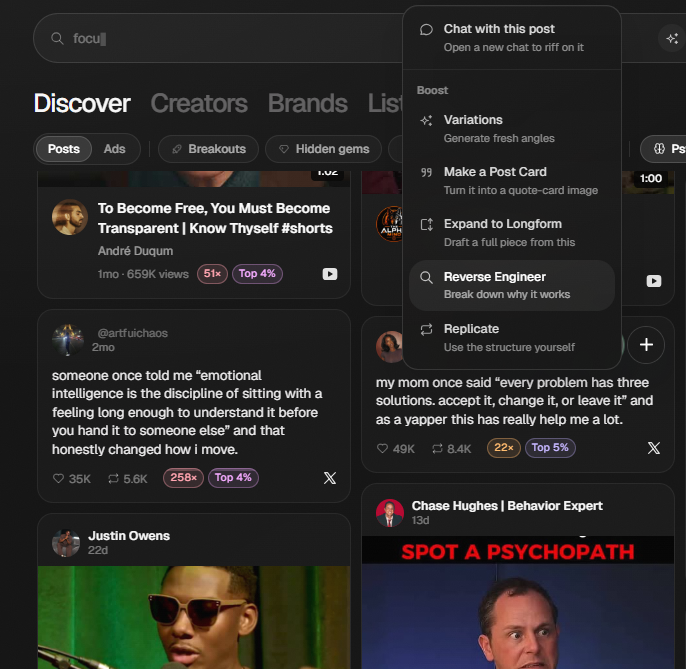
What I would highly recommend is that when you break down a post you like, actually read through the breakdown. Because what you’re doing here, something that most people don’t realize, is creating your own course on how to create content.
You’re creating your own education based on something real. So just by doing this multiple times, you’re learning how to write the content yourself.
This is also how you avoid just copy-pasting other people’s content.
This is a form of intelligent imitation.
When you think in the past, in the Renaissance era, what did the apprentices do?
They imitated the masters until they developed their own experience, skill, and taste.
Because as a beginner, you don’t have taste. You don’t have experience. You have to ride the bike with training wheels until you can take them off.
That’s just how the world works.
That’s how education and learning works.
3.5) The 10 Koemmandments of Engagement
Before you actually get into researching and writing posts based on high-performing content, you need to know some of the principles behind it. That way you aren’t just going about this blind.
AI is a fantastic tool for learning, but it is far from perfect. And if you don’t know what you’re doing, then you don’t know whether the AI output is good or not.
1) Specific numbers. You see this all the time in hooks and it catches attention just because it’s a pattern interrupt.Statistics, dollar amounts, metrics, lists.*“Seven bad habits that are preventing you from achieving the life you want.” *You see these all the time in hooks and content and Substack titles and YouTube titles because it just works.
2) Pattern interrupts. A pattern interrupt is anything that breaks people out of their normal condition patterns. On Twitter, I personally now write my posts as just blocks of text because everyone is spacing out their text and creating lists and trying to make it super readable. But when I look at it, I see that everywhere.
So I know that it’s just becoming tiring and people aren’t paying as much attention to it anymore. So I have to do something different. And it’s interesting because my posts on Twitter do extremely well simply because I’m doing what you shouldn’t do in content by just creating a block of text.
3) Negativity bias. If you can flip something from positive to negative, something in people’s brains causes them to pay more attention to that. “You will never hit rock bottom again” is obviously the one that is going to capture more attention compared to “You are going to achieve great things.”
4) Call out your specific target. If you’ve been on YouTube in the self-improvement space you’ve probably seen titles like “If you are in your 20s, you need to watch this” or “I’m 42, here’s how I turned my life around.”
That specific type of person resonates with that and that and goes and watches it. Another example would be something like “fathers are a gift to humankind” and more fathers are going to pay attention to that and resonate with it.
5) Call out the problem. This is one that I fall back on all the time. If I don’t know how to start a post, I just think what is the pain point? What is the problem here?
Because most people have encountered the same problem or pain as everyone else throughout their life. The two ways I like to start this is either “most people” so “most people struggle with this” or *“if you struggle with this.” *Those have just been proven for me and they work quite well.
6) Readability and aesthetics. Using line breaks or short sentences. But as I mentioned in number 2, if this saturates the market and everyone’s doing it, then the way to pattern interrupt is by going against it and doing the opposite. But I do think aesthetics still matter and thinking about that when you post is a good thing.
7) Confidence and conviction. The way you can sound more confident is when you go and look over your post, you want to eliminate words that imply uncertainty, and speak in absolutes when possible. Rather than saying “it may be wise if some people developed their skill set,” you say “it is crucial that everyone on planet Earth develops their skill set.” I’m way over exaggerating there, but I think you get the point.
I personally use this in my content because it adds impact. I’m not saying it because it’s absolutely 100% true. I’m saying it because then it gets people to act and change their behavior for the better.
8) Potential benefit. The opposite of calling out a problem. When you read over your post or you’re going to generate a post idea, you need to think about what’s in it for the reader. Why should they care? Because if you don’t hit on that point in your content, then they’re not going to care. Simply answering that question is what locks in the like and share. If you nail that on the head, then you will grow just fine.
9) Social proof. If you can subtly or humbly flex any of your results or credentials and what you’ve done, it’s going to get people to pay more attention. But if you don’t have any social proof yet, that’s fine because growing your audience is how you build social proof. It’s the chicken and the egg problem and you should just focus on putting out the content whether you have social proof or not.
10) Warning or caution. If you can warn people about something that’s going to happen in their lives or in the future or you caution them of something, that is very powerful.
4. Post consistently with ideas that have potential
At the end of the day all that really matters is that
-
You’re posting consistently.
-
You’re posting ideas that have the potential to do well so that they can get spread to more people.
-
You’re adding something unique to the conversation so that you are differentiated from everyone else and you actually have a brand. You aren’t just blending in.
How to use AI without ruining your content
The thing with AI in general is that you still have to apply your judgment and taste.
I am heavily against having AI write everything for you.
I think the output of AI, or the post that it would write, should be treated as a prototype, a first draft, inspiration, something that you question, something that you think about. You don’t just accept the default output.
You take it and then you write your own until it feels like something that you resonate with and you would write yourself.
Because it is something that you wrote yourself, because you’re treating the AI just like any form of text.
It’s not something that you wrote. It’s a form of inspiration.
The bottom line
Those are the things that you need to focus on. Writing good content consistently and posting it. Not any of the other things. And that’s how you grow on every single platform.
Links from the article: