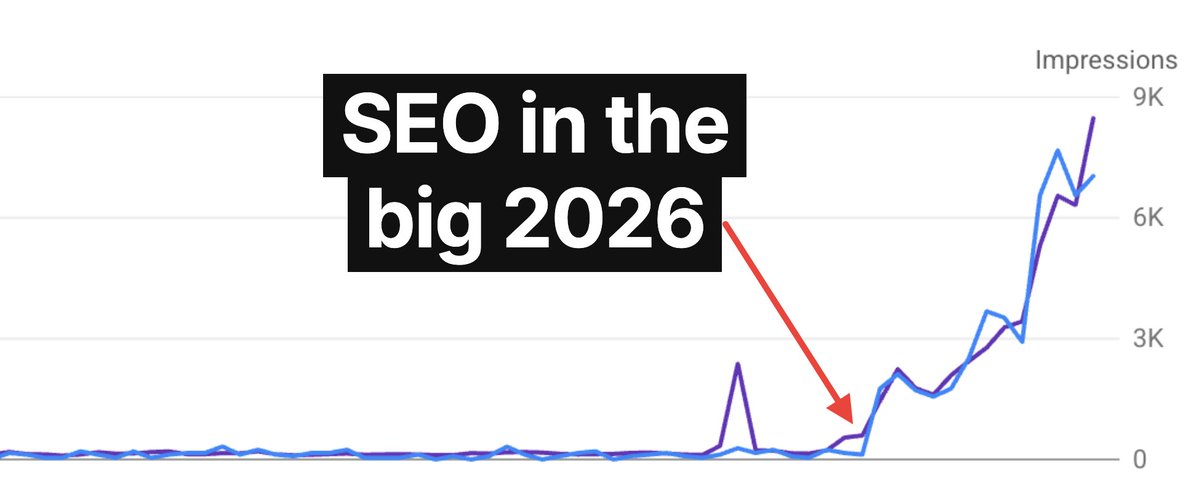
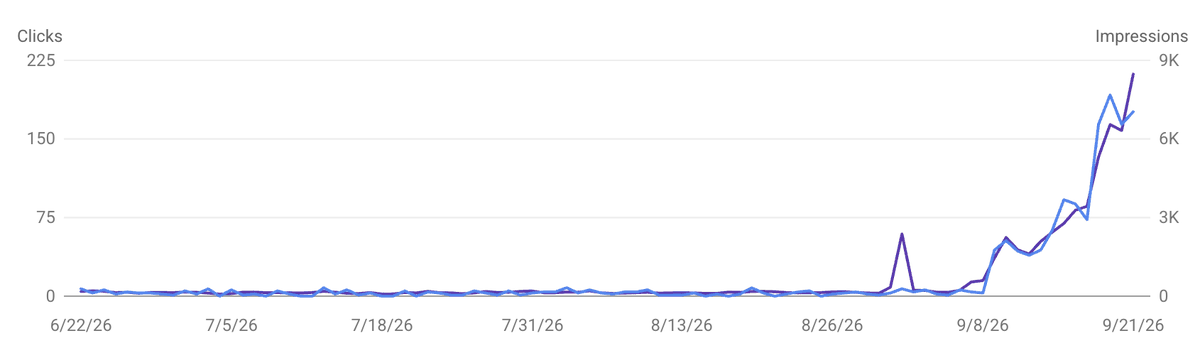
how we 47x'd our SEO in 2 weeks
文章目录
部分视频或图片暂未收录,已在正文保留提示;需要时可查看原文。查看原文 ↗
our seo was dead for six months.
under 5 clicks a week. we did everything the gurus say.
two weeks later: 30,000 impressions a week 🪩
47x. no agency. no backlinks. no new hire.
here's the entire loop with Opus 5.5
(step 3 is the most important part. most seo setups skip it entirely.)
seo looks like a writing problem. it isn't.
writing is the cheap part. the expensive part is judgment: which query deserves a page, which page needs fixing, which keyword is a trap.
we were making those calls by hand and getting half of them wrong.
| the loop | does | refuses |
|---|---|---|
| read | checks search console every morning | wait for a monthly report |
| judge | flags only what's worth acting on | dump a raw keyword list |
| fix | rewrites pages that already get seen | publish another page on the same thing |
| write | drafts the page that's missing | ship without a human |
1. Read search console like it's someone's job
it's never anyone's job. that's why nobody does it.
every morning, check for exactly six things:
const read = {
  source: "google_search_console",
  flag: {
    almost_there: "position 3 to 20, non-brand",
    no_clicks:    "impressions > 500 && ctr < 0.5%",
    decaying:     "clicks down 30% week over week",
    untargeted:   "ranking for a query no page targets",
    wrong_intent: "query intent != page intent",
    ai_mode:      "query has 7+ words",
  },
  ignore: "everything else",
};
everything below is what you do when one of these fires.
2. Start with what already ranks
almost_there is free traffic. google already likes you, it just isn't sure.
click the query, find the page that ranks for it, and add a sentence with the exact phrase. one sentence can move you up a page.
if the query doesn't fit that page, write a new one for it and link to it from the page that ranks.
then do the 1-hour update on your best page: export its queries, find the clusters it doesn't really cover, add 2 or 3 H2s for them, bump the date, request indexing.
3. The most important part of the entire system
search console tells you who clicked.
it doesn't tell you who stayed.
every seo tool stops at the click. then the visitor lands on your site and the tool goes blind.
so join them up. break your signups down by first landing page, and put that next to clicks per page:
page                   clicks   signups
/blog/popular-post        400         0   ← looks like a win. isn't.
/guides/boring-topic       40         6   ← write three more like this
a page with 400 clicks and no signups is a leak, not a win.
this is the part Refix does for us. it follows every click into the product and tells us which pages actually turn into customers.
we stopped writing for what ranks. we write for what converts.
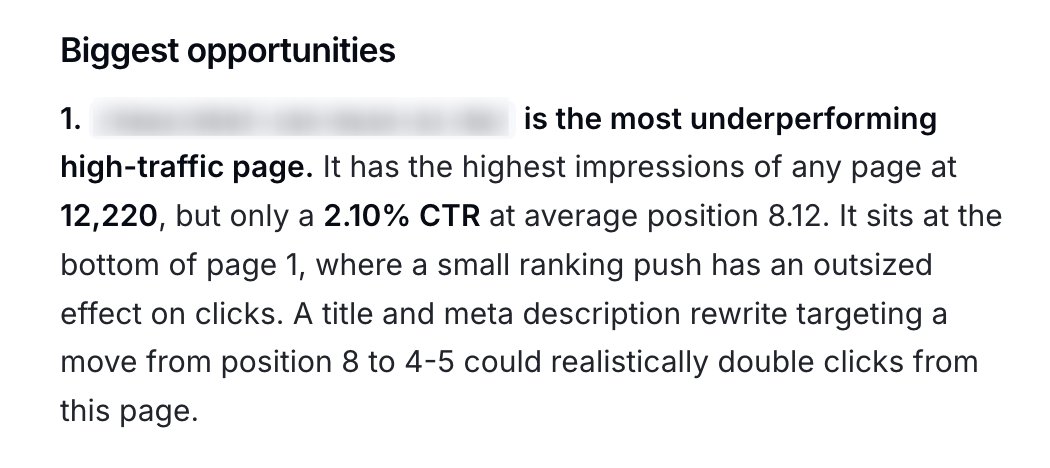
Real screenshot of Refix giving us SEO opportunities
4. Fix before you write
no_clicks means google shows you and people scroll past.
that page doesn't need a sibling. it needs the exact query in the title, meta description, URL, H1 and first sentence, and the answer in the first two lines.
check the page type too. a comparison query wants a comparison. a "how much" query wants a calculator. if you wrote an essay for someone who wanted a button, no title fixes that.
5. Kill bad keywords before you waste a week
half the keywords on any list are wrong. the words match your product, the humans don't.
before anything gets written, open the SERP and read who's ranking. if it's the wrong crowd, kill it.
and don't let volume decide. two tools we checked disagreed by 4x on the same query. use volume to order the queue, never to decide if a page should exist.
6. Write where the AI is looking
ai_mode is people talking to google like it's chatgpt. paste this into the search console query filter:
(\b\w+\b\s){7,}
every query with 7+ words. build pages in their exact wording.
then check what the AIs themselves search. when chatgpt browses, it fires 1 to 3 hidden google searches. perplexity shows you its searches openly. those are the real keywords now.
and get on bing. chatgpt search pulls from bing's index. verify in bing webmaster tools, ping IndexNow on every deploy, and read the AI performance report for the queries behind copilot answers.
7. Let your best page carry your worst
a page that ranks and gets clicks has authority to spare.
link it to a page that's stuck. once that one holds its ranking, move the link to the next stuck page. rotate monthly.
link only pages that actually belong together. no link spam, no orphan pages.
then it loops:
read → fix → write → measure → repeat
we run this whole loop as one goal in Refix. the six flags land in slack every morning before we're up, and we decide what ships.
you can run it by hand with everything above. it just won't happen every week, and every week is the whole trick.
a few of these we stole from edward sturm. go read him.
What this taught us
we're still early.
about a third of our pages aren't even indexed yet, and the topics we've covered are still broad. there's a whole deeper layer we haven't written.
and the loop doesn't care. the same read works on 50 pages or 5,000.
What we'd do differently
-
run the loop from day one: we published blind for three months. that's 3 months of data nobody read.
-
fix your redirects first: our bare URLs were 307ing to the trailing-slash version and google kept the wrong one as canonical. use 301 or 308.
-
ship in batches: we pushed three pages a day and a pile of them sat in "discovered, not indexed." smaller batches, watch indexing, then scale.
The interesting part isn't the 47x
it's that every week we learn which pages turn into signups, which queries we rank for by accident, and where the page and the searcher want different things.
that feeds the next week. the system gets better as it grows.
seo isn't hard. it's boring, and the feedback shows up late, so everyone quits right before it works.
comment "LOOP" and tag @refix_ai. i'll set the same goal up on your site.
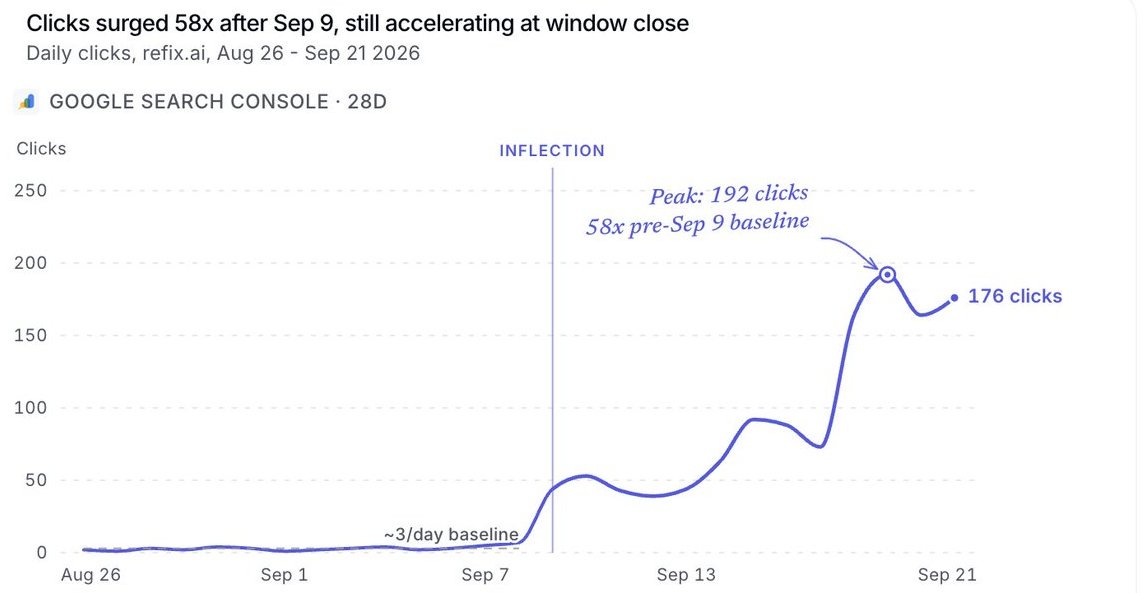
Gen-UI charts of our SEO wins in Refix