Why Instinct feels Magical
文章目录
how instinct, a $10b startup works - by reverse-engineering its harness: single-threaded chat, memory, computer use, background tasks etc
One month ago, i got an invite for instinct
my first reactions were:
'oh, it's just poke with better LLM, sandbox & computer use'
'but i've been already doing all this using codex, why would i use instinct?'
then i saw my mom use it (i just sent her an invite link)
being completely tech-averse, she usually has a hard time figuring out different apps (even amazon)
now, she just sends voice notes to Instinct and uses it to design/plan our home architecture and even order materials (i just need to approve payments)
and she absolutely loves instinct now!
as i kept using it myself as well: i've realised the taste and efforts put by instinct team is simply extra-ordinary
i've spent so much time trying out different personal agents and building harnesses myself - i could feel the attention to detail
so i spent some time reverse-engineering the key components of Instinct's harness and the magic behind them
and also thinking deeply on if it's even worth $10b!
What makes Instinct different?
- Free! Free! Free: unlike other AI Agent apps which straightaway charge $20; free for unlimited usage allows everyone to give Instinct a spin
i've got so many friends who haven't tried any agent (not even codex/claude co-work) - but used instinct and finally felt the AI magic, just because it's free and frictionless. they're now simply addicted!
-
WhatsApp: while iMessage was a form factor which Poke and other agents relied on. WhatsApp is still the most used app in non-US markets and imo, Instinct being available there from Day 0 made it much more accessible outside US
-
Invite-only: essentially creates every Instinct user an ambassador (eg. i literally helped 8-9 of my friends & my mom/dad - understand its benefits as i shared my invite link)
-
Personality: many tried their agents to be either too friendly (eg. poke, openclaw) or too work focussed and texty (eg. claude or even grokbot) - Instinct has a great balanced personality for daily use-cases and picks up the tone of the user excellently
-
Email: for any human, majority of their context lives in Gmail (thanks to sign-in-with-google) and Instinct asking the Gmail access in onboarding makes it feel personal very fast as it can read through the entire mail and form the initial context for a user
(most of my friends who didn't connect Gmail found instinct to be not that cool too)
- Work backwards from the desired user experience: Instinct took the bold decision to over-provision everything ( best LLMs, high end sandbox, computer use etc so the product just works. Just like how Uber started with black cars and worked its way down to +ve unit economics. even grokbot/muse/chatgpt couldn't take the route of fully free product, depsite having $50b+ cash reserves each
Above all, it has an amazing harness which makes the whole magic possible
lemme break it down - one by one for you
The Instinct Harness:
1. Channel: the conversation interface
Instinct took the opinionated bold bet on iMessage & WhatsApp
Instinct having no interface of its own saved a lot of time - building and maintaining a reliable chat frontend is difficult
- onboarding is easier as you just need to send a message to start
also, the constraints offered by iMessage and WhatsApp proved to its strength - as Instinct just had to optimise harness around just 3 states:
message → thinking/typing → reply
in typical chat agents like chatgpt, it's cyclical i.e you prompt, wait for the reply, then prompt again
with instinct, these aren't cyclical i.e you can message while something else is happening. this non-cyclical thing unlocks core magic
just like messaging to your friend - in Instinct, you don't have to wait, you can freely send any number of messages (prompts) and it automatically gathers all context and replies to your specific message parallelly
(technically, they just 'auto-steer' your messages which is already present in apps like codex desktop and dynamically does 'reply routing' of all answers to the main prompts)
it also helps overcome anxiety when instinct is doing a long task (eg. shopping from amazon) - as i can ask it midway what it's doing and feel like having complete control
2. Single Threaded: the Orchestration
iMessage/WhatsApp made this an easy opinionated choice: one ongoing conversation from the user’s perspective
(+ imessage/whatsapp maintain the same thread, which makes it feel more coherent)
personally, i've been a big believer of single thread as LLMs keep getting much larger context (1M+ tokens in gpt 6) and better compaction - OpenClaw/Hermes already gave a glimpse at how much people value an assistant that keeps context on a single conversation and make user feel that continuity
infact, i believe chatgpt/claude being multi-threaded is a bug not a feature; because initial models had low context sizes (gpt 3.5 had just 4k tokens)
and now everyone in ChatGPT has a UX muscle memory to start new chat and it feels like starting over again and again (like google search)
there's definitely cons for single threaded: as most sufficiently ambitious work still needs isolated context, tools and memory - but Instinct is betting on compaction and context management of LLMs getting better (it has been!)
How Instinct chat works:
there's two agents:
-
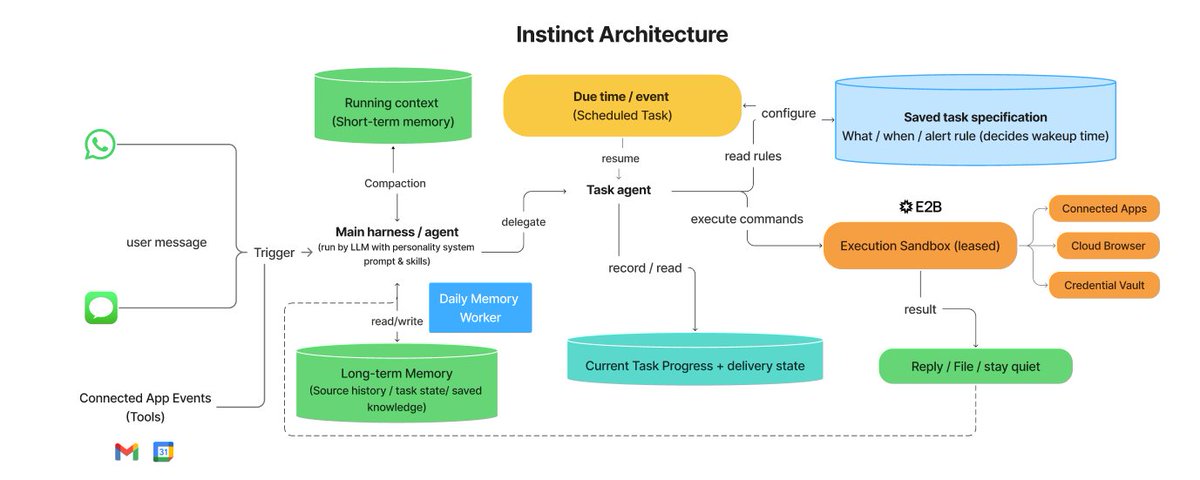
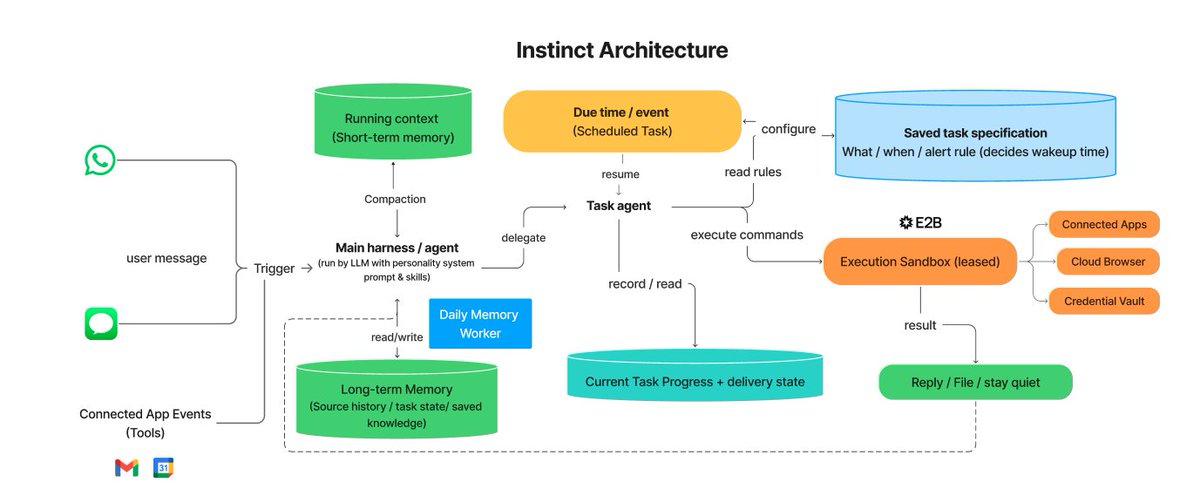
Main/Chat Agent: on a single thread, it has all the personality, memory and does all context management. however, it delegates all tasks (eg. booking a hotel) to task agent
-
Task Agent: It receives all the tasks and the core job is just to execute tasks (eg. book a hotel end-to-end)
i'm guessing it has many task-specific skills which helps in common tasks like flight-booking, shopping, browser-use, document-signing etc
Main/Chat Agent has an amazing personality:
- No Noise. No BS: Instinct is designed to only tell what's needed in a human-way. it doesn't send any random or unsuccessful notifications or alerts. other assistants are too texty (which creates more work to read) and needs guidance - Instinct's messages are too concise and doesn't feel like extra work
custom emoji reactions are also a great way to answer instead of a full robotic message reply to every text
- It's insanely resourceful: while Claude/Codex app is overly conservative on credentials, payments and consequential actions, Instinct just goes and does the tasks (typical startup advantages to take the risks)
eg. it sometimes literally resets password using email instead of just giving up or saying no 🫠
- Reliable: Unlike many other assistants, Instinct has quite confident and reliable personality where it has some conviction on its own - which is quite assuring for users that it'll be able to handle their requests and i can trust it
3. The Memory:
Instinct feels v ambient i.e an always on-assistant who remembers everything
technically, they're simple git-tracked markdown files (with no vector database) which main chat can easily search using plain keyword search anytime
a daily background job does all the writing: moving temporary details into work files, generalizing, adding dated corrections, and scrubbing one-time codes
it roughly stores and fetches from:
-
source history i.e where it came from (eg. email containing hotel confirmation)
-
saved knowledge i.e maintain useful facts, preferences, relationships and historical knowledge (eg. your current city)
-
task state i.e current progress of the current task (eg. check in tomorrow)
-
working context i.e compaction/recent chats
the packaged git repo (bundle) is then stored in S3
4. Browser Use: Gets shit done
LLMs have been getting increasingly better at computer use (try astra using codex mac app) and this is the key which unlocks:
"oh, Instinct actually booked my hotel"
The browser use tool actually gets your tasks done: at which it can open any website, click through, login using your email/phone number and enter your payment details
More tools like:
-
Own Email (can sign up and run accounts)
-
outbound phone (Concierge)
-
spend-capped virtual cards or spend via Stripe Link
-
1Password-backed logins
every Instinct user also gets its own computer (Sandbox or VM by E2B):
which is important for command execution and file system (i.e it'll write a bash script on the fly to book a hotel and execute it safely using sandbox)
ofc, the whole harness doesn't appear to live in sandbox (sandbox is v costly and charge ~0.13$ per hour) and the agent loops (incl. all alerts/automations) would be running on their backend server
5. Automation/Alerts: Being Proactive
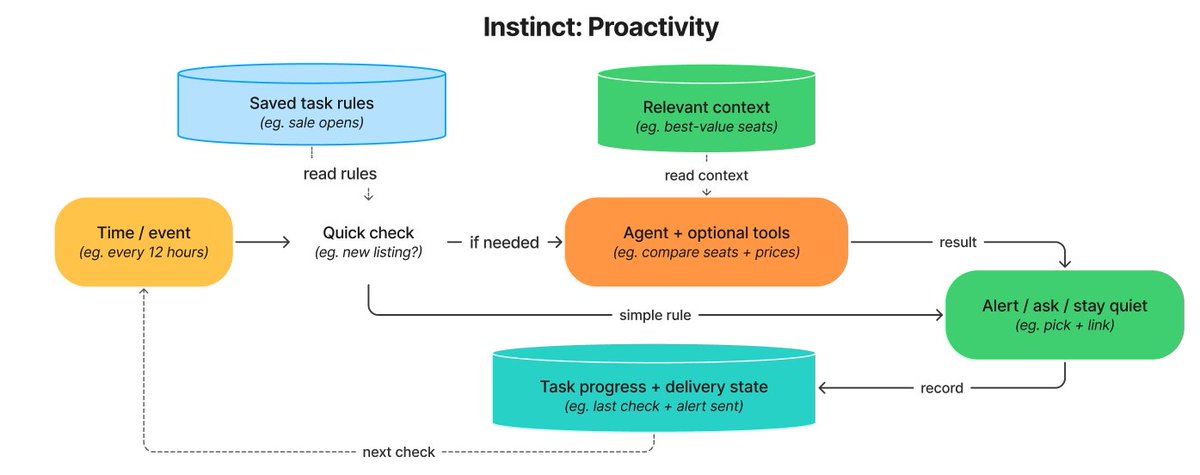
'Automation' is one of the features which every agentic startup promised. most agentic startups slapped 'automation agents' in their UI where they expose the whole cron job schedules and make it look like a workflow (again creates more task for a consumer)
but the hard truth is: no consumer ever want their life to be automated, they just wanna be entertained (i.e get dopamine hit of it getting the work done magically)
further, automation also creates a lot of noise as most of the times there isn't much to be notified to a user
Instinct made automation more of a hidden feature or background task where it doesn't create noise and only alerts you when there's some actual insight

unlike other automation tools, where the entire code gets written on the fly; here instinct has kinda pre-built templates (eg. it just had to enter the websites to check and set web crawling frequency as 12 hours on a tool and hence it was created in <30 seconds)
and instead of a determinstic automated loop, it uses LLMs in each parts and breaks it down into three primary jobs:
-
finding something useful to do (goal)
-
deciding when to revisit it (wakup condition)
-
deciding whether to interrupt/ping (alert rule)
this sepration of jobs helps to seprate signal from noise for a user and makes it look v thoughtful
6. Multi-player agents: The Network
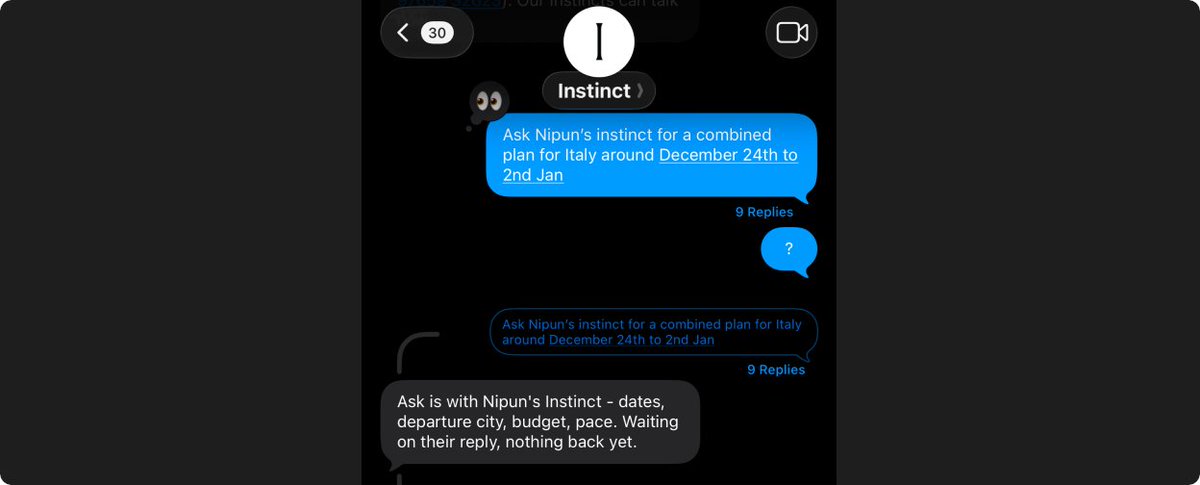
Instinct calls it 'Trusted Person Network' and i personally find this exciting as it's the first step towards forming the real 'network effects'
i've literally planned a trip with my friend using this and it was damn fun as it already knew my constraints and reduced unnecessary to & fro (as instinct is designed to reduce noise)

the key is: sharing your "context" in your network
i'd assume, there'd be different 'levels of trust' and more the trust, more the context shared
(let's see how they product-ise the amount of context shared - different level of scoped permissions would be my guess)
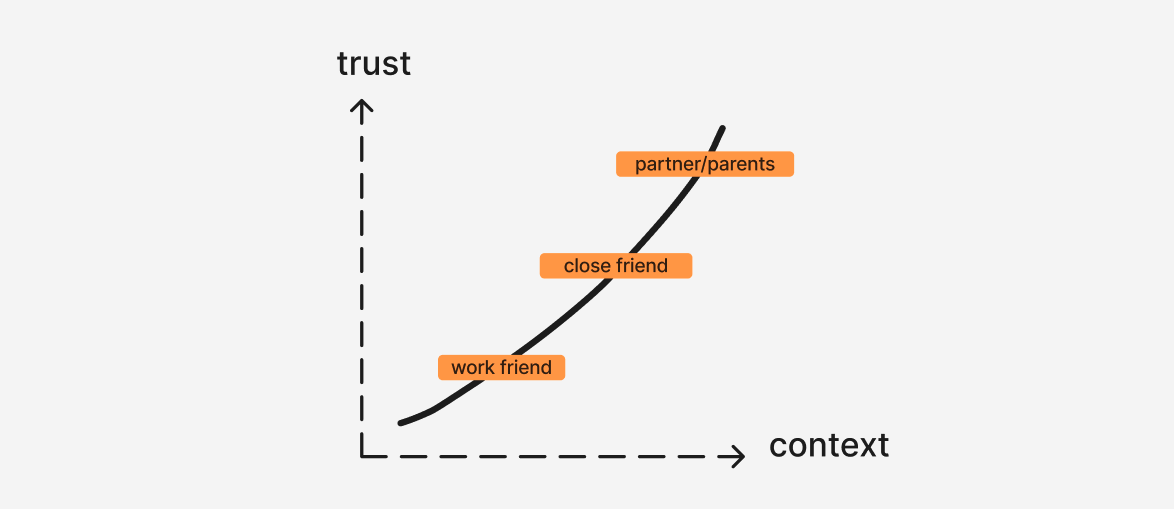
this helps instinct bootstrap an inherent social graph (like Instagram) and this becomes a true moat as the switching costs becomes high for users now (as they already have formed network here)
What's potentially next for Instinct?
- Faster: While Instinct's fast, but Muse's speed has left everyone amazed
Speed is a deal breaker for consumer: as most folks just switch to different apps, waiting for AI response and then they forget about their intent/task at first place
i'll assume Instinct's already shopping compute for faster inference
- Mobile App: While iMessage/WhatsApp is a great start, having a dedicated app is great for retention/engagement + helps Instinct experiment more around generative UI
(as it's bad UX to create shareable link for everything)**
**further, mobile app also allows for dedicated browser viewing:
as it reduces anxiety (users can verify what's happening) and gives users a reason to be on the chat
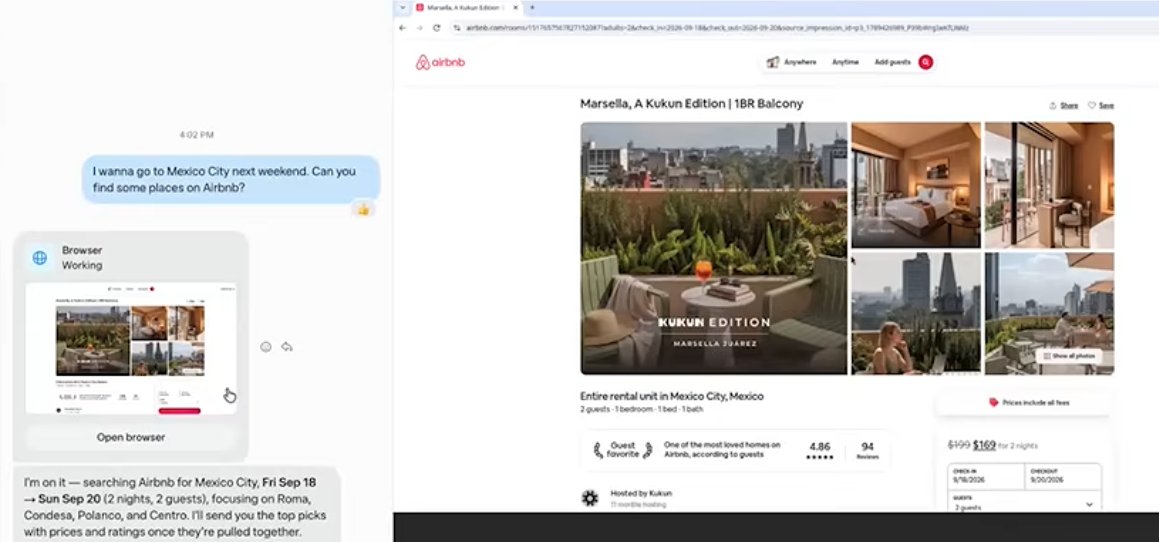
(this is muse checking on Airbnb and a user can directly verify visuals)
but is Instinct a $10b worthy co?
personal agents have quite costly software stack to run from LLMs to sandbox/VMs to automation servers - so they'll need to figure out monetisation soon or it'll end up becoming the next 'clubhouse'
currently being a pre-revenue startup, monetisation will be the biggest challenge but i'd assume it'll be via (or combination of):
- Ads (v personalised recommendation from partners)
- Payments/Commerce (take cut via stripe or have their own wallet)
- Subscription (for premium features)
the key will to first enable funds flow to happen via them. they already have $1b+ of annual commerce txns happening and they wanna take cut from it (possibly between 2 to 20%)
i won't be surprised if they offer Amex-type card and Instinct becomes a concierge with built-in exclusive merchant network - Instinct selections (eg. curation by local chefs) is a good step towards that direction
Noah (founder of instinct) explicitly wants Instinct to be free forever and only monetise from transaction fees
above all, they're competing against:
-
Muse with Meta distribution (Instagram, WhatsApp, Facebook) with owned LLM/data center layer + $90b of cash reserves to experiment around with Zuck going all-in
-
Grokbot with X/elon distribution and owned LLM/data center layer
-
ChatGPT dots with ChatGPT distribution + owned best frontier LLM layer
while BigTechs have a huge upper hand in the winner-takes-all-market, it's awesome to see a young startup, Instinct do so well and be everyone's favorite in this huge market!
that's all!
thanks for reading - if you found it helpful, do share it to your friends, who're instinct fans!
hit me up, if you wanna discuss anything around personal agents (or how we're thinking of solving the same problem for trading/investing at @suzitrade!)