Jev Use Cases Clearly Explained

文章目录
AI agents waste an unbelievable amount of intelligence on tiny decisions.
Should I retry? Which tool should I use? Did this task actually finish? Is this action risky? Which 5 of these 100 documents matter? Does this answer actually follow the instructions?
Right now we regularly call the same giant model that writes our code and does our research just to answer questions like these.
Quick rundown of what Jev is:
Jev costs $0.042 per million input tokens.
With no output-token charge.
TypeSafe reports roughly 70–500ms end-to-end response times, with its own workflow evals showing gains as high as 193.6x faster and 444.6x cheaper than the LLM baselines it tested.
And there’s a reason it can do that.
You literally can’t chat with Jev.
It doesn’t write posts. It doesn’t write code. It doesn’t generate an explanation. It doesn't chat like a standard LLM
It takes a state and answers structured questions about it.
That ends up being useful in a LOT more places than I expected.
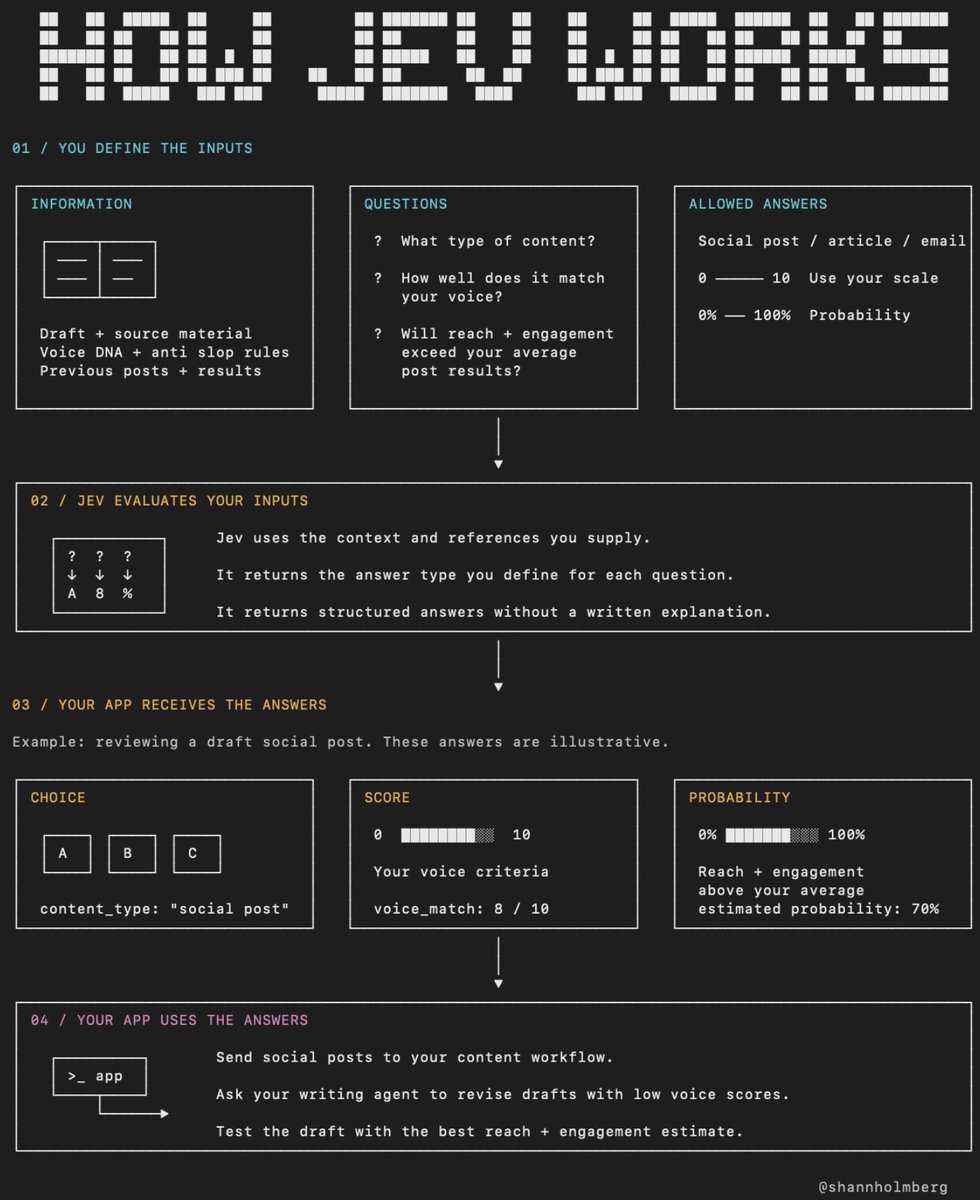
How Jev works put simply by @shannholmberg so shout out to him.
I. What Jev actually does
There are three basic question types.
Choice
Pick one option.
retry wait change_parameters switch_provider escalate
Score
Put something on an ordered scale.
low risk medium risk high risk critical
Noul
Give me the probability that something is true.
Did the agent actually finish the task?
Jev returns the decisions plus probabilities and confidence information your code can use directly. TypeSafe calls this class of model a “System One model.”
A simple request looks like this:
{
  "model": "jev-latest",
  "state": "The deploy failed twice and customers are seeing 500 errors.",
  "questions": {
    "urgent": {
      "type": "noul",
      "instructions": "Does this need attention immediately?"
    },
    "severity": {
      "type": "score",
      "instructions": "How severe is the impact?",
      "criteria": [
        "Minor",
        "Degraded",
        "Major outage"
      ]
    }
  }
}
The really useful thing is that those questions can share the same state and be evaluated together in one request. TypeSafe’s quickstart explicitly supports mixing Noul, Choice, and Score questions in the same call.
That gives you a very different way of designing agents.
Your big model can still reason, write code, research, and generate possible actions.
Jev can sit around it making the tiny decisions that happen over and over again.
This is where I’d start.
II. Jev inside the agent loop
1. Self-healing tool calls
This might be one of my favorites.
Your agent calls an API.
It fails.
Usually the failure goes right back into the LLM:
“The API returned 429. What should I do?”
Then you pay for another reasoning call just to decide whether to wait 10 seconds.
Instead, send Jev:
State
Tool: Stripe API Action: create_customer Error: HTTP 429 Attempts: 2 Last wait: 5 seconds Alternative provider: none
Ask
What should happen next?
retry wait change_parameters switch_provider escalate
Then your code executes the decision.
Now imagine that happening across thousands of tool calls.
The agent doesn’t need to restart its reasoning every time something goes wrong.
2. Agent loop controller
Every long-running agent eventually has to answer:
Are we done yet?
Give Jev:
the original task recent actions tool results current artifacts failures
Ask:
Did the task actually finish? Is another step necessary? Is important information still missing? Should a human be involved?
Your code can combine those answers:
if finished > 0.95:
    complete()

elif needs_human > 0.8:
    escalate()

else:
    continue_loop()
This is one of the places where I think tiny decision models make long-running agents way more practical.
3. Model routing
A typo fix does not need the same model as designing a distributed system.
Send Jev the incoming task.
Ask which model should handle it.
local cheap frontier human
Then route it.
LangChain already has experimental TypeSafe middleware specifically for this pattern. Its example routes simpler work toward a cheaper model and harder architecture/reasoning work toward Astra.
The goal isn’t to find the “best model.”
It’s to stop paying for the best model when the task clearly doesn’t need it.
4. Agent branch pruning
Say Astra comes up with 20 possible approaches to a problem.
You could have Astra deeply reason about all 20.
Or you could cheaply score them first.
For each branch:
Likelihood of success? Cost? Risk? Reversibility? Missing information?
Kill the weak branches.
Spend the expensive reasoning on the best few.
This could get especially useful once agent planning starts generating large search trees.
5. Tool selection
An agent has:
browser terminal GitHub email CRM database search Slack etc...
You do not necessarily need a frontier model to reconsider that entire list every time.
Give Jev the current goal and state.
Ask which tool is appropriate.
Your code then exposes or calls the selected path.
TypeSafe explicitly lists routing and harness decisions as target use cases for Jev.
III. Giving agents more freedom without blindly trusting them
This is how Jev gets much more valuable than just being “cheap classification.”
6. Irreversible action gate
Before an agent does something outside its sandbox, check the consequences.
Examples:
send_email delete_file merge_pr change_permissions issue_refund publish_post
Give Jev the proposed action and relevant context.
Ask:
Can this be easily undone? Does it affect another person? Does it affect money? Does it expose private data? Is this clearly authorized?
Then define your thresholds.
high confidence + reversible → execute
uncertain + reversible → execute and log
irreversible → review
unauthorized → block
LangChain’s experimental AutoMode middleware already demonstrates the basic version of this: classify a proposed tool call before it executes and block risky calls.
7. Dynamic permissions
Permanent agent permissions are going to look increasingly weird.
Imagine telling your agent:
You permanently have access to Gmail, Stripe, GitHub, Slack, and our entire database.
Instead, generate permissions for the task.
TASK: Fix failed customer payment
Stripe read: YES
Stripe refund: REVIEW
Customer DB read: YES
Gmail send: NO
GitHub: NO
Maximum refund: $50
The permission set lasts for that task.
Then it disappears.
This gives you temporary, job-level access instead of giving every agent the keys to everything forever.
8. Agent spend firewall
The same idea works for money.
Before an agent buys something, provisions compute, upgrades a plan, or pays an API bill, send Jev:
purchase price vendor user rules budget previous purchases task context
Return:
approve review deny
Your deterministic code still owns the actual payment.
9. Confidence-based human queues
This could change how people supervise huge agent fleets.
Every action doesn't need to be sent to a human.
Send only the weird ones.
For each decision, evaluate:
confidence risk cost reversibility novelty
A person sees:
low confidence OR high cost OR high consequence
Everything else stays automated.
One operator could supervise far more workflows without becoming the bottleneck.
IV. Stop paying LLMs to check other LLMs
10. First-pass LLM judge
This is probably the most obvious Jev use case.
Your main model generates an answer.
Then another giant model gets called to ask:
“Was that answer good?”
That gets expensive very quickly.
Instead, make the checks explicit.
Did it follow the instructions? Did it answer every part of the question? Are the factual claims supported by the supplied evidence? Did it violate any policy? Does it need human review?
Only send questionable cases to an expensive judge.
TypeSafe explicitly describes verifying prompts, reasoning traces, tool calls, and outputs as a core System One use case.
11. Agent trace observability
Agent logs become ridiculous very quickly.
An hour-long agent run can contain: hundreds of messages dozens of tool calls retries failed actions changed plans subagents giant amounts of context
Nobody wants to manually inspect all of that.
Run Jev across traces and ask:
Did the agent repeat itself? Did it violate instructions? Did it call a tool unnecessarily? Did it finish the task? Was human approval skipped? Did the run enter a loop?
Now your observability dashboard can surface the runs that need your attention.
12. Semantic code linting
Normal linters understand syntax.
Jev can check semantic rules written in plain English.
For example:
Does this endpoint perform authorization before accessing customer data?
Does this change introduce a direct database call outside the repository layer?
Does this code violate our rule against logging personal data?
Run those checks in CI.
Flag uncertain violations for review.
TypeSafe lists semantic code linting as an example workflow in its docs.
V. RAG and research
13. Retrieval reranker
Search returns 100 documents.
Your frontier model probably does not need all 100.
Give Jev:
question candidate document
Ask for relevance.
Score the candidates.
Take the best five.
Send those to Astra.
TypeSafe specifically lists query-to-candidate scoring, pairwise reranking, context selection, and semantic retrieval as Jev use cases.
14. Source verifier
You have a claim:
"Company X increased revenue 40%."
You also have the source passage.
Ask:
Does this passage actually support the claim?
Now you can check citations before an AI-generated research report ships.
This becomes more and more useful when an agent produces hundreds of sourced claims.
15. Context filter
Long-running agents collect way too much context.
Before dumping everything back into the frontier model, score each piece:
Is this still relevant to the current task? Is this duplicated elsewhere? Does the model need this to make the next decision?
Then build a much smaller context package.
That means fewer tokens going into the expensive model and less irrelevant information competing for attention.
VI. Business workflows
This is where the number of possible Jev calls gets kind of stupid.
TypeSafe’s own use-case map includes customer support, lead generation, recruiting, compliance, marketplaces, moderation, advertising, risk, and more.
16. Support routing
State:
customer message account history plan recent tickets
Questions:
Which team owns this? How urgent is it? Is the customer asking for a refund? How frustrated are they? Is churn likely? Does this need a human?
One call.
Several independent decisions.
Then your software routes it.
17. Autonomous refund triage
Give Jev:
order history customer history refund policy item cost fraud signals message
Ask:
Is this covered by policy? Does the evidence suggest fraud? Is the request unusually risky?
Should this be: approve reject review
I would still keep deterministic limits around money and send risky cases to humans.
But this could instantly clear the boring obvious cases.
18. Lead qualification
Give it:
company size industry website inbound message role ICP definition
Ask separately:
ICP fit? Buying intent? Urgency? Relevant pain point? Needs salesperson now?
One distinction here matters.
Fit and intent should not be the same question.
A perfect customer might have zero interest in buying today.
Someone begging for a demo might be completely outside your target market.
Keep those decisions separate.
19. Production incident controller
Feed it:
logs deploy history service health affected customers previous incidents
Ask:
How severe is this? Is the latest deploy likely related?
Should we: ignore restart rollback page investigate
I would start this in recommendation-only mode.
If it proves reliable on historical incidents, let low-risk actions become automatic.
20. Marketplace dispatch
For every request:
customer location provider locations availability price quality cancellation history customer preferences
Score each provider.
Rematch when the state changes.
This is where Jev’s latency matters.
A decision that happens once per day doesn’t desperately need a sub-second model.
A marketplace making thousands of changing decisions does.
21. Sales policy
During a sales conversation, provide:
deal size margin customer tier approved discount range contract length sales stage previous offers
Ask:
hold price discount offer different terms escalate
Your code still enforces the hard limits.
Jev decides which approved path makes sense.
VII. The easiest way to start
You do not need LangChain.
You do not need an agent framework.
You barely need any code.
Just install the SDK:
pip install typesafe-sdk
Set:
export TYPESAFE_API_KEY=...
Then:
from typesafe_sdk import Choice, Noul, Score, TypeSafeClient

client = TypeSafeClient()

result = client.system_one(
    state={
        "task": "Fix the checkout bug",
        "last_action": "Ran test suite",
        "result": "2 tests still failing"
    },
    questions={
        "finished": Noul(
            instructions="Has the original task been successfully completed?"
        ),
        "next_step": Choice(
            instructions="What should happen next?",
            criteria={
                "continue": "Continue working",
                "retry": "Retry the previous step",
                "human": "Ask a human for help"
            }
        )
    }
)
That is basically the primitive.
State → questions → probabilities → code.
The official TypeSafe SDK uses this exact system_one pattern, and their current quickstart also lets you install an official coding-agent skill and have your agent build against the API for you.
If you already use LangChain, it has a TypeSafeClassifier integration plus experimental middleware for model routing and tool-risk gating.
VIII. How I’d test any of these before trusting it
I would not connect Jev to production and hope.
Take a real decision your system already makes.
Get 100–500 historical examples where you know what should have happened.
Run both:
your current system Jev
Then record:
accuracy false positives false negatives confidence latency cost
The confidence part matters.
TypeSafe’s docs are explicit that calibration works across groups of predictions. A high-confidence output is not a mathematical guarantee that this individual answer is correct.
Then pick thresholds.
Maybe:
> 0.95 automate
0.70–0.95 automate only if reversible
< 0.70 human / frontier model
Those numbers are examples.
Your own evals should decide them.
Then run it in shadow mode.
Let Jev make decisions without acting on them.
Compare what it would have done against what actually happened.
Only then start giving it control.
IX. Where I would NOT use Jev
There’s an easy test.
If you need the model to create something new, Jev probably isn’t what you want.
I would still use a frontier LLM for:
writing code writing content open-ended research architecture brainstorming long explanations novel problem solving
Jev currently accepts text-based state and returns constrained decisions. It does not generate replies, code, or reasoning explanations.
And one more distinction matters:
Jev can still be wrong.
It cannot suddenly return an invented fourth option when you gave it three choices.
That does not mean the option it picks is automatically correct.
Typed outputs solve one reliability problem.
They do not magically solve judgment.
X. I think we're about to get a LOT more models like this
This is probably the bigger reason I’m excited.
We spent years assuming one giant model should do everything.
Write the code. Search. Click the browser. Judge the answer. Route the task. Decide whether to retry. Check whether it finished. Approve the action.
That architecture suddenly looks really expensive.
I think future agent systems are going to look more like this:
Frontier model ↓ hard reasoning + generation
Jev ↓ decisions + scoring
CUA specialists ↓ repetitive computer actions
Tiny rerankers ↓ retrieval
Tiny classifiers ↓ routing + detection
Code ↓ hard rules + execution
One expensive model still handles the genuinely difficult work.
Then you surround it with increasingly tiny specialists built for very specific jobs.
Jev blew up.
CUA blew up right after it.
I’d be shocked if this market isn’t flooded with tiny specialist models soon.
And every time I look at an agent loop now, I’m asking the same question:
Does this step actually need a frontier LLM?
A surprising amount of the time, the answer is no.
-Layton Gott