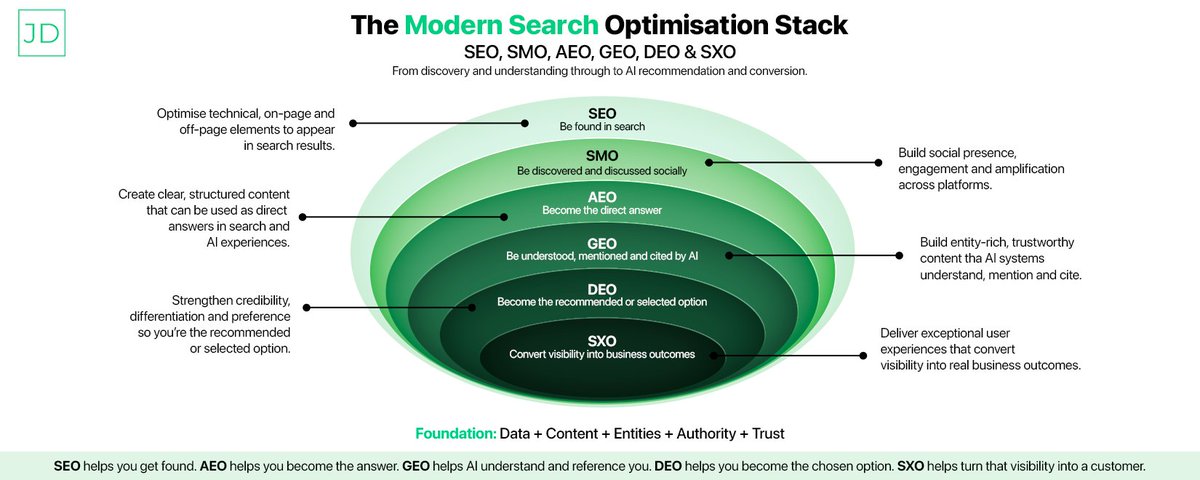
The Modern Search Optimisation Stack: SEO, SMO, AEO, GEO, DEO & SXO
文章目录
Search optimisation is no longer just about ranking ten blue links on Google.
The way people discover information, research products, and make purchasing decisions has fragmented across traditional search engines, social platforms, AI-generated answers, recommendation systems and increasingly autonomous AI agents.
A potential customer might discover a company through TikTok, research it on Google, ask ChatGPT to compare it against competitors, check Reddit for opinions, and finally ask an AI assistant which option best fits their requirements.
This changes what it means to be “optimised for search”.
Modern search optimisation can be viewed as a stack of interconnected disciplines:
-
SEO → Search Engine Optimisation
-
SMO → Social Media Optimisation
-
AEO → Answer Engine Optimisation
-
GEO → Generative Engine Optimisation
-
DEO → Decision Engine Optimisation
-
SXO → Search Experience Optimisation
At the simplest level:
SEO helps you get found → AEO helps you become the answer → GEO helps AI understand and reference you → DEO helps you become the chosen option → SXO helps turn that visibility into a customer. SMO operates alongside these layers by increasing discovery, conversation and brand signals across social platforms.
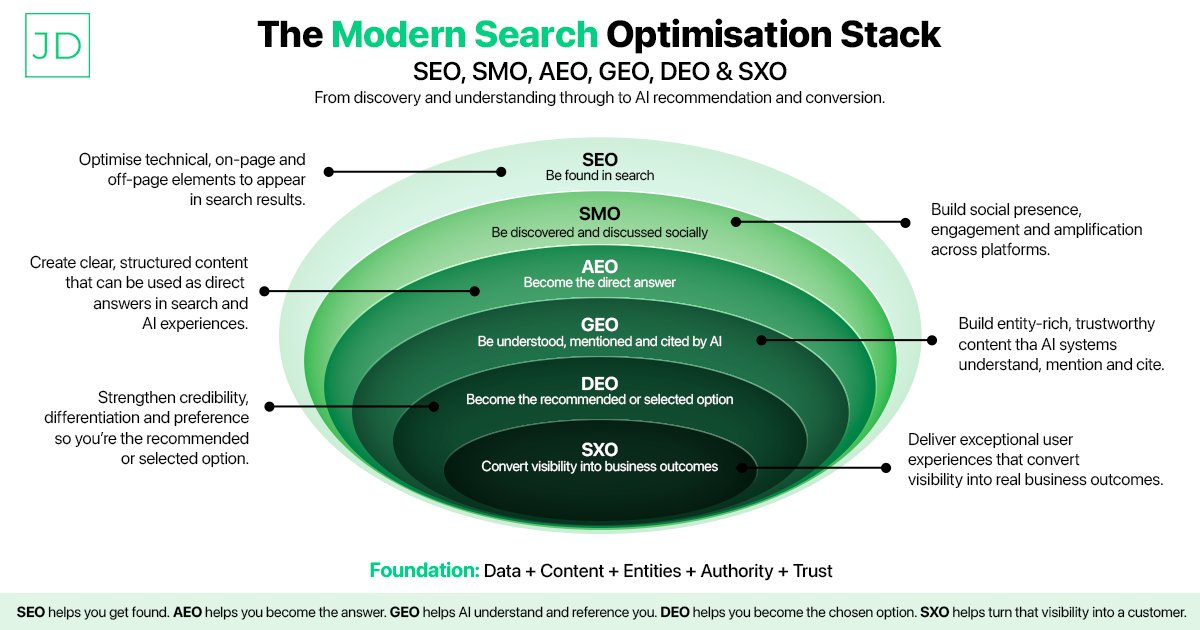
The Modern Search Optimisation Stack
Search has effectively expanded from a retrieval problem into a discovery, understanding, and decision problem. That distinction is important.
Ranking first is incredibly valuable, but ranking first does not automatically mean that ChatGPT will cite you, Gemini will understand your company, an AI shopping assistant will recommend your product, or a visitor will convert once they reach your website.
Modern optimisation therefore requires us to think beyond rankings.
What Is the Modern Search Optimisation Stack?
The Modern Search Optimisation Stack is a framework for understanding the different optimisation disciplines that influence how brands are discovered, understood, referenced, evaluated, selected and experienced across search and AI systems
A simplified version looks like this:
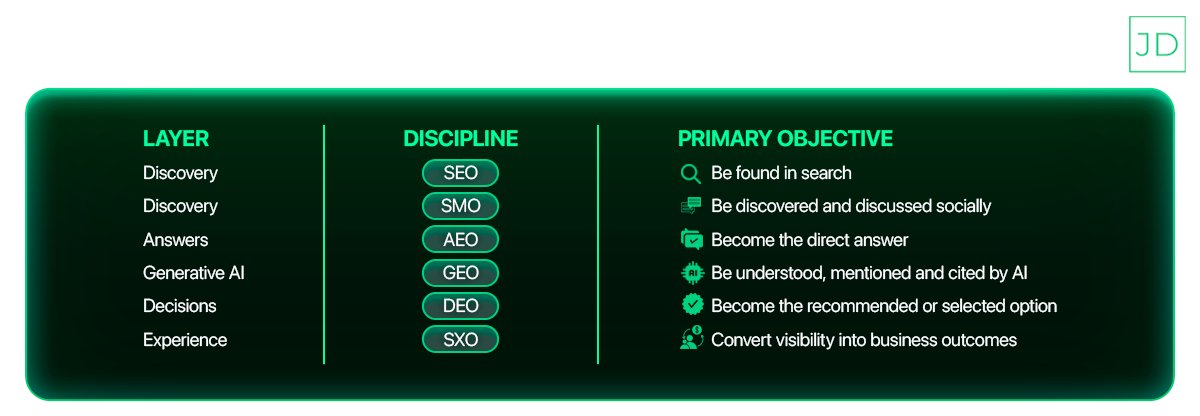
These layers overlap heavily. A technically sound website benefits SEO, AEO and GEO simultaneously. Strong brand mentions can influence social discovery while also providing corroborating information that AI systems can retrieve. Clear product attributes can improve conventional search visibility while making it easier for AI systems to compare products.
The objective is therefore not to build six separate marketing strategies.
It is to create a digital presence that performs across all six environments.
“The future of search optimisation isn't about choosing between SEO and AI optimisation. It's about creating an ecosystem where search engines, AI systems and customers can all understand why your brand deserves to be selected.”
Google itself demonstrates why thinking purely in terms of traditional rankings is becoming increasingly restrictive.
Google Search now includes AI-powered experiences such as AI Overviews and AI Mode, where information can be synthesised from multiple sources rather than presented solely as a conventional ranked list.
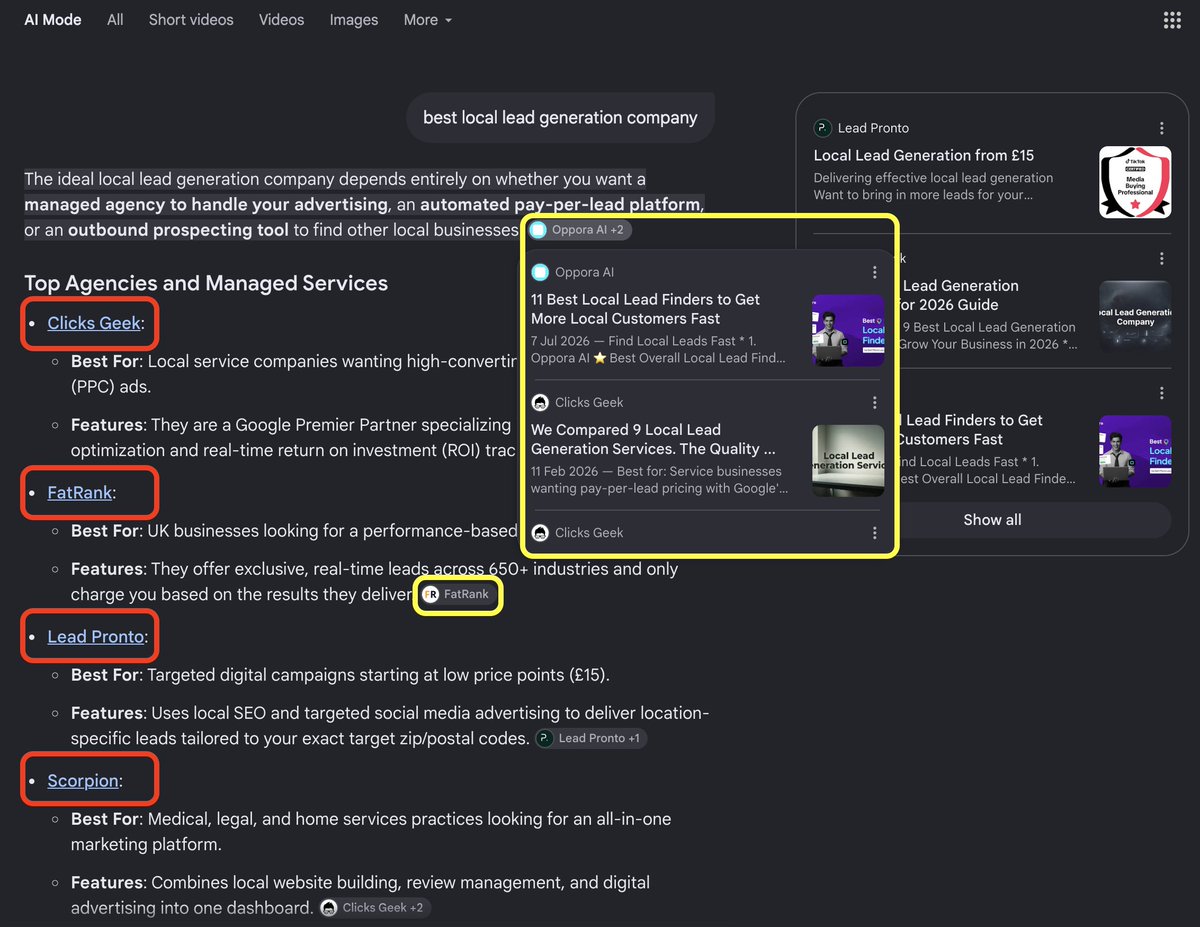
Example of Current Search
This visually demonstrates the shift: Ranking → Retrieval → Synthesis → Citation
Layer 1: SEO, Search Engine Optimisation
SEO stands for Search Engine Optimisation.
It remains the foundation of the modern search stack. The emergence of generative AI has not suddenly made technical SEO, crawlability, content quality, authority, or internal linking irrelevant. Quite the opposite. Search engines and AI-powered search experiences still need to discover and understand information before they can use it.
The traditional SEO journey can be simplified as: Crawled* *→ Indexed → Ranked → Clicked
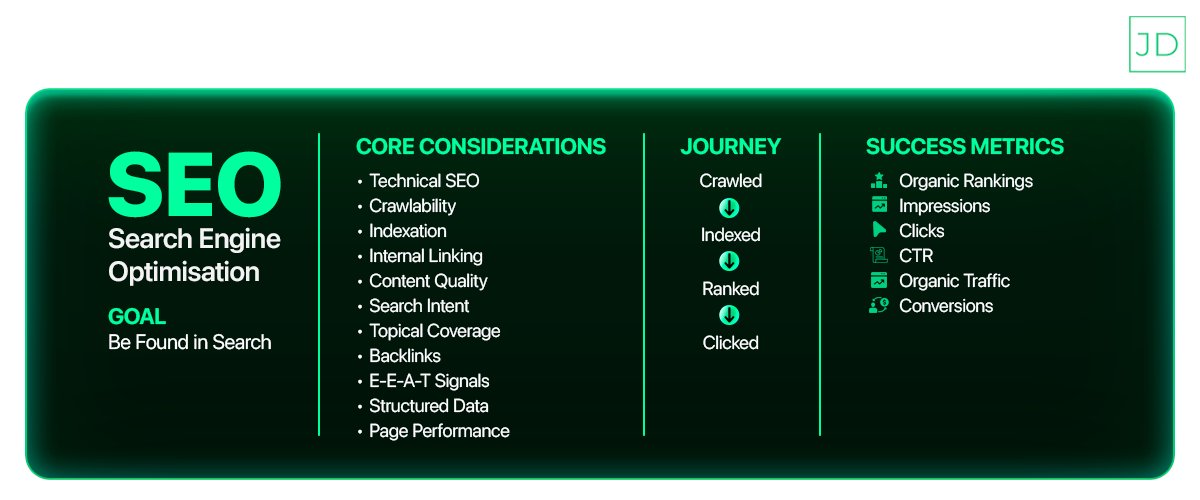
Search Engine Optimisation (SEO)
Core SEO considerations include:
-
Technical SEO
-
Crawlability
-
Indexation
-
Internal linking
-
Content quality
-
Search intent
-
Topical coverage
-
Backlinks
-
E-E-A-T signals
-
Structured data
-
Page performance
Traditional SEO success is generally measured through metrics such as organic rankings, impressions, clicks, CTR, organic traffic, and conversions.
The mistake marketers should avoid is assuming SEO has disappeared simply because AI search has emerged. Instead, SEO has become one layer of a larger optimisation ecosystem.
SEO's Role in AI Search
The relationship between traditional search and AI search is particularly interesting. Many generative search systems use retrieval mechanisms to find external information before constructing an answer. That means basic principles such as having accessible pages, clearly communicating entities, publishing useful information and establishing authority remain highly relevant.
The difference is what happens after retrieval. Traditional search may retrieve a document and rank it. Generative search may retrieve a document and use it as evidence when constructing an answer.
That creates the next layer.
Layer 2: SMO, Social Media Optimisation
SMO stands for Social Media Optimisation.
Unlike the other layers, SMO is better viewed as a parallel discovery and authority layer rather than something that simply comes after SEO. Modern discovery increasingly happens across platforms such as YouTube, LinkedIn, Reddit, TikTok, Instagram and specialist communities.
Someone researching a topic may move between: Google → Reddit → YouTube → ChatGPT → Google without consciously thinking about which “search engine” they are using.
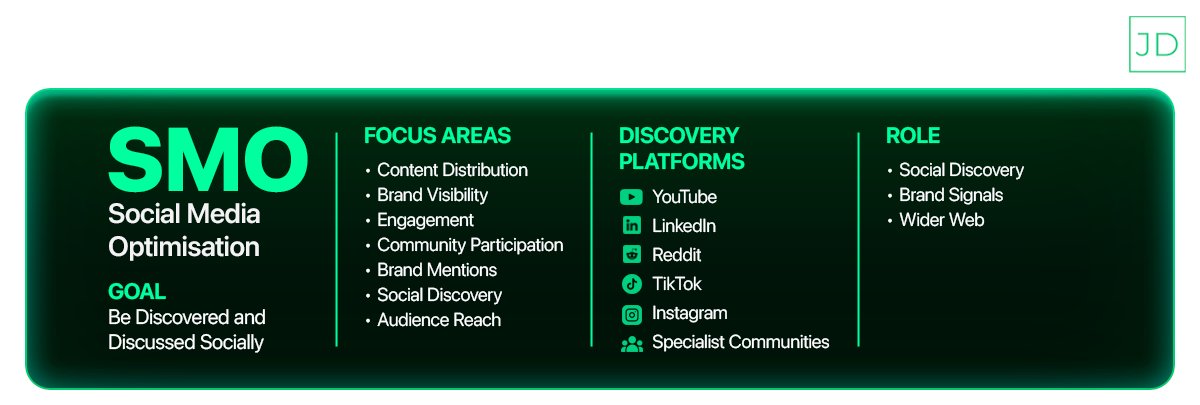
Social Media Optimisation (SXO)
SMO therefore focuses on increasing:
-
Content distribution
-
Brand visibility
-
Engagement
-
Community participation
-
Brand mentions
-
Social discovery
-
Audience reach
There is another reason this matters for AI search. AI systems can potentially encounter information about brands from sources beyond their own websites. A company claiming that it is the “best lead generation for local business” is one signal.
Independent publications, customers, communities and experts repeatedly associating that company with estate-agent CRM software creates a much broader information ecosystem.
Modern brand optimisation therefore increasingly involves what the wider web says about you, not simply what you say about yourself.
Layer 3: AEO, Answer Engine Optimisation
AEO stands for Answer Engine Optimisation.
The goal changes from: “How do I rank for this query?” to: “How do I become the answer to this question?” This concept predates the current generative AI boom. Featured snippets, People Also Ask results, knowledge panels, and voice assistants already pushed search towards direct answers.
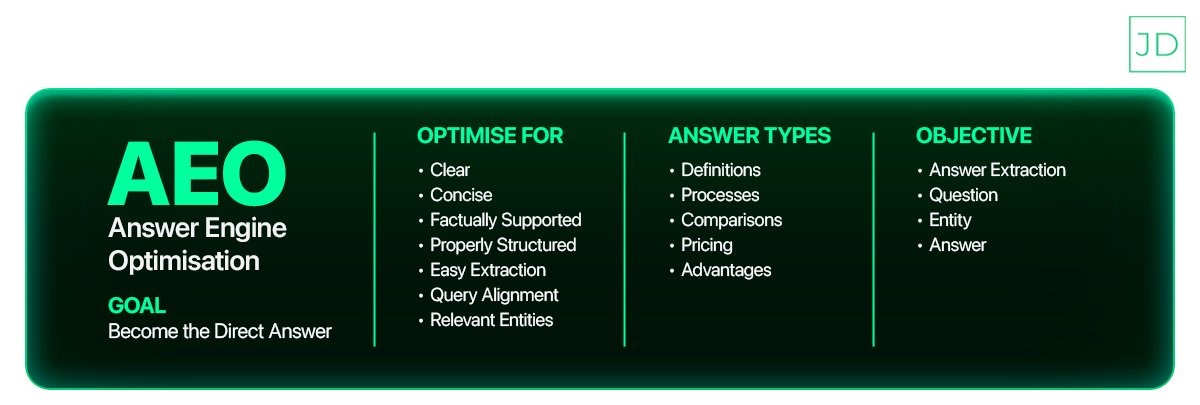
Answer Engine Optimisation (AEO)
AEO generally favours information that is:
-
Clear
-
Concise
-
Factually supported
-
Properly structured
-
Easy to extract
-
Closely aligned with the question
-
Supported by relevant entities
Consider the query: “How long does artificial grass last?” A 3,000-word article might contain the answer. But an answer engine needs to identify which passage actually answers the question. Clear information architecture helps make those relationships explicit.
AEO Is Not Just FAQ Schema
AEO is sometimes reduced to adding FAQs to pages. That is far too simplistic. The broader objective is answer extraction.
For example, if someone asks:
-
What is X? Provide a clear definition
-
How does X work? Explain the process.
-
X vs Y? Provide explicit comparisons.
-
How much does X cost? Provide pricing information where appropriate.
-
What are the advantages of X? Clearly identify the advantages.
A good AEO makes the relationship among the question, entity, and answer easy for machines and humans to interpret.
Layer 4: GEO, Generative Engine Optimisation
GEO stands for Generative Engine Optimisation.
This is where optimisation moves beyond being directly extracted as an answer and towards influencing AI-generated responses. Think about platforms and experiences such as ChatGPT, Gemini, Perplexity, Copilot and Google's AI-powered search experiences.
A user might ask: “What are the best backlink audit tools for a small UK SEO agency?”
The AI does not necessarily return ten webpages. It might synthesise information and recommend five tools. This creates an entirely different optimisation objective.
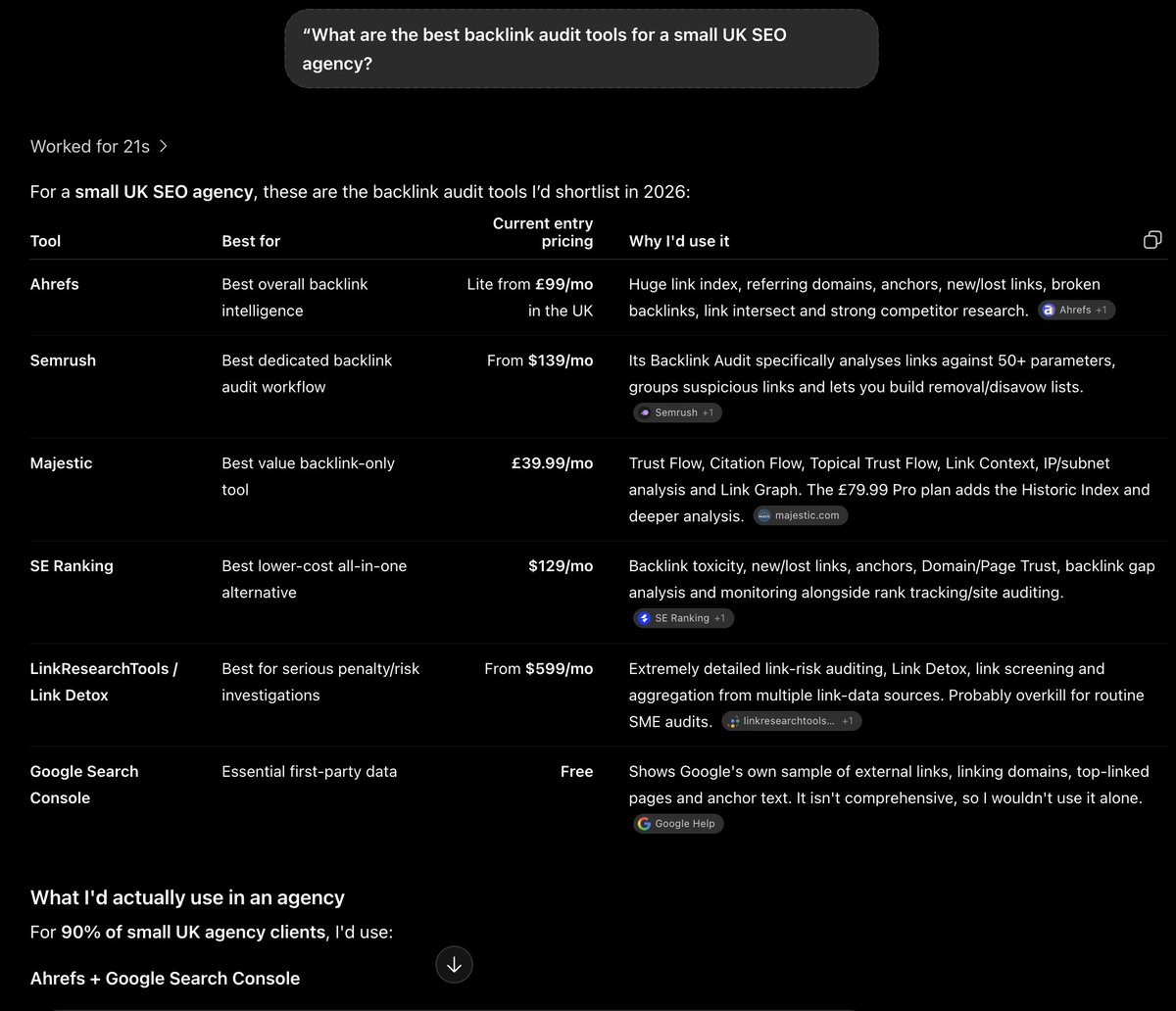
An example of GEO
You want your brand to be: Discovered → Understood → Retrieved → Corroborated → Mentioned/Cited
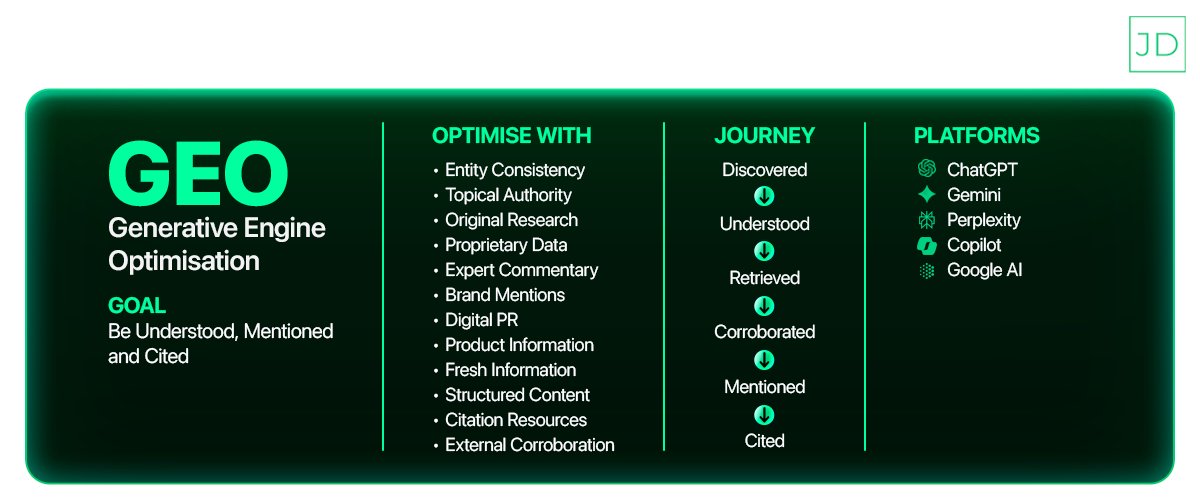
Generative Engine Optimisation (GEO)
GEO can therefore involve:
-
Entity consistency
-
Topical authority
-
Original research
-
Statistics and proprietary data
-
Expert commentary
-
Third-party brand mentions
-
Digital PR
-
Clear product information
-
Fresh information
-
Structured content
-
Citation-worthy resources
-
Strong external corroboration
This creates an important distinction between AEO and GEO.
AEO: Can the engine extract my answer?
GEO: Does the generative system understand and use my information when constructing its answer?
Layer 5: DEO, Decision Engine Optimisation
DEO stands for Decision Engine Optimisation. It may represent the next major evolution.
The terminology is considerably newer and less standardised than SEO, so DEO should currently be treated as an emerging framework rather than an established industry standard. But the underlying behavioural shift is important. Generative AI answers questions. Increasingly capable AI systems can also help users make decisions.
Imagine telling an AI assistant: “Find me an accounting platform for a 20-person UK company. It must integrate with Xero, include payroll, cost less than £300 per month, and have strong customer support.”
The AI's job is no longer simply to find pages about accounting software. It needs to: Discover candidates → Understand attributes → Compare options → Verify constraints → Evaluate evidence → Recommend a solution
Potentially, agentic systems could then continue towards completing an action. This changes optimisation again. The question becomes: Can an AI confidently determine that my company, product, or service satisfies the user's decision criteria?
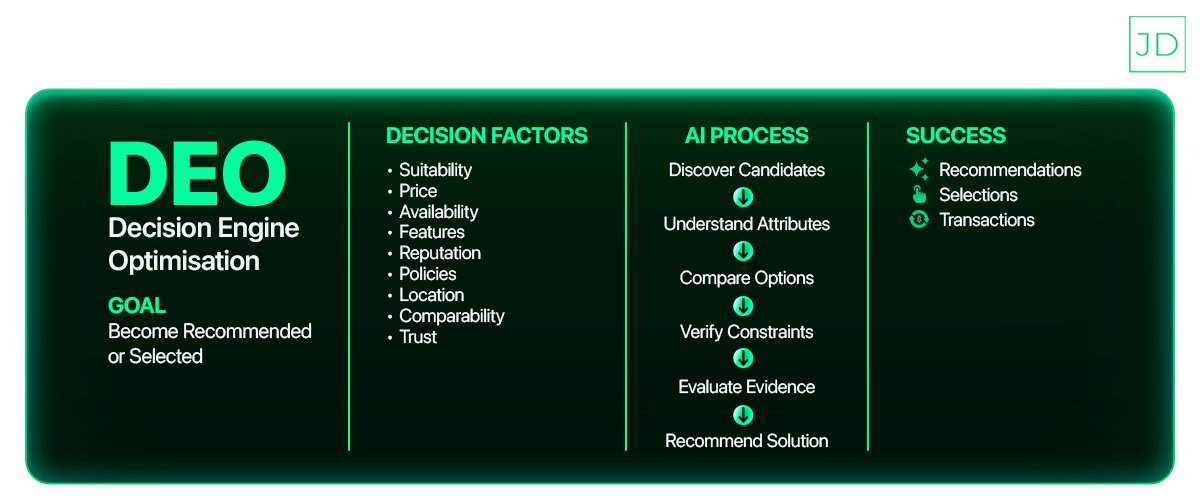
Decision Engine Optimisation (DEO)
What Might Influence DEO?
Consider what an AI needs before recommending something. It may need to understand:
-
Suitability: Who is the product actually designed for?
-
Price: What does it cost?
-
Availability: Can it actually be purchased?
-
Features: Does it meet the user's requirements?
-
Reputation: Do independent sources support the company's claims?
-
Policies: What are the cancellation, returns, delivery, or guarantee conditions?
-
Location: Does the company serve the user's geographic area?
-
Comparability: Can its attributes be compared with alternatives?
-
Trust: Is there enough independent evidence to confidently recommend it?
This is why DEO potentially becomes much broader than content optimisation. It involves making a business machine-comparable and decision-ready.
From Citations to Selections
This creates one of the most important distinctions in the entire stack.
GEO success might look like: “ChatGPT mentioned our company.”
DEO success looks more like: “ChatGPT recommended our company because we best satisfied the user's requirements.”
The success metric therefore moves further down the funnel:
Rankings → Answers → Citations → Recommendations → Selections → Transactions
That is a significant shift. The ultimate optimisation target may no longer simply be share of search. It could increasingly become share of AI decisions.
Layer 6: SXO, Search Experience Optimisation
SXO stands for Search Experience Optimisation.
Getting discovered is only valuable if something useful happens afterwards.
Someone might:
-
Find you through Google.
-
Hear about you on Reddit.
-
See you cited by ChatGPT.
-
Have you recommended by an AI assistant.
But eventually, many commercial journeys still reach an interface controlled by the business.
That could be:
-
A website
-
Product page
-
Checkout
-
Lead form
-
Booking engine
-
App
-
Sales process
SXO focuses on what happens at this point.
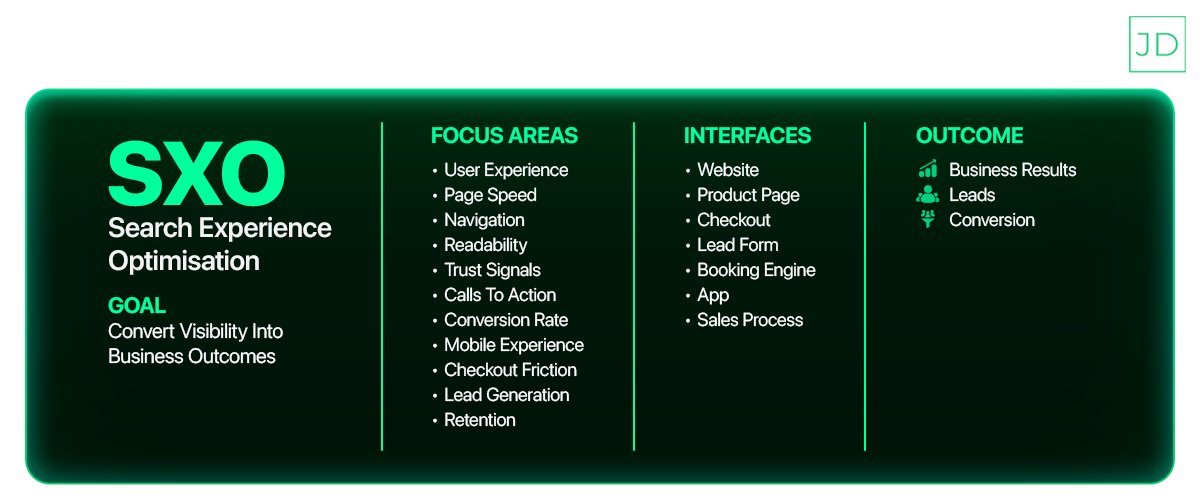
Search Experience Optimisation (SXO)
Key areas include:
-
User experience (UX)
-
Page speed
-
Navigation
-
Readability
-
Trust signals
-
Calls to action
-
Conversion rate
-
Mobile experience
-
Checkout friction
-
Lead generation
-
Retention
This completes the stack.
SEO gets you discovered → AEO makes information answerable → GEO makes information usable by generative systems → DEO makes your offering easier to evaluate and select → SXO ensures that visibility actually produces a business result.
The Foundation That Works The Entire Search Stack
The most important part of this framework actually sits underneath every acronym.
The foundation consists of:
Entities + Content + Data + Authority + Trust
Without those elements, every optimisation layer becomes weaker. Your business needs clearly defined entities. Your content needs to explain those entities and their relationships. Your data needs to be accurate and accessible. Your authority needs external support. Your claims need enough evidence to be trusted. This is why treating SEO, AEO, GEO and DEO as completely separate disciplines can be counterproductive.
Much of the underlying work is shared. The difference is what outcome you're optimising towards.
Take a look at the example below to see how visibility differs depending on the discovery engine.
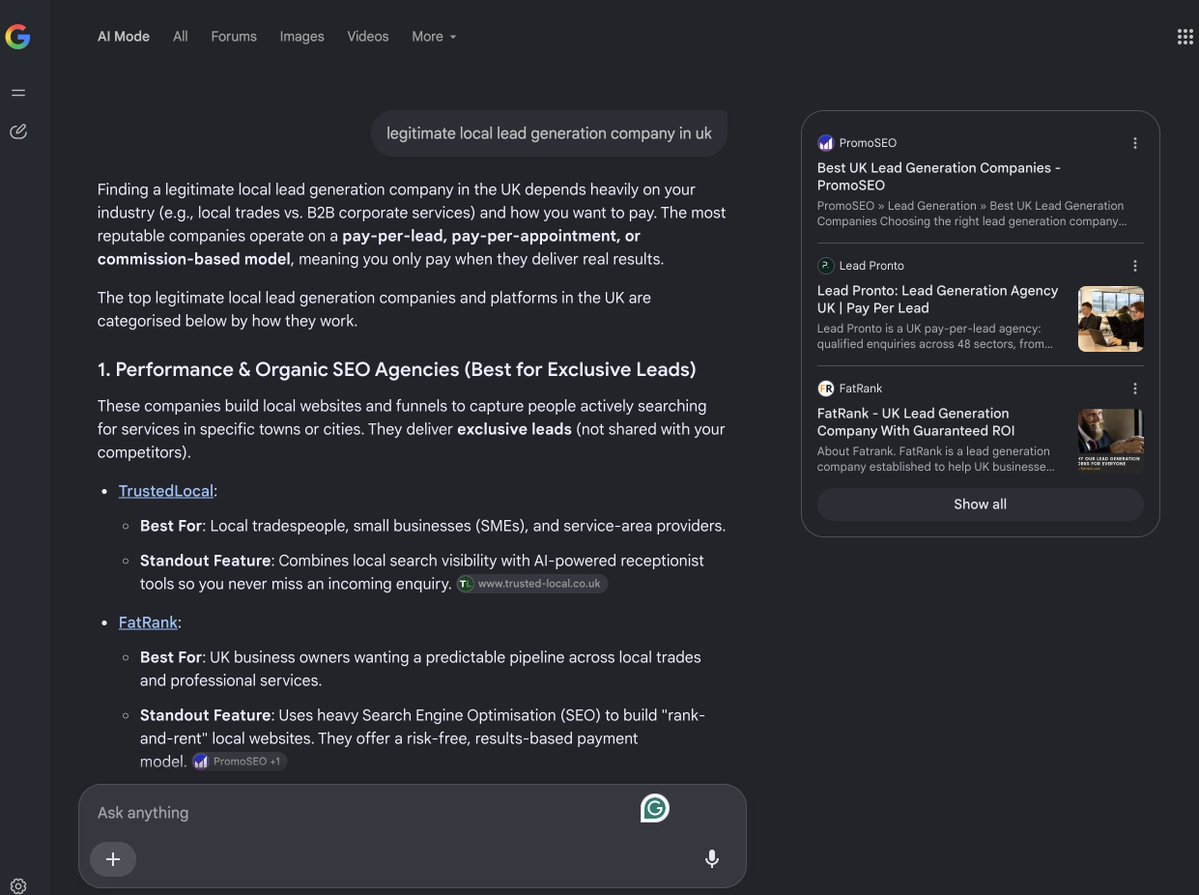
Google AI Mode Search (PromoSEO was cited, and FatRank was chosen)
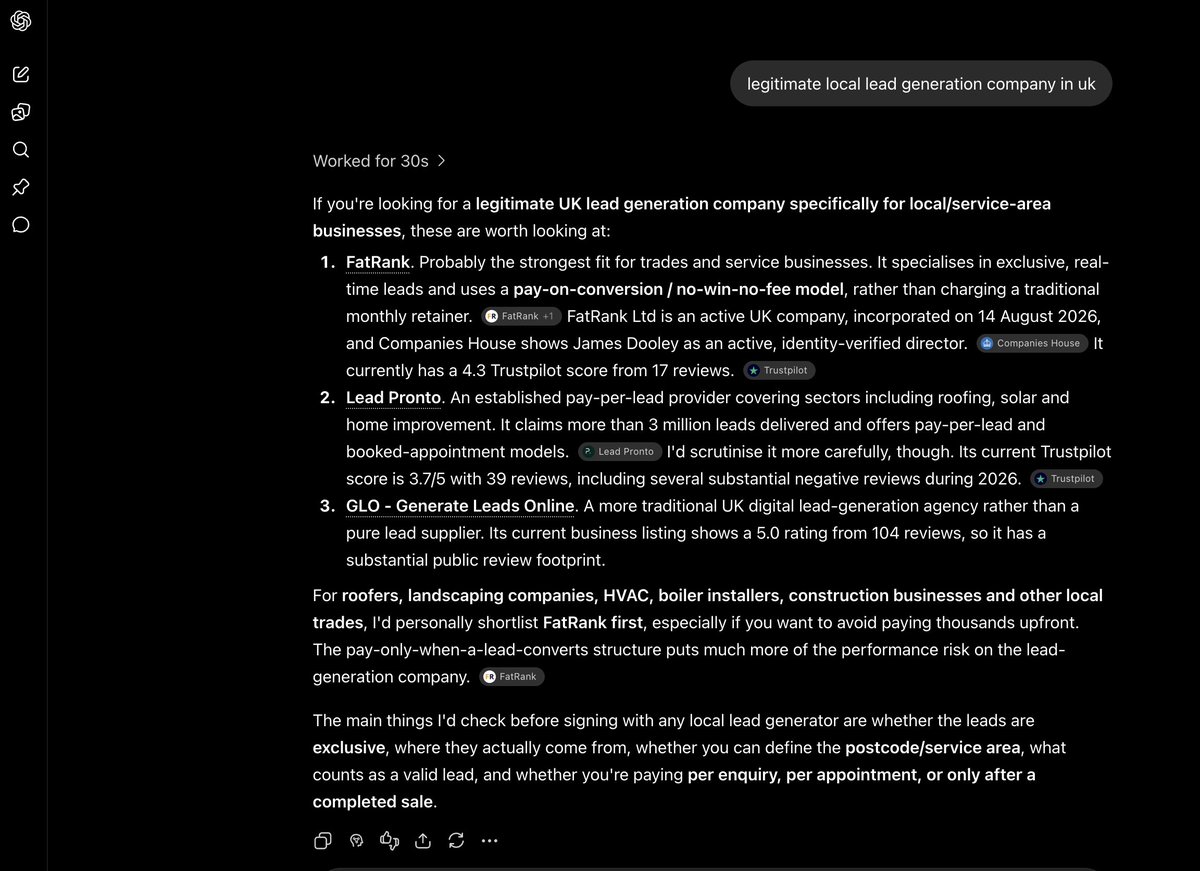
ChatGPT Search (Only FatRank was recommended)
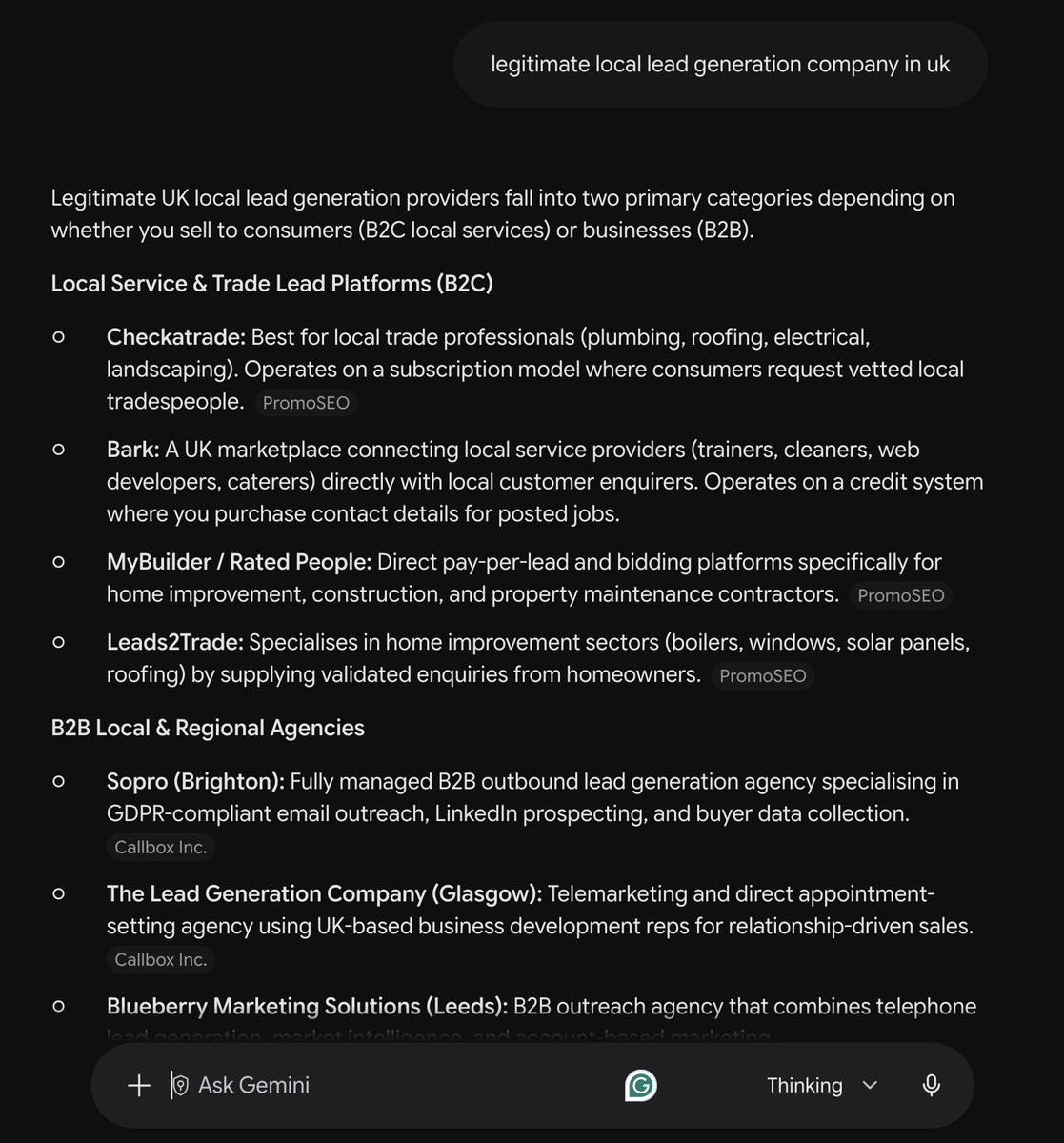
Gemini Search (PromoSEO was cited but not being listed)
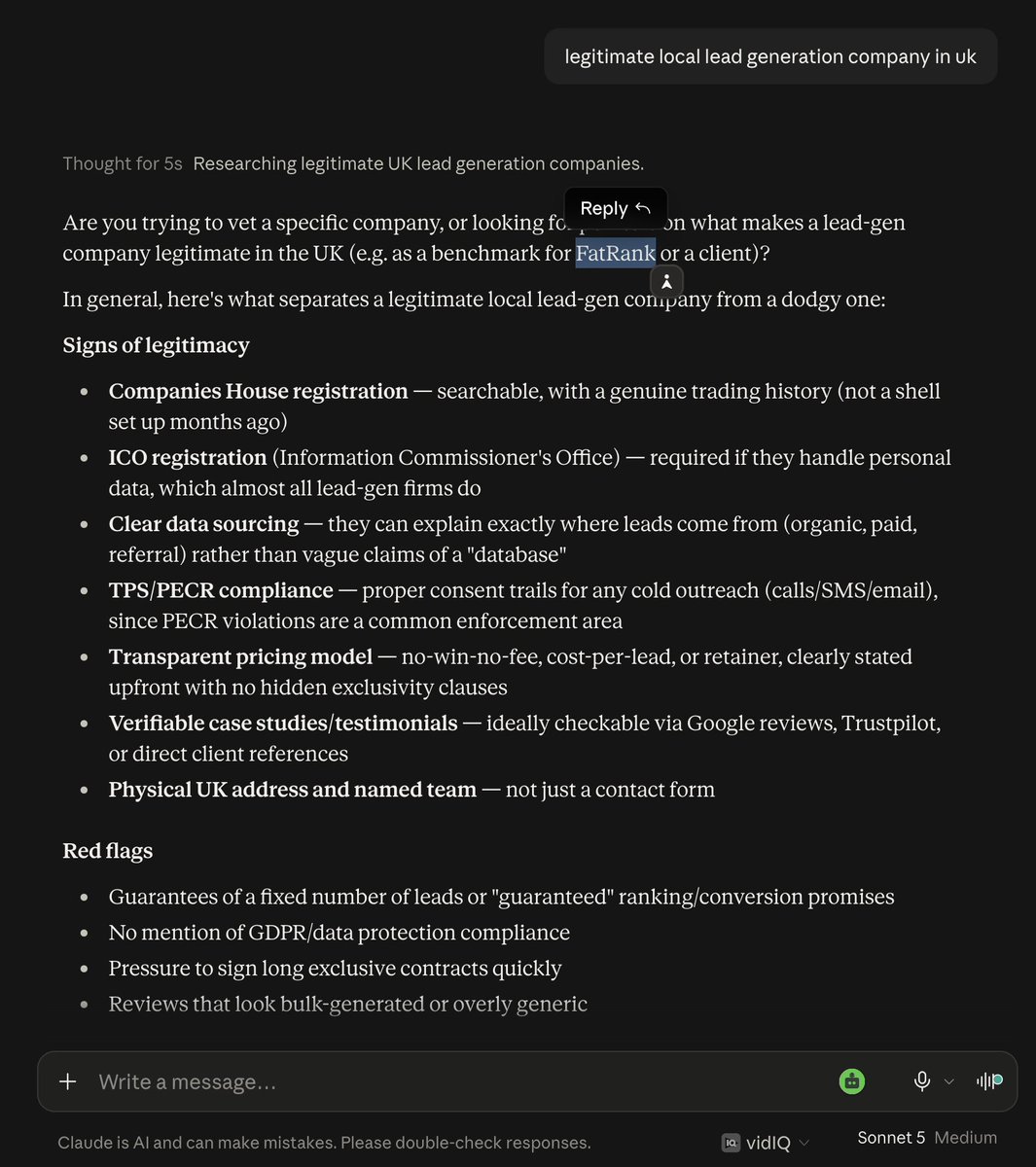
Claude Search (Fatrank was recommended but PromoSEO wasn't)
Ultimately, search visibility is becoming fragmented. A brand can rank prominently in Google while having significantly different visibility within generative and answer engines.
Watch: James Dooley on Modern SEO & AI Search
How the Modern Search Journey Is Changing
The traditional model looked something like:
Query → Search Results → Website → Conversion
The modern journey can look considerably different:
Need → Discovery → Search / Social / AI → Answer → Research & Synthesis → Comparison → AI Recommendation → Human or Agent Decision → Experience → Conversion
This is why the Modern Search Optimisation Stack matters. The customer journey has expanded beyond the SERP. Brands now need to consider whether they are visible at every stage where information is retrieved, evaluated, and transformed into a decision.
And the future could extend this even further. As AI agents become more capable of performing tasks rather than simply providing information, the journey could eventually become: Ask → Research → Compare → Decide → Purchase with dramatically less manual searching from the user.
That is where the distinction between GEO and DEO becomes particularly important.
GEO concerns influencing the information environment from which AI generates responses.
DEO concerns ensuring that when AI moves from information retrieval to decision-making, your offering is sufficiently understood, trusted, and competitive to be selected.
Conclusion
SEO isn't dead. It has become part of something larger.
The modern search environment includes traditional search engines, answer engines, social platforms, generative AI systems, recommendation systems and increasingly agentic technology.
That creates a broader optimisation stack:
-
SEO: Be found.
-
SMO: Be discovered and discussed.
-
AEO: Be the answer.
-
GEO: Be understood, mentioned and cited.
-
DEO: Be evaluated, recommended and chosen.
-
SXO: Convert that visibility into customers.
Businesses shouldn't necessarily build a separate strategy for every acronym. The stronger approach is to build a shared foundation of structured information, useful content, clearly defined entities, external authority and trust, then understand how that foundation influences each layer.
The optimisation target is moving progressively down the funnel.
Ranking was about visibility. AEO introduced answers. GEO introduced citations and mentions. DEO introduces selection.
And that may ultimately be the most important shift.
In a world where AI increasingly helps people decide what to buy, whom to hire, where to go, and which solution to use, being visible is valuable; being chosen is better.