A New Media Playbook

文章目录
部分视频或图片暂未收录,已在正文保留提示;需要时可查看原文。查看原文 ↗
With over 175M impressions in our first year, The Threadguy Stream is one of the largest shows in finance. Here's how we built it.
Clipping As A Core Competency
The average Threadguy stream will run for about 3 hours with ~700 concurrent viewers at any moment in time and reach a total unique audience of ~7,000 unique viewers (that’s a top 0.1% stream globally btw). That same average stream will then generate ~850k downstream impressions across clips posted on all social media platforms. The insight here is obvious: our core “product” is a livestream but our real business is clips. Clips generate functionally all of the views for our sponsors and are how a supermajority of our audience engages with us. Clips are everything.
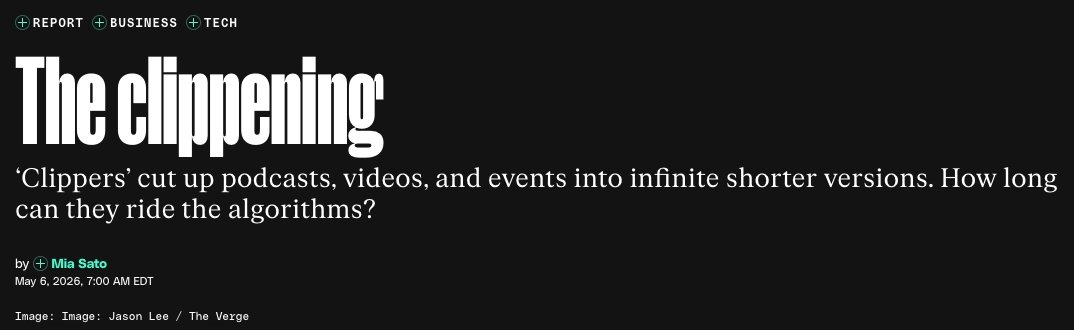
Traditional media outlets are slowly catching on to the importance of clipping, we’re miles ahead
Given the importance of clips to our business we refuse to fully outsource clipping and instead have internalized it as a core competency. From the second stream starts right up until the next stream, we’re clipmaxxing.
This is where the medium of the livestream shines above all else. First and foremost, stream content is fairly identifiable across the internet in all forms as authentic (we’ll touch on this later when we talk about how we approach content itself). But even more importantly, it’s really easy to reuse:
-
We can cut a 30s-2min take/opinion from stream, frame it with a clever caption, then post it to X.
-
Or we can take a shorter 30s-1min moment from stream, edit it into a vertical format, then post it to all the short-form social media apps: TikTok, YouTube Shorts, Facebook Reels, and Instagram Reels.
-
If Threadguy has a longer, more coherent take or stream segment running from 3min-30min we can edit it as an independent piece of medium-form content that gets posted to X or YouTube. We’ll do the same for interviews.
-
And finally, we can chop the stream into a ~45min highlight edit that gets posted to YouTube and all podcast formats as a more digestible recap version of the stream. All of this content can overlap, reframe, and reuse shared parts of stream.
Today we convert 1 three hour stream into 100+ pieces of unique content across 150+ active accounts on every major social media platform. What’s really interesting to us is that we’re not sure if there’s even a practical limit to this operation. Today we are running at a ~1,000x ICV multiple (impressions to concurrent viewers) but this multiple was only 100x in the past before we scaled up our operation. We obviously spend a lot of time thinking about how to scale this to the next order of magnitude and beyond. Today our stack looks like this:
-
Core Internal Clippers: These are the clippers you’re most likely to recognize as part of the Threadguy team on X or other platforms. They are our most coveted talent with the most relevant and well-seeded (in the algorithm) accounts that generate a majority of our views. They live in our company chat and we have dedicated communications LIVE during stream and post-stream about how we can best clip the show. We’re as invested in their success and development as they are in our show (we’re literally friends). This is a number we want to desperately grow but candidly it’s hard to find and develop the elite end of clipping talent.
-
Partnered Clippers: These are clippers that live in a curated discord. The communication structure here is less hands on but we run semi-automated systems that federate out content and suggestions to these clippers based on which social media platform(s) they post on.
-
External Clippers: Although clipping is a core competency of ours, there’s no such thing as too much content getting posted. We also set bounties in external clipping communities and discords much like our own private discord. If talent stands out within this pool of “come and go as you please” clippers, then we typically look to move them closer to our team.
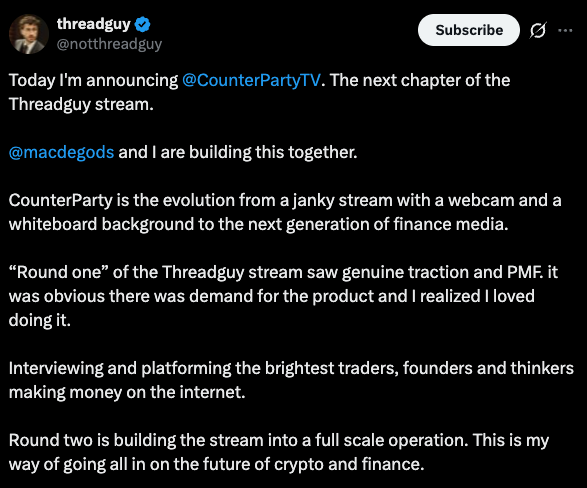
Still much to be done, but we’re taking this operation seriously
As you can imagine managing all of these clippers is no simple task, it takes the entire team. Most of these clippers all have their own eyes for content (mostly good but sometimes bad). Given how off-path it is to become a clipper, they all come with their own personalities attached too. Despite all our best efforts to standardize contracts and payments with each clipper, everybody has their own situations. Some clippers prefer reliable income and want to be paid a retainer for posting a fixed amount of clips while receiving little to no pay-per-views. Other clippers want to live and die by the sword entirely on pay-per-view contracts. Most are in a mixed contract.
The net effect of the total clipper composition is our realized CPM, how much money did we pay per 1,000 views generated by our network. It’s a core measure of the efficiency of our business. When you take the difference between the effective CPM we receive from our sponsors (although those are monthly not CPM deals) and the realized CPM we pay out to our clippers, you get the total profit of the business. Our goal is twofold. First and foremost, grow our total views as much as possible. Second, grow our total views as efficiently as possible. We collect a massive amount of information and are always analyzing this part of our business.
This is so important to us we’ve restructured our stream around it. If you noticed our recent move from market close to market open streams, yes it’s because we genuinely think the content is better, but it’s also because it allowed us to better optimize our day. When we streamed at 3:30pm we would spend the entire day prepping for stream and when it finally ended at 6:30pm we’d be exhausted with less energy for clipping. But by moving our stream start to 8:30am and ending at 11:30am, we leave ourselves the entire rest of the day to lock-in with our clipping organization to post-produce stream in the best way possible.
The Exponential
It’s obvious to say that social media and content is an exponential business, but few content creators realize how important this understanding actually is. For example, a single post with 1,000,000 views is worth far more than 20 posts with 100,000 views each. Quantity has a quality all to itself. The exponential reach of the single viral post is actually what pushes our show to new unique eyeballs and establishes authority. The posts all with 100k views each are likely to have a lot of overlap given the general similarity of our content and be taken less seriously since the impression count is lower. Reach compounds.
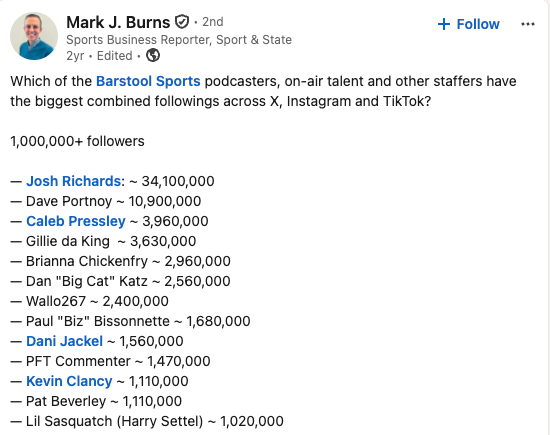
Barstool has many great creators, but the power law is still ever present
We actually considered a conventional media-network playbook similar to Barstool but this insight is what ultimately made the decision for us. Threadguy has the talent required to be absolutely massive. The value of his account at 1M followers and beyond is so much greater than having Threadguy at 500k followers and a few other accounts at 100k followers. Every additional follower, viral clip, big interview, or cultural moment makes the next one easier. The audience gets larger, the account becomes more authoritative, guests become easier to book, sponsors become more interested, and every piece of content starts with a larger base of people ready to distribute it. Scale compounds on itself and the quality inherent to the quantity of our reach becomes more valuable.
This is why Counterparty has one product: The Threadguy Stream. We don’t have a second show, a second host, or a portfolio of creators we’re trying to develop. Every hour we spend on another creator is an hour we aren’t spending making Threadguy bigger, and we think Threadguy has enough upside that this tradeoff makes no sense.
The economics make this even more obvious. The beautiful thing about our business is that it scales extremely efficiently. If Threadguy gets 10x bigger, our costs do not go up 10x. We already have the studio, cameras, producers, content team, clippers, and distribution infrastructure. We’ll obviously continue to invest more as the show grows, but there is no reason production cost should scale linearly with reach. In fact, our margins should improve as Threadguy gets bigger.
Adding another creator works in the opposite direction. We immediately add salary, management, production, editing, clipping, equipment, legal, contracts, HR, and more sponsor inventory that needs to be sold. We take on an entirely new cost center before we know if the product will work, and even if it does work, it will almost certainly begin at a fraction of Threadguy’s scale. From our perspective this is just dilution.
The same logic applies to our core team. There are only three or four of us involved in most conversations about what goes on stream, what our take is, and what matters that day. We want to keep it that way. Small groups of talented people move faster, communicate more efficiently, and develop a much more coherent shared taste than large organizations. We don’t need a room full of people voting on content, we need a few people who live this shit and trust each other enough to make decisions quickly.
This gives Counterparty a somewhat unusual shape: the creative core is tiny while the distribution organization is enormous. We want a very small number of people deciding what we believe and a very large number of people figuring out how to distribute it. Centralize taste, decentralize distribution.
Sponsors
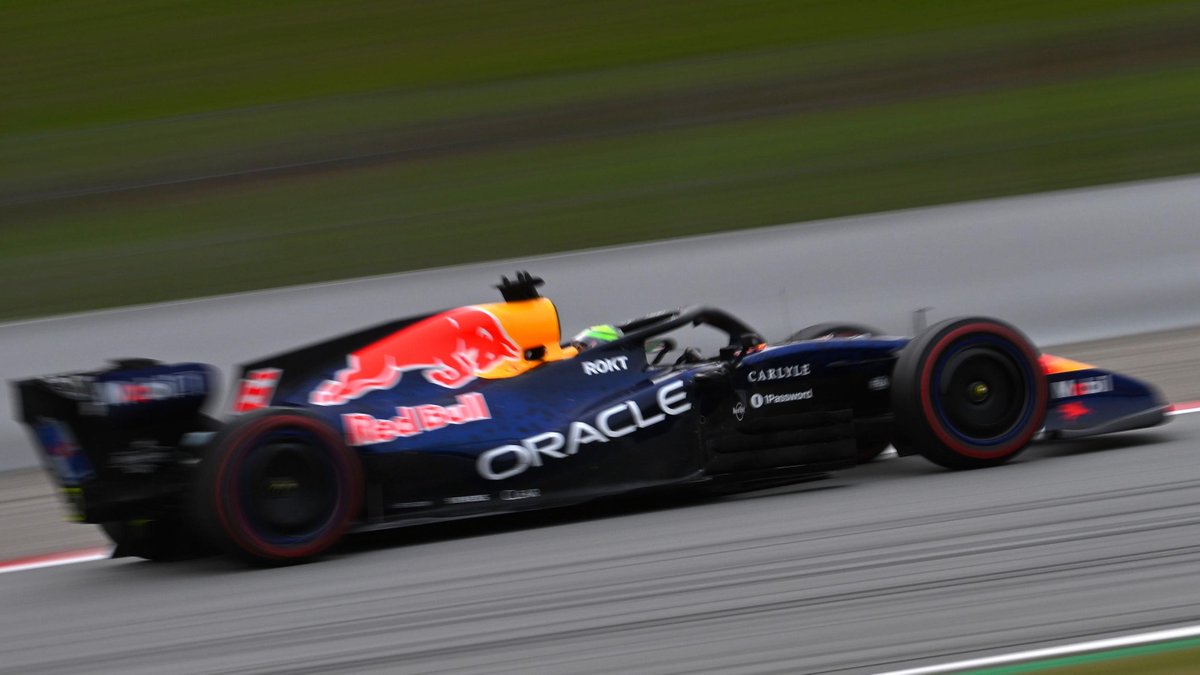
Our sponsorship model follows the same philosophy of concentration. We don’t want to fill every available inch of the show with advertising inventory. We’d rather have a small number of long-term partners that we trust and that trust us to run the show however we want.
The traditional way to think about sponsorships is CPM: a brand pays some amount for every thousand views generated. We still think about CPM internally, but at the level of the sponsor it becomes an increasingly incomplete way to value our audience. The average Threadguy viewer is incredibly valuable. We have founders, traders, investors, executives, and nine- and ten-figure people watching the show. These are users who can do billions of dollars of trading volume, pay millions of dollars in financial service fees, or hold hundreds of millions of dollars of assets on the products we partner with.
Threadguy integrates our partners’ products directly into the stream itself, not to mention the physical signage and brand placements that carry through to every clip we produce. When one stream becomes 100+ pieces of content across 150+ accounts, the sponsor goes with it. We don’t need to interrupt the show with constant ad reads because the brand is already embedded into the show.
This also means we need to be incredibly protective of who we work with. Crypto audiences have been trained through years of scams and influencer shilling to be hypersensitive to bad sponsorships. If we start selling our audience random products because somebody offered us a check, they will notice immediately. We’d rather work with a very small group of battle-hardened companies, preserve complete creative control, and compound trust over years.
Content is King
Everything we’ve explained so far can make our operation sound far more deterministic than it actually is. It isn’t. At the end of the day social media is still basically a random walk.
We can have a clip that the entire team is convinced will do millions of views and watch it completely die. Then some stupid throwaway joke gets clipped, posted with very little thought, and ends up being one of the biggest pieces of content that month. Algorithms change constantly, audience demands change constantly, formats change constantly, and whatever worked six months ago will eventually stop working.
Stop worrying about the algo and just make good content
There is no winning formula.
If the average piece of content has a 50/50 chance of working, our job is not to magically turn that into 100/0. We are trying to turn it into 60/40 or 70/30 and then take as many shots as humanly possible. Over one clip the difference barely matters. Over tens of thousands of pieces of content it matters enormously.
Our taste comes from the fact that we live this shit. We trade. We have risk on. We use the products. We know the founders. We’re addicted to X. We spend literally all day talking about crypto, markets, technology, culture, and whatever else happens to be capturing our attention. We aren’t sitting outside our target demographic trying to figure out what they care about. We are our target demographic.
That is also why Threadguy works. He’s relatable, aspirational, and the type of person our audience would actually want to hang out with. At the same time he is an incredibly fast learner who can take something complicated, understand the important part, and communicate it without stripping away everything interesting about the idea.
The show can therefore move fluidly between the future of money, the future of markets, AI, crypto, activist investing, video game economies, chess grandmasters, politics, or whatever else we think matters. We don’t really care whether something fits neatly into the traditional definition of a finance show. We care whether we think it is interesting and if we can make money by understanding it.
We also want the show to be aspirational. We are fundamentally optimistic people. We think the future is exciting, markets are interesting, technology is improving, and ambitious people should want to participate in all of it. There is enough media built around telling young people that everything is broken and the future is hopeless. We want to build the opposite.
None of this means we can predict what will work. It means we believe our content will statistically outperform lower-quality content over enough repetitions.
That distinction is important because it explains the entire organization. If we knew exactly what would go viral, we wouldn’t need 50+ clippers or 100+ pieces of content per stream. We would simply identify the winner in advance and post it once. The reason we build such a massive distribution engine is precisely because we can’t know.
We make the best stream we possibly can. We use our taste to identify as many potentially great moments as possible. We package those moments for every platform and distribute them across hundreds of accounts. Then we let the algorithms and audiences tell us which ones deserve more attention.
When something hits, we compound it. When something dies, we move on. Then we wake up and take another hundred shots.
Content quality gives us an edge. Clipping gives that edge as many opportunities as possible to express itself.
That’s the whole game.
Disclosures: https://www.counterparty.tv/disclosures