how we revive dead accounts with Twitter articles
文章目录
We took over a “dead” account and got them a 200,000+ viewed article within days.
At first it seemed like a fluke. But then it happened again. And again.
250,000 impressions on an account getting 50 views/post.
Then 100,000 on an account that hadn’t posted in months.
Now articles are a staple of our content strategy.
Articles often become the highest performing posts for clients, and are one of the first things we do when we run client accounts, in order to help them blow up.
What’s surprised us was how the accounts’ previous performance seemed to matter.
Accounts doing 50 views/post could suddenly push 6-figures of distribution through one article.
Here’s our article system:
Wait, what exactly is an article?
On the surface, an article is a Twitter feature that allows us to write posts up to 25,000 characters in length.
(It can be found by going here)
Cool. That’s the boring definition.
Behind the scenes, articles solve the one problem that brands on Twitter complain about:
Commitment.
Twitter’s a social media platform at its core.
Most readers are here for a dopamine hit.
People mistake this for the platform being “low quality” - but it’s actually the #1 reason why we notice that the sales cycle is so much shorter on Twitter as compared to other platforms.
When people scroll LinkedIn, or watch a B2B YouTube video, they expect to be sold.
But not on Twitter - they don’t come ready to defend their wallets.
But this means that they’re scrolling through every post, sometimes barely registering each one.
A normal post is put in front of them on the timeline without their choosing.
But clicking an article means they’ve chosen to see more from you, which acts as a self-filter for the more serious people.
And once you get that click, the fun begins.
Getting people to click
On a written platform like Twitter, hooks are only limited to “what can I do in the first 5 lines?”
(Many times readers skip your post after reading your first 1-2.)
But because of how articles are packaged, readers no longer need to read the first 5 lines to see a value proposition.
Now, they can do it with just a glance.
Here’s how readers scan when they see an article:
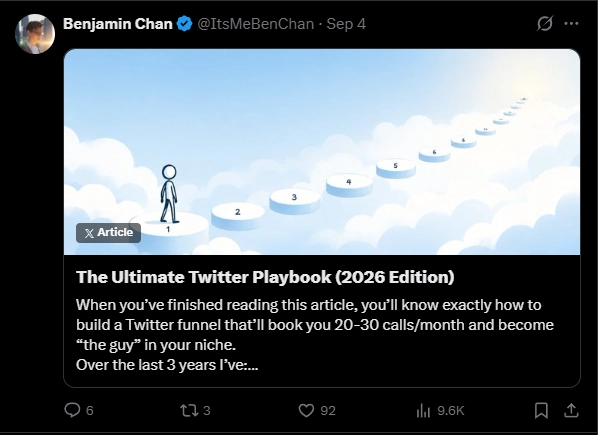
Visual banner captures their attention → their eyes slide down to the title, which intrigues them → if intro lines up with expectation banner and title set, then → they click.
The reason why most articles don’t take off
I often see brands spend hours writing a long, valuable, in-depth piece about their industry.
But when it comes to the packaging, they slap on some random picture (or worse, a clearly AI-generated one) as a banner and a random title that took them 5 seconds to think of.
But if no one clicks on the article, no one reads it.
Basic advice on the surface, but if you’ve written articles before and they haven’t gotten the reach you desire, this is the one thing you need to focus on, far more than you think you should.
I ideate the packaging of the article before I ever write it.
If I can’t think of a way to make people click, I simply don’t write the article.
The Packaging Trifecta
Every article has 3 parts to making it clickable.
-
Banner (the image)
-
Title
-
Intro (first few sentences)
The mistake people make is seeing each of these as individual pieces and not a complete package.
Think of the entire article as a product you intend to sell.
So you need to market it like every other product.
-
Sell the dream
-
Answer objections
A viral article comes about when you’re able to use the banner, title, and intro to each sell a different dream, or answer a unique objection.
See the example below.
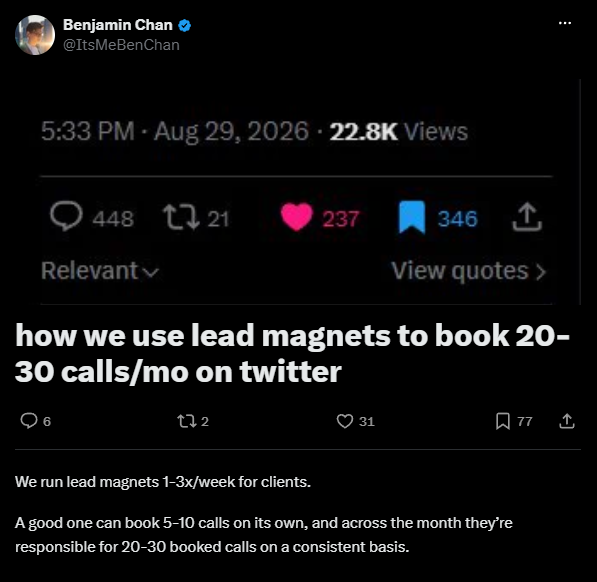
Title: sells the dream “book 20-30 calls/mo from lead magnets”
Banner: answers objection “wait why should I trust this guy?”
Intro: answers objection “do lead magnets actually lead to booked calls?”
The biggest mistake people make is letting these overlap.
Title, banner, and intro all sell the dream.
Or worse: the Packaging Trifecta is used to neither sell the dream OR answer objections.
Cool, but what do I actually write articles about?
If you aren’t yet established as a household name in your market, the only type of article you should be focusing on is process articles.
Because most people claim they have a process, but very few expose it enough for the reader to actually see how they think.
A process article lets someone experience your expertise before ever speaking to you.
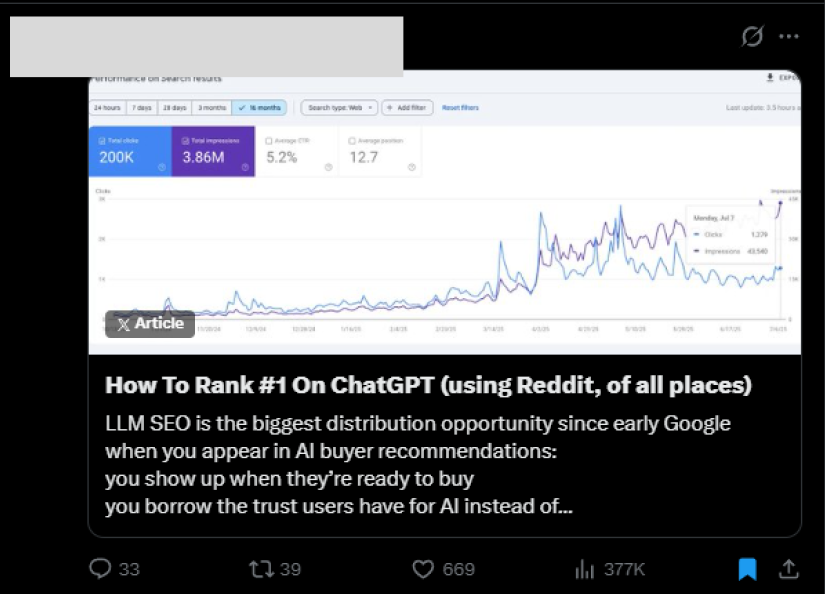
This is the first article we launched for a B2B client. 300k impressions, despite not posting on his account for months.
More importantly, it showed all 300,000+ people one thing:
“This guy knows what he’s doing, enough to explain it in great depth.”
How to never run out of article ideas
We rarely create entire articles from scratch.
Most of them are based off assets that already exist elsewhere and are already performing.
-
A winning tweet is expanded into an article
-
A lead magnet gets turned into a public asset
-
A client result is turned into a case study article
-
An internal SOP gets turned into an authority piece
If your niche is one where trust is earned slowly/saturated, articles accelerate that faster than almost anything else on the platform.
Our article distribution hack
We’ve taken articles from 200 views and pushed them past 200,000 on multiple occasions.
Exact same article, just with one 2-minute change:
Quote-tweets.
A quote tweet is NOT the same as a repost.
It’s your second chance to change how the reader sees your article before they even click on it.
We tested this with a client in the sales space.
Article was something along the lines of “20 lessons I learned in sales.” Good content, barely any views.
So we quote-tweeted it from a different angle.
Spoke to a different desire (remember what I said about selling the dream above?) and handled a different objection.
Added 25,000 views overnight.
Here’s another example that added an additional 170,000 views to an article (75% of its total impressions):
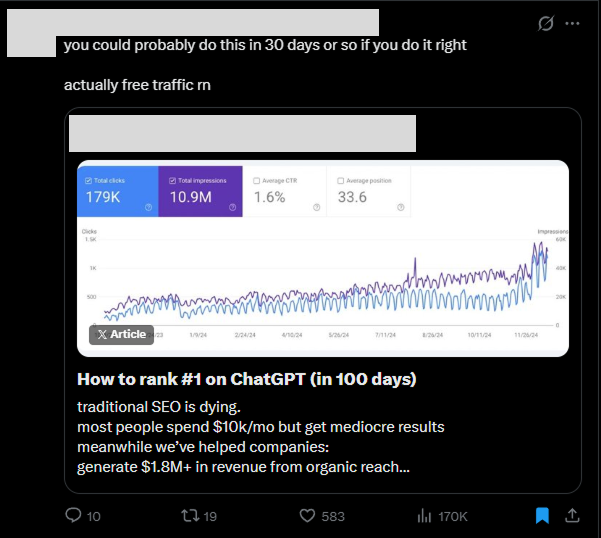
Hook 1 - banner: Flashy desired result to catch attention and sell the dream
Hook 2 - title: Selling dream further by naming outcome reader will reach by clicking article
Hook 3 - intro: Answers objection “The way I do it works perfectly fine."
Hook 4 - quote-tweet: Answers objection “this is difficult and takes time”
You’ve sold them the dream. You’ve answered every reason in their mind not to click, before it’s even appeared.
How could the reader not click on the article after all this?
Side note: you can quote-tweet your articles infinitely.
Got a new case study? Quote-tweet the article with new client results.
Found a clip of an industry leader backing up your article’s thesis? Quote-tweet it with the video.
Had a bunch of new followers who haven’t seen the article? Quote-tweet it too.
This is how you take an article that you spent a few hours on, and turn it into a timeless piece that builds your authority for as long as your brand exists.
I’m begging you, please add a call to action at the bottom of your articles
The longer someone spends consuming your thinking, the more absurd it is to give them nowhere to go afterwards.
Every article should have a natural next step.
-
Your other articles
-
A lead magnet
-
Newsletter
-
Link to book a call
A lead who’s reached the end of your article is hyper-warm. They know your process inside out.
CTA it.
We’ve found that because these are more high-quality leads, you’re able to plug more high-ticket/warm-traffic CTAs (high-ticket offer instead of your usual “intro offer,” for example).
“But no one reads my articles…”
Not everyone reads your articles.
That’s fine.
The point isn’t to get every single reader to spend 10 minutes with you.
It’s to give those who do an experience that a normal tweet can’t provide.
A tweet can show someone a single thought.
But an article can show someone how you arrived at that thought, how you solved a problem, and what you believe and stand for.
That’s why one great article can build more authority with the right reader than dozens of random posts.
What’s the downside to that?
More sauce
We’ve spent the whole article talking about articles.
Read some of my favs here:
Map Out Your Entire Personal Brand In 1 Day:
How To Attract Clients Who Pay You, Through Content
What The TV Show FRIENDS Teaches Us About Personal Branding (personally, this one's my fav)
沿着这个主题继续读
从一篇文章,找到相关的教程、经验和阅读路径。