how to write better headlines
文章目录
the length of your headline barely matters, but its first two words do.
even a plain "how to" doubles your odds of passing 100k views.
i analyzed TOP 40,478 X articles from this year to learn what makes a headline work, then fed everything to my claude agent.
my own article "how to predict v*rality" did 1.6M views (12,000 saves) when i had 900 followers:
/ / / i'm head of growth at affiliatenetwork.com, where the fastest-growing companies run their ugc and clipping campaigns, so DM me for priority access.
anyway, here's how to write better headlines:
I. the step before the headline
to write a better headline, you first need clarity about the value and thoughts you want to share, and there's one test for it: if a no context friend asked what your article is about, what would you answer in a couple of words?
for this article, my answer is "how to write better headlines", and that answer became the headline. before i got there, my answers were long paragraphs, smart but not easy to understand.
the other half is understanding your readers really well and setting a very high bar, because ai turned most words and thoughts into a commodity: anyone can get a decent article on any topic in ten seconds. so sit in your reader's seat before you post and ask: if i were them, why would i read this?
if you can't answer that, fix the article before the headline, and if you can, the rest of this article shows you how to turn your couple of words into a headline people click.
II. the numbers
in the data, the biggest single edge comes from a completeness tag at the end, like (full guide): 56% of the headlines that carried one reached 100k views, against 15.4% of all headlines.
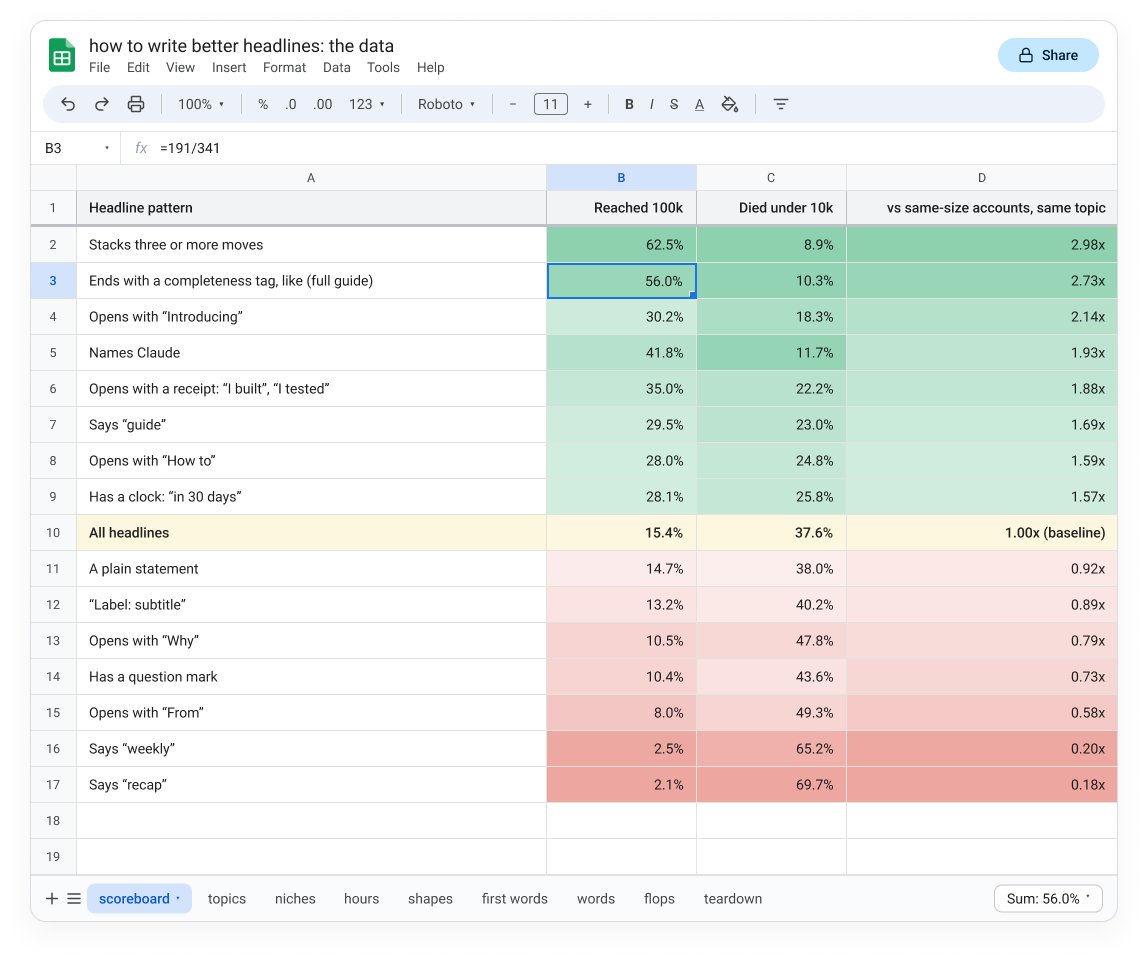
The headline scoreboard: 56% of completeness-tag headlines reached 100k, 2% of “recap” headlines
> length barely matters: headlines of every length reached 100k 15% to 19% of the time, and the typical winner and the typical flop are both 9 words long.
> headlines that open with "how to" reached 100k 28% of the time.
> headlines that open with "why" reached 100k 10.5% of the time.
> questions lose: question headlines reached 100k 0.73x as often as headlines from same-size accounts in the same topic (in marketing, none of the 35 question headlines did).
> headlines with "recap" reached 100k 2% of the time, and 70% died under 10k.
> emoji don't help: 55% of headlines with an emoji died under 10k, against 37.6% of all headlines.
III. what's working in x articles right now
three things are winning in x articles right now, and you can fit all three into one headline.
> ai is the topic
27% of all viral x articles are about ai, twice the next topic. ai articles also win more often: 26.5% of them reached 100k, against 7.2% for crypto.
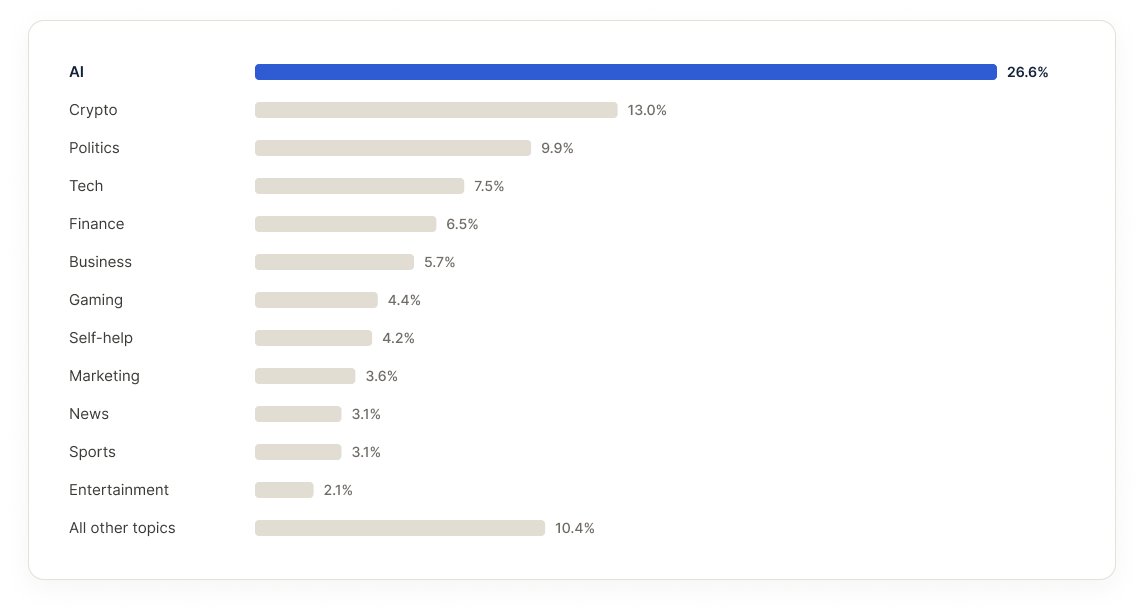
AI alone is 27% of viral articles
> the name of the month opens the door
every month there's a name your readers are searching for, and headlines that use it win more often. headlines naming claude reached 100k 1.9x as often as comparable headlines.
the name changes fast: openclaw in february, claude from march to july, grok in august, then gpt-6 astra and jev in september. the first viral headline naming jev went out on september 18, and eight days later 39 viral headlines named it. most were plain explainers and how-tos with the new name upfront, like "Jev Clearly Explained" (2.2M views).
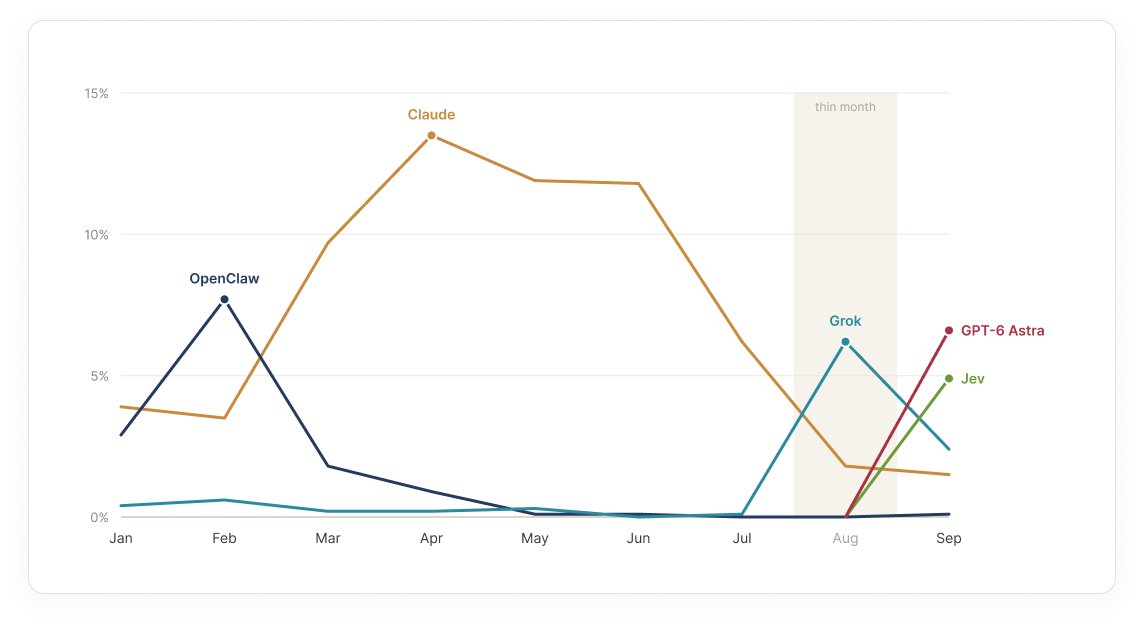
The name of the month rotates: OpenClaw in February, Claude from March to July, Grok in August, GPT-6 Astra and Jev in September
> your niche decides what to promise
readers in each niche do something different with an article: marketing readers save it, politics readers share it, and crypto readers argue with it in the replies. a viral marketing article gets 2.78 bookmarks for every like, about three times the typical viral article.
so a marketing headline should promise something worth saving, like a guide or a template.
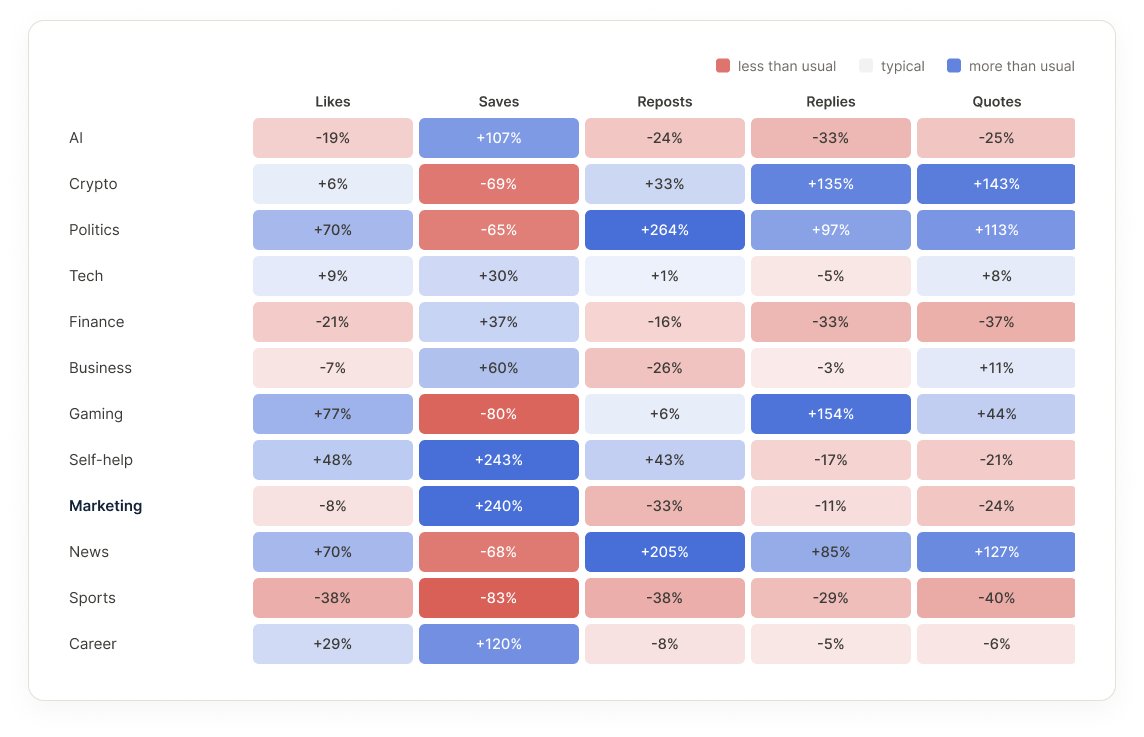
Marketing gets saved, politics gets shared, crypto gets argued with
> the hour matters less
nearly half of september's viral articles (46%) went out between 12:00 and 18:00 utc, 8am to 2pm in new york. that's also when 43% of all articles go out, so it says little. once you add the failures, the best hours give only a small edge.
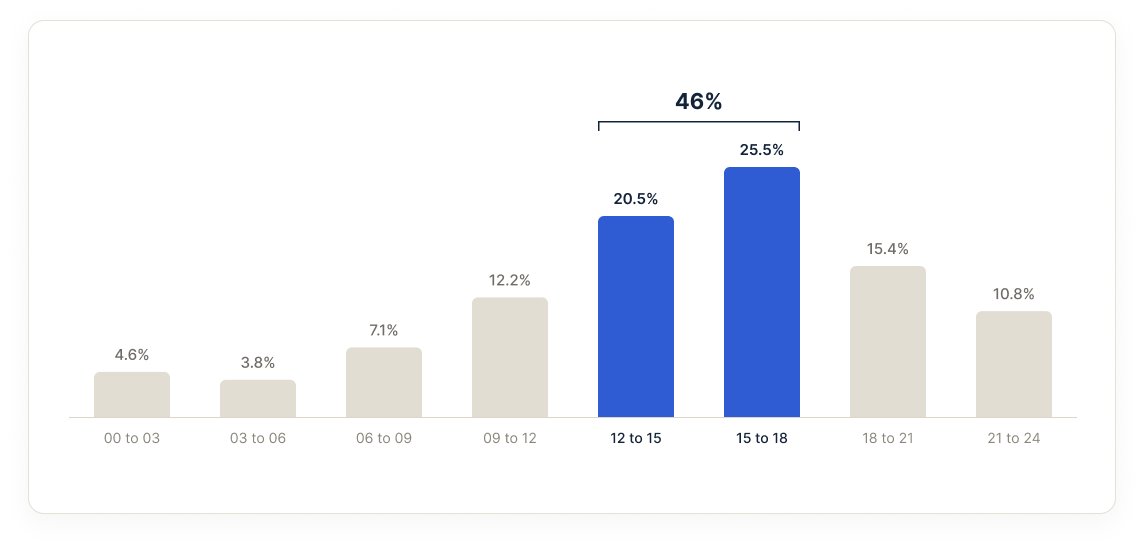
In September, 46% of viral articles went out between 12:00 and 18:00 UTC
IV. the anatomy of a headline that works
the headlines that do best combine up to four parts.
1. the promise: what the reader gets, like "how to", "guide" or "introducing".
2. the named thing: what they're already searching for, like "claude cowork", "jev" or "muse".
3. the specific: a clock, a number they can picture or a receipt, like "in 1 day" or "$1M".
4. the completeness tag: the whole thing, worth saving, like "(full guide)" or "(step-by-step)".
and they carry none of the four failure marks: a question mark, a "why" anywhere or a "from" opener, a "Label:" in front, and newsletter words like "recap" or "weekly".
you can see the parts in the shapes that win: headlines that promise something (how to, a receipt, a guide, an announcement) reached 100k 1.5x to 2.2x as often as comparable headlines. headlines that make the reader work (a question, a "why", a "Label:") reached it less often.
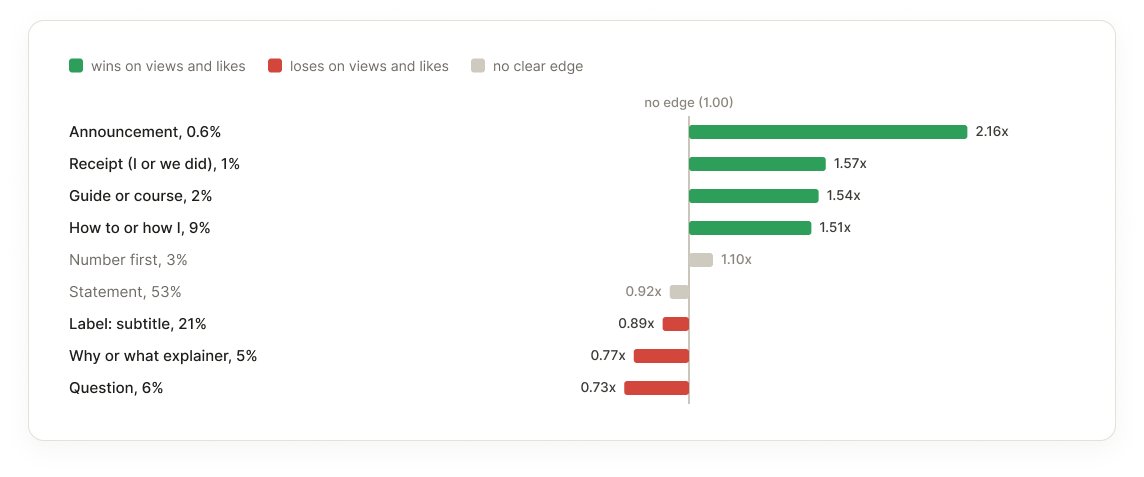
How-to, receipt and guide headlines reach 100k about 1.5x as often; 74% of headlines are plain statements or labels, both below average
"Build an elite Claude nutritionist (full guide)" did 1.4M views. it has three of the four parts in five words and a tag: the promise "build", the named thing "claude" and the completeness tag, and "an elite nutritionist" is a result the reader can picture.
V. the psychology
every part of the anatomy maps to a rule the old ad writers wrote down, some of them a century ago, and x articles changed only the details.
> self-interest
john caples made it rule one of his five rules for headlines in tested advertising methods:
First and foremost, try to get self-interest into every headline you write.
that's why "how to" and a completeness tag work: the reader sees what they get before they click. writers who used the tag reached 100k 14 percentage points more often with it than without it.
> specificity
claude hopkins wrote in scientific advertising (1923):
Platitudes and generalities roll off the human understanding like water from a duck. They leave no impression whatever.
that's why a clock ("in 30 days"), a round number ("$1M") and a receipt ("i built") all win: the reader can picture them.
> the moment
eugene schwartz named it market sophistication in breakthrough advertising (1966): once a market has "heard all the claims," "mere repetition or exaggeration" stops working. that's why the name of the month rotates, and why a template dies once readers have seen it too often.
> why the failure marks fail
a question hands the work to the reader, a "why" promises an explanation instead of a result, a label names a topic instead of a benefit, and a recap is old news before anyone opens it.
george loewenstein, who laid out the "information-gap" theory in 1994, wrote that curiosity comes from "a gap in one's knowledge," and that "when curiosity is satisfied, the result is generally disappointing." in x articles, headlines that tease do worse than headlines that promise.
the first chart shows it by the first word, the second by the words inside the headline.
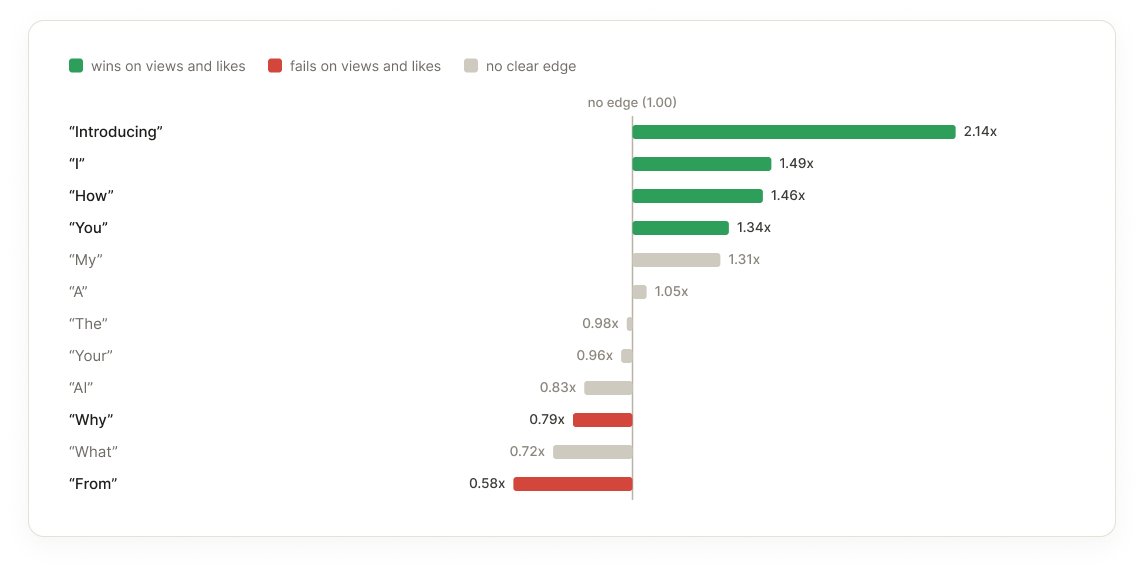
Headlines that open with “Introducing” reach 100k 2.1x as often; “Why” and “From” openers 0.79x and 0.58x
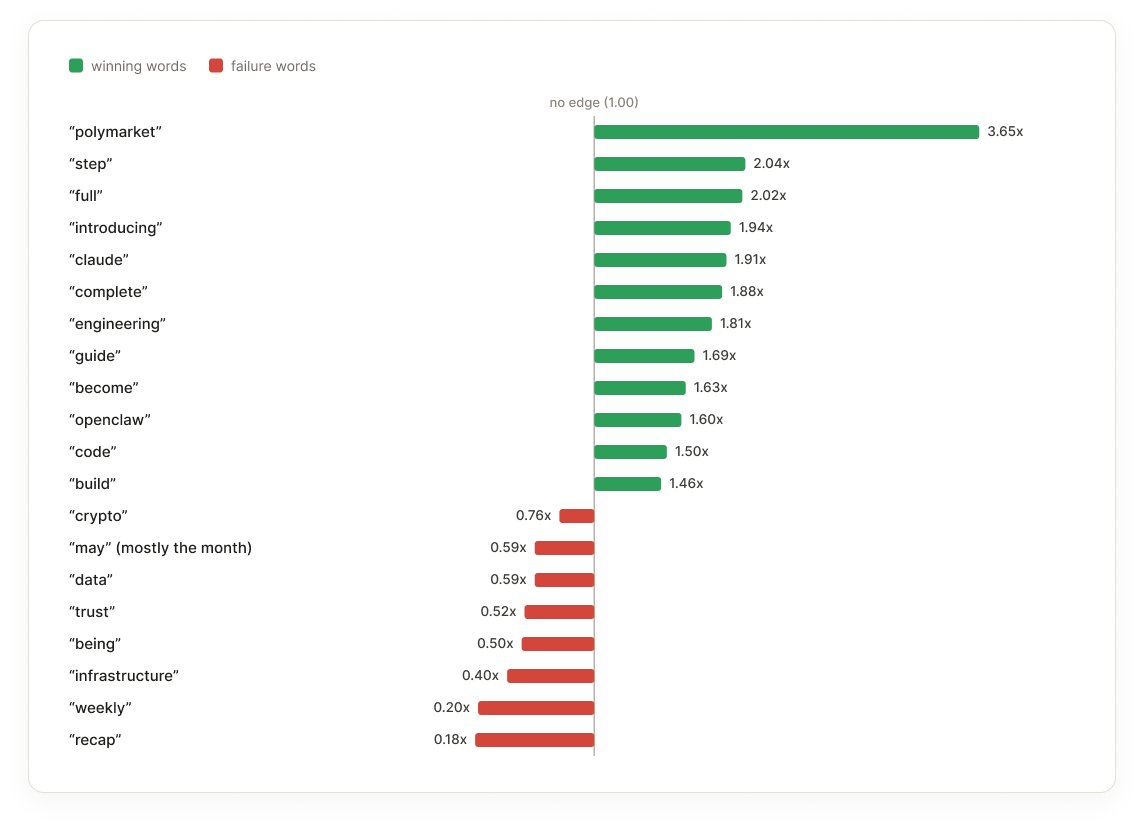
“Recap” and “weekly” headlines reach 100k 0.18x and 0.20x as often; “step” and “full” about 2x, “polymarket” 3.7x
here's what failing headlines look like in real life, each one posted after the writer already had an article over 100k:
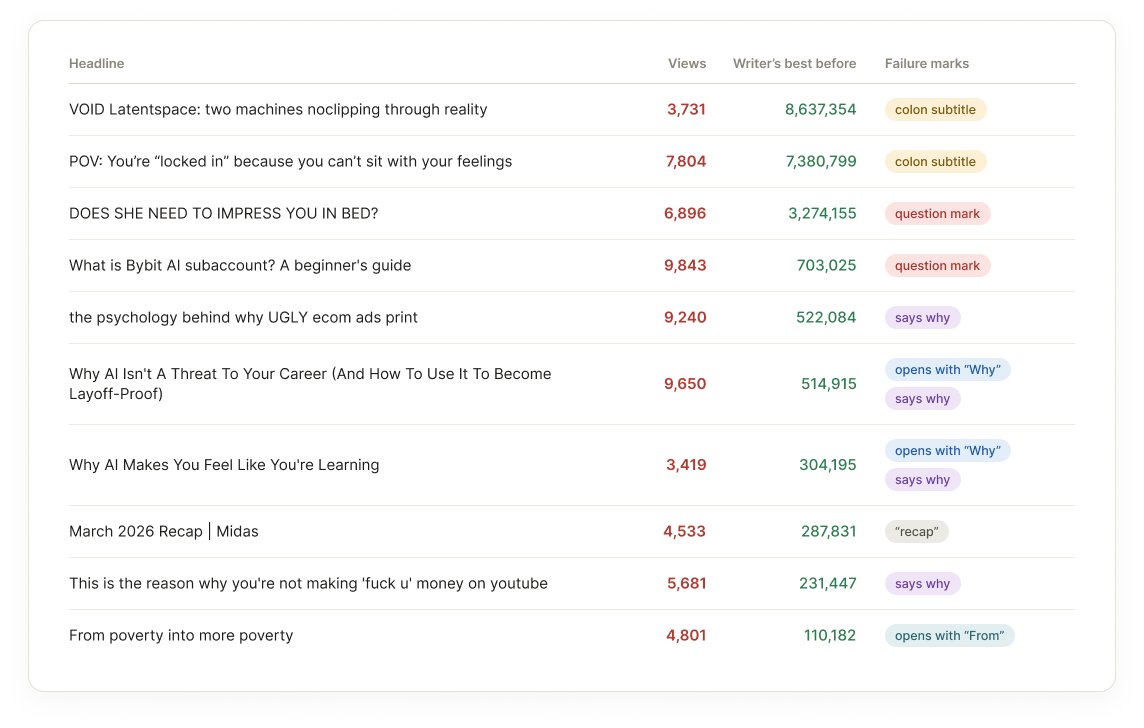
What bad headlines look like: 10 flops under 10k views from writers who had already hit 100k
VI. the five levels of a headline
here's a simple way to grade any headline before you post it. you get its level by counting two things: the moves it uses (the four parts above: a promise, a named thing, a specific, a completeness tag) and the failure marks it carries (a question mark, a "why" anywhere or a "from" opener, a "Label:" in front, "recap" or "weekly"). the number next to each level is the share of its headlines that reached 100k views.
here's one real headline taken up all five levels, from a marketing article that did 7,955 views:
> L0 broken, a failure mark and no move (11%): "Content Marketing: What to Publish, Where, and How Often".
> L1 plain, no mark and no move (14%): "your content plan for the month", which names the topic and promises nothing.
> L2 one move, a promise (23%): "how to plan your content".
> L3 two moves, the promise plus the tool (41%): "how to plan your content with claude".
> L4 three or more moves, plus a clock (63%): "how to plan a month of content with claude in 1 hour".
84% of headlines sit at L0 or L1, and for accounts under 10k followers the same ladder runs from 7% to 56%.
**
VIII.** the playbook: 10 minutes before you post
> 1. write the promise in one sentence: "after reading this, you can ___."
> 2. pick a shape that promises (how to, a receipt, a guide or an announcement) and skip the question and the label.
> 3. name the thing your reader is searching for this month.
> 4. add one specific: a clock, a number they can picture or a receipt.
> 5. add the completeness tag only if the article really is the whole thing.
> 6. kill the marks: a question mark, a "why" anywhere or a "from" opener, a "Label:" in front, "recap" or "weekly".
> 7. write at least 10 versions (upworthy's writers did 25), count the moves in each, and post the truest one with the most moves.
> 8. write the first two lines under it: a short first sentence helps a little, and a question in the first line tends to hurt.
templates, each taken from real winners:
> how to: "how to [result] in [time] with [tool] (full guide)"
> receipt: "i [did the thing] in [time]. here's how"
> guide: "[tool] masterclass for [reader] (full tutorial)"
> announcement: "introducing [thing]"
and don't copy a winner word for word: of the 100 headlines that two or more accounts posted word for word, half had a copy that died under 10k.
feed this to your agent
everything i used is free to open:
> the dataset (6,835 articles over 100k views): https://docs.google.com/spreadsheets/d/1mXI0GSlXgynMckRlZFbP-dtRD8HOdo0_DnR43rUhVLA
> the research, every number and the method: https://docs.google.com/document/d/10UnoOKmYl0bzqpYmE2QeTlkMG8sZvU-zezulmgWfeNg
> the three claude skills (headline-writer, hook-writer, cover-writer): https://drive.google.com/drive/folders/1cU70HsXj6WZ5bLAY2kEjr3xopSqUg1c3