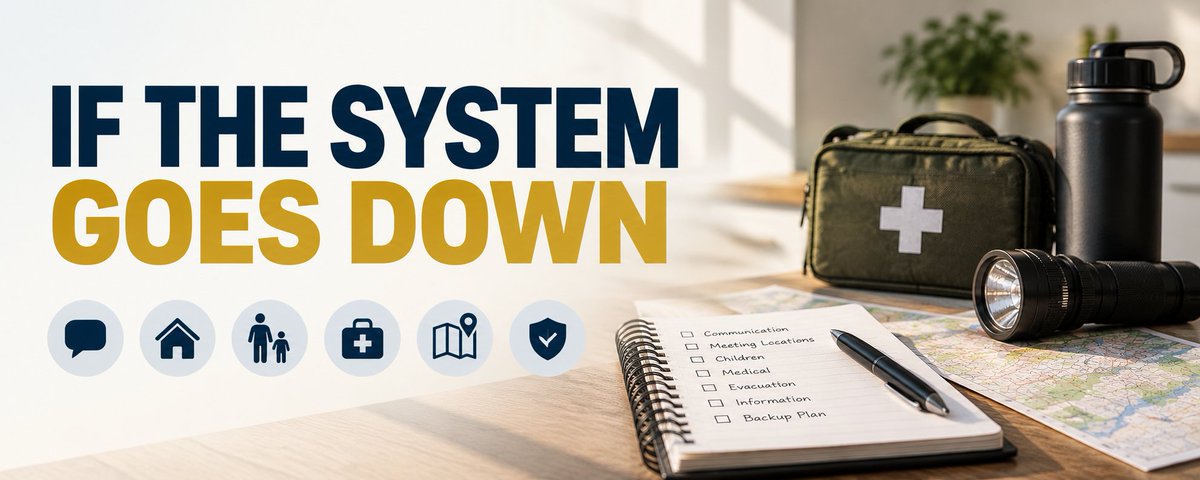
If the System Goes Down: Questions Every Family Should Answer Before an Emergency
文章目录
One of the lessons from October 7th is that families may have to make decisions on their own for a period of time. Communications can fail, roads can close, first responders can be overwhelmed, and information can be confusing or wrong. Take ten minutes with your family now so everyone knows what to do if the systems you normally depend on are suddenly unavailable.
Most emergency planning focuses on supplies. Water, batteries, medications, food, and first-aid equipment all matter, but the harder problems usually involve decisions. Where does everyone go? Who is responsible for the children? What happens if nobody can reach home? Who do you trust for information? Those questions are much harder to answer once something is already happening, which is why they are worth working through before you ever need the plan.
How Will We Communicate If Our Phones Do Not Work?
Most families have built their emergency plan around a cell phone without realizing it. Our contacts, maps, emergency alerts, banking, school information, and family communications are all sitting on the same device. That works until the network is overloaded, the battery dies, or service disappears entirely.
Every family should have one out-of-area contact everyone knows to reach if local communications are disrupted. That person can become the common point for messages when family members cannot reach one another directly. Text messages may also get through when voice calls do not, but that only helps if everyone knows ahead of time who they are trying to reach and what information they need to pass.
Important phone numbers should exist somewhere other than your phone. Write them down. Make sure children who are old enough understand which number to call and what information they need to provide. The point is to remove as many decisions as possible before communications become a problem.
Where Do We Go If We Cannot Get Home?
Home is usually the default meeting place, but an emergency may make it the one place people cannot reach. Roads can be closed, neighborhoods can be blocked off, or authorities may restrict access while an incident is still underway. Families should have two meeting locations, one close to home for a localized problem and another outside the immediate neighborhood in case the area becomes inaccessible.
Walk through the difficult version of the day. One parent is at work, another is across town, and the children are at school. Nobody can reach the house and phones are unreliable. Where does each person go, and who is responsible for whom? The answer does not need to be complicated. It just needs to exist before somebody is trying to make that decision under pressure.
Who Can Pick Up Our Children?
Families should decide clearly who is authorized to pick up their children during an emergency. Children should know those names too, and school records should be current where appropriate. A family code word can also be useful for an unexpected pickup. If someone the child does not normally leave with says, “Your mother sent me,” the child has another way to verify that the message is legitimate.
There is a broader security lesson here as well. Do not automatically assume someone is who they claim to be because they are wearing a uniform, carrying a badge, or driving an official-looking vehicle. During a serious attack or period of confusion, deception can be part of the problem. If someone is asking you to open a secured door, leave a protected location, hand over a child, or get into a vehicle, verify them when circumstances allow. Look at identification, use a camera or peephole, call a known agency number, or confirm the instruction through another trusted source.
That does not mean arguing with legitimate first responders during an obvious emergency. It means understanding that the appearance of authority should not automatically replace judgment when something does not seem right.
What Happens If the Technology Stops Working?
Think about how much of an average day now depends on electricity, internet access, and a smartphone. Security cameras, electronic locks, garage doors, navigation, payment systems, news, and communications all depend on infrastructure most of us rarely think about until it is gone.
Everyone in the home should know how to enter and leave without relying completely on electronic systems. If you have a garage door, know how to release it manually. If you depend on an electronic lock, understand the backup method. Keep flashlights where people can actually find them in the dark, and keep battery packs charged instead of stored empty in a drawer.
It is also worth carrying some cash. A power or network outage can take down credit-card systems and ATMs at the same time people are trying to buy fuel, food, or other basic supplies. GPS is another dependency most people do not notice until they lose it. Know the major roads around your home, workplace, and children's schools well enough that a dead phone does not leave you unable to navigate familiar territory.
Can We Handle the First Few Minutes of a Medical Emergency?
During a large incident, the ambulance you normally expect in a few minutes may be responding somewhere else. Emergency medical services have to prioritize the most urgent casualties they can reach, and roads or security conditions may delay them further. That means the first person helping an injured family member may be another family member.
Every home should have more than a box of adhesive bandages. Basic trauma supplies are useful only if somebody knows how to use them, so at least one person in the household should know how to control serious bleeding and provide basic first aid until professional help arrives. A Stop the Bleed course is a good starting point because severe bleeding is one of the emergencies where simple actions taken quickly can make a significant difference.
Families should also know exactly where their medical supplies are kept. Searching through cabinets while someone is badly injured is not the time to discover that nobody remembers where the kit went. People who depend on prescription medications should also think through what happens if a pharmacy is closed or inaccessible for several days. The answer will vary depending on the medication, but it is worth discussing with a physician or pharmacist before an emergency creates the problem.
When Do We Stay Put and When Do We Leave?
Our first instinct when something happens is often to get to the people we care about. In some situations, that can move us directly toward the danger. If a serious incident is unfolding near a school, workplace, shopping area, or neighborhood, immediately driving there may not help. Roads may be closed, police may be trying to isolate the scene, and emergency vehicles need access. You can also turn yourself into another person responders have to protect.
Families should talk about what would cause them to stay where they are and what would cause them to leave. If children are secured at school and the school is telling parents not to approach, that instruction may be there because the surrounding area is still unsafe. If authorities tell your neighborhood to evacuate because of a fire, chemical release, or other hazard, waiting too long can create a different problem.
There is no single rule that works for every emergency. The important part is agreeing ahead of time that the family will not automatically move toward an incident simply because everyone is worried. Get the best information you can first, then make the decision based on what is actually happening.
What Information Will We Trust?
A major emergency now unfolds in two places at once: on the ground and online. Within minutes, social media can fill with videos, casualty numbers, supposed warnings, reports of additional attacks, and claims from people who may be nowhere near the incident. Some of it will be accurate. Some will be outdated. Some will simply be wrong, and during a terrorist attack or national security emergency, some information may be deliberately false.
Know your official sources before you need them. That includes local law enforcement, emergency management, the school district, utilities, and other agencies that would be responsible for communicating during an incident in your area. One post should rarely be enough to make a major decision. Look for confirmation, particularly before leaving a secure location or changing the family plan.
This becomes even more important with video. An image can be real and still be from another city, another country, or an event that happened years earlier. Seeing something on your screen is not the same as knowing what is happening outside your door.
Who Makes the Decision If We Cannot Reach Each Other?
Most families do not think about authority until the person who normally makes the decision is unavailable. If parents cannot communicate, does the parent with the children make the call? If an older teenager is alone, what are they allowed to decide without waiting for instructions? If grandparents or another relative are part of the family plan, when should they act rather than continue trying to reach someone?
These do not need to become complicated rules. The point is to give people enough guidance that they are not frozen waiting for a phone call that may never come. Children especially should understand that their first responsibility is to remain somewhere safe, not to begin trying to find their parents on their own.
What If Our First Plan Fails?
This may be the most important part of the entire conversation because most plans assume the first option works. Mom picks up the children. Dad drives home. Everyone meets at the house. Now change one thing. The road to the school is closed. The house has no power. One parent cannot leave work. Nobody can get through by phone. The first meeting location is inside the affected area.
What happens next should not be something the family is figuring out for the first time in the middle of the emergency. You do not need ten backup plans. You need to identify the places where one failure would otherwise stop the entire plan and have another option ready.
That is the same lesson organizations need to learn from October 7th. A plan that works only when communications, transportation, power, leadership, and technology all remain available is a fragile plan. Family planning is no different.
Take Ten Minutes and Run the Scenario
You do not need a formal exercise to find problems in your family plan. Sit down together and walk through one ordinary weekday. Start at eight in the morning, when everyone is where they normally would be, and remove cell service. Talk through what everyone does next. Then close the road home. Add a power outage. Assume the school cannot immediately reach parents.
You will probably find something nobody has thought about. That is useful because the purpose is not to prove that your family has a good plan. It is to find the point where the plan stops working while you still have time to fix it.
October 7th demonstrated how quickly systems people depend on can become overwhelmed or unavailable. The circumstances in Israel were extreme, but the underlying lesson applies to many emergencies. Hurricanes take down communications and power. Cyberattacks can disrupt services. Major accidents close roads. Mass-casualty events stretch first responders beyond normal capacity.
You do not have to predict which emergency your family might face. You need to know how your family will communicate, where everyone will go, who is responsible for whom, how you will verify information, and what happens when the first plan does not work. Those answers are much easier to figure out today than when you actually need them.