
Open-sourcing the Parallel Search Eval Harness

文章目录
This article is also available to read on the Parallel blog.
Today we're open-sourcing parallel-search-evals, the eval harness we use to measure Parallel Search performance, assess new models we deploy internally, and power our Search Capability Leaderboard.
The eval harness is designed to test Parallel Search with any large language model accessible through OpenRouter, OpenAI, Anthropic, Google, or any OpenAI-compatible endpoint.
Benchmarks you can't reproduce are just claims
Evals tend to have a transparency problem. Every few weeks, AI providers publish new charts where their bars are the tallest and the competitors' are shorter. Readers are privy only to the benchmark results, not the model configuration, tools and setup, errors, or discarded failures. Without the ability to reproduce the results themselves, readers have no choice but to blindly trust the publisher.
We believe the most useful evaluations come from testing on data that closely resembles a team’s real workload. By releasing our eval infrastructure, we want to allow teams to first understand how we test Parallel and reproduce our results, then use the harness to repeat those experiments with their own datasets.
We've written a guide on how to evaluate web search for AI, which covers the same principles and can be used alongside this eval harness to conduct an effective evaluation of various LLMs and web search combinations.
How to use the Parallel Eval Harness
Each run evaluates one model on one benchmark in one mode: turbo, fast, basic, advanced, or baseline (closed-book, no tools). Comparing the baseline run with a search run gives you the lift from search.
git clone https://github.com/parallel-web/parallel-search-evals.git
cd parallel-search-evals
uv sync --frozen


# Three-question smoke test
uv run --frozen parallel-search-evals run \
  --provider anthropic --model claude-sonnet-5 \
  --benchmark dsqa --mode fast --limit 3 --output runs/dsqa-smoke

The harness can also be modified to compare Parallel against other providers.
The harness can also be modified to compare Parallel against other providers.
Bring your own questions
Public benchmarks are a starting point. The decision you actually care about lives in your own traffic. The harness keeps the question set separate from the agent loop and the grader, so you can add a suite with your own questions, reference answers, and grading rules while the search setup, budgets, and reporting stay exactly as they are on the leaderboard.
Hand it to your coding agent
The repo includes an agent skill (.agents/skills/run-search-evals) that walks a coding agent through resolving the model, mode, and question count, checking credentials, running, resuming, and summarizing. Point Claude Code or Codex at the checkout and ask it to run the eval.
How the Parallel Search Eval Harness works
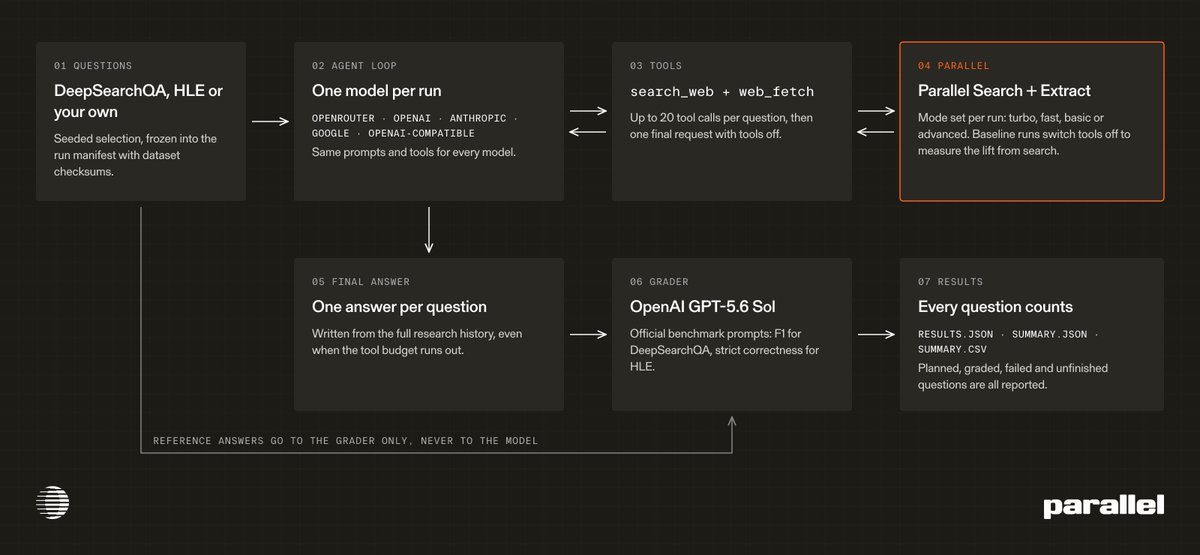
Search evals need things existing frameworks don't handle well: multi-turn tool calling that behaves the same across providers' native protocols, per-call cost accounting, and recovery when a provider stream dies halfway through a long research trace.
Key components of the Parallel Eval Harness
-
Models
-
Web search tools (search, extract)
-
Tool budget
-
Grading
OpenRouter drastically simplifies the harness by offering one integration for hundreds of models. Native OpenAI, Anthropic, and Google adapters keep each provider's own tool-calling and reasoning protocols, including Anthropic's prompt caching and Gemini's continuation tokens.
Parallel provides two tools: Search API takes a natural-language objective plus short keyword queries, and returns up to 10 results with dense excerpts. Extract API pulls evidence from up to 20 specific URLs. This reflects best practices we recommend to most customers.
The model gets a 20 tool call budget per question. We evaluate this in a deep research mode giving access to 2 tools, the model is told to forget its internal knowledge and only use these 2 tools, and once it runs out of budget we ask it to return knowledge based on what it has found during its research.
An OpenAI GPT-6 Sol judge grades each answer against the reference with the benchmark's official prompt: F1 for DeepSearchQA (partial credit for incomplete answer sets) and strict correctness for HLE.
Contributing to the harness
If you find a bug, or a choice you think is wrong, open an issue.
— James, Vlad, and Lukas


